
Ресурсы
Изучайте широкий спектр ценных ресурсов ВГГ, чтобы углубить своё понимание и повысить эффективность исследований, просветительской деятельности, преподавания и обучения.
Найдено: 48
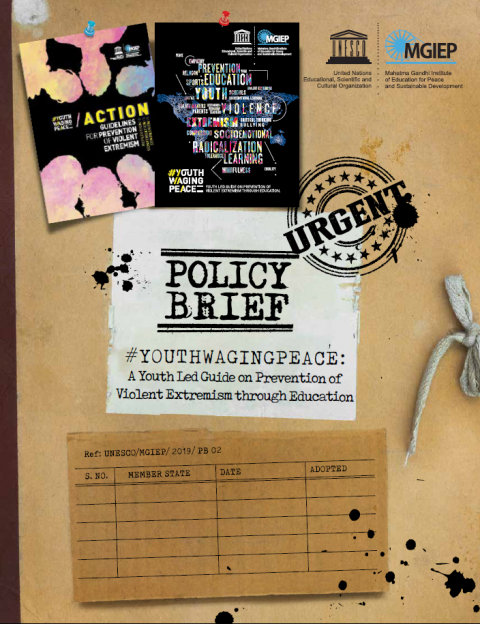 [Policy Brief] YOUTH WAGING PEACE: A Youth Led Guide on Prevention of Violent Extremism through Education Год публикации: 2019 Организация-автор: Mahatma Gandhi Institute of Education for Peace and Sustainable Development (MGIEP) The #YouthWagingPeace guidebook is a document for anyone interested in understanding Violent Extremism and exploring the relationship between Education and Prevention of Violent Extremism (PVE). Led by 2 dynamic Coordinating Lead Authors and 5 Lead/Chapter Authors, the guide garnered over 2000 youth submissions/case studies, and finally integrated over 150 case study submissions from young educators and practitioners from 50+ countries. #YouthWagingPeace guidebook provides a set of actionable guidelines for PVE to teachers, school administrators, policy makers, family, religious leaders and other informal influencers.
  Rethinking Learning: A Review of Social and Emotional Learning for Education Systems Год публикации: 2020 Автор: Nandini Chatterjee Singh | Anantha Duraiappah Организация-автор: Mahatma Gandhi Institute of Education for Peace and Sustainable Development (MGIEP) This publication titled ‘Rethinking Learning: A Review of Social and Emotional Learning for Education Systems’, published by the UNESCO Mahatma Gandhi Institute of Education for Peace and Sustainable Development (MGIEP) reviews the latest research on Social and Emotional Learning (SEL), its impact on student health and school climate and its transformative role in building happier classrooms. It seeks to inform and impress upon Member States the urgent need to mainstream social and emotional learning in education systems.
  [Summary] Rethinking Learning: A Review of Social and Emotional Learning for Education Systems; Summary for Decision Makers Год публикации: 2020 Организация-автор: Mahatma Gandhi Institute of Education for Peace and Sustainable Development (MGIEP) The publication, titled “Rethinking Learning: A Review of Social and Emotional Learning (SEL) for Education Systems” was worked upon from 2018 to 2020. The purpose of this publication was to review the latest research on SEL and to present scientific evidence for why SEL is key to education, and by that corollary, to achieving the United Nations (UN) Sustainable Development Goals (SDGs), specifically SDG 4, Target 7 that focuses on building peaceful and sustainable societies through education.This summary, aimed at decision makers, synthesises and integrates the main findings, challenges and recommendations from the eight chapters of the full Review. The key questions that guided the Review were: (i) What constitutes an SEL intervention; (ii) Why and when SEL interventions are necessary; (iii) The science and evidence supporting SEL interventions; (iv) How can SEL be implemented; and (iv) The cost and benefits of SEL interventions.
  Action: Guidelines for Prevention of Violent Extremism Год публикации: 2018 Автор: Carolyn Nash | Yulia Nesterova | Kenneth Primrose | Wing Yu Alice Chan | Raul A. Rios | María José Velásquez Flores | Aniqah Zowmi Организация-автор: Mahatma Gandhi Institute of Education for Peace and Sustainable Development (MGIEP) The UNESCO MGIEP #YouthWagingPeace guidebook was launched by Director General of UNESCO at its 39th General Conference, 2017. The guidebook was a culmination of reaching out to 2000+ youth, and integrating 130+ submissions from 57 countries.After analysing these voices and experiences, and supplemented by the literature, the guide put forth a set of tangible action guidelines for education stakeholders.In this abridged version, stakeholders will find a curated set of critical ideas and lessons gleaned from the full guide, designed to be as accessible as possible. The hope is that teachers, parents, mentors, school administrators, policymakers, and anyone else committed to realizing positive change will find these Action Guidelines an effective resource for guiding immediate and effective actions in their communities.The Action Guidelines for Prevention of Violent Extremism is designed to identify engagement opportunities for all stakeholders. Some require time, preparation, and resources. Others are small steps that will help create safer societies and stronger communities. No action is too small to contribute to building a more resilient and just world.
  Rethinking Pedagogy: Exploring the Potential Of Digital Technology In Achieving Quality Education Год публикации: 2019 Автор: Lorena Alemán de la Garza | Alessandra Anichini | Péter Antal | Aurélie Beaune | Éric Bruillard | Diane Burke | Pedro Henrique Cacique Braga | Ruma Chakravarti | Sriya Chakravarti | Deng Chen | Lidiya Chikalova | Helen Crompton | Ilana De Almeida Souza Concilio | William Cope | Lorenz Denks | Matthew Farber | Giovanni Fonseca | Pintér Gergely | Marcela Georgina Gómez Zermeño | Russell Hazard | Laura Hosman | Mary Kalantzis | Kojanitz László | Xavier Levoin | Kristen Linzy | Arnab Mandal | Yoko Mochizuki | Ariam Mogos | Tünde-Lengyel Molnár | Matthew Montebello | Sadaqat Mulla | Sandra Gudiño Paredes | Christelle Pauty-Combemore | Boyka Parfitt | Réka Racsko | Irais Monserrat Santillán Rosas | Khitam Shraim | Jisoo Song | Avgoustos Tsinakos Организация-автор: Mahatma Gandhi Institute of Education for Peace and Sustainable Development (MGIEP) With the exponential growth of digitally mediated communication, digital media and gaming, the landscape of what we understand as learning environments is changing significantly. Today the use of digital technology in education is attracting considerable public and policy attention as
well as private investment. With a rise in discourses both heralding and cautioning against the use of digital technology in education, there is a need to pool the expertise and experience on the use of technology in education from around the world to advance public debate and evidence-informed policymaking. Based on the literature review, mapping of digital education resources in circulation, and examples of implementation of digital education initiatives from around the world, this report aims to provide insights that would help lead to the wise, innovative and ethical use of digital technology in education as a new dimension in achieving SDG 4 — inclusive and equitable quality education and lifelong learning opportunities for all. By so doing, it also attempts to contribute to a rethink of teaching and learning in the face of enormous opportunities and challenges brought about by digital technology in the times of change and turmoil.
Rethinking Pedagogy: Exploring the Potential Of Digital Technology In Achieving Quality Education Год публикации: 2019 Автор: Lorena Alemán de la Garza | Alessandra Anichini | Péter Antal | Aurélie Beaune | Éric Bruillard | Diane Burke | Pedro Henrique Cacique Braga | Ruma Chakravarti | Sriya Chakravarti | Deng Chen | Lidiya Chikalova | Helen Crompton | Ilana De Almeida Souza Concilio | William Cope | Lorenz Denks | Matthew Farber | Giovanni Fonseca | Pintér Gergely | Marcela Georgina Gómez Zermeño | Russell Hazard | Laura Hosman | Mary Kalantzis | Kojanitz László | Xavier Levoin | Kristen Linzy | Arnab Mandal | Yoko Mochizuki | Ariam Mogos | Tünde-Lengyel Molnár | Matthew Montebello | Sadaqat Mulla | Sandra Gudiño Paredes | Christelle Pauty-Combemore | Boyka Parfitt | Réka Racsko | Irais Monserrat Santillán Rosas | Khitam Shraim | Jisoo Song | Avgoustos Tsinakos Организация-автор: Mahatma Gandhi Institute of Education for Peace and Sustainable Development (MGIEP) With the exponential growth of digitally mediated communication, digital media and gaming, the landscape of what we understand as learning environments is changing significantly. Today the use of digital technology in education is attracting considerable public and policy attention as
well as private investment. With a rise in discourses both heralding and cautioning against the use of digital technology in education, there is a need to pool the expertise and experience on the use of technology in education from around the world to advance public debate and evidence-informed policymaking. Based on the literature review, mapping of digital education resources in circulation, and examples of implementation of digital education initiatives from around the world, this report aims to provide insights that would help lead to the wise, innovative and ethical use of digital technology in education as a new dimension in achieving SDG 4 — inclusive and equitable quality education and lifelong learning opportunities for all. By so doing, it also attempts to contribute to a rethink of teaching and learning in the face of enormous opportunities and challenges brought about by digital technology in the times of change and turmoil.  Textbooks for Sustainable Development: A Guide to Embedding Год публикации: 2017 Организация-автор: UNESCO | Mahatma Gandhi Institute of Education for Peace and Sustainable Development (MGIEP) This guidebook introduces the approach of embedding education for sustainable development into core subjects, building on the German initiative as well as consolidating other existing efforts. This ambitious work began when the UNESCO Mahatma Gandhi Institute of Education for Peace and Sustainable Development (MGIEP), with support from Engagement Global gGmbH, brought together 30 international experts in mathematics, sciences, languages, geography and education for sustainable development in Bangalore, India, in June 2016. These experts co-drafted this guidebook. This publication is designed as a guide for stakeholders in textbook development – education ministries, national curriculum authorities, textbook writers and publishers – to help them produce a new generation of textbooks. Such textbooks will make a clear departure from the mechanistic transmission of information and procedural knowledge devoid of meaning and contextual relevance. They will also advocate a new vision of learning and contribute to fostering young people’s competencies and capabilities to shape more peaceful and sustainable societies. Competencies such as critical and systemic thinking, appreciation of diversity, empathy and commitment to change are the key goals of this ambitious publication. Учебные пособия по устойчивому развитию. Руководство по внедрению Год публикации: 2017 Организация-автор: UNESCO | Mahatma Gandhi Institute of Education for Peace and Sustainable Development (MGIEP) Данное руководство представляет подход по внедрению образования для устойчивого развития в учебные дисциплины, основываясь на опыте Германии, а также объединяя другие существующие усилия. В июне 2016 года Институт Махатмы Ганди по образованию в интересах мира и устойчивого развития ЮНЕСКО, при поддержке Engagement Global gGmbH, собрал в г. Бангалор, Индия, 30 международных экспертов по математике, естественным наукам, языкам, географии и образованию для устойчивого развития. Эти эксперты участвовали в разработке данного руководства.Данная публикация разработана в качестве руководства для заинтересованных сторон – министерств образования, органов, разрабатывающих государственные образовательные стандарты и учебные планы, авторов и издателей учебников в помощь и поддержку в создании ими учебных материалов нового поколения. Такие учебники станут очевидным отступлением от механической передачи информации и методических знаний, лишенных смысла и контекстуальной значимости. Они также поддержат новое видение обучения и будут способствовать укреплению компетенции и возможностей молодежи в создании более мирных и устойчивых обществ. Ключевыми целями этого амбициозного руководства являются развитие таких компетенции, как критическое и систематическое мышление, правильное восприятие разнообразия, сопереживание и приверженность изменениям.
  Backtalk: The Participatory Film and Its Residency in the Space of Cultural Violence and Creative Education towards a Conceptual Understanding of Peace Год публикации: 2017 Автор: Ruchika Gurung Организация-автор: Mahatma Gandhi Institute of Education for Peace and Sustainable Development (MGIEP) Cultural violence is defined as the beliefs, attitudes and values that justify structural and direct violence (Galtung 1990). It dulls us into seeing exploitation and repression as normal or in not actively witnessing it, and the media plays a vital role in its dissemination. Media and in particular film studies occupies a space through which notions of culture, ideology, peace and violence are negotiated.While the observational approach to film is well established in education, participatory filmmaking as an educational tool is what this paper addresses, with reference to concepts of cultural violence and peace education.This paper uses Brantmeier’s (2011) five stage model, that encourages social and cultural change towards a future that is nonviolent, sustainable and renewable, and Bery’s (2003) conceptualisation of empowerment to propose that participatory film functions as a transformative creative process and challenges notions of identity and culture while helping learners describe the world around them (Zembylas & Bekerman 2013).Through analysing existing cases in the field of participatory video (Schwab-Cartas & Mitchell 2014), the author argue that participatory film functions as a tool for creative education practices that promotes a more hands-on approach to raising awareness about cultural violence and engaging with identity formation, and as a creative tool for knowledge creation and dissemination.