
Ресурсы
Изучайте широкий спектр ценных ресурсов ВГГ, чтобы углубить своё понимание и повысить эффективность исследований, просветительской деятельности, преподавания и обучения.
Найдено: 3
 Global Citizenship and Lingual Identity: The Ability to Perform in Different Lingual Settings Год публикации: 2011 Автор: Ann-Christin Torpsten Организация-автор: SAGE Publications The aim of this article is to interpret second-language pupils’ encounter with the Swedish school regarding first- and second-language learning. An empirical context called experienced learning is investigated by interpreting student teachers’ oral and written narrated learning memories. Using a life-story approach, the interpretation focuses on lingual skills, lingual identity and citizenship. The study looks at participation in Swedish as a second language and mother tongue education when the subjects encountered the Swedish school system. Participating in those lessons is described as positive. Participating made it easier to improve skills in the second language and mother tongue. Mother tongue skills were transferred to the second-language improvement. It became much easier to continue developing the second language when skills in the mother tongue increased. Language skills were positive for continued learning, linguistic development, development of bilingualism and multilingualism. Through widened linguistic horizons it becomes possible to develop identity as multilingual persons. When skills increase in different languages such as Swedish as a second language and mother tongue, the subjects become aware of their identities as multilingual persons. They become aware of their possibilities of being active, multicultural, global citizens. Their ability to perform in different lingual settings becomes visible. Citoyenneté mondiale et Identité linguale : la capacité d'exécuter dans différents contextes linguales Год публикации: 2011 Автор: Ann-Christin Torpsten Организация-автор: SAGE Publications Le but de cet article est d'interpréter la rencontre des élèves de langue seconde à l'école suédoise au sujet de première et de l'apprentissage de la langue seconde. Un contexte empirique appelé apprentissage expérimenté est étudié en interprétant des souvenirs d'apprentissage orales et écrites narrés des enseignants aux étudiants. En utilisant une approche histoire de vie, l'interprétation se concentre sur les compétences linguales, l'identité et la citoyenneté lingual. L'étude se penche sur la participation en suédois comme langue seconde et éducation en langue maternelle lorsque les sujets ont rencontré le système scolaire suédois. La participation à ces leçons est décrit comme positif. La participation a rendu plus facile d'améliorer les compétences dans la langue seconde et langue maternelle. Compétences en langue maternelle ont été transférés à l'amélioration de la langue seconde. Il est devenu beaucoup plus facile de continuer à développer la deuxième langue lorsque les compétences dans la langue maternelle ont augmenté. Les compétences linguistiques ont été positifs pour l'apprentissage continu, le développement linguistique, le développement du bilinguisme et le multilinguisme. A travers élargi les horizons linguistiques, il devient possible de développer une identité en tant que personnes multilingues. Lorsque les compétences augmentent dans différentes langues comme le suédois comme langue seconde et la langue maternelle, les sujets prennent conscience de leur identité en tant que personnes multilingues. Ils prennent conscience de leurs possibilités d'être multiculturelles, des citoyens actifs. Leur capacité à effectuer dans différents contextes linguales devient visible.
 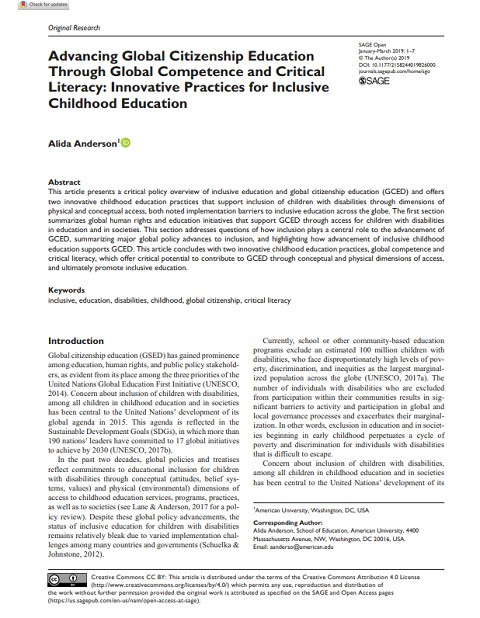 Advancing Global Citizenship Education Through Global Competence and Critical Literacy: Innovative Practices for Inclusive Childhood Education (SAGE Open; Vol. 9, No. 1) Год публикации: 2019 Автор: Alida Anderson Организация-автор: SAGE Publications This article presents a critical policy overview of inclusive education and global citizenship education (GCED) and offers two innovative childhood education practices that support inclusion of children with disabilities through dimensions of physical and conceptual access, both noted implementation barriers to inclusive education across the globe. The first section summarizes global human rights and education initiatives that support GCED through access for children with disabilities in education and in societies. This section addresses questions of how inclusion plays a central role to the advancement of GCED, summarizing major global policy advances to inclusion, and highlighting how advancement of inclusive childhood education supports GCED. This article concludes with two innovative childhood education practices, global competence and critical literacy, which offer critical potential to contribute to GCED through conceptual and physical dimensions of access, and ultimately promote inclusive education.