
Ресурсы
Изучайте широкий спектр ценных ресурсов ВГГ, чтобы углубить своё понимание и повысить эффективность исследований, просветительской деятельности, преподавания и обучения.
Найдено: 3
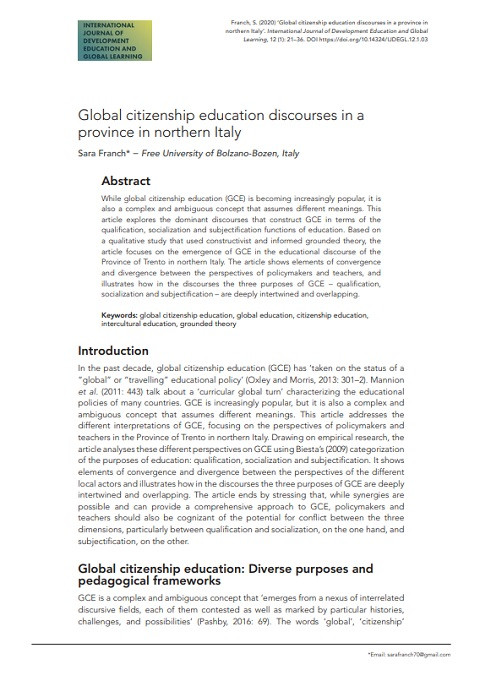 Global Citizenship Education Discourses in a Province in Northern Italy (International Journal of Development Education and Global Learning; Vol. 12, No. 1) Год публикации: 2020 Автор: Sara Franch Организация-автор: UCL Press While global citizenship education (GCE) is becoming increasingly popular, it is also a complex and ambiguous concept that assumes different meanings. This article explores the dominant discourses that construct GCE in terms of the qualification, socialization and subjectification functions of education. Based on a qualitative study that used constructivist and informed grounded theory, the article focuses on the emergence of GCE in the educational discourse of the Province of Trento in northern Italy. The article shows elements of convergence and divergence between the perspectives of policymakers and teachers, and illustrates how in the discourses the three purposes of GCE – qualification, socialization and subjectification – are deeply intertwined and overlapping.
 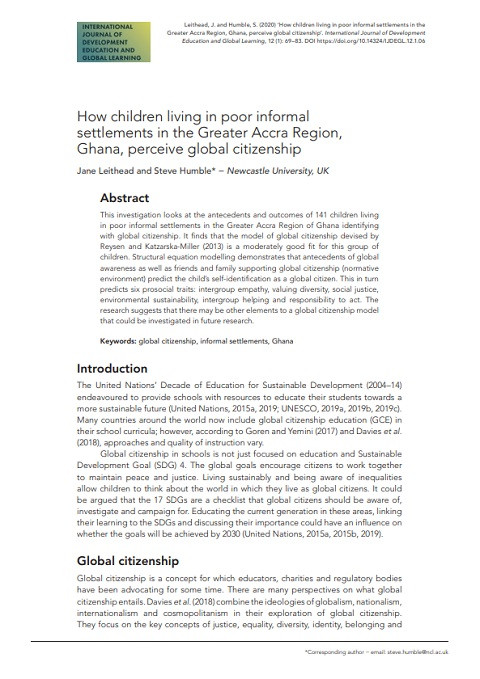 How Children Living in Poor Informal Settlements in the Greater Accra Region, Ghana, Perceive Global Citizenship (International Journal of Development Education and Global Learning; Vol. 12, No. 1) Год публикации: 2020 Автор: Jane Leithead | Steve Humble Организация-автор: UCL Press This investigation looks at the antecedents and outcomes of 141 children living in poor informal settlements in the Greater Accra Region of Ghana identifying with global citizenship. It finds that the model of global citizenship devised by Reysen and Katzarska-Miller (2013) is a moderately good fit for this group of children. Structural equation modelling demonstrates that antecedents of global awareness as well as friends and family supporting global citizenship (normative environment) predict the child’s self-identification as a global citizen. This in turn predicts six prosocial traits: intergroup empathy, valuing diversity, social justice, environmental sustainability, intergroup helping and responsibility to act. The research suggests that there may be other elements to a global citizenship model that could be investigated in future research.
 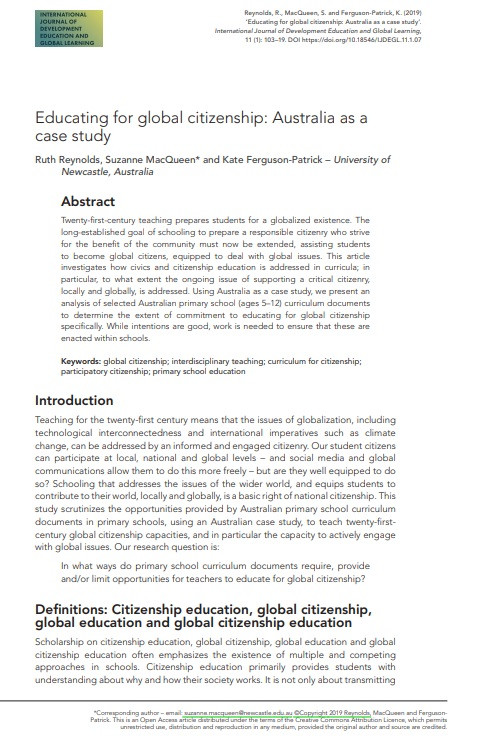 Educating for Global Citizenship: Australia as a Case Study (Vol. 11. No. 1) Год публикации: 2019 Автор: Ruth Reynolds | Suzanne MacQueen | Kate Ferguson-Patrick Организация-автор: UCL Press Twenty-first-century teaching prepares students for a globalized existence. The long-established goal of schooling to prepare a responsible citizenry who strive for the benefit of the community must now be extended, assisting students to become global citizens, equipped to deal with global issues. This article investigates how civics and citizenship education is addressed in curricula; in particular, to what extent the ongoing issue of supporting a critical citizenry, locally and globally, is addressed. Using Australia as a case study, we present an analysis of selected Australian primary school (ages 5–12) curriculum documents to determine the extent of commitment to educating for global citizenship specifically. While intentions are good, work is needed to ensure that these are enacted within schools.