
Ресурсы
Изучайте широкий спектр ценных ресурсов ВГГ, чтобы углубить своё понимание и повысить эффективность исследований, просветительской деятельности, преподавания и обучения.
Найдено: 1,583
 可持续发展教育(ESD)为21世纪建设一个更加美好和更加公平的世界 Год публикации: 2012 Организация-автор: UNESCO Education for Sustainable Development allows every human being to acquire the knowledge, skills, attitudes and values necessary to shape a sustainable future. Education for Sustainable Development means including key sustainable development issues into teaching and learning; for example, climate change, disaster risk reduction, biodiversity, poverty reduction, and sustainable consumption. It also requires participatory teaching and learning methods that motivate and empower learners to change their behaviour and take action for sustainable development. Education for Sustainable Development consequently promotes competencies like critical thinking, imagining future scenarios and making decisions in a collaborative way. Education for Sustainable Development requires far-reaching changes in the way education is often practised today. UNESCO is the lead agency for the UN Decade of Education for Sustainable Development (2005-2014).
  How Does Education About the Holocaust Advance Global Citizenship Education? Год публикации: 2018 Автор: E. Doyle Stevick Организация-автор: UNESCO Can education about past genocides shape our understanding of how violence occur in today’s world? Can it foster a sense of belonging to a common humanity and empower young people to become active citizens who work globally for peace and human rights? How does learning about such crimes, which profoundly affect the core dignity of human beings, support the objectives of Global Citizenship Education (GCED), a priority of the 2030 Education Agenda?This paper, commissioned by UNESCO, offers an overview of empirical research on teaching and learning about the Holocaust and how such education may impact leaners’ cognitive, socio-emotional and behavioural skills and competencies. It provides insights for educators on how effective lessons about the Holocaust can meet some of the key expected outcomes of Global Citizenship Education (GCED), such as critical thinking skills, attitudes of empathy and solidarity, and motivation to take action to prevent human rights abuses. Report on the survey on the implementation of the road map for arts education Год публикации: 2010 Организация-автор: UNESCO The Road Map for Arts Education is a reference document that aims to explore the role of arts education in meeting the need for creativity and cultural awareness in the 21st Century, while placing emphasis on the strategies required to introduce or promote arts education in the learning environment. Within this conceptual framework, all UNESCO Member States interested in initiating or developing arts education practices can mould their own national policy guidelines, adapted to their socio-cultural specificities. With the Road Map, UNESCO advocates the essential role of arts education within societies, to create a common ground of understanding for all stakeholders. The development of the Road Map for Arts Education was a lengthy and comprehensive consultation process. The document was first elaborated by a group of experts and UNESCO, then presented at the First World Conference on Arts Education (Lisbon, 2006) and later revised and updated, following recommendations from NGOs and Member States. The Road Map was finally distributed to the UNESCO Member States in November 2007 in English and French and then translated into Spanish and Russian following popular demand. More than a year after this distribution, UNESCO launched a wide-ranging survey in order to assess the implementation of the Road Map in its 193 Member States. Through its National Commissions, the Organization relayed this document to Ministries of both Education and Culture. The aim of this exercise was threefold: to learn whether the Road Map was being applied and to what extent it was influencing policy decisions at national level; to act as a reminder of the importance of the UNESCO reference document and encourage its use; finally, to assess the situation of arts education in the responding countries. Thus, this survey not only acted as a catalyst for the implementation of the Road Map, but also provided precious knowledge on arts education around the world. The Member States’ responses also contributed greatly to the Second World Conference on Arts Education (Seoul, May 2010), inspiring one of its main themes and the topics for a number of workshops. They also encouraged a more integral participation of these States in the conference through preparatory consultations.
 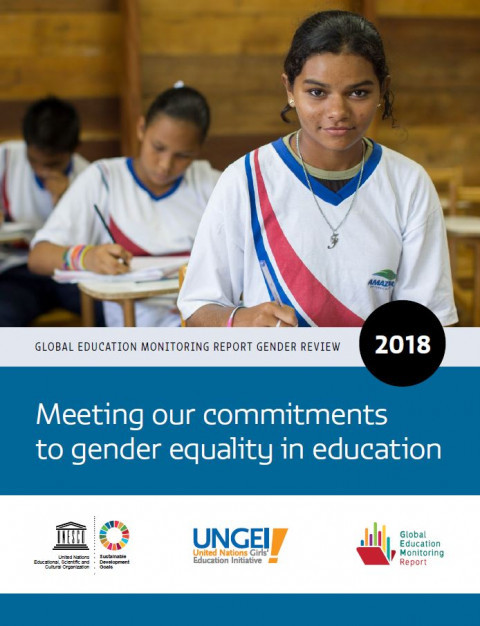 Tenir nos engagements en faveur de l'égalité des genres dans l'éducation: Rapport mondial de suivi sur l'éducation, résumé sur l'égalité des genres 2018 Год публикации: 2018 Организация-автор: UNESCO Le Cadre d’action Éducation 2030, outil qui vise à aider la communauté internationale à atteindre l’ODD 4 sur l’éducation, reconnaît explicitement l’égalité des genres comme principe directeur lié à la réalisation du droit à l’éducation. Il stipule clairement que les filles et les garçons, les femmes et les hommes, doivent bénéficier des mêmes possibilités « dans et par l’éducation ».Dans ce sixième résumé sur l’égalité des genres, qui fait partie d’une série qui a commencé en 2011, l’équipe du Rapport mondial de suivi sur l’éducation reste concentrée sur une large conception de l’égalité des genres, qui va au-delà du simple comptage du nombre de filles et de garçons dans les classes. La première partie du résumé examine les disparités en matière de participation et de compétences, aux postes à responsabilité des secteurs éducatif et politique et dans certains aspects des infrastructures et des programmes scolaires. Elle examine également les questions liées au genre dans le cadre de la formation professionnelle, en explorant le rôle de l’éducation dans trois autres ODD concernant l’agriculture, la santé, et l’eau et l’assainissement.La deuxième partie du résumé analyse les institutions, les lois et les politiques afin d’explorer des manières de déterminer et de faire appliquer le principe de responsabilité pour l’égalité des genres dans l’éducation.
  Thinkpiece on education and conflict Год публикации: 2009 Автор: Lynn Davies Организация-автор: UNESCO This paper looks first at the learning sites generally (violent schools, schools as a weapon of war, curriculum and textbooks). It then focuses on specific groups in conflict – gender, language, refugees, child soldiers. Thirdly it discusses education policy and donor intervention; and finally talks of the role of research. All these overlap hugely. This is not a prescription for how the Global Monitoring Report should be structured, but identification of themes and lessons learned that seem the most significant. Pensez pièce sur l'éducation et les conflits Год публикации: 2009 Автор: Lynn Davies Организация-автор: UNESCO Ce document examine d'abord les sites d'apprentissage en général (écoles violentes, les écoles comme une arme de guerre, programmes et manuels). Elle se concentre ensuite sur des groupes spécifiques dans les conflits - le sexe, la langue, les réfugiés, les enfants soldats. Troisièmement, il discute de la politique de l'éducation et de l'intervention des bailleurs de fonds; et, enfin, parle du rôle de la recherche. Tous ces chevauchent énormément. Ce n'est pas une prescription pour la façon dont le rapport Suivi mondial devrait être structuré, mais l'identification des thèmes et des leçons apprises qui semblent les plus importants. Dialogue interculturel: impliquer les jeunes dans le monde entier Год публикации: 2010 Автор: Elizabeth Khawajkie Организация-автор: UNESCO | DAIMLER It is hoped that this review will help to highlight why there is a persistent call for the continuation of such endeavors, like Mondialogo, which promoted dialogue among cultures and people, mutual respect and understanding so effectively. The Mondialogo journey, begun as an exploratory exercise, ended with compelling and often moving experiences.
  UNESCO's work on education for peace and non-violence: building peace through education Год публикации: 2008 Организация-автор: UNESCO The promotion of peace through education is at the heart of UNESCO’s mission. As stated in its constitution of 1945, UNESCO advances international peace and the common welfare of humanity through educational, scientific and cultural relations between peoples of the world. Though the world has changed over the past sixty years and continues to change at an ever increasing rate, UNESCO’s mission - a commitment to promoting universal values of peace and nonviolence, human rights and social justice, intercultural dialogue and mutual understanding – persists with growing urgency. UNESCO’s approach to educating for peace is multidimensional, in that it links education with a range of activities that address the root causes of violence, from human security to sustainable development. The goal of UNESCO’s education programmes and partnerships is the development of comprehensive systems of education that embrace the values of human rights, intercultural understanding and tolerance. Education for peace and non-violence promotes the knowledge, skills, attitudes and behaviours that reflect and inspire these values. As the lead agency within the UN system for the International Decade for a Culture of Peace and Non-Violence for the Children of the World, 2001- 2010, UNESCO is responsible for coordinating and directly implementing activities that promote the objectives of the Decade through education, the sciences, culture, communication and information. The culture of peace is defined as a set of values, attitudes, modes of behaviour and ways of life that reject violence and aim to prevent conflicts by tackling their root causes through dialogue and negotiation between individuals, groups and nations. UNESCO promotes the culture of peace through an intersectoral platform. This platform involves all five sectors of UNESCO: education, natural sciences, social and human sciences, culture, and communication and information. It seeks to mainstream intercultural dialogue in policies and actions with the aim of promoting mutual understanding, tolerance and respect, all of which are considered to be creative forces for a sustainable future. The intersectoral platform will also develop tools based on good practices in intercultural dialogue. UNESCO's work on education for peace and non-violence: building peace through education Год публикации: 2008 Организация-автор: UNESCO La promotion de la paix par l'éducation est au cœur de la mission de l'UNESCO. Comme indiqué dans sa constitution de 1945, l'UNESCO fait avancer la paix internationale et le bien-être commun de l'humanité à travers les relations éducatives, scientifiques et culturelles entre les peuples du monde. Bien que le monde a changé au cours des soixante dernières années et continue de changer à un rythme de plus en plus élevé, la mission de l'UNESCO - un engagement à la promotion des valeurs universelles de paix et de non-violence, les droits de l’homme et la justice sociale, le dialogue interculturel et la compréhension mutuelle - persiste avec une urgence croissante . L'approche de l'UNESCO à l'éducation pour la paix est multidimensionnelle, en ce qu'il lie l'éducation avec une gamme d'activités qui abordent les causes profondes de la violence, de la sécurité humaine au développement durable. L'objectif des programmes et des partenariats de l'éducation de l'UNESCO est le développement de systèmes complets d'éducation qui embrassent les valeurs des droits de l'homme, de la compréhension interculturelle et la tolérance. L'éducation pour la paix et la non-violence favorise les connaissances, les compétences, les attitudes et les comportements qui reflètent et inspirent ces valeurs. En tant qu'organisme responsable au sein du système de l’ONU pour la Décennie internationale pour une culture de la paix et de la non-violence pour les enfants du monde, 2001- 2010, l'UNESCO est chargée de coordonner et mettre en œuvre directement des activités qui favorisent les objectifs de la Décennie par l'éducation , les sciences, la culture, la communication et de l'information. La culture de la paix est définie comme un ensemble de valeurs, attitudes, modes de comportement et des modes de vie qui rejettent la violence et visant à prévenir les conflits à leurs causes profondes par le dialogue et la négociation entre les individus, les groupes et les nations. L'UNESCO promeut la culture de la paix à travers une plate-forme intersectorielle. Cette plate-forme comprend les cinq secteurs de l'UNESCO: l'éducation, les sciences naturelles, les sciences sociales et humaines, la culture et la communication et de l'information. Il cherche à intégrer le dialogue interculturel dans les politiques et les actions dans le but de promouvoir la compréhension mutuelle, la tolérance et le respect, qui sont tous considérés comme des forces créatives pour un avenir durable. La plate-forme intersectorielle développera également des outils basés sur les bonnes pratiques dans le dialogue interculturel. Panorámica regional: América Latina y el Caribe Год публикации: 2011 Организация-автор: UNESCO The past decade has seen mixed progress towards Education for All (EFA) in Latin America and the Caribbean. More children are participating in pre-school education, many countries have achieved universal primary education and more students are moving from primary to secondary education. Gender parity has been achieved at the primary level in the majority of countries and adult literacy rates are improving. The region invests a relatively high share of national income in education and external aid to basic education has increased in recent years. However, challenges remain. The Caribbean has seen a decline by nearly one-tenth in primary enrolment ratios and 2.9 million children were not enrolled in school in the region as a whole in 2008. Some 36 million adults are still illiterate and levels of learning achievement are low in many countries. The 2011 EFA Global Monitoring Report puts the spotlight on armed conflict and one of its most damaging yet least reported consequences: its impact on education. Conflict-affected states have some of the world’s worst indicators for education. The Report documents the scale of this hidden crisis in education, looks at its underlying causes and explores the links between armed conflict and education. It also presents recommendations to address identified failures that contribute to the hidden crisis. It calls on governments to demonstrate greater resolve in combating the culture of impunity surrounding attacks on schoolchildren and schools, sets out an agenda for fixing the international aid architecture and identifies strategies for strengthening the role of education in peacebuilding.