
Ресурсы
Изучайте широкий спектр ценных ресурсов ВГГ, чтобы углубить своё понимание и повысить эффективность исследований, просветительской деятельности, преподавания и обучения.
Найдено: 796
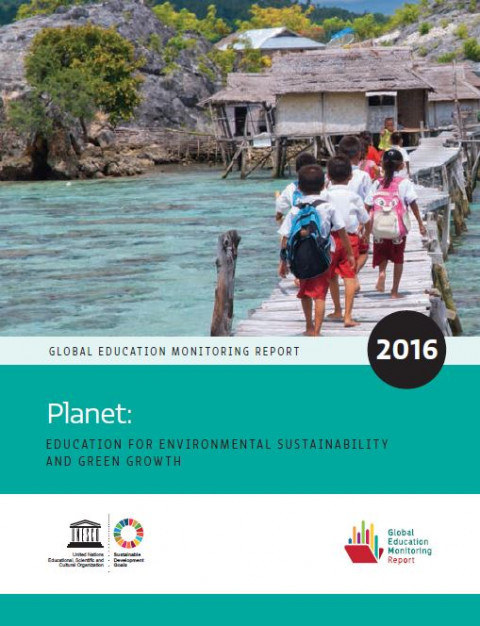 Global Education Monitoring Report, 2016: Planet: Education for Environmental Sustainability and Green Growth Год публикации: 2016 Организация-автор: UNESCO PLANET: Education for environmental sustainability and green growth, a publication taken from the full 2016 Global Education Monitoring Report, explores the knowledge and skills needed for sustainable and inclusive economic growth that does not damage our planet.This publication demonstrates how education can help people understand and respond to environmental issues and climate change. Environmental education can increase green knowledge and build sustainability practices. The publication warns that while education contributes to economic growth, education systems must be careful not to encourage unsustainable lifestyles and all learners must acquire the knowledge and skills needed to promote sustainable development.It also argues that we must continue to learn throughout our lives in order to make production and consumption sustainable, and to provide green skills for green industries. Creating green industries relies on high-skill workers with specific training, yet by 2020 there could be 40 million too few workers with tertiary education relative to demand. Higher education and research should also be oriented towards green innovation and growth; innovation depends on cooperation in higher education and investment in research and development to transform production in vast swaths of the economy.It also recognises that education must change in order to keep up with the changing face of work. Green and transferable skills should be taught in both school and the workplace. The greening of industries requires not only the production of more high-skill workers, but the continued training and education for low and medium skill workers, often on the job. “To ensure the Sustainable Development Goals are implemented, everyone involved needs to think, to work, to organise, to communicate and to report in ways that are completely different from what has been done up till now. Education truly is key to a wide appreciation not just of the SDGs but the new ways of thinking and working that are going to be necessary to fulfil them. So the challenge to all of us is to re-learn, and that does not just apply to educators, but it applies to all of us.”
 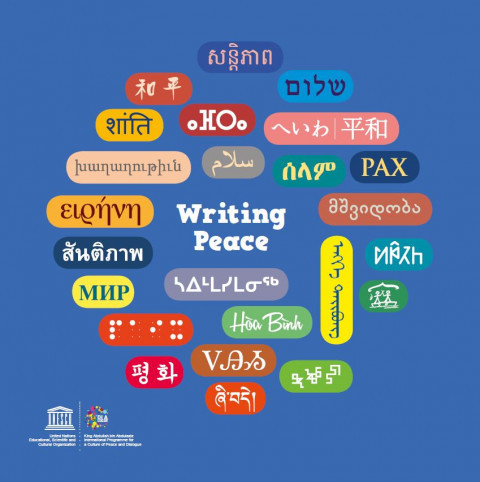 Writing Peace Год публикации: 2017 Автор: Eric Cattelain Организация-автор: UNESCO “Writing Peace” is a manual that invites young audiences to discover contemporary writings through the introduction of various languages. Its goal is to make the world appear a little closer and a little more familiar. "Writing Peace" encourages children (ages8 to 14) to become aware of the interdependence of cultures through familiarization with contemporary writing systems, their history, and their borrowings.The manual contains 24 activity sheets. Each section presents the characters of a writing system, an introductory text and historical background, the word “peace” and the word “hello,” the language(s) attached to the system(s), and an activity whose answers appear at the end of manual.Six thousand years after the advent of writing, what do we know about others, their systems of thought, and the transcriptions of their writing systems? How can different writing systems contribute to a better understanding of the world and our place within it? By beginning to learn about these writings and their fascinating beauty, the manual connects children to diversity, thus opening their eyes to the concept of peace and our awareness of it.
  Guidelines on Sustainability Science in Research and Education Год публикации: 2017 Организация-автор: UNESCO “Guidelines on Sustainability Science in Research and Education” is the main output of the international UNESCO project “Broadening the Application of the Sustainability Science Approach” initiated in October 2015 with the support of the Japanese Ministry of Education, Culture, Sports, Science and Technology (Japan/MEXT) to identify good practices and develop policy guidelines to help Member States harness the potential of sustainability science in their sustainable development strategies.This project aimed to help UNESCO Member States and other stakeholders introduce or reinforce a sustainability science approach into transdisciplinary research and education, to enable them to better respond to global challenges, through three symposia to foster dialogue and collaboration among experts and policy-makers. Based on the joint efforts of UNESCO’s Natural Sciences Sector, Social and Human Sciences Sector, Education Sector and Regional Science Bureau for Asia and the Pacific in Jakarta, the project benefited from the guidance of a multidisciplinary steering committee and a drafting sub-committee.For further information on Sustainability Science, please visit: https://en.unesco.org/sustainability-science
  Meeting on Learning to Live Sustainably in Cities in Latin America and the Caribbean, Villa María, Argentina (26-28 April 2017): Meeting Report Год публикации: 2017 Организация-автор: UNESCO Villa Maríia, the first Argentinian city to join the UNESCO Global Network of Learning Cities (GNLC), co-hosted the first GNLC meeting in the region, titled ‘Learning to live sustainably in cities in Latin America and the Caribbean’. This three-day event was a joint effort of the City of Villa Maríia, the UNESCO Institute for Lifelong Learning (UIL), UNESCO Headquarters, and the UNESCO Regional Bureau for Education in Latin America and the Caribbean (OREALC/UNESCO Santiago). Participants explored new ways to implement sustainable solutions at the local level, as well as increase awareness and training related to Education for Sustainable Development (ESD). More than 170 city representatives from over 40 cities and 20 countries (including mayors and deputy mayors, experts, authorities and practitioners) were welcomed by the host city. The first day of the meeting was composed of plenary sessions; the second day consisted of two parallel workshop sessions: (1) a regional workshop on the Global Action Programme (GAP) on ESD and Cities, and (2) a regional workshop on learning cities.
 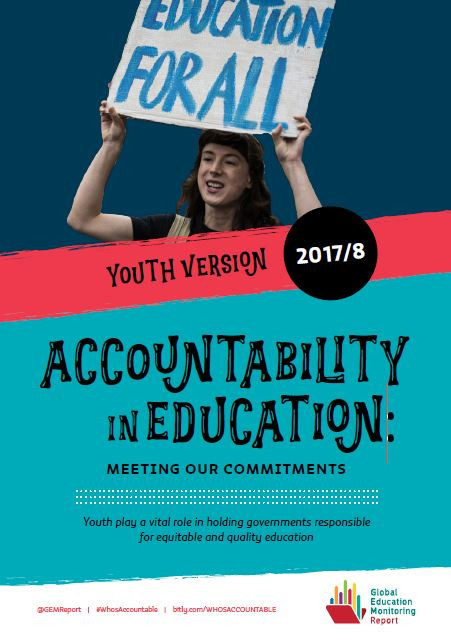 Accountability in Education: Meeting our Commitments; Global Education Monitoring Report, Youth Version, 2017/8 Год публикации: 2017 Организация-автор: UNESCO This Youth Report, based on findings and conclusions from the 2017/8 Global Education Monitoring report, asks how young people are involved in the process of accountability in education. As students, what are we responsible for in our education and how are we held accountable? How can we make sure other actors – like schools, universities and governments – are held accountable for their responsibilities? These are critical questions, because we know that there’s a long way to go before all young people around the world have access to a quality education: absent teachers, overcrowded classrooms, illegitimate diplomas, unregulated private schools and truancy are all issues that education systems are struggling to overcome.It’s sometimes tempting to say that these problems aren’t ours to fix, that the responsibility lies with the government or with an older generation. But this simply isn’t true: education is a shared responsibility, and young people have an important role to play. In this Report, you’ll hear the stories of young people around the world who have stood up for the right to education in their communities and who have been integral in triggering change. You’ll also read about how you can become involved in our campaign to make sure governments can be held to account for education. This means making sure that citizens can take their governments to court if they are not meeting their education responsibilities. From creating video clips to holding awareness-raising events, there is a range of ways to make your voice heard. Your involvement is integral in making sure the world is on the right path to meeting our education goals.
  Europe and North America Regional Workshop on the Global Action Programme on Education for Sustainable Development and Cities Год публикации: 2017 Организация-автор: UNESCO UNESCO promotes Education for Sustainable Development (ESD) through the Global Action Programme (GAP), the official follow-up to the UN Decade of ESD. The Europe and North America region was the first to officially adopt a regional strategy for the United Nations Decade of Education for Sustainable Development (DESD, 2005-2014), which seeks to promote a better quality of life for populations and human settlements. Learning to live in a sustainable way and securing people’s involvement and participation in community and urban life are key factors in ensuring sustainable economic, social and environmental development. It is in this context that UNESCO, the UNESCO Global Network of Learning Cities, with its secretariat in the UNESCO Institute for Lifelong Learning (UIL) in Hamburg, and the Free and Hanseatic City of Hamburg, organized the regional workshop for Europe and North America on the role of cities in accelerating sustainable solutions at local level through education. More than 50 experts and city representatives from Europe and North America participated in the regional workshop in Hamburg, Germany, from 12 to 14 December 2016. The workshop examined how education and learning beyond the formal system can be used to support the implementation of the five Ps (Planet, People, Peace, Prosperity and Partnership) of the 2030 Agenda to achieve the Sustainable Development Goals (SDGs). Experts shared their views on ESD, with cities providing insight into their good practices and enriching discussions on the challenges of promoting the various SDGs through education and lifelong learning at city level. These discussions helped to promote awareness on integrating ESD in their cities’ development and education agendas.
  Better Life, Better Future: UNESCO Global Partnership for Girl's and Women's Education Год публикации: 2015 Организация-автор: UNESCO Since its inception, UNESCO has been a strong advocate, promoter and defender of the right to quality education for all, especially for girls and women. Gender equality and education are fundamental human rights, which stand at the core of UNESCO’s mandate. UNESCO launched the Global Partnership for Girls’ and Women’s Education in 2011, guided by the conviction that by educating girls and women, we can break persistent cycles of poverty and in turn foster greater social justice. The Partnership aims to increase learning opportunities for adolescent girls and women and to find solutions to some of the biggest challenges and obstacles to their education. The partnership addresses two weakest links which are secondery education and literacy.
 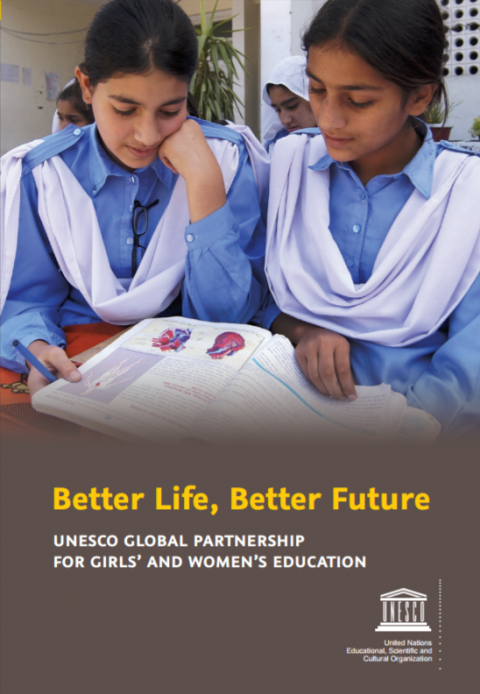 Better Life, Better Future: UNESCO Global Partnership for Girls' and Women's Education Год публикации: 2014 Организация-автор: UNESCO Since its creation, UNESCO has been advocating for, promoting and defending the right to quality education for all, especially for girls and women. As fundamental human rights, gender equality and education stand at the core of UNESCO’s mandate. UNESCO launched the Global Partnership for Girls’ and Women’s Education in 2011 guided by the conviction that educating girls and women can break the cycle of poverty and foster greater social justice. The Partnership seeks to increase learning opportunities for adolescent girls and women and to find solutions to some of the biggest challenges and obstacles to their education. The Partnership addresses two main areas which require increased attention: secondary education and literacy.
 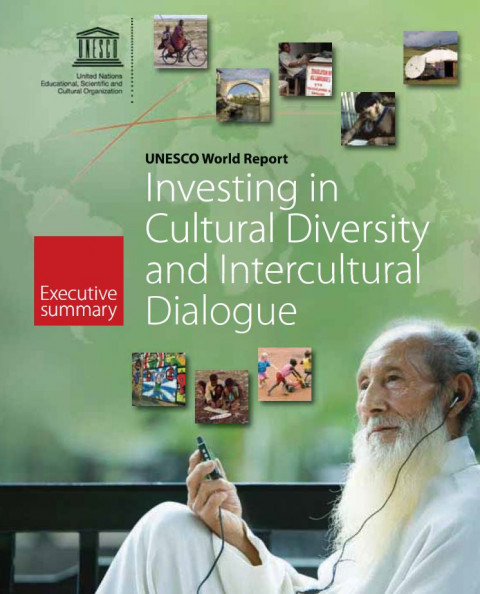 [Summary] Investing in Cultural Diversity and Intercultural Dialogue: UNESCO World Report; Executive Summary Год публикации: 2009 Организация-автор: UNESCO Cultural diversity has emerged as a key concern at the turn of a new century. Yet the meanings attached to this catch-all term are as varied as they are shifting. Some see cultural diversity as inherently positive, insofar as it points to a sharing of the wealth embodied in each of the world’s cultures and, accordingly, to the links uniting us all in processes of exchange and dialogue. For others, cultural differences are what cause us to lose sight of our common humanity and are therefore at the root of numerous conflicts.This second diagnosis is today all the more plausible since globalization has increased the points of interaction and friction between cultures, giving rise to identity-linked tensions, withdrawals and claims, particularly of a religious nature, which can become potential sources of dispute. The essential challenge, therefore, would be to propose a coherent vision of cultural diversity and thereby to clarify how, far from being a threat, it can become beneficial to the action of the international community. This is the essential purpose of the present report.
  Global Citizenship Education: Topics and Learning Objectives Год публикации: 2015 Организация-автор: UNESCO This publication, titled Global Citizenship Education: Topics and learning objectives, is the first pedagogical guidance from UNESCO on global citizenship education. It is the result of an extensive research and consultation process with experts from different parts of the world. This guidance draws on the UNESCO publication Global Citizenship Education: Preparing learners for the challenges of the 21st century and the outcomes of three key UNESCO events on global citizenship education: the Technical Consultation on Global Citizenship Education (September 2013), as well as the First and Second UNESCO Fora on Global Citizenship Education, organized in December 2013 and January 2015 respectively. Before it was finalized, the guidance was field-tested by education stakeholders in selected countries in all regions to ensure its relevance in different geographical and socio-cultural contexts. Following the foundational work of UNESCO to clarify the conceptual underpinnings of global citizenship education and provide policy and programmatic directions, this document has been developed in response to the needs of Member States for overall guidance on integrating global citizenship education in their education systems. It presents suggestions for translating global citizenship education concepts into practical and age-specific topics and learning objectives in a way that allows for adaptation to local contexts. It is intended as a resource for educators, curriculum developers, trainers as well as policy-makers, but it will also be useful for other education stakeholders working in non-formal and informal settings.