
Ресурсы
Изучайте широкий спектр ценных ресурсов ВГГ, чтобы углубить своё понимание и повысить эффективность исследований, просветительской деятельности, преподавания и обучения.
Найдено: 795
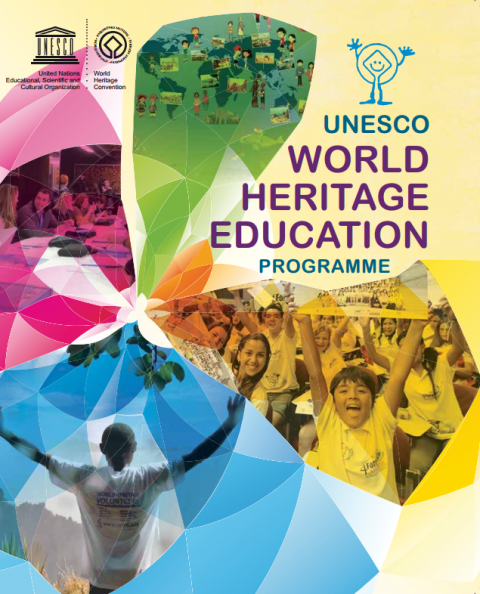 UNESCO World Heritage Education Programme Год публикации: 2013 Организация-автор: UNESCO The WORLD HERITAGE EDUCATION PROGRAMME gives young people a chance to voice their concerns and to become involved in the protection of our common cultural and natural heritage. Launched as a Special Project in 1994 by the United Nations Educational, Scientific and Cultural Organization (UNESCO), and officially called ‘Young People’s Participation in World Heritage Preservation and Promotion’, this programme seeks to encourage and enable tomorrow’s decision-makers to participate in heritage conservation and to respond to the continuing threats facing our World Heritage. Young people learn about World Heritage sites, about the history and traditions of their own and other cultures, about ecology and the importance of protecting biodiversity. They become aware of the threats facing the sites and learn how the international community works together to save our common heritage. Most importantly, they discover how they can contribute to heritage conservation and make themselves heard.
  70 quotes for peace: UNESCO's 70th anniversary celebrations Год публикации: 2015 Автор: Guila Clara Kessous Организация-автор: UNESCO This book, created to mark the 70th anniversary of the United Nations Educational Scientific and Cultural Organization (UNESCO), features 70 quotes from artists, intellectuals, activists, politicians and statesmen. The quotes all testify to a strong conviction that peace, in order to be sustainable, must be built upon a mutual understanding between people and the intellectual solidarity of humankind. But they also demonstrate that each person bears within himself a huge capacity for tolerance and dignity that he can choose to use to achieve this ideal.
  Education for peace: planning for curriculum reform; guidelines for integrating an education for peace curriculum into education sector plans and policies Год публикации: 2015 Организация-автор: UNESCO | UNESCO International Bureau of Education (IBE) | UNESCO International Institute for Educational Planning (IIEP) This Resource and Development Capacity Package was developed based on the belief that, as part of a wider social, economic and political effort, education can play a significant role in a country’s peace-building efforts. Its purpose is to assist Member States in integrating or strengthening peace education programs in their national education systems to promote peace and prevent future conflict. UNESCO, IBE, and IIEP developed this resource within the framework of UNESCO’s Intersectoral Project, Promoting a culture of peace and nonviolence in Africa through education for peace and conflict prevention. The Package contains Technical Guidelines and Capacity Development training modules on policy, program design and curriculum planning to integrate peace and conflict prevention into all aspects of the education system. It is meant for curriculum developers and planners from Africa. The development of the package received the support of the UNESCO Addis-Ababa Office, which assisted in the testing of materials in Addis-Ababa (Ethiopia) and Yaounde (Cameroon).This resource will furthermore help to ensure that curricula, teaching and learning resources and teacher education are in line with the post-2015 vision of education for holistic development. This vision reconceptualises education in terms of global citizenship and responsibility by focusing on inclusion and social cohesion that is global in orientation. In this regard, Global Citizenship Education (GCED) seeks to empower learners with knowledge, skills, values and attitudes that are needed to forge more just and inclusive societies, capable of resolving existing conflicts and emerging global challenges.
  MTB-MLE: mother tongue-based multilingual education; lessons learned from a decade of research and practice Год публикации: 2014 Организация-автор: UNESCO What role can language play in improving education for minority language communities? What are language rights? What place does Mother Tongue-Based Multilingual Education have in realizing other development goals?These important questions were addressed by the 4th International Conference on Language and Education. The conference brought together over 300 practitioners from 30 countries, reflecting the incredible diversity of the Asia-Pacific region and clearly demonstrating the importance of Mother Tongue-Based Multilingual Education (MTB-MLE). This brochure summarizes some of the key messages from this landmark event. Educação para a cidadania global: preparando alunos para os desafios do século XXI Год публикации: 2014 Организация-автор: UNESCO The United Nations Secretary-General’s Global Education First Initiative (GEFI) has established education as a means to ‘foster global citizenship’ – one of its three priority areas. To support this, UNESCO organized two landmark meetings on GCE in 2013. This publication aims to define the parameters of GCE by using the collective expertise, experience and wisdom of those participants who gathered at these landmark events, and to plan for future action in line with emerging thinking and other ongoing work. The review establishes that GCE has a critical role to play in equipping learners with competencies to deal with the dynamic and interdependent world of the twenty-first century. While GCE has been applied in different ways in different contexts, regions and communities, it has a number of common elements, which include fostering in learners. In formal settings, GCE can be delivered as an integral part of an existing subject (such as civic or citizenship education, social studies, environmental studies, geography or culture), or as an independent subject area. Integrated models appear to be more common. Some less traditional, but at least as effective, pathways for GCE have included the following: the use of information and communication technologies and social media, sport competitions and the use of art and music, and youth-led initiatives employing a wide variety of approaches. Both traditional and new horizons for GCE are profiled in this review. This publication also explores a number of enabling conditions for the promotion and implementation of GCE. These include: the existence of an open environment for universal values, the implementation of transformative pedagogy and support for youth-led initiatives. The review acknowledges that there are a number of ongoing tensions with the concepts of global citizenship and global citizenship education. While these tensions vary, they all point to the fundamental question of how to promote universality (e.g. common and collective identity, interest, participation, duty), while respecting singularity (e.g. individual rights, self-improvement). Some ways forward to resolve these tensions are suggested, whilst maintaining that challenges around theoretical elements of GCE should not undermine its practice. The processes documented in this publication have strengthened partnerships, built coalitions and contributed to improving the evidence base on the theory and practice of global citizenship education. While there are tasks that remain, this foundation bodes well for improving the enabling conditions and the practices highlighted in this review. By preparing learners to fulfil their potential in an increasingly globalized world, we are promoting transformed societies that are also better equipped to deal with the twenty-first century challenges and to seize twenty-first century opportunities.
 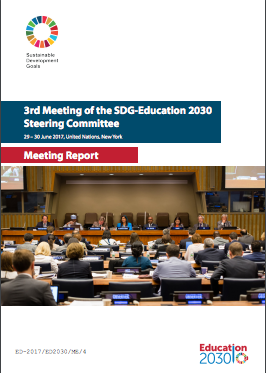 3rd Meeting of the SDG-Education 2030 Steering Committee, 29-30 June 2017, United Nations, New York: meeting report Год публикации: 2017 Организация-автор: UNESCO An inclusive high-level multi-stakeholder partnership, the SDG-Education 2030 Steering Committee (SC) provides a global forum for consultation and a mechanism to coordinate and harmonize global education efforts. It is mandated to provide strategic guidance to Member States and the education community, make recommendations for catalytic action, advocate for adequate financing, and monitor progress toward SDG4 targets through the UNESCO Institute for Statistics and the Global Educational Monitoring (GEM) Report. The 3 rd meeting of the SC was organized in New York on 29-30 June 2017 back to back with the HighLevel Action SDG Action Event on Education convened by the President of the UN General Assembly, Peter Thompson, in partnership with key SDG 4 stakeholders, to drive a new push for inclusive and equitable quality education and lifelong learning opportunities. At this meeting the SC examined successes and challenges in the implementation of SDG4 since the adoption of the 2030 Agenda. After highlighting the critical role of regional organizations as policy peer learning mechanisms in enhancing effective implementation of SDG4-Education 2030, the SC endorsed a set of recommendations for improved implementation in 2018 and 2019. Inclusion from the start: guidelines on inclusive early childhood care and education for Roma children Год публикации: 2014 Организация-автор: UNESCO | Council of Europe Inclusion from the start: guidelines on inclusive early childhood care and education for Roma children (Guidelines hereafter) is a joint contribution by the Council of Europe and UNESCO to improving access to quality early childhood services for Roma children. They are a concrete follow-up to the recommendations arising from an expert meeting, organised by the two organisations in 2007.1 Recognising that quality early childhood experience is an important stepping stone toward inclusive participation in school and society, the Guidelines address the challenges specifc to Roma children in the early years and transition to primary education. They provide guidance on key themes, such as the conceptualisation of early childhood care and education (ECCE) services, agenda-setting, stakeholders’ responsibilities, curricular and pedagogical approaches, staf training and professional development, assessment and transition to primary education. The Guidelines primarily address formal ECCE services – such as kindergartens and preschools – which typically cater for children from ages 3-6 years. The reason for this focus is that providing care and education experience prior to primary school entry is crucial for supporting Roma children’s school readiness and for facilitating an equal start in their frst year. This being said, the Guidelines also acknowledge the critical importance of the years pre-natal to age 3, and consider health and nutrition interventions and non-formal ECCE programmes (e.g. community-based childcare, parenting education) as essential services in deprived neighbourhoods and settlements.
 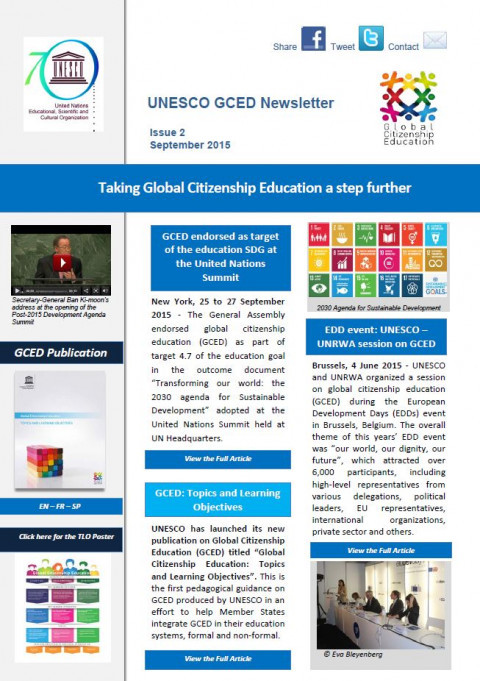 UNESCO GCED eNewsletter Issue 2 Год публикации: 2015 Организация-автор: UNESCO Featuring:Taking Global Citizenship Education a step furtherGCED endorsed as target of the education SDG at the United Nations SummitGCED: Topics and Learning ObjectivesEDD event: UNESCO-UNRWA session on GCEDCapacity-building workshops-providing assistance for GCED implementationGCED for West African countries – building on peace and human rights educationTool for writing textbooks free of prejudiceOrientation and Capacity Building on GCED for Latin American and Caribbean countriesKey tweetsUpcoming events Joint E-9 Statement on Education Beyond 2015: Islamabad Statement Год публикации: 2014 Организация-автор: UNESCO This statement is adopted by the participants of the 10th E-9 Ministerial Review Meeting held in Islamabad, Pakistan, on November 27-28, 2014. They have taken stock of the progress made since 2000 and challenges remaining in the nine countries in achieving the six Education for All (EFA) goals, and reflected on the priorities and prospects for each country to sustain and further advance educational development beyond 2015. Their deliberations were based on a careful examination of the National EFA 2015 Reviews of the countries concerned, the Muscat Agreement adopted at the Global Education for All Meeting (Muscat, Oman, 12-14 May 2014), the Outcome Document of the United Nations General Assembly Open Working Group on Sustainable Development Goals, and took into account the Aichi-Nagoya Declaration on Education for Sustainable Development as well as the changing global environment that shapes the cooperation among the E-9 countries.
 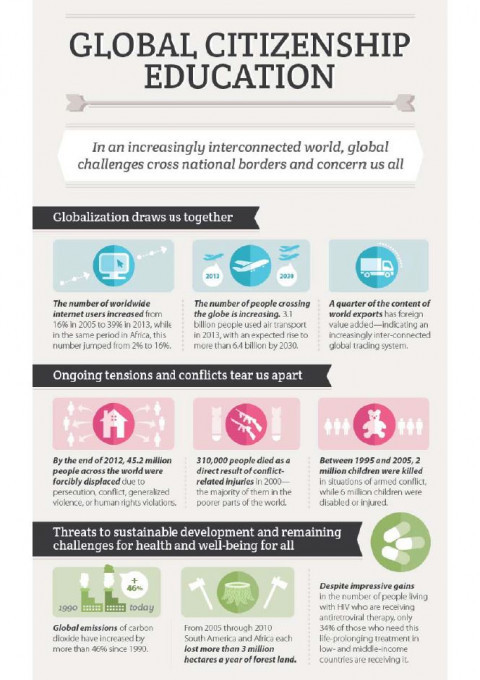 Global Citizenship Education infographic Год публикации: 2014 Организация-автор: UNESCO In an increasingly interconnected world, global challenges cross national borders and concern us all. With issues like these threatening human and environmental well-being, we need to re-think the role and relevance of education. We need Global Citizenship Education. Global Citizenship Education is transformative. What are the barriers to this kind of education? What needs to change in education? What is UNESCO doing? What can you do?