
Ресурсы
Изучайте широкий спектр ценных ресурсов ВГГ, чтобы углубить своё понимание и повысить эффективность исследований, просветительской деятельности, преподавания и обучения.
Найдено: 795
 Climate Change and Sustainability in Science and Social Science Secondary School Curricula Год публикации: 2024 Автор: Marcia McKenzie | Aaron Benavot Организация-автор: UNESCO There is an urgent need to transform the way climate change and sustainability are taught in classrooms and at schools. Learners must grasp the environmental impacts of climate change, how climate change relates to their own context and what actions can be undertaken and contribute to making societies more sustainable, equitable, just and climate-resilient. The findings presented in this publication indicate that accelerated efforts are needed. In a study of over 530 Grade 9 science and social science curricula from 85 countries worldwide, we found that 69 per cent of curricula contained no references to climate change, while 66 per cent had no references to sustainability. Furthermore, while 69 per cent of surveyed teachers from eight of the countries studied reported that environment, sustainability and climate change topics were included in the science and social science curricula in their schools only 50 per cent included them in their teaching. While there is a notable inclusion of environment, sustainability and climate change in science and social science curricula across countries, the depth of focus of this inclusion varies widely. Cognitive learning prevails over social and emotional or action-oriented learning. Climate change and sustainability in school practices must be strengthened, with teachers playing a key role in enhancing integration through teaching methods and materials.
  Science, Technology and Innovation Policy Instruments for the Sustainable Development Goals: A Global Outlook Год публикации: 2024 Автор: Galindo Moreno | Manuel Ricardo Организация-автор: UNESCO This publication explores the design, implementation and impact of science, technology and innovation (STI) policy instruments across regions, revealing diverse policy priorities and support strategies. Data from the UNESCO Global Observatory of Science, Technology and Innovation Policy Instruments (GO-SPIN) platform shows that STI policy instruments are closely linked to the SDGs, particularly with SDG 9 (industry, innovation and infrastructure), SDG 8 (decent work and economic growth) and SDG 4 (quality education). Over three-quarters of these policy instruments target these goals. This publication advocates for the use of evidence in designing policies and policy instruments and underscores the importance of continuous monitoring of their implementation. Additionally, it recommends diversifying funding sources, enhancing program management, fostering communication with stakeholders, and applying policy instruments to promote transformative learning.
  The Water, Energy, and Food Security Nexus in Asia and the Pacific: The Pacific Год публикации: 2024 Организация-автор: UNESCO | UNESCO Bangkok | UNESCO Jakarta Global climate targets and the call to action from the Pacific must be heeded while major environmental, societal and economical progress is needed in the region. Leadership from Pacific Island Countries and Territories needs to be supported with action and resourcing to meet both global net zero goals and regional SDGs. This volume applies the water, energy, and food security nexus approach solely in a Pacific context for the first time, bringing together the region’s 17 countries and 7 Territories. This approach improves the security of each sector and supports regional climate and environmental priorities. Effective intersectoral solutions exist with connectivity between the water-food and water-energy sectors of particular benefit. Traditional knowledge and crop production have historically and will continue to play a major role in food security and water resources management in the region. Increased energy demand needs to be met with increased renewables installation as well as new technologies that encompass storage and transport considerations.
  Global Citizenship Education in a Digital Age: Teacher Guidelines Год публикации: 2024 Организация-автор: UNESCO This book is an essential resource for teachers seeking to understand the critical role that digital citizenship education plays in promoting a more informed, engaged, and responsible global citizenry. While digital technologies have opened up new opportunities for life-long learning, they have also given rise to emerging concerns, notably in relation to the rise of disinformation and hate speech online. Aimed at building the capacities of teachers to prepare learners to act ethically and responsibly in physical and digital environments, these guidelines stress the importance of considering how Global Citizenship Education (GCED) and related knowledge, values, skills and attitudes can be fostered for teaching, learning and engaging for a more sustainable, inclusive, just and peaceful world.
 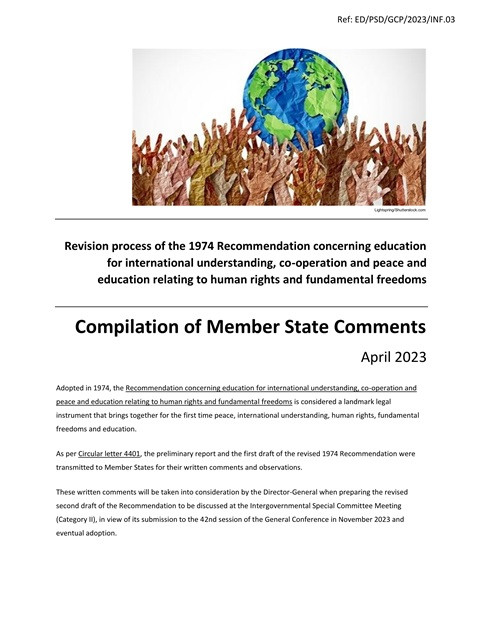 Revision Process of the 1974 Recommendation concerning Education for International Understanding, Co-operation and Peace and Education relating to Human Rights and Fundamental Freedoms: Compilation of Member State Comments Год публикации: 2023 Организация-автор: UNESCO Adopted in 1974, the Recommendation concerning education for international understanding, co-operation and peace and education relating to human rights and fundamental freedoms is considered a landmark legal instrument that brings together for the first time peace, international understanding, human rights, fundamental freedoms and education. As per Circular letter 4401, the preliminary report and the first draft of the revised 1974 Recommendation were transmitted to Member States for their written comments and observations. These written comments were taken into consideration by the Director-General when preparing the revised second draft of the Recommendation to be discussed at the Intergovernmental Special Committee Meeting (Category II), in view of its submission to the 42nd session of the General Conference in November 2023 and eventual adoption.
 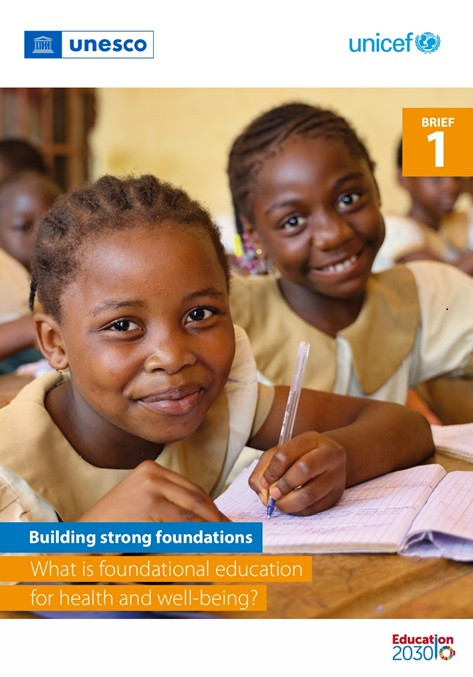 Building Strong Foundations: What is Foundational Education for Health and Well-being? (Brief 1) Год публикации: 2024 Организация-автор: UNESCO | United Nations Children's Fund (UNICEF) In a rapidly changing world, establishing strong foundations for children is vital for their well-being and resilience. Quality education is central to this endeavour and is the key to lifelong health and success. Recognizing that children thrive in the classroom when they are in good health, it is crucial to learn about health and well-being early on in primary schools. The Building strong foundations briefs, developed jointly by UNESCO and UNICEF, provide evidence-based guidance to support primary school-aged children to thrive through foundational education for health and well-being. Drawing from extensive research and consultations with leading experts from various fields and across the world, these briefs serve as a roadmap for education stakeholders to equip learners with the requisite knowledge and skills to navigate their current and future health and well-being needs. This document is the first of four briefs. It provides an overview of the essential role that primary schools play in enhancing health and well-being. The document outlines what foundational refers to, why it is important for health and education, and how it contributes to paving the way for healthier, inclusive and thriving societies. The brief shares compelling evidence and case studies to distill six essential elements for an effective whole-school approach to health and well-being.
 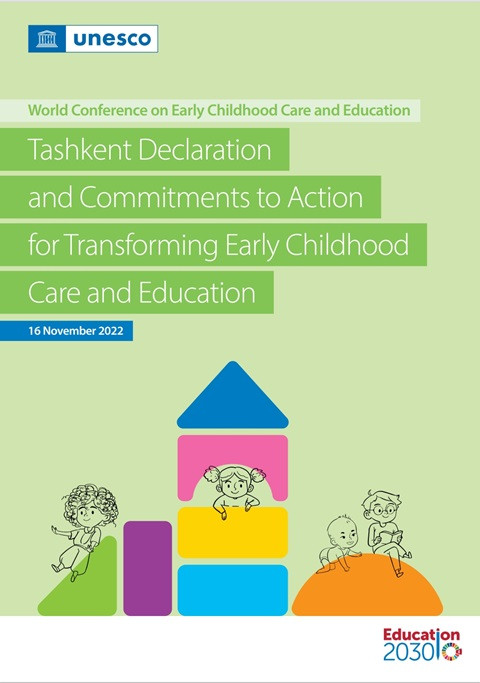 World Conference on Early Childhood Care and Education: Tashkent Declaration and Commitments to Action for Transforming Early Childhood Care and Education, 16 November 2022 Год публикации: 2022 Организация-автор: UNESCO From 14 to 16 November 2022, the second World Conference on Early Childhood Care and Education took place in Tashkent, Uzbekistan. Over 2,600 conference participants from 147 Member States, including ministers, development partners, practitioners, scientists, civil society, and private organizations, came together to reaffirm the right of every young child to quality early childhood development, care, and education. The Tashkent Declaration and Commitments to Action for Transforming Early Childhood Care and Education (ECCE) sets out the guiding principles and strategies for the urgent transformation of ECCE for accelerating achievement of SDG Target 4.2, and concrete actions for Member States, the international community, non-governmental organizations, and UNESCO to be regularly monitored, reviewed, and evaluated.
 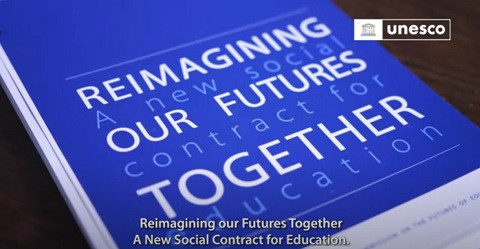 UNESCO Futures of Education Report Explained by Members of the International Commission Год публикации: 2022 Организация-автор: UNESCO Initiated by UNESCO, the International Commission on the Futures of Education has prepared a new report on how education can best shape the future of humanity and the planet. In this video, members of the Commission and its chair explain the main recommendations and defining features of their report, Reimagining our futures together: A new social contract for education. The report is part of UNESCO’s Futures of Education initiative which aims to rethink education and shape the future. The initiative is catalyzing a global debate on how knowledge, education and learning need to be reimagined in a world of increasing complexity, uncertainty, and precarity.
  The Impact of Climate Displacement on the Right to Education Год публикации: 2020 Организация-автор: UNESCO Ce rapport tente d'expliquer les conséquences du réchauffement climatique sur l'éducation des populations, vouées à se déplacer pour fuir la dégradation de leur environnement, ce qui empêche les enfants de suivre une scolarisation complète et de qualité. This report attempts to explain the consequences of global warming on the education of populations, who are forced to move to escape the degradation of their environment, preventing children from receiving a complete, quality education.
  Green School Quality Standard: Greening Every Learning Environment Год публикации: 2024 Организация-автор: UNESCO Climate change threatens our planet and future. Schools and other learning institutions are central places for accelerating climate action among learners and local communities. By empowering teachers and students to understand climate change in their own context contribute to making societies more sustainable and climate resilient. This publication provides for the first time ever a quality standard for greening schools and other learning environments. It outlines four core areas for integrating sustainability principles and climate action: 1) school governance, 2) facilities and operation, 3) teaching and learning, and 4) community engagement. Through the Greening Education Partnership, this standard establishes a common language for all stakeholders to jointly reach the global target of greening at least 50% of schools in all countries by 2030. Policy-makers and ministries in charge of education accreditation schemes, as well as educators, learners and communities are encouraged to use the green school quality standard and join the climate-ready school movement to ensure that every learner is equipped to address climate challenges.