
Ресурсы
Изучайте широкий спектр ценных ресурсов ВГГ, чтобы углубить своё понимание и повысить эффективность исследований, просветительской деятельности, преподавания и обучения.
Найдено: 795
 Guidance and Toolkit for Impact Assessments in a World Heritage Context Год публикации: 2022 Автор: Sarah Court | Eugene Jo | Richard Mackay | Mizuki Murai | Riki Therivel Организация-автор: UNESCO | International Centre for the Study of the Preservation and Restoration of Cultural Property (ICCROM) | International Council on Monuments and Sites (ICOMOS) | International Union for Conservation of Nature (IUCN) | Korea R. Cultural Heritage Administration As the World Heritage Convention celebrates its 50th anniversary in 2022, over 1100 sites around the world are recognized as World Heritage - places that are so valuable to humanity that there conservation has been deemed our collective responsibility. Yet many of these exceptional places face increasing pressure from diverse types of development projects within and around the sites. Assessing the impacts of such projects – before deciding to proceed with their implementation – is essential to both prevent damage to World Heritage and identify sustainable options.The Guidance and Toolkit for Impact Assessments in a World Heritage Context is the go-to reference that explains the process for achieving these goals. Offering practical tips and tools including checklists and a glossary, it provides a framework for conducting impact assessments for cultural and natural heritage sites.Developed by UNESCO and the Advisory Bodies to the World Heritage Committee, ICCROM, ICOMOS and IUCN, this Guidance and Toolkit fosters cross-sectoral, multidisciplinary collaboration to identify solutions for both protecting World Heritage sites and supporting good quality and appropriate development . States Parties to the World Heritage Convention, heritage managers, decision-makers, planners and developers are invited to use it to help realise our collective commitment to passing on our precious heritage to future generations.
  Building Strong Foundations: What to Teach for Foundational Education for Health and Well-being (Building Strong Foundations Brief; 2) Год публикации: 2024 Организация-автор: UNESCO | United Nations Children's Fund (UNICEF) In a rapidly changing world, establishing strong foundations for children is vital for their well-being and resilience. Quality education is central to this endeavour and is the key to lifelong health and success. Recognizing that children thrive in the classroom when they are in good health, it is crucial to learn about health and well-being early on in primary schools. The Building strong foundations briefs, developed jointly by UNESCO and UNICEF, provide evidence-based guidance to support primary school-aged children to thrive through foundational education for health and well-being. Drawing from extensive research and consultations with leading experts from various fields and across the world, these briefs serve as a roadmap for education stakeholders to equip learners with the requisite knowledge and skills to navigate their current and future health and well-being needs. The present document is the second of four briefs. It is a go-to resource to better understand what makes a primary school curriculum effective in supporting health, well-being and learning. The brief provides practical tips and insights on integrating core thematic concepts for health and well-being into the curriculum, including concrete examples of learning objectives for lower primary and upper primary curricula. Whether a seasoned curriculum designer, a passionate educator or an individual involved in primary school curriculum processes, this brief equips readers with the tools to design impactful curricula for transformative learning, health and well-being.
  Why the World Needs Happy Schools: Global Report on Happiness In and For Learning Год публикации: 2024 Организация-автор: UNESCO Seeing a teacher smile. Hearing students laugh. Feeling a hug from a friend. Smelling fresh air. Tasting a nutritious school meal. These five senses can stimulate happiness at school and improve the learning experiences, outcomes and well-being of students. Through the ‘Happy Schools’ initiative, UNESCO is placing happiness at the core of the transformation of education. It encourages education systems to recognize happiness as both a means to and a goal of quality learning. The initiative is informed by a growing evidence base linking happiness with better learning, teaching, well-being and overall system resilience. This report presents the UNESCO global Happy Schools framework consisting of 4 pillars – people, process, place and principles – and 12 high-level criteria to guide the transformation of learning. It offers a holistic model for embedding happiness into education policies and cultivating it in schools through systemic changes. The report illustrates how the ‘Happy Schools’ initiative aims to create top-down and bottom-up transformation, encouraging governments to recognize happiness as a core objective of education. It supports the scaling of promising practices of joyful learning from the school to the policy level.
  Transforming Education Towards SDG4: Report of a Global Survey on Country Actions to Transform Education; Highlights Год публикации: 2024 Организация-автор: UNESCO In 2022, the United Nations Transforming Education Summit responded decisively to mobilize action, ambition and solidarity as well as to elevate education to the top of the political agenda. This powerful mobilization led to 143 countries presenting national statements of commitment, demonstrating their political resolve to reimagine and transform their education systems. On the Summit’s fi rst anniversary, UNESCO invited its Member States to participate in the Survey on Country Actions to Transform Education and report on how they have translated their commitments into actions. This document presents highlights from the Transforming Education Towards SDG 4: Report of a global survey on country actions to transform education. It showcases transformative actions that countries have undertaken to accelerate progress towards SDG 4. The report emphasizes that education must adopt a holistic, lifelong and comprehensive approach that addresses the development and well-being of individual learners and society. Transforming education requires placing inclusion, equity and gender equality at the core of policies and interventions. It also requires more and better education fi nancing, and investments in the teaching profession.
 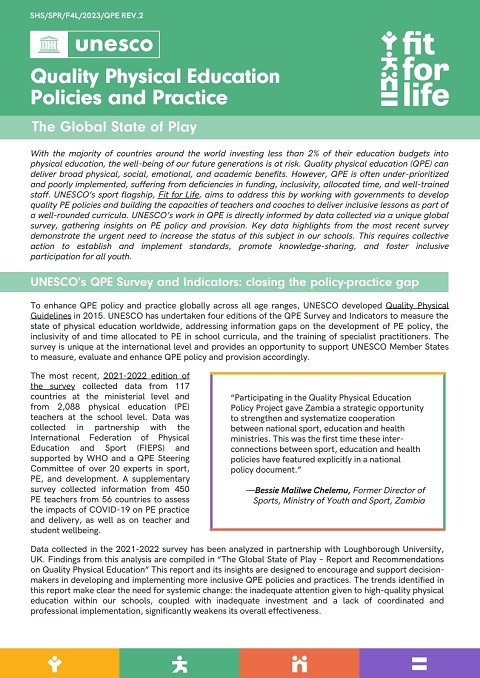 Quality Physical Education Policies and Practice: The Global State of Play Год публикации: 2023 Организация-автор: UNESCO With the majority of countries around the world investing less than 2% of their education budgets into physical education, the well-being of our future generations is at risk. Quality physical education (QPE) can deliver broad physical, social, emotional, and academic benefits. However, QPE is often under-prioritized and poorly implemented, suffering from deficiencies in funding, inclusivity, allocated time, and well-trained staff. UNESCO’s sport flagship, Fit for Life, aims to address this by working with governments to develop quality PE policies and building the capacities of teachers and coaches to deliver inclusive lessons as part of a well-rounded curricula. UNESCO’s work in QPE is directly informed by data collected via a unique global survey, gathering insights on PE policy and provision. Key data highlights from the most recent survey demonstrate the urgent need to increase the status of this subject in our schools. This requires collective action to establish and implement standards, promote knowledge-sharing, and foster inclusive participation for all youth.
 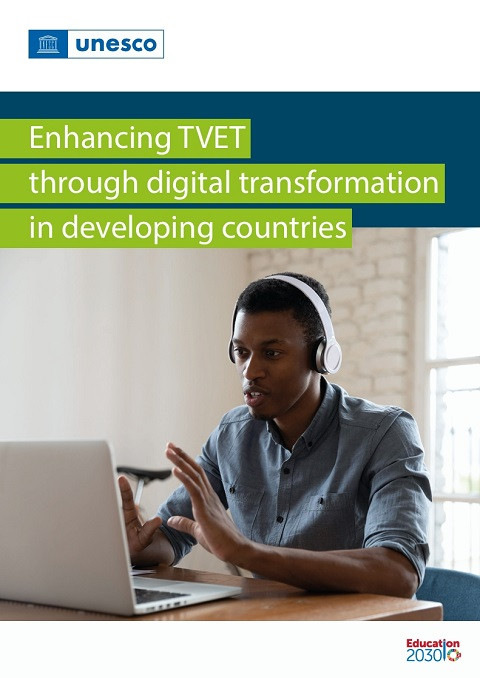 Enhancing TVET through Digital Transformation in Developing Countries Год публикации: 2023 Организация-автор: UNESCO Technological advancements and digitalization are profoundly reshaping our work and lifestyle, business models and operations, and government policy choices. Digital transformation in technical and vocational education and training (TVET) is the planned and structured introduction of automated and streamlined processes within institutions and national technical and vocational education and training (TVET) systems through digital technology, with the goal of enhancing their scope, scale, efficiency and effectiveness and ultimately, driving their more sustainable development. This document provides overall perspective and five country case studies on digital transformation in TVET. Most countries studied face similar enabling factors: the digital infrastructure available; legal and policy frameworks; focused institutional change to improve the acquisition of digital skills; and the promotion of equality and inclusivity. To understand how digital transformation in TVET is occurring, the report analyses it at four levels: technical and technological development; curriculum and qualifications; teaching and learning using technology; and its contribution to the sustainability and resilience of societies.
  High Level Ministerial Dialogue on Education for Peace Год публикации: 2023 Организация-автор: UNESCO This High-level event brought together voices from around the world to discuss what quality and relevant education needs to look like today to bring about real and lasting peace.
  Including Education in the Pact for the Future: An SDG 4 Youth & Student Network Contribution Год публикации: 2024 Автор: Laeek Siddiqui | Juliette Gudknecht | Daniela Moreno Farfán | Azkha Mikdhar Организация-автор: SDG 4 Youth & Student Network | UNESCO Inclusion is the promise towards a fair and equitable education for all. It is critical to ensuring that every youth and student succeeds. Highlighted by UNESCO in the 2020 Global Education Monitoring Report, striving towards inclusive education is non-negotiable, as education is a human right. With the current challenges of our world highlighted in the 2030 Agenda, specifically in the areas of poverty, armed conflict and digital transformation, inclusion must be an essential imperative in all policies. The Summit of the Future (SOTF) convenes on the 22 to 23 of September at the United Nations Headquarters in New York, United States. One of its outcomes, if inter-governmentally agreed-upon, would be the Pact for the Future. The Pact is action-oriented, including a chapeau followed by 5 chapters: 1) sustainable development and financing for development; 2) international peace and security; 3) science, technology and innovation and digital cooperation; 4) youth and future generations; and 5) transforming global governance. Along with the Pact are two annexures: the Global Digital Compact and the Declaration on Future Generations. This document introduces the advocacy of the SDG 4 Youth & Student Network – a network hosted by the United Nations Educational, Scientific and Cultural Organization (UNESCO) as the Global Education Cooperation Mechanisms Inter-Agency Secretariat – for inclusive and equitable education at the SOTF, to uphold peace, sustainable development, youth and future generations. It is essential to #IncludeEducation in the Pact and the outcomes of the SOTF for our #InclusiveFuture, to ensure that no one is left behind. It brings attention to how education is essential to global cooperation and empowering future generations, calling upon you to join us in supporting inclusive education systems, with the Global Education Meeting convened by UNESCO side by side with the G20 meeting on 31 October and 1 November 2024 in Fortaleza, Brazil.
  Chile: Artificial Intelligence Readiness Assessment Report Год публикации: 2023 Организация-автор: UNESCO The Readiness Assessment Methodology (RAM) is a diagnostic tool intended to assist Member States in upholding their commitment to the Recommendation by helping them understand how prepared they are to implement AI ethically and responsibly for all their citizens. The RAM questionnaire forms the basis for the first section of this readiness assessment report, providing a comprehensive but detailed overview of laws, institutions, and the cultural, social, and human capital landscape shaping AI. This is then complemented in the second section by a summary of concerns and priorities raised during a national multistakeholder consultation that was conducted in 2023. Finally, the third section presents a roadmap and recommendations for building capacities across national institutions, laws and policies, and human capital, to achieve a responsible AI ecosystem aligned with the UNESCO Recommendation. As the very first country to complete the RAM and the country report, Chile is blazing the trail not only for Latin America but the world. We applaud the initiative the Chilean government has taken to update its AI strategy putting ethics and governance front and centre, and thank them for inviting UNESCO to assist in this endeavour. The report presented here reveals a complex and rapidly-changing landscape. In the legal and regulatory dimension, the 2021 National Artificial Intelligence Policy (NAIP) represents a substantive and wide-ranging commitment to developing AI. One of the key recommendations of this report is to fully integrate the UNESCO Recommendation into the NAIP’s axis of Ethics, Regulation, and Socioeconomic Impacts. Notably, the RAM reveals the pressing need to update legislation around data protection and cybersecurity to meet the challenges of AI. It also highlights several areas the Chilean government is actively working to develop. [...] Overall, this report presents a fundamentally optimistic vision that we at UNESCO share: that ethical governance and responsible regulation of AI is entirely consistent with innovation and economic growth, and is essential for ensuring a technological ecosystem that benefits the public good. In drawing a clear line from the RAM data through to the multistakeholder consultations and the recommendations, Chile has a clear roadmap for how to get there. (This text has been extracted from the Foreword of the publication)
  World Heritage Glaciers: Sentinels of Climate Change Год публикации: 2022 Организация-автор: UNESCO | International Union for Conservation of Nature (IUCN) It outlines the importance of glaciers for sustaining life, their role as indicators of climate change, and their accelerated retreat due to global warming. The report emphasizes the urgent need to drastically reduce greenhouse gas emissions to limit global warming to 1.5°C, which could save glaciers in two-thirds of World Heritage sites. Additionally, it underscores the importance of adaptive measures like improved monitoring networks, early warning systems, and targeted policies to address the inevitable changes in glacierized areas. It also advocates for inclusive stakeholder engagement, particularly involving Indigenous Peoples and local communities, to develop effective responses to the challenges posed by climate change. The document serves as a call to action for international cooperation and collaboration to protect the Outstanding Universal Value of World Heritage glaciers and ensure their continued benefits for humanity.