
Ресурсы
Изучайте широкий спектр ценных ресурсов ВГГ, чтобы углубить своё понимание и повысить эффективность исследований, просветительской деятельности, преподавания и обучения.
Найдено: 795
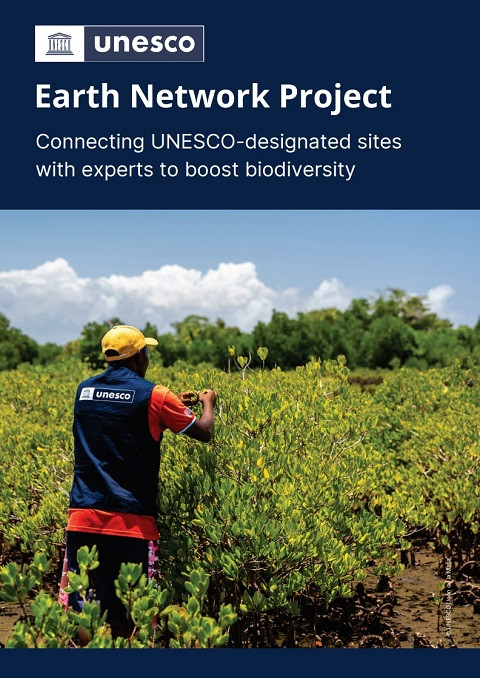 Earth Network Project: Connecting UNESCO-Designated Sites With Experts to Boost Biodiversity Год публикации: 2024 Организация-автор: UNESCO The Earth Network project was launched in 2021 with the support of the Government of Italy. It brings together over 380 experts from more than 60 countries, encompassing diverse biodiversity-related fields that include land restoration, environmental management and environmental law. The specialists volunteer to put their unique skillsets and knowledge at the disposal of sites designated by UNESCO which request their assistance. The Earth Network covers all scientific domains and proudly combines different forms of knowledge: scientific, practitioner, local and indigenous. On the ground, these experts provide technical advice, collect data, build partnerships, and provide training tailored to the specific needs and priorities of each UNESCO-designated site.
  Education 2030: Incheon declaration and framework for action towards inclusive and equitable quality education and lifelong learning for all Год публикации: 2015 Организация-автор: UNESCO | United Nations Development Programme (UNDP) | United Nations Population Fund (UNFPA) | UN. Office of the United Nations High Commissioner for Refugees (UNHCR) | United Nations Children's Fund (UNICEF) | United Nations Entity for Gender Equality and the Empowerment of Women (UN Women) | World Bank This framework — painstakingly drafted over many months with input from governments, international agencies, civil society and experts — provides guidance for implementing the education commitments made in the 2030 Agenda for Sustainable Development at a national, regional and global level. In particular: it aims at mobilizing all countries and partners around Sustainable Education Goal 4 and its targets;it proposes ways of implementing, coordinating, financing and monitoring the new commitments; andit proposes indicative strategies which countries may wish to draw upon in developing their plans, taking into account different national realities, capacities and levels of development and respecting national policies and priorities.
 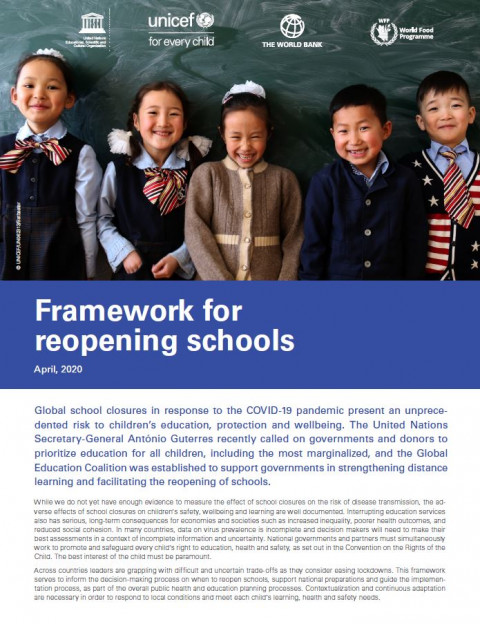 Framework for Reopening Schools; April, 2020 Год публикации: 2020 Организация-автор: UNESCO | United Nations Children's Fund (UNICEF) | World Bank | World Food Programme By late April, nationwide school closures were still disrupting the learning of more than 73 per cent of students, or more than 1.2 billion children and youth. When deciding whether to reopen schools, authorities should look at the benefits and risks across education, public health and socio-economic factors, in the local context, using the best available evidence. The best interest of every child should be paramount.The guidelines aim to inform the decision-making process regarding school reopening, support national preparations and guide the implementation process, as part of overall public health and education planning processes. It is designed to be a flexible tool that can be adapted to each context and updated as the situation changes. The guidelines outline six key priorities to assess the readiness of those schools and inform planning.
  Asia-Pacific Migration Report 2024: Assessing Implementation of the Global Compact for Migration Год публикации: 2024 Организация-автор: UN. Economic and Social Commission for Asia and the Pacific (UN. ESCAP) | International Labour Organization (ILO) | International Organization for Migration (IOM) | UN. Office of the United Nations High Commissioner for Human Rights (UN. OHCHR) | United Nations Centre for Human Settlement Programme (UN Habitat) | United Nations Entity for Gender Equality and the Empowerment of Women (UN Women) | United Nations Development Programme (UNDP) | UNESCO | UN. Office of the United Nations High Commissioner for Refugees (UNHCR) | UN. Office on Drugs and Crime (UNODC) | World Bank This report aims to assess the state of GCM implementation in the region, its progress and its challenges since the first Asia-Pacific Regional Review of Implementation of the Global Compact for Migration in 2021, in which a Chair’s summary was adopted. Chapters 2 to 5 each consider clusters of GCM objectives, as presented in General Assembly resolution 73/326 and following the same groupings as in the Asia-Pacific Migration Report (APMR) 2020. These chapters open with a summary of the discussions from the first regional review of the GCM, held in 2021, drawing from the Chair’s summary. Chapter 6 provides overarching recommendations to support and accelerate GCM implementation in Asia and the Pacific. At the end of the report are annexes with information on the GCM objectives and guiding principles, references to migration in Voluntary National Reviews to the High-Level Political Forum on Sustainable Development, and GCM pledges at the level of the State or City, Municipality and Local Authority.
 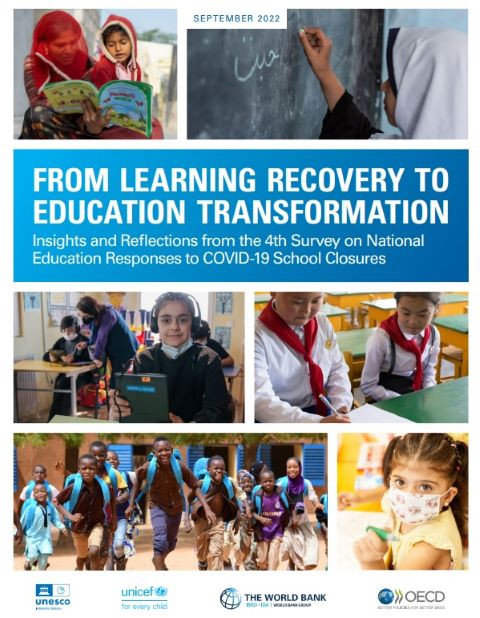 From Learning Recovery to Education Transformation: Insights and Reflections from the 4th Survey on National Education Responses to COVID-19 School Closures Год публикации: 2022 Организация-автор: UNESCO | UNESCO Institute for Statistics (UIS) | United Nations Children's Fund (UNICEF) | World Bank | Organisation for Economic Co-operation and Development (OECD) From Learning Recovery to Education Transformation, a new joint report by UNESCO, UNESCO Institute for Statistics (UIS), UNICEF, The World Bank and The OECD, presents findings from the fourth round of the Survey on National Education Responses to COVID-19 School Closures, administered between April–July 2022 with responses from Ministries of Education in 93 countries. It explores how countries are progressing in the RAPID actions to recover learning: Reach every child and keep them in school; Assess learning levels regularly; Prioritize teaching the fundamentals; Increase the efficiency of instruction; and Develop psychosocial health and wellbeing.
  Global Education Coalition Gender Flagship: Highlights of Action in 2020 Год публикации: 2021 Организация-автор: UNESCO | Global Education Coalition At the onset of the COVID-19 pandemic in March 2020, UNESCO launched the Global Education Coalition, an international multi-sector partnership aiming to meet the urgent and unprecedented need for continuity of learning.Most governments around the world have temporarily closed educational institutions at some point in 2020 in an attempt to contain the spread of the COVID-19 pandemic. At its peak, these nationwide closures impacted more than 1.5 billion, or over 90% of the world’s student population, from pre-primary to higher education. The Global Education Coalition selected three flagships, or focus areas, covering: teachers, connectivity and gender.The Gender Flagship is rallying coalition members to work together to highlight and address the gender dimensions of the COVID-19 school crisis and safeguard progress made on gender equality in education in recent decades.This report presents the work of the Gender Flagship in 2020, and its plans for 2021.
  Humanistic Futures of Learning: Perspectives from UNESCO Chairs and UNITWIN Networks Год публикации: 2020 Организация-автор: UNESCO UNESCO’s Futures of Education initiative aims to rethink education and shape the future. The initiative is catalyzing a global debate on how knowledge, education and learning need to be reimagined in a world of increasing complexity, uncertainty and precarity. This publication presents the first curated input to the Futures of Education initiative from the UNITWIN/UNESCO Chairs Programme, which now represents an extensive global network of more than 800 higher education institutions in over 115 countries. It features think pieces that highlight key dimensions to be considered in re-visioning and re-purposing education for the future of humanity and the planet. The collection of the pieces calls for greater focus on a number of critical areas such as: The role of culture in strengthening social and environmental sustainability; the values and attitudes that are needed to shape future generations; the importance of both robust public education, as well as of other learning spaces; the need to strengthen human creativity and capability in the digital era, as well as the role of higher education in generating the knowledge and driving the innovation required to transform our world.
  Artificial Intelligence and Gender Equality: Key Findings of UNESCO’s Global Dialogue Год публикации: 2020 Организация-автор: UNESCO The purpose of the UNESCO’s Dialogue on Gender Equality and AI was to identify issues, challenges, and good practices to help: Overcome the built-in gender biases found in AI devices, data sets and algorithms; Improve the global representation of women in technical roles and in boardrooms in the technology sector; and Create robust and gender-inclusive AI principles, guidelines and codes of ethics within the industry. This Summary Report sets forth proposed elements of a Framework on Gender Equality and AI for further consideration, discussion and elaboration amongst various stakeholders. It reflects experts’ inputs to the UNESCO Dialogue on Gender Equality and AI, as well as additional research and analysis. This is not a comprehensive exploration of the complexities of the AI ecosystem in all its manifestations and all its intersections with gender equality. Rather, this is a starting point for conversation and action and has a particular focus on the private sector. It argues for the need to 1. Establish a whole society view and mapping of the broader goals we seek to achieve in terms of gender equality;2. Generate an understanding of AI Ethics Principles and how to position gender equality within them; 3. Reflect on possible approaches for operationalizing AI and Gender Equality Principles; and4. Identify and develop a funded multi-stakeholder action plan and coalition as a critical next step.
  UNESCO Women for Ethical AI: Outlook Study on Artificial Intelligence and Gender Год публикации: 2024 Организация-автор: UNESCO The gender chapter of the UNESCO Recommendation on the Ethics of AI is a concrete commitment by 194 Member States to advance gender equality in the AI ecosystem. To track progress in the implementation of the gender provisions of UNESCO’s Recommendation, and to assess the impacts of AI on gender equality, the UNESCO Women for Ethical AI (W4EAI) Platform has been established. This report advances the workstream through evidence-based insights in three critical areas: women’s participation in AI development and deployment, the inclusion of gender equality concerns in AI governance and the impact of AI on gender equality. It highlights the significant underrepresentation of women in AI, the lack of gender-disaggregated data, and the compounded challenges women face in the field. The report also addresses the neglect of gender dimensions in AI policy, the risks posed by AI systems to women, and the need for responsible and ethical AI governance to promote gender equality. Finally, it outlines actionable recommendations to enhance gender equality through and in AI, emphasizing the importance of comprehensive data collection, targeted interventions, and inclusive policy-making.
 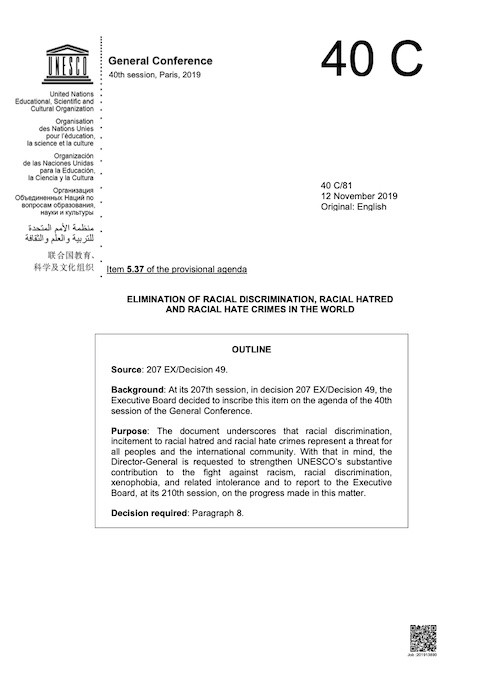 Elimination of Racial Discrimination, Racial Hatred and Racial Hate Crimes In the World (General Conference; 40th session) Год публикации: 2019 Организация-автор: UNESCO At its 207th session, in decision 207 EX/Decision 49, the Executive Board decided to inscribe this item on the agenda of the 40th session of the General Conference. The document underscores that racial discrimination, incitement to racial hatred and racial hate crimes represent a threat for all peoples and the international community. With that in mind, the Director-General is requested to strengthen UNESCO’s substantive contribution to the fight against racism, racial discrimination, xenophobia, and related intolerance and to report to the Executive Board, at its 210th session, on the progress made in this matter.