
Ресурсы
Изучайте широкий спектр ценных ресурсов ВГГ, чтобы углубить своё понимание и повысить эффективность исследований, просветительской деятельности, преподавания и обучения.
Найдено: 795
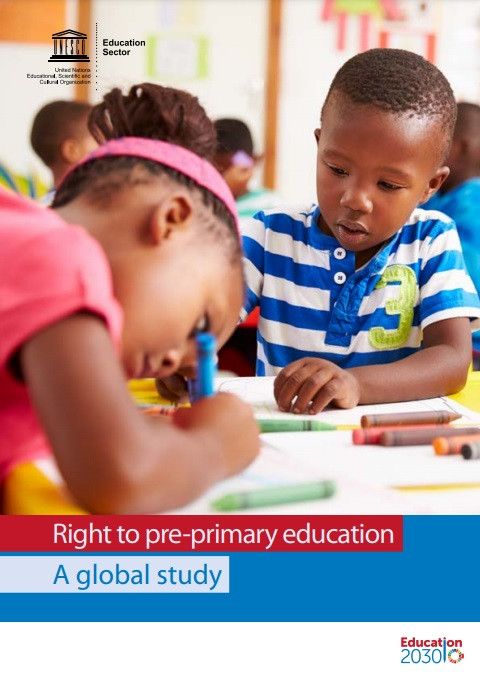 Right to Pre-Primary Education: A Global Study Год публикации: 2021 Организация-автор: UNESCO Early childhood care and education is increasingly recognized as an essential element in realizing a wide range of educational, social and economic rights. Children from vulnerable households and communities stand to gain most from access to quality early learning opportunities. With about 50 per cent of children globally not yet enrolled in pre-primary education, enabling their inclusion remains a central question for education policymakers, stakeholders and parents.This Study provides a global overview and an analysis of the adoption of legal provisions for free and compulsory pre-primary education at national level. By offering a rights-based perspective to the implementation of pre-primary education, it aims to complement existing literature on SDG Target 4.2, which focuses mainly on policy outcomes.The results show that pre-primary education is a well determined and defined right in too few countries. Yet, the benefit of free and compulsory education observed is that children appear to have higher rates of early childhood well-being.In light of the research conducted and its main conclusions, a set of levers to promote the inclusion of early childhood and pre-primary education as a human right within long-term education and development objectives are presented in terms of governance and financing, legal framework, societal expectations, monitoring and evaluation and early childhood development overall. Prioritizing the needs of young children and the fulfilment of their right to free and compulsory pre-primary education is a critical opportunity for governments to make positive differences in children’s lives and to achieve broader national, social and economic goals.
 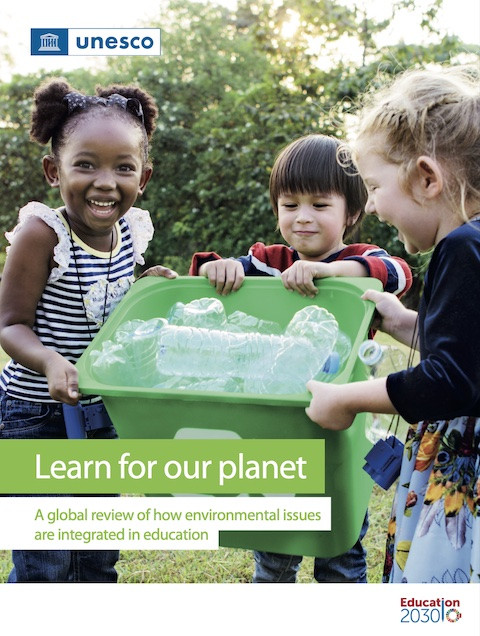 Learn for Our Planet: A Global Review of How Environmental Issues Are Integrated in Education Год публикации: 2021 Организация-автор: UNESCO 2020 was the equal hottest year on record. One million species are at risk of extinction. We use more resources than the planet can generate each year - if we continue to live the way we do today, we will need three earths by 2050. The way we currently live is not sustainable. Urgent change is needed, but lasting change is impossible without education.This publication presents the extent to which environmental issues are integrated in primary and secondary education policies and curricula across 46 UNESCO Member States. Over half of education policies and curricula studied made no mention of climate change. Only 19 per cent made reference to biodiversity. Countries have made progress: 83 per cent of education policies and curricula studied addressed the environment at least once, and 69 per cent mentioned sustainability - but it is clear that more needs to be done to prepare learners with the knowledge, skills, values and attitudes to act for our planet. Governments, education policy-makers, academics, and education and environmental stakeholders need to further commit to Education for Sustainable Development.
 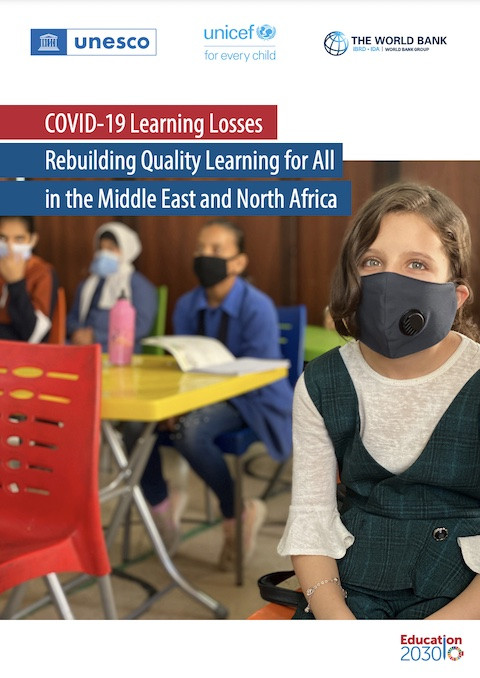 COVID-19 Learning Losses: Rebuilding Quality Learning for All in the Middle East and North Africa Год публикации: 2021 Автор: Hana Yoshimoto | Jeannette Vogelaar | Brenda Haiplik Организация-автор: UNESCO | United Nations Children's Fund (UNICEF) | World Bank An entire generation of children in the Middle East and North Africa (MENA) is estimated to be affected by the education crisis determined by the COVID-19 pandemic, with potential impacts that are going beyond the immediate/short term and also well beyond the education domain itself, with consequences on children’s socialisation, mental well-being, and future perspective of being active members of their society, including in the labor market. More information on the impact of the crisis would help countries to put in place strategies to mitigate the impacts. Timely investment and action to prevent extreme impacts of this crisis on education are of paramount importance in MENA, which already tackling a learning crisis before the COVID-19 outbreak.This publication delineates the overall education status in MENA after the breakout of COVID-19 pandemic, by presenting the education responses in MENA, and assessing the potential learning loss through a simulation analysis, recommendations are provided on how to build back better and enhance access and quality learning for all.
 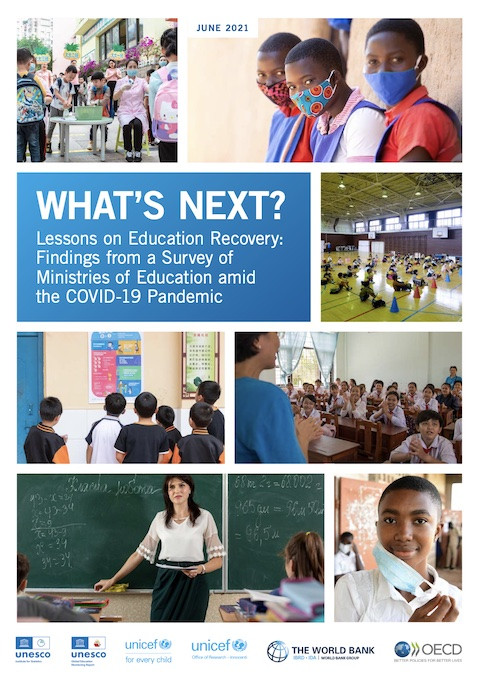 What’s Next? Lessons on Education Recovery: Findings From a Survey of Ministries of Education Amid the COVID-19 Pandemic Год публикации: 2021 Организация-автор: UNESCO | United Nations Children's Fund (UNICEF) | World Bank | Organisation for Economic Co-operation and Development (OECD) United Nations Educational, Scientific and Cultural Organization (UNESCO), the United Nations Children’s Fund (UNICEF), the World Bank and the Organisation for Economic Co-operation and Development (OECD) have collaborated in the third round of the Survey on National Education Responses to COVID-19 School Closures, administered by the UNESCO Institute for Statistics (UIS) and OECD to Ministry of Education officials. The questions covered four levels of education: preprimary, primary, lower secondary and upper secondary. While the first two rounds of the survey were implemented during the periods May–June and July–October 2020, respectively, the third round was implemented during the period February–June 2021. In total, 143 countries responded to the questionnaire. Thirty-one countries submitted responses to the OECD (“OECD survey”) and 112 countries responded to the UIS (“UIS survey”). Seven countries responded to both surveys. In these instances, the more complete set responses were used in analysis.
 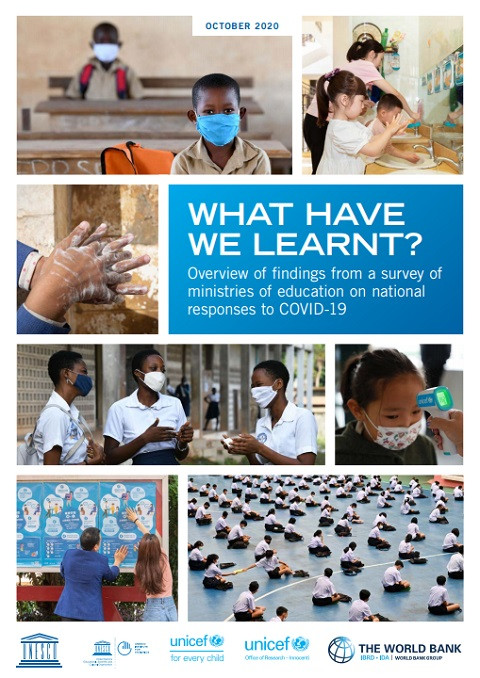 What Have We Learnt?: Overview of Findings From a Survey of Ministries of Education on National Responses to COVID-19 Год публикации: 2020 Организация-автор: UNESCO | United Nations Children's Fund (UNICEF) | World Bank As part of the coordinated global education response to the COVID-19 pandemic, UNESCO, UNICEF and the World Bank conducted a Survey on National Education Responses to COVID-19 School Closures. In this joint report, the results of the first two rounds of data collection administered by the UNESCO Institute for Statistics (UIS) were analysed. They cover government responses to school closures from pre-primary to secondary education.
 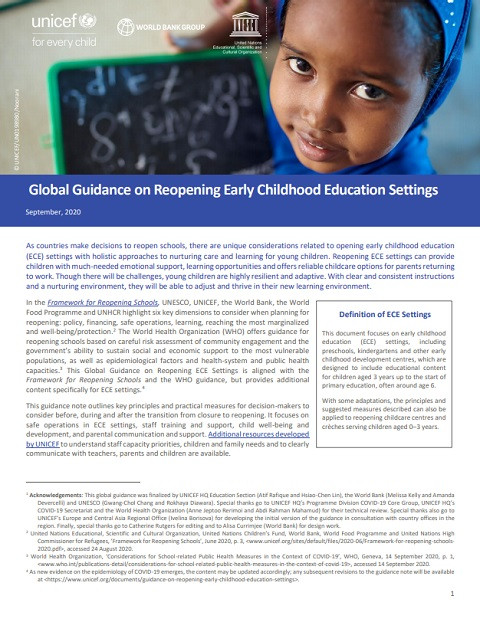 Global Guidance on Reopening Early Childhood Education Settings Год публикации: 2020 Организация-автор: United Nations Children's Fund (UNICEF) | World Bank | UNESCO This guidance note outlines key principles and practical measures for decision-makers to consider before, during and after the transition from closure to reopening. It focuses on safe operations in ECE settings, staff training and support, child well-being and development, and parental communication and support.
 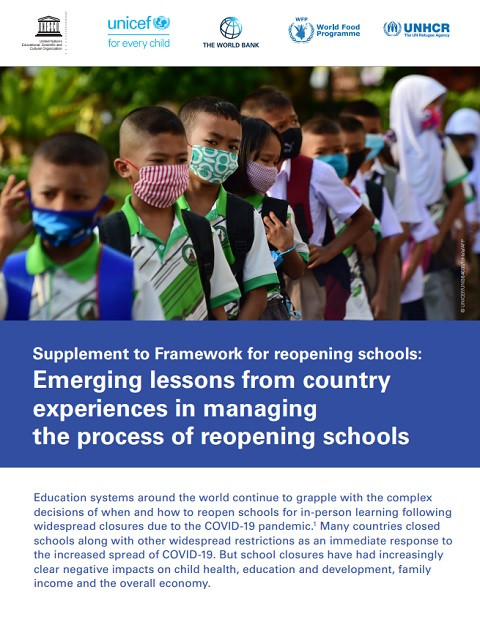 Supplement to Framework for Reopening Schools: Emerging Lessons From Country Experiences in Managing the Process of Reopening Schools Год публикации: 2020 Организация-автор: UNESCO | United Nations Children's Fund (UNICEF) | World Bank | World Food Programme | UN. Office of the United Nations High Commissioner for Refugees (UNHCR) Education systems around the world continue to grapple with the complex decisions of when and how to reopen schools for in-person learning following widespread closures due to the COVID 19 pandemic. This supplement to the Framework for reopening schools, originally published jointly by UNICEF, UNESCO, the World Bank, the World Food Programme, and the UN Refugee Agency (UNHCR) in April 2020, summarizes emerging lessons learnt over the past months.The supplement follows the four main dimensions of the Framework (safe operations, focus on learning, wellbeing & protection, and reaching the most marginalized) and highlighting a number of country examples.
 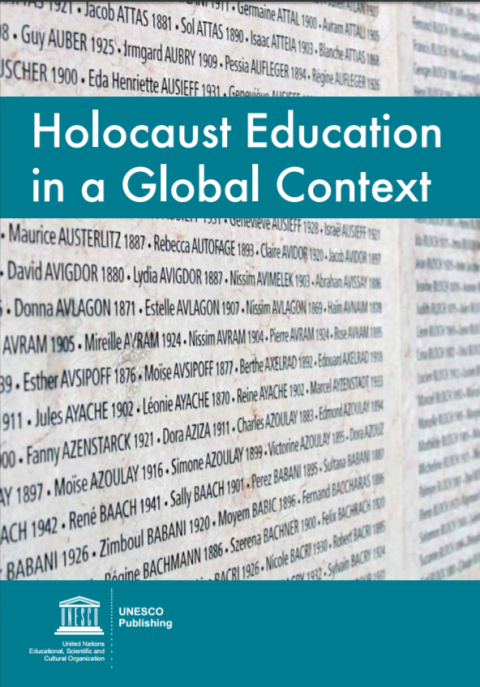 Holocaust Education in a Global Context Год публикации: 2014 Автор: Karel Fracapane | Matthias Haß Организация-автор: UNESCO | Topography of Terror Foundation (Germany) International interest in Holocaust education has reached new heights in recent years. This historic event has long been central to cultures of remembrance in those countries where the genocide of the Jewish people occurred. But other parts of the world have now begun to recognize the history of the Holocaust as an effective means to teach about mass violence and to promote human rights and civic duty, testifying to the emergence of this pivotal historical event as a universal frame of reference. In this new, globalized context, how is the Holocaust represented and taught? How do teachers handle this excessively complex and emotionally loaded subject in fast-changing multicultural European societies still haunted by the crimes perpetrated by the Nazis and their collaborators? Why and how is it taught in other areas of the world that have only little if any connection with the history of the Jewish people? Holocaust Education in a Global Context will explore these questions.
  Education Kit on Combating Desertification: Learning to Combat Desertification; A Teacher’s Guide Год публикации: 2003 Организация-автор: UNESCO The educational guide contained in this kit is addressed to teachers around the world living in areas affected by or under threat from desertification. For this reason, the guide should be seen as a general presentation to be adapted to the specific realities and preoccupations of each region or country. The guide begins with the different problems of desertification, which the teachers could integrate into lessons (fauna, flora, crop varieties or rearing, methods of land exploitation, socio-economic problems etc.). It presents the major objectives of the Convention and proposes several solutions to combat desertification.
  Disinfodemic: Deciphering COVID-19 Disinformation (Policy Brief; 1) Год публикации: 2020 Автор: Julie Posetti | Kalina Bontcheva Организация-автор: UNESCO The purpose of this brief is to provide a structure for understanding the COVID-19 disinfodemic and the responses to it, highlighting practices which have a bearing on the UN Sustainable Development Goals (SDGs), the right to health and the right to freedom of expression. SDG 16.10 calls for “public access to information and fundamental freedoms”.