
Ресурсы
Изучайте широкий спектр ценных ресурсов ВГГ, чтобы углубить своё понимание и повысить эффективность исследований, просветительской деятельности, преподавания и обучения.
Найдено: 1,583
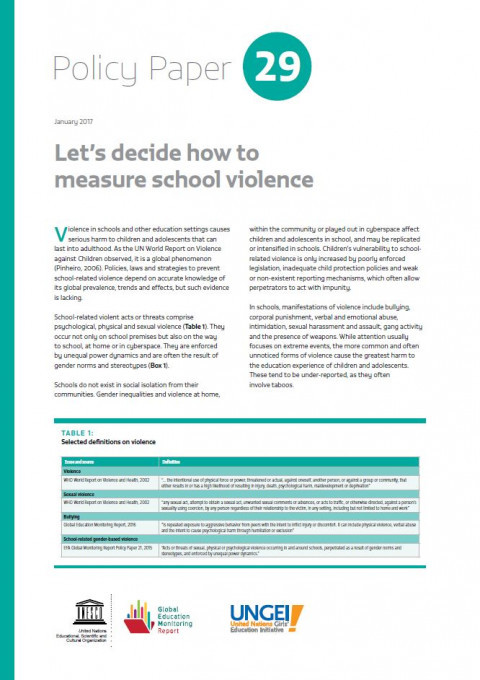 Let's Decide How to Measure School Violence (Policy Paper 29) Год публикации: 2017 Организация-автор: UNESCO Violence in schools and other education settings causes serious harm to children and adolescents that can last into adulthood. As the UN World Report on Violence against Children observed, it is a global phenomenon (Pinheiro, 2006). Policies, laws and strategies to prevent school-related violence depend on accurate knowledge of its global prevalence, trends and effects, but such evidence is lacking.In schools, manifestations of violence include bullying, corporal punishment, verbal and emotional abuse, intimidation, sexual harassment and assault, gang activity and the presence of weapons. While attention usually focuses on extreme events, the more common and often unnoticed forms of violence cause the greatest harm to the education experience of children and adolescents. These tend to be under-reported, as they often involve taboos.To collect data on aspects of violence in schools, large-scale, multi-country school-based surveys are increasingly used; some countries also have well-established monitoring mechanisms. Overall, however, consistent evidence on the global prevalence and trends of school-related violence is lacking. To ensure reliable data is gathered, action is needed to bridge differences between the various monitoring methods. This paper, launched to coincide with the International Symposium on School Violence and Bullying: From Evidence to Action, in Seoul, Republic of Korea (January 17–19, 2017), aims to inform the current debate and propose options for the future.
  Measurement of global citizenship education Год публикации: 2013 Автор: Vegard Skirbekk | Michaela Potančoková | Marcin Stonawski Организация-автор: UNESCO In this study we provide an overview of Global Citizenship Education, focusing on definitions, methodological advances and data. We present an assessment of some of the existing initiatives for the measurement Global Citizenship Education, and make suggestions for how to move towards a globally consistent measure. Although there is some disagreement over how to measure global citizenship and global citizenship education, we also find consensus on parts of the concept. We are proposing to construct a composite indicator consisting of three complementary levels – the societal level (e.g., the level of democracy; macro level indicators of openness), the supplier level (e.g., provision of education; availability of training relevant for global citizenship); and the receiver level (civic identity, values, skills and knowledge). We conclude that one potential cost-effective approach could be to integrate evidence from several nationally representative surveys, providing us with world-wide coverage. We also discuss the feasibility and benefits of this measurement approach as well as its challenges. Measurement of global citizenship education Год публикации: 2013 Автор: Vegard Skirbekk | Michaela Potančoková | Marcin Stonawski Организация-автор: UNESCO Dans cette étude, nous présentons un aperçu de l’Éducation à la Citoyenneté Mondiale, en se concentrant sur les définitions, les progrès méthodologiques et des données. Nous présentons une évaluation de quelques-unes des initiatives existantes pour la mesure d'éducation à la citoyenneté mondiale, et de faire des suggestions sur la façon de progresser vers une mesure cohérente au niveau mondial. Bien qu'il y ait un certain désaccord sur la façon de mesurer la citoyenneté mondiale et de l'éducation à la citoyenneté mondiale, on trouve aussi un consensus sur certaines parties du concept. Nous proposons de construire un indicateur composite constitué de trois niveaux complémentaires - le niveau de la société (par exemple, le niveau de la démocratie, les indicateurs macro-niveau d'ouverture), le niveau des fournisseurs (par exemple, la fourniture de l'éducation, la disponibilité de la formation pertinente à la citoyenneté mondiale) ; et le niveau du récepteur (identité civique, les valeurs, les compétences et les connaissances). Nous concluons qu'une approche potentielle rentable pourrait être d'intégrer des preuves de plusieurs enquêtes représentatives au niveau national, nous fournissant une couverture mondiale. Nous discutons aussi la faisabilité et les avantages de cette approche de mesures ainsi que ses défis.
  Transforming Lives through Education Год публикации: 2018 Автор: Anne Müller | Cristina Stanca-Mustea Организация-автор: UNESCO 1945-2018: This book invites the reader on a fascinating photographic journey that highlights UNESCO’s work in promoting education across the world for more than seven decades. Above all, it testifies to the power of education to transform lives, build self-confidence, contribute to economic and social progress, and promote intercultural understanding.Through this book, the reader will discover the history of UNESCO’s work in education from its foundation to its current role as global leader for the coordination of Goal 4 of the United Nations 2030 Agenda for Sustainable Development, dedicated to education.The publication highlights the important milestones, normative advances, innovations and outstanding projects in our history, which bear witness to our humanistic vision of education. Drawing on a rich archive of photographs, some of them little known, this book illustrates the scale and diversity of UNESCO’s education programme across the globe. Transformer la vie grâce à l'éducation Год публикации: 2018 Автор: Anne Müller | Cristina Stanca-Mustea Организация-автор: UNESCO 1945-2018 : cet ouvrage vous invite à un passionnant voyage photographique qui témoigne de l’action de l’UNESCO pour promouvoir l’éducation à travers le monde depuis maintenant plus de sept décennies. Il témoigne avant tout du pouvoir de l’éducation pour transformer les vies, développer la confiance en soi, contribuer au progrès économique et social, favoriser la compréhension interculturelle.En parcourant cet ouvrage, le lecteur découvrira l’histoire de l’action de l’UNESCO en matière d’éducation, depuis ses débuts jusqu’à son rôle actuel de chef de file, au niveau mondial, pour la coordination de l’Objectif de développement durable 4 dédié à l’éducation, dans le cadre de l’Agenda 2030 défini par les Nations Unies.Ce livre reflète les jalons que nous avons posés, les avancées normatives et les innovations que nous avons réalisées, les projets phares que nous avons conduits et rend compte de notre vision humaniste de l’éducation. S’appuyant sur de riches archives photographiques, don't certaines sont peu connues, ce livre illustre l’ampleur et la variété du programme d’éducation de l’UNESCO à travers le monde.
 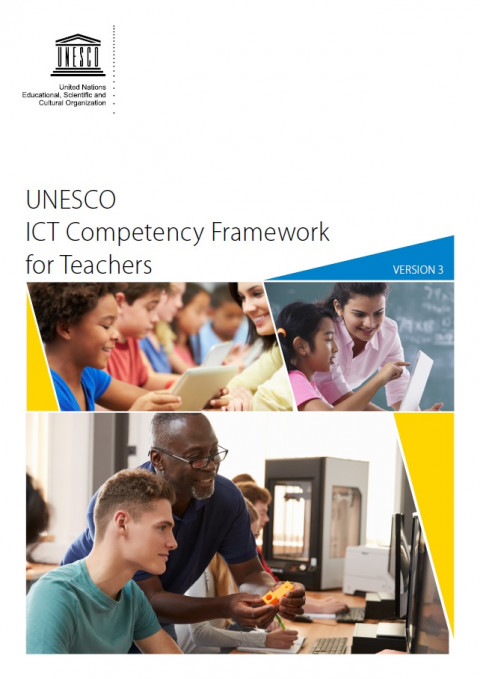 UNESCO ICT Competency Framework for Teachers (ver.3) Год публикации: 2018 Организация-автор: UNESCO UNESCO has developed the ICT Competency Framework for Teachers (ICT CFT) as a tool to guide pre- and in-service teacher training on the use of ICTs across the education system. The ICT CFT is intended to be adapted to support national and institutional goals by providing an up-to-date framework for policy development and capacity building in this dynamic area.The ICT Competency Framework for Teachers (ICT CFT) Version 3 is a response to recent technological and pedagogical developments in the field of ICT and Education, and incorporates in its structure inclusive principles of non-discrimination, open and equitable information accessibility and gender equality in the delivery of education supported by technology. It addresses the impacts of recent technological advances on education and learning, such as Artificial Intelligence (AI), Mobile Technologies, the Internet of Things and Open Educational Resources, to support the creation of inclusive Knowledge Societies. The ICT CFT provides a comprehensive set of competencies teachers need to integrate ICT into their professional practice in order to facilitate students’ achievement of curricular objectives. Strong political commitments and sustained investment in teacher education, and concerted actions between pre- and in-service teacher trainings form the foundation of the successful implementation of this Framework as it is contextualized to national and institutional goals. For this reason, this document underlines the importance of steadfast commitment to supporting teachers’ continuous professional development including through ICT, and includes examples to illustrate how ICT CFT could be used to facilitate teachers’ development in diverse contexts. We look forward to strengthening our collaboration with all stakeholders everywhere to leverage ICT to develop the skills required to thrive within the fast-changing inclusive Knowledge Societies.
  Plan Estratégico 2018 - 2021. Equipo especial internacional sobre docentes para Educación 2030 Год публикации: 2018 Организация-автор: UNESCO Con el final de la era de la EPT, la TTF ha decidido articular sus actividades en torno a los objetivos educativos internacionales recientemente adoptados.El Plan Estratégico 2018-2021 se basa en los Objetivos de Desarrollo Sostenible (ODS), especialmente en la meta del ODS 4.c sobre docentes, y en la Declaración de Incheon y el Marco de Acción para la realización del Objetivo de Desarrollo Sostenible 4 adoptados en 2015.Este nuevo Plan Estratégico fue informado por una evaluación externa realizada en 2016-2017. Las conclusiones y recomendaciones de la evaluación fueron discutidas por el Comité Directivo de la TTF en mayo de 2017 e impulsan algunas de las direcciones estratégicas de este Plan Estratégico. Plan stratégique 2018 - 2021. Équipe spéciale internationale sur les enseignants pour Éducation 2030 Год публикации: 2018 Организация-автор: UNESCO Avec la fin de l'ère EPT, l'Équipe spéciale sur les enseignants a décidé d'articuler ses activités autour des objectifs d'éducation internationale nouvellement adoptés. Le Plan stratégique 2018-2021 se fonde sur les Objectifs de Développement Durable (ODD), en particulier sur la cible 4.c de l'ODD 4 sur les enseignants, ainsi que sur la Déclaration d'Incheon et le Cadre d'action Éducation 2030 adoptés en 2015. Ce nouveau plan stratégique a été informé par une évaluation externe réalisée en 2016-2017. Les conclusions et les recommandations de l'évaluation ont été discutées par le comité directeur du de l'Équipe spéciale sur les enseignants en mai 2017 et donnent certaines des orientations de ce plan stratégique.
  Образование в интересах устойчивого развития (ОУР): строительство нового, более справедливого мира в XXI веке Год публикации: 2012 Организация-автор: UNESCO Education for Sustainable Development allows every human being to acquire the knowledge, skills, attitudes and values necessary to shape a sustainable future. Education for Sustainable Development means including key sustainable development issues into teaching and learning; for example, climate change, disaster risk reduction, biodiversity, poverty reduction, and sustainable consumption. It also requires participatory teaching and learning methods that motivate and empower learners to change their behaviour and take action for sustainable development. Education for Sustainable Development consequently promotes competencies like critical thinking, imagining future scenarios and making decisions in a collaborative way. Education for Sustainable Development requires far-reaching changes in the way education is often practised today. UNESCO is the lead agency for the UN Decade of Education for Sustainable Development (2005-2014). Address by Mr Koïchiro Matsuura, Director-General of UNESCO, on the occasion of the International Seminar on Climate Change Education; UNESCO, 27 July 2009 Год публикации: 2009 Организация-автор: UNESCO This document is the address of Mr Mr Koïchiro Matsuura, Director-General of UNESCO, on the occasion of the International Seminar on Climate Change Education; UNESCO, 27 July 2009. He presented the climate change issues and highlighted the importance of education for sustainable future.