
Ресурсы
Изучайте широкий спектр ценных ресурсов ВГГ, чтобы углубить своё понимание и повысить эффективность исследований, просветительской деятельности, преподавания и обучения.
Найдено: 6
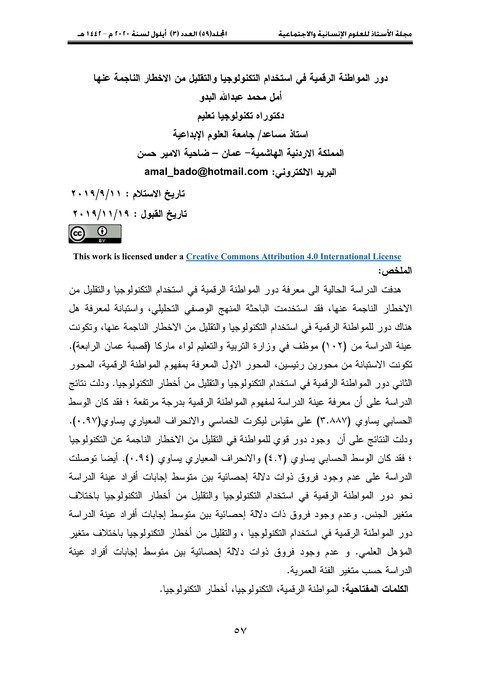 The Role of Digital Citizenship in the Use of Technology and Reducing the Risks Resulting from it (Alustath Journal for Human and Social Sciences; vol.59, no.3) Год публикации: 2020 Автор: Amal Mohammed Abdullah Albado Организация-автор: University of Baghdad. College of Education Ibn Rushd The current study aims to know the role of digital citizenship in the use of technology and reducing the risks resulting from it. The researcher uses the descriptive analytical approach and makes a questionnaire to know if there is a role for the digital citizenship in the use of technology and reducing the dangers caused by it. The study sample consists of (102) employees in the Ministry of Education Marka Brigade (the fourth Amman qasaba). The questionnaire consists of two main axes: the first axis, which is defined as the concept of digital citizenship, the second axis is the role of digital citizenship in the use of technology and reducing the dangers of technology. The results of the study show that the awareness of the sample of the study of the concept of digital citizenship is on a high level, on average that equals (3.887) of the Likert quinary scale and the standard deviation is equal to (0.97). The results also show a strong role for citizens in reducing the dangers caused by technology where the arithmetic mean equals (4.2) and the standard deviation was (0.94). دور المواطنة الرقمية في استخدام التكنولوجيا والتقليل من الاخطار الناجمة عنها (الاستاذ للعلوم الانسانية والاجتماعية; no.3, vol.59) Год публикации: 2020 Автор: Amal Mohammed Abdullah Albado Организация-автор: University of Baghdad. College of Education Ibn Rushd هدفت الدراسة الحالية الى معرفة دور المواطنة الرقمية في استخدام التكنولوجيا والتقليل من الاخطار الناجمة عنها، فقد استخدمت الباحثة المنهج الوصفي التحليلي، واستبانة لمعرفة هل هناك دور للمواطنة الرقمية في استخدام التكنولوجيا والتقليل من الاخطار الناجمة عنها، وتكونت عينة الدراسة من (102) موظف في وزارة التربية والتعليم لواء ماركا (قصبة عمان الرابعة). تكونت الاستبانة من محورين رئيسين، المحور الاول المعرفة بمفهوم المواطنة الرقمية، المحور الثاني دور المواطنة الرقمية في استخدام التكنولوجيا والتقليل من أخطار التكنولوجيا. ودلت نتائج الدراسة على أن معرفة عينة الدراسة لمفهوم المواطنة الرقمية بدرجة مرتفعة ؛ فقد كان الوسط الحسابي يساوي (3.887) على مقياس ليكرت الخماسي والانحراف المعياري يساوي(0.97). ودلت النتائج على أن وجود دور قوي للمواطنة في التقليل من الاخطار الناجمة عن التكنولوجيا ؛ فقد كان الوسط الحسابي يساوي (4.2) والانحراف المعياري يساوي (0.94).
  A Suggested Proposal for the Role of Universities in Developing Students’ Awareness of Digital Citizenship in Light of Requirements and Challenges of the Digital Age: A Case Study of Bisha University (Arts for Educational & Psychological Studies; vol.14, no.1) Год публикации: 2022 Автор: Sheikha Abdullah Al-Briki Balabied Организация-автор: Dhamar University The study aimed to measure the degree of students’ awareness of the digital citizenship at the University of Bisha, and to develop a proposed scenario in the light of the results of the study, which included a framework for activating the role of universities in developing their students' awareness of digital citizenship to meet the requirements and challenges of the digital age. The analytical descriptive method was used by conducting an exploratory study and designing a questionnaire to measure the degree of students' awareness of digital citizenship. The most prominent results were that the degree of students' awareness of digital citizenship was "very high" on the total digital citizenship awareness scale. There were no statistically significant differences between the average scores of males and females, nor between the average degrees of students of theoretical and practical colleges on the total digital citizenship awareness scale. تصور مقترح لدور الجامعات في تطوير وعي الطلبة بالمواطنة الرقمية في ضوء متطلبات العصر الرقمي وتحدياته جامعة بيشة أنموذجًا (مجلة الآداب للدراسات النفسية والتربوية; vol.14, no.1) Год публикации: 2022 Автор: Sheikha Abdullah Al-Briki Balabied Организация-автор: Dhamar University هدفت الدراسة إلى قياس درجة وعي طلبة الجامعة بالمواطنة الرقمية، ووضع تصور مقترح في ضوء نتائج الدراسة تضمن إطار عمل لتفعيل دور الجامعات في تنمية وعي الطلبة بالمواطنة الرقمية في ضوء متطلبات وتحديات العصر الرقمي. استُخدم المنهج الوصفي التحليلي من خلال تصميم استبانة لقياس درجة وعي الطلبة بالمواطنة الرقمية. ولتحقيق ذلك اتبعت الباحثة المنهج الوصفي التحليلي من خلال الدراسة الاستطلاعية وبناء استبانة لقياس درجة وعي الطلبة بالمواطنة الرقمية. وكانت أبرز النتائج أن درجة وعي الطلاب بالمواطنة الرقمية "مرتفعة جدًا"، بالإضافة إلى عدم وجود فروق ذات دلالة إحصائية بين متوسطات درجات الذكور والإناث، وكذلك بين متوسطات درجات طلاب الكليات النظرية والعملية على إجمالي مقياس الوعي بالمواطنة الرقمية.
 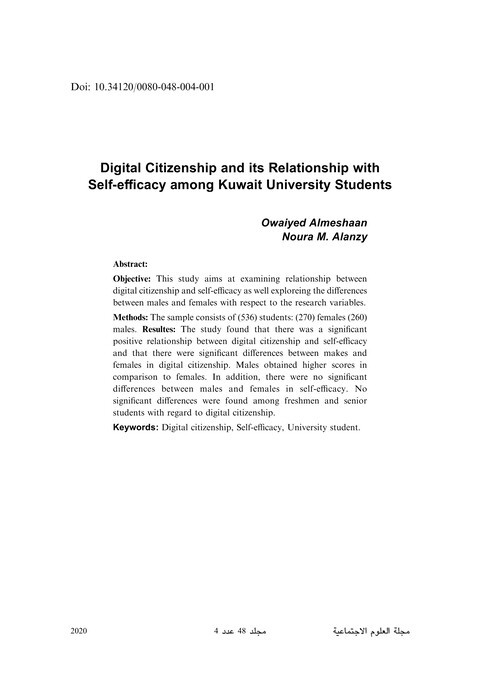 المواطنة الرقمية وعلاقتها بالكفاءة الذاتية لدى طلاب جامعة الكويت وطالباتها (مجلة العلوم الاجتماعية ;no.4, vol.48) Год публикации: 2020 Автор: Owaiyed Almeshaan | Noura Alanzy Организация-автор: Kuwait University تهدف هذه الدراسة إلى فحص العلاقة بين المواطنة الرقمية والكفاءة الذاتية، والكشف عن الفروق بين الذكور والإناث في متغيرات الدراسة. المنهجية: تكونت عينة الدراسة من (536)؛ بواقع (266) من الذكور و(270) من الإناث. النتائج: كشفت نتائج الدراسة عن أنه توجد علاقة موجبة بين المواطنة الرقمية والكفاءة الذاتية، كما توجد فروق دالة إحصائياً بين الذكور والإناث في المواطنة الرقمية؛ إذ إن متوسط الذكور أعلى من متوسط الإناث، بينما لا توجد فروق بينهما في الكفاءة الذاتية. كما لا توجد فروق دالة إحصائياً بين الذكور والإناث وفقاً للكلية والمرحلة الدراسية. Digital Citizenship and Its Relationship With Self-Efficacy Among Kuwait University Students (Journal of Social Sciences; vol.48, no.4) Год публикации: 2020 Автор: Owaiyed Almeshaan | Noura Alanzy Организация-автор: Kuwait University This study aims at examining relationship between digital citizenship and self-efficacy as well exploring the differences between males and females with respect to the research variables.Methods: The sample consists of (536) students: (270) females (260) males. Results: The study found that there was a significant positive relationship between digital citizenship and self-efficacy and that there were significant differences between males and females in digital citizenship. Males obtained higher scores in comparison to females. In addition, there were no significant differences between males and females in self-efficacy. No significant differences were found among freshmen and senior students with regard to digital citizenship.