
Ресурсы
Изучайте широкий спектр ценных ресурсов ВГГ, чтобы углубить своё понимание и повысить эффективность исследований, просветительской деятельности, преподавания и обучения.
Найдено: 88
 Construir ciudadanía desde las universidades, responsabilidad social universitaria y desafíos ante el siglo XXI Год публикации: 2011 Автор: Eduardo Gasca-Pliego | Julio César Olvera-García Организация-автор: Universidad Autónoma del Estado de México El presente ensayo aporta una reflexión respecto al rol que deben adquirir las universidades como agentes de transformación y consolidación del modelo democrático, principalmente ante al reto de construir ciudadanos completos, interesados por las necesidades del entorno físico y social, por la toma de decisiones colectivas, que se conciben a sí mismos como ciudadanos partícipes y no únicamente como votantes con miras a satisfacer sus propios intereses. Destaca el papel prioritario de la responsabilidad social universitaria que promueva la gestión social del conocimiento para todos los actores sociales, que tenga como finalidad la construcción de una ciudadanía informada, responsable y participativa, que responda ante la injusticia, la insostenibilidad, la violencia y la corrupción. Repensar la función social de la universidad pública requiere defender los valores propios de la educación pública, en el sentido de que todos los ciudadanos tengan la igualdad de oportunidades para desarrollar sus capacidades, eliminando obstáculos de carácter económico y social, así como los culturales y políticos que afectan e impiden ese desarrollo.
  Manuel d'apprentissage de la démocratie pour les jeunes en Tunisie Год публикации: 2011 Организация-автор: UNESCO Rabat The main aim of these manual and guide is to raise awareness among Tunisian youth about the values of democracy, human rights and responsible citizenship, and empower youth to make their voice heard during this critical period in the Tunisian democratic transition. دليل شباب تونس في تعلّم الديمقراطيّة Год публикации: 2011 Организация-автор: UNESCO Rabat The main aim of these manual and guide is to raise awareness among Tunisian youth about the values of democracy, human rights and responsible citizenship, and empower youth to make their voice heard during this critical period in the Tunisian democratic transition.
  Education for citizenship and democracy in a globalized world: a comparative perspective Год публикации: 2005 Организация-автор: Inter-American Development Bank The present document, Education for Citizenship and Democracy in a Globalized World: A Comparative Perspective, was developed in response to a request from the members of the Regional Policy Dialogue/Education Network. The studies in this document were presented and discussed during the VII Regional Policy Dialogue meeting held in January 2005 at the Inter-American Development Bank ’s headquarters in Washington, D.C. Within the general context of recent economic and political developments in Latin America and the Caribbean, experts regard free market and democracy as the fundamental economic and political paradigm leading to modernization and development in the global market. There is a concern in a number of democratic nation-states about levels of political engagement, particularly among the youths. This is cited as a reason for strengthening citizenship education.The studies presented in this document discuss Education for Citizenship and Democracy and the role of schools as systematic providers of the civic knowledge and the participatory practices that are the foundation of democracy. Among all of the institutions that facilitate the acquisition and development of skills for democratic participation, the school is the one that provide students with the competencies to effectively participate as citizens in a democracy. There has been an increasing interest in citizenship education both in the national and international contexts. At the national level, the aim is to pursue commitment and political participation, particularly from youth. In the international sphere, the objective is to find answers to the challenges such as immigration, global communications and trade across international borders and to a new level of awareness and appreciation for human rights. By providing a comprehensive overview of progress made by industrialized countries in the field of citizenship education, this study intents to share lessons learnt and effective practices which may be applied in the context of Latin America and the Caribbean. In addition, this study includes three experiences from Latin American countries (Chile, Colombia and Mexico) that were presented during the VII Regional Policy Dialogue. The three experiences show a practical and positive approach to the feasibility of introducing citizenship education in the schools of the Region. The cases present examples of reforms that evolved from the traditional civic education into an engaging education for citizenship and democracy. The Inter American Development Banks trusts that this publication will contribute to the discussions among member countries and create alternatives for the strengthening of democracy in the Region through education and citizenship. Education à la citoyenneté et de la démocratie dans un monde globalisé: une perspective comparative Год публикации: 2005 Организация-автор: Inter-American Development Bank Le présent document, Éducation à la Citoyenneté et la Démocratie dans un monde globalisé: une perspective comparative, a été développé en réponse à une demande des membres du Dialogue Politique Régionale / Réseau Education. Les études présentées dans ce document ont été présentés et discutés lors de la réunion de dialogue politique régionale VII tenue en Janvier 2005 au siège de l'Organisation interaméricaine de la Banque de développement à Washington, DC Dans le contexte général des développements économiques et politiques récents en Amérique latine et dans les Caraïbes , les experts considèrent le marché libre et la démocratie comme le paradigme économique et politique fondamentale qui a conduit à la modernisation et le développement sur le marché mondial. Il y a une préoccupation dans un certain nombre d'Etats-nations démocratiques sur les niveaux d'engagement politique, en particulier chez les jeunes. Elle est citée comme une raison pour le renforcement de l'éducation civique. Les études présentées dans ce document discutent éducation à la citoyenneté et la démocratie et le rôle des écoles en tant que prestataires systématiques des connaissances civiques et les pratiques participatives qui sont le fondement de la démocratie. Parmi toutes les institutions qui facilitent l'acquisition et le développement des compétences pour la participation démocratique, l'école est celle qui fournit aux étudiants les compétences nécessaires pour participer efficacement en tant que citoyens dans une démocratie. Il y a eu un intérêt croissant pour l'éducation à la citoyenneté à la fois dans les contextes nationaux et internationaux. Au niveau national, l'objectif est de poursuivre l'engagement et la participation politique, en particulier des jeunes. Sur le plan international, l'objectif est de trouver des réponses aux défis tels que l'immigration, les communications mondiales et le commerce à travers les frontières internationales et à un nouveau niveau de conscience et l'appréciation des droits de l'homme. En fournissant une vue d'ensemble des progrès réalisés par les pays industrialisés dans le domaine de l'éducation civique, cette étude des intentions de partager les leçons apprises et les pratiques efficaces qui peuvent être appliquées dans le contexte de l'Amérique latine et les Caraïbes. En outre, cette étude comprend trois expériences des pays d'Amérique latine (Chili, Colombie et Mexique) qui ont été présentées lors du Dialogue Politique Régionale VII. Les trois expériences montrent une approche pratique et positive à la possibilité d'introduire l'éducation à la citoyenneté dans les écoles de la région. Les cas présentent des exemples de réformes qui ont évolué à partir de l'éducation civique traditionnelle en une éducation engageante pour la citoyenneté et la démocratie. Les banques de développement américaines Inter veut croire que cette publication contribuera aux discussions entre les pays membres et de créer des solutions de rechange pour le renforcement de la démocratie dans la région par l'éducation et la citoyenneté.
  Higher Education and Democratic Culture: Citizenship, Human Rights and Civic Responsibility (Council of Europe Higher Education Series No.8) Год публикации: 2008 Автор: Josef Huber | Ira Harkavy Организация-автор: Council of Europe This book on the responsibility of higher education for a democratic culture is the 8th volume in the Council of Europe's Higher Education series. It is the direct result of a Higher Education Forum held in June 2006 on the responsibility of higher education for citizenship, human rights and sustainability. This forum was a part of the Council of Europe's long-standing commitment to work in the area of education for democratic citizenship and human rights. It complements earlier work on the public responsibility for higher education and research which led to a recommendation of the Committee of Minister to the member states of the Council of Europe in 2007. If our aim is to work for sustainable democratic societies, the responsibility of public authorities for a high-quality higher education system must go hand in hand with the responsibility of higher education institutions towards the advancement of society.
 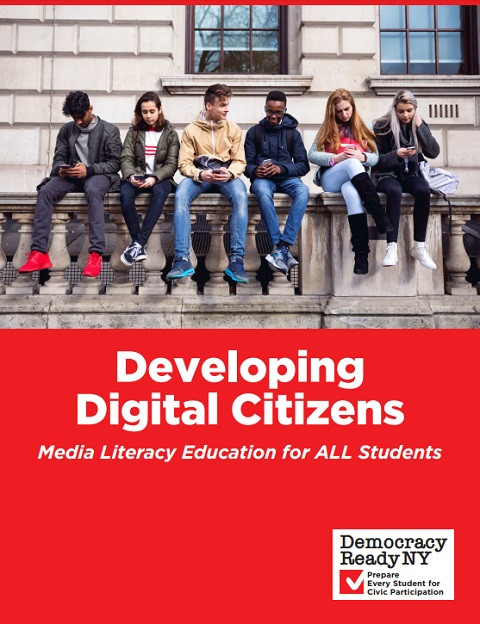 Developing Digital Citizens: Media Literacy Education for All Students Год публикации: 2020 Автор: Jessica R. Wolff | Ann LoBue | Michael A. Rebell Организация-автор: DemocracyReady NY Developing Digital Citizens: Media Literacy Education for All Students, a new report from DemocracyReady NY, calls for immediate and decisive steps to require media literacy education in schools throughout New York State. Stressing that “the internet has become the new public square,” it asserts that “to be democracy ready, all students must be media literate.”. The report defines what media literacy encompasses in an increasingly digital age, and establishes a clear framework to ensure that all students become media literate civic participants. This report includes recommendations for:Clear state standards for media literacy educationQualified personnel for teaching media literacySuitable MLE curricula and course offeringsUp-to-date facilities, instructional materials, and technologyTransparent monitoring and reporting of MLE resources and results.
  Learning-service and Citizenship Education Год публикации: 2011 Автор: Josep M.ª Puig Rovira | Mònica Gijón Casares | Xus Martín García | Laura Rubio Serrano Организация-автор: Universidad de Barcelona The aim of this article is to present the methodology of service learning as an especially significant contribution to citizenship education. Service learning is an activity that combines community service and curricular learning. It is an educational setup in which a circular link is formed between participation in services created to meet a community need and the learning of knowledge and values. The project presents an initiative for education in values and citizenship based on experience, participation and critique. Service learning is at the same time an excellent instrument for making education more inclusive and for helping students develop a set of basic skills that can only be acquired through a comprehensive, contextualized activity. Through service learning, students acquire a real, committed engagement with the search for the common good; this acquisition of commitment is a key formative mechanism in achieving a complete education for citizenship. The article begins by analyzing the different elements that make up citizenship education and the pedagogical means required for their acquisition. The concepts of ‘practice’ and ‘citizenship practice’ are the basis for proposing service learning as an ideal methodology for educating participative citizens who can contribute to the common good. The rest of the article is devoted to analyzing each of the constitutive aspects of service learning. This portion of the article begins by presenting a more-precise definition of ‘service learning’ and continues with an analysis of the components of service learning: social needs, the learning of contents and competences, community service, partnerships between institutions and the required networking. The article concludes by reviewing the different levels at which service learning has an impact and identifying and organizing the various personal acquisitions and institutional achievements that this type of educational activity provides. Aprendizaje-servicio y Educación para la Ciudadanía Год публикации: 2011 Автор: Josep M.ª Puig Rovira | Mònica Gijón Casares | Xus Martín García | Laura Rubio Serrano Организация-автор: Universidad de Barcelona El objetivo de este artículo es presentar la metodología del aprendizaje-servicio como una aportación especialmente relevante para la Educación para la Ciudadanía. El aprendizaje- servicio es una actividad que combina el servicio a la comunidad con el aprendizaje curricular. Es una propuesta educativa que vincula de una manera circular la participación en servicios pensados para satisfacer alguna necesidad de la comunidad y el aprendizaje de conocimientos y valores. Con ella, la educación en valores se pone en práctica de una manera participativa y crítica. Al mismo tiempo, también es un buen instrumento para hacer una educación más inclusiva y para desarrollar un conjunto de competencias básicas que solo pueden adquirirse a través de un trabajo global y contextualizado. Incorporar la intervención real y comprometida de los educandos en la búsqueda del bien común es un mecanismo formativo imprescindible para lograr una completa Educación para la Ciudadanía. Para lograr este objetivo, el escrito empieza analizando los distintos aprendizajes que supone la Educación para la Ciudadanía, así como los medios pedagógicos para alcanzarlos. Los conceptos de práctica y de práctica de ciudadanía permiten proponer el aprendizaje-servicio como una metodología idónea para lograr la formación de una ciudadanía participativa y capaz de contribuir al bien común. A continuación, se analizan los aspectos constitutivos del aprendizaje-servicio. Se presenta primero una aproximación más exacta a su definición y luego se desglosan sus componentes: las necesidades sociales, el aprendizaje de contenidos y competencias, el servicio a la comunidad, el partenariado entre instituciones y el trabajo en red que requiere. Al final del artículo se muestran los distintos niveles en los que impacta el aprendizaje-servicio, y se señalan y ordenan las distintas adquisiciones personales y logros institucionales que proporciona este tipo de actividad educativa.
  The Challenges to Build Citizenship: Media as a Platform for Dialogue Год публикации: 2010 Автор: Claudia Lagos Организация-автор: Universidad de Chile The OREALC / UNESCO Santiago and the UNESCO National Commission, the Regional Delegation for Cooperation in the Southern Cone and Brazil, the French Embassy in Chile, the Freedom of Expression Program of the Institute of Communication and Image of the University of Chile and the UNESCO Chair "Media and citizen participation" of the Universidad Diego Portales, commemorated the World Day for Press Freedom 2009 with the seminar "The challenges to build citizenship. Media as a platform for dialogue ", held on May 5, 2009 at the Central House of the University of Chile. The meeting, with national and international guests, made it possible to reflect on and discuss the main issues -although not the only ones- that are currently in the hands of issues related to the promotion of pluralism and diversity; the challenges for journalism and the media in a context of high technological renewal and economic crisis; the lines of work in the matter for the design and execution of public policies, and research in communication. This publication collects the presentations of the speakers during the Seminar, as well as leaves testimony of the commitments assumed by the presidential candidates that we hope will become an agenda not only for the 2010-2014 administration, but also for the political sectors that represent each one of those who signed the document.