
Ресурсы
Изучайте широкий спектр ценных ресурсов ВГГ, чтобы углубить своё понимание и повысить эффективность исследований, просветительской деятельности, преподавания и обучения.
Найдено: 88
 Strengthening Democracy Is the Key to Preventing Far-Right Extremism Год публикации: 2021 Автор: Cynthia Miller-Idriss This article emphasizes that Disinformation, misinformation and propaganda undermine democratic practices in ways that should be fought not only by trying to shrink or contain the extremist fringe, but also by strengthening democratic values and practices within the mainstream.And also highlights that It is critical to engage proactively and consistently in order to prevent further escalations in far-right extremism and interrupt violent radicalisation at early stages.
  “Can Education Transform Our World?: Global Citizenship Education and the UN’s 2030 Agenda for Sustainable Development” Год публикации: 2020 Автор: Joel Westheimer Организация-автор: Brill This book chapter is taken from the book Grading Goal Four: Tensions, Threats, and Opportunities in the Sustainable Development Goal on Quality Education, which aims to support the immplementation of Sustainable Development Goal 4 by exploreing various tensions, threats, and opportunities. This chapter specifically focuses on the role of eucation in fostering global citizenship and how educational systems and policies can be improved to facilitate creating a sustainable society and contribute to the 2030 SDG Agenda.
  Democracy in the Educational Institution: Between the Qualification of Schooling and the Rooting of Training Год публикации: 2017 Автор: Abdel Karim Belhadj | Abd al-Ilah Shrayat Организация-автор: Supreme Council for Education, Training, and Scientific Research This paper discusses the relationship between school and democracy. It shows the intersection between them. Then the paper turns on how to educate for democracy. The paper concludes with a vision for global citizenship education. الديمقراطية بالمؤسسة التعليمية : بين تأهيل التمدرس وتأصيل التمرس Год публикации: 2017 Автор: Abdel Karim Belhadj | Abd al-Ilah Shrayat Организация-автор: Supreme Council for Education, Training, and Scientific Research تناقش الورقة العلاقة بين المدرسة والديمقراطية. وتوضح التقاطع بينهما. ثم تعرج الورقة علي كيفية التربية من أجل الديمقراطية. تنتهي الورقة بوضع تصور للتربية من أجل المواطنة العالمية.
  Strengthening Democracy With a Modern Civics Education Год публикации: 2019 Автор: Ashley Jeffrey | Scott Sargrad Организация-автор: Center for American Progress This report aims to examine the state of civic education and look deeper at promising approaches to increase civic engagement. It provides an updated state-by-state analysis of civics education requirements and civic engagement measures.
 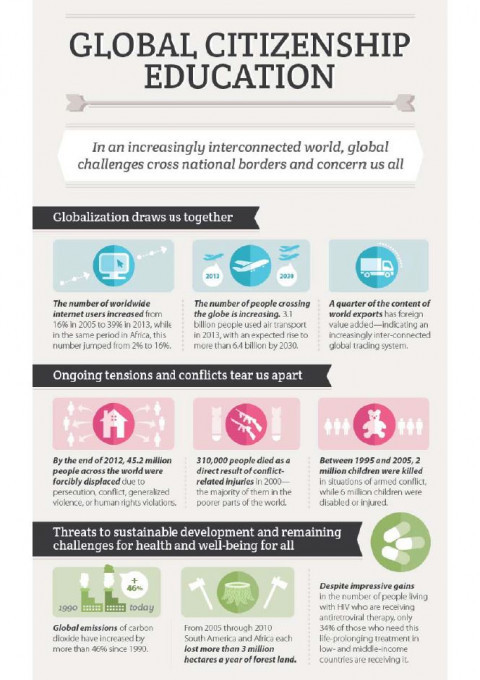 Global Citizenship Education infographic Год публикации: 2014 Организация-автор: UNESCO In an increasingly interconnected world, global challenges cross national borders and concern us all. With issues like these threatening human and environmental well-being, we need to re-think the role and relevance of education. We need Global Citizenship Education. Global Citizenship Education is transformative. What are the barriers to this kind of education? What needs to change in education? What is UNESCO doing? What can you do?
  Civic education for media professionals: a training manual Год публикации: 2009 Автор: Fackson Banda Организация-автор: UNESCO Civic awareness enables both media practitioners and users to appreciate the role of journalism and media in building democratic societies. This manual serves as a resource for journalism students and media professionals in developing countries, providing them with essential knowledge for the analysis of the relationship between media functions and active citizenship, and the underlying nexus of democracy, development and the media based on the fundamental principles of democracy and human rights that lie at the heart of UNESCO’s mandate. For the purpose of this manual, civic education refers to the cultivation of civic knowledge, civic skills and civic virtues. Civic knowledge consists of fundamental ideas and information that learners must know and use to become effective and responsible citizens in a democracy. Civic skills include the intellectual skills needed to understand, explain, compare, and evaluate principles and practices of government and citizenship. They also include participatory skills that enable citizens to monitor and influence public policies. Civic virtues include the traits of character, dispositions, and commitments necessary for the preservation and improvement of democratic governance and citizenship. Examples of civic virtues are respect for the worth and dignity of each person, civility, integrity, self-discipline, tolerance, and compassion. Commitments include a dedication to human rights, the common good, equality and the rule of law. L'éducation civique pour les professionnels des médias: un manuel de formation Год публикации: 2009 Автор: Fackson Banda Организация-автор: UNESCO La conscience civique permet aux deux professionnels des médias et aux utilisateurs d'apprécier le rôle du journalisme et des médias dans l'édification de sociétés démocratiques. Ce manuel sert de ressource pour les étudiants en journalisme et les professionnels des médias dans les pays en développement, en leur fournissant des connaissances essentielles pour l'analyse de la relation entre les fonctions des médias et la citoyenneté active, et le lien sous-jacent de la démocratie, le développement et les médias sur la base des principes fondamentaux de la démocratie et des droits humains qui sont au cœur du mandat de l'UNESCO. Aux fins de ce manuel, l'éducation civique fait référence à la culture des connaissances civiques, les compétences civiques et les vertus civiques. la connaissance civique se compose d'idées fondamentales et de l'information que les apprenants doivent connaître et utiliser pour devenir des citoyens efficaces et responsables dans une démocratie. compétences civiques comprennent les compétences intellectuelles nécessaires pour comprendre, expliquer, comparer et évaluer les principes et les pratiques du gouvernement et de la citoyenneté. Ils comprennent également les compétences participatives qui permettent aux citoyens de suivre et d'influencer les politiques publiques. vertus civiques comprennent les traits de caractère, les dispositions et les engagements nécessaires à la préservation et l'amélioration de la gouvernance démocratique et de la citoyenneté. Des exemples de vertus civiques sont le respect de la valeur et la dignité de chaque personne, la civilité, l'intégrité, l'auto-discipline, la tolérance et la compassion. Les engagements comprennent un attachement aux droits de l'homme, le bien commun, l'égalité et la primauté du droit.
  인권과 민주주의, 평화를 위한 교육 활동 선언과 통합 프레임워크 Год публикации: 1995 Организация-автор: 유네스코 본 문서는 1995년 11월 파리, 제 28회 유네스코 총회에서 승인된, 교육에 관한 제 44차 국제회의선언 문서이다. (1994년 10월, 제네바)
  إعلان وإطار العمل المتكامل بشأن التربية من أجل السلام وحقوق الإنسان والديمقراطية Год публикации: 1995 Организация-автор: UNESCO This document is Declaration of the 44th session of the International Conference on Education (Geneva, October 1994) endorsed by the General Conference Declaration of the 44th session of the International Conference on Education (Geneva, October 1994) endorsed by the General Conference of UNESCO at its twenty-eight session Paris, November 1995 of UNESCO at its twenty-eight session Paris, November 1995.