
Ресурсы
Изучайте широкий спектр ценных ресурсов ВГГ, чтобы углубить своё понимание и повысить эффективность исследований, просветительской деятельности, преподавания и обучения.
Найдено: 7
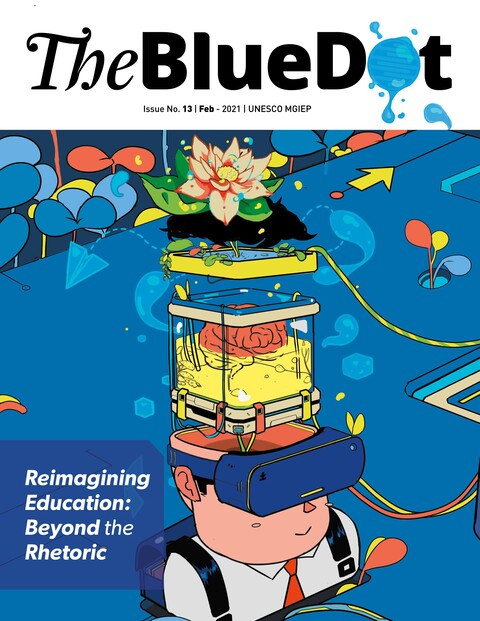 Reimagining Education: Beyond the Rhetoric (The Blue Dot; No.13, 2021) Год публикации: 2021 Организация-автор: Mahatma Gandhi Institute of Education for Peace and Sustainable Development (MGIEP) The events of the year 2020, driven predominantly by the COVID-19 pandemic, have forced governments, policymakers, educators and organisations to rethink the purpose, structure and modality of existing education systems. Even while the world is struggling with climate change, decreased empathy, violent extremism, xenophobia and an increase in mental health issues in children, with a recent report by WHO highlighting that 800,000 people between the ages of 15-29 are dying by suicide ever year, globally1 , the COVID-19 virus singlehandedly shut down access to face-to-face school education for roughly half of the world’s student population. These ongoing and unexpected challenges bring to light the urgent need for education systems to be more adaptable, responsive, and resilient to future shocks and disasters. We can work to transform education in many ways, such as by translating our understanding of how the brain learns from the research laboratory to the classroom and leveraging the power of technology to ensure that learning can reach every child who hungers to learn. It is time we reimagine education to ensure learning continues with minimal disruption but also empowers students as compassionate human beings, prepared for an unpredictable future, but also as global citizens seeking a peaceful and kinder world. The purpose of education needs to change from being instrumental (based on human capital) to one that is constitutive (human-flourishing), accessible to all and structured such that learning can happen anytime and anywhere and always.
  The Impact of AI on Curriculum Systems: Towards an Orbit-Shifting Dialogue (In-Progress Reflection; no. 32, 2019) Год публикации: 2019 Организация-автор: UNESCO International Bureau of Education (IBE) ‘Artificial Intelligence’ (AI) refers to the theory and development of computer systems able to perform tasks normally requiring human intelligence. In order to achieve transformational change in contemporary curriculum systems and learning environments, we need to engender an orbitshifting dialogue about the potential relationship between AI and education, in terms of both independent variables (threats), and dependent variables (opportunities). Through such a dialogue, we need to create foresight indicators that can predict the process of this relationship. It is, however, crucial that the relationship between AI and education is strong and directly proportionate. If the potential of the relationship is not exploited sufficiently, then underdeveloped education systems will lag behind and fail to achieve their potential for transformation, whether radical or incremental. Indeed, some may even become obsolete. The paper contends that in order to effectively contribute to the knowledge economy and to sustainable development in the age of the 4th Industrial Revolution (characterized by a fusion of cyber-physical technologies) modern educational systems need to overcome obstacles to innovation in order to maximize the potential for transformative change. To achieve this will require an ‘orbital shift’ in educational planning, practice and resourcing, to enable schools to respond more effectively to the rapidly changing needs of young people, society, the economy and environment in the third decade of the 21st century. Schools, educational institutions and environments, need to transform from being primarily spaces for teaching and taking exams, into spaces for innovation and personal learning, based on a culture of actively listening to the voices, choices, needs and goals of learners. Teachers need to become facilitators, coaches and mentors for learners. Schools need to create AI-enabled, flexible, collaborative working spaces. Visionary, energetic educational leaders need to communicate effectively with all stakeholders, including employers and parents, to inspire and manage change and smart decision-making to develop schools of the future. The aim of this reflection is to initiate an ‘orbit-shifting’ dialogue about the potential of AI applications to transform all components of the curriculum system to meet emergent 21st century educational goals. The conceptualization aims to explore the variable roles and impact of curriculum learning and assessment on these emerging educational goals. Theme 1 of the paper outlines the concepts and characteristics of a range of existing AI systems and their potential to enhance teaching learning and assessment. Theme 2 reflects on the potential to embrace AI systems across the curriculum system. Theme 3 proposes an action model to enable AI to have an ‘orbit shifting impact’ on all the components of the curriculum system (i.e. learners, teachers, learning environments, leadership and management, content, pedagogy and assessment) by enhancing opportunities for individualization, creativity and uniqueness.
 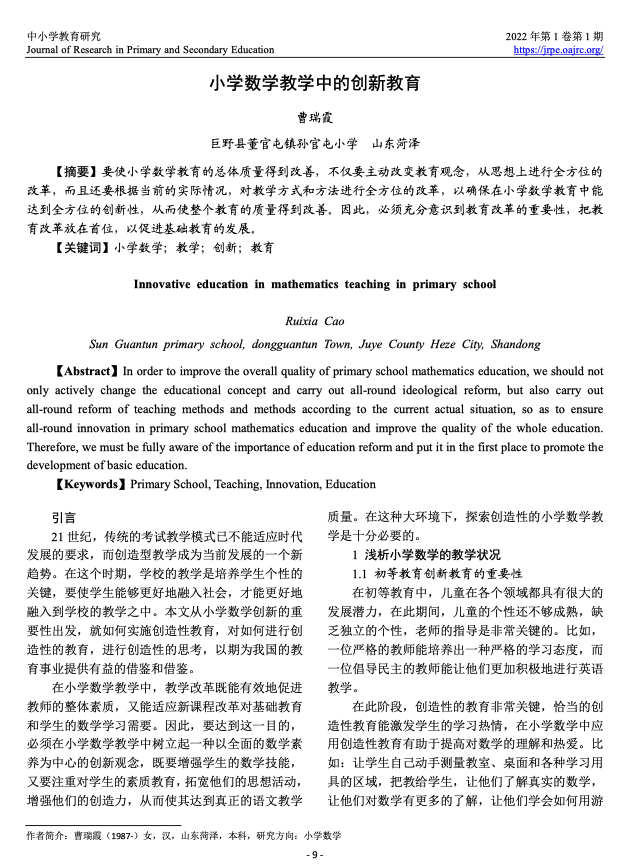 小学数学教学中的创新教育 Год публикации: 2022 Автор: 曹瑞霞 要使小学数学教育的总体质量得到改善,不仅要主动改变教育观念,从思想上进行全方位的改革,而且还要根据当前的实际情况,对教学方式和方法进行全方位的改革,以确保在小学数学教育中能达到全方位的创新性,从而使整个教育的质量得到改善。因此,必须充分意识到教育改革的重要性,把教育改革放在首位,以促进基础教育的发展。
 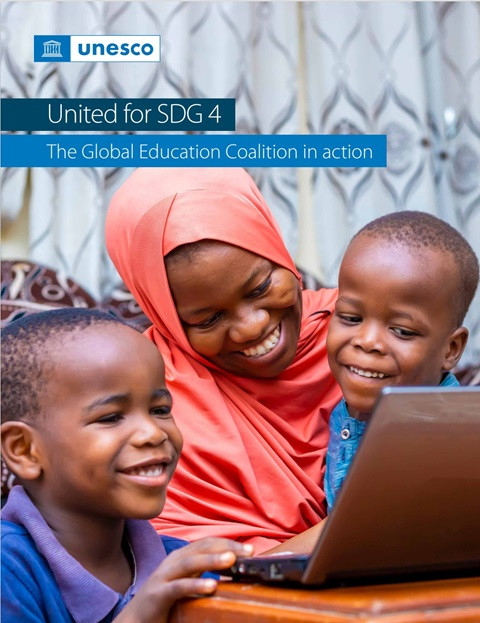 United for SDG 4: The Global Education Coalition in Action Год публикации: 2024 Организация-автор: UNESCO The Global Education Coalition, launched by UNESCO, is a platform for collaboration and exchange to protect the right to education and serves as a transformative accelerator towards SDG 4. This progress report of the Coalition builds on documents published in September 2020, March 2021, and March 2023 and covers activity between March 2023 and March 2024. Four years in and moving into its fifth, the Coalition works together to ensure all learners are empowered equally in and through education.
 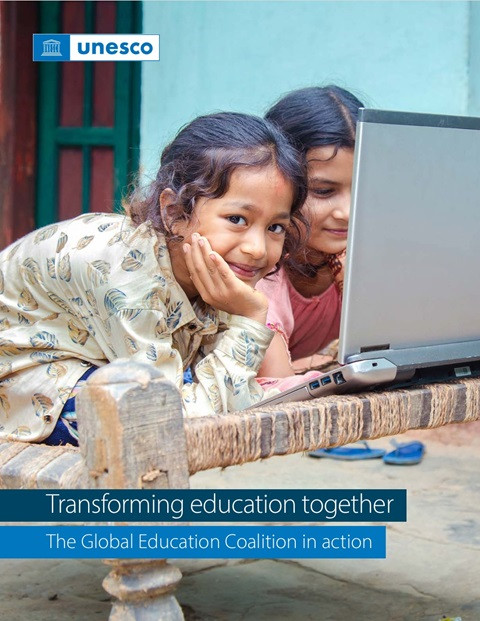 Transforming Education Together: The Global Education Coalition in Action Год публикации: 2023 Организация-автор: UNESCO The Global Education Coalition, launched by UNESCO, is a platform for col-laboration and exchange to protect the right to education during this unprec-edented disruption and beyond. This is the fourth progress report of the Coalition and builds on the inaugural document released in September 2020 and the first annual report published in March 2021. This document covers activity between November 2021 and March 2023.
  The Tasks for Future Education through the Analysis of Educational Innovation Cases Год публикации: 2019 Автор: Eunhee Hwang | Sujin Choi | Jongheon Lim | Heejin Park | Jaeduck Lee | Sungki Kim | Giljae Lee | Hunho Kim | Ammi Jang Организация-автор: Korean Educational Development Institute (KEDI) It is predicted that the future society will be low populated of the school-age but high populated of the elderly, intelligent information centered, and multicultural society. According to these changes of the society, it is time for education to shift to preparing for a future education system rather than growth from competition. Based on this perspectives, this study aims to explore the tasks of the future education by analyzing domestic and international cases of educational innovations. Specifically, this study suggests several practical tasks that general high schools can implement for the future education, analyzing the selected cases contributed to the educational innovation. This is because the cases of educational innovation are the stepping stones for general high school to move forward to the future education, although the cases are not perfect examples. 교육 혁신 사례 분석을 통한 미래교육 실천 과제 Год публикации: 2019 Автор: 최수진 | 임종헌 | 박희진 | 이재덕 | 김성기 | 이길재 | 김훈호 | 장암미 Организация-автор: 한국교육개발원 미래사회의 특징으로 학생 수 감소 및 고령화, 지능정보사회, 다문화 사회 등이 언급되고 있다. 이러한 미래사회의 변화에 따라 우리나라의 교육도 경쟁을 통한 성장보다는 미래를 대비하는 체제로 전환해야 할 시점에 놓여있다. 이 연구는 국내・외에서 이루어진 교육 혁신의 사례를 통해 미래교육의 실천 과제를 탐색하기 위한 것이다. 미래교육의 수준이나 내용은 미래의 범위를 어디로 설정하는가에 따라 다양할 수 있다. 이 연구에서는 일반 고등학교의 실천 가능성에 중요성을 두고 현재 완벽한 미래교육 시스템을 구축하고 있다고는 할 수 없지만 현재의 일반학교보다 한 발 앞서 미래교육을 준비하며 다양한 시행착오를 거쳐 성과를 거두고 있는 교육 혁신의 사례를 현재의 학교교육과 미래의 학교교육의 연결고리로 보고, 이들 사례에서 도출된 미래교육 실천 과제를 현재 학교들이 미래교육의 방향을 향해 나아가야할 실천 과제로 제안하였다.