
Ресурсы
Изучайте широкий спектр ценных ресурсов ВГГ, чтобы углубить своё понимание и повысить эффективность исследований, просветительской деятельности, преподавания и обучения.
Найдено: 123
 The Impact of Holocaust education: how to assess policies and practices? International Seminar, 27 January 2014, UNESCO, Paris; Report Год публикации: 2014 Организация-автор: UNESCO International Bureau of Education (IBE) | Georg Eckert Institute for International Textbook Research (Germany) | Hungary. Permanent Delegation to UNESCO UNESCO, which is charged with “promoting awareness of Holocaust remembrance through education” by resolution 34 C/61 of its General Conference, marked the International Day of Commemoration in Memory of Victims of the Holocaust on 27 January 2014 by convening an international seminar for members of the global community who are involved with and committed to this mandate. The event, titled “The Impact of Holocaust Education: How to Assess Policies and Practices”, aimed at highlighting current practices and debates in the field of research in Holocaust education. It was organized in partnership between UNESCO, including its International Bureau of Education, and the Georg Eckert Institute for International Textbook Studies with the support of the Delegation of Hungary to UNESCO.
  The 1994 Genocide as Taught in Rwanda’s Classrooms Год публикации: 2017 This blog looks at how textbook and curricula reforms in Rwanda have worked to cover the 1994 Genocide and instill the ideals of tolerance, unity and reconciliation in students. It is part of a series of blogs on this site published to encourage debates around a new GEM Report Policy Paper: Between the Lines, which looks at the content of textbooks and how it reflects some of the key concepts in Target 4.7 in the UN Sustainable Development Goals (SDGs).by Jean-Damascene Gasanabo, PhD, Director-General, Research and Documentation Center on Genocide, National Commission for the Fight against Genocide (CNLG), Kigali, Rwanda. The 1994 Genocide against the Tutsi saw the slaughter of more than one million people over the span of three months, and placed Rwanda at the forefront of the world’s political consciousness. Almost 23 years later, Rwanda has rebuilt and become a modern hub of progress and development, putting in place social, political and economic systems that are grounded in national unity and reconciliation – with education reforms playing a central role.The large-scale participation of children and adolescents in perpetrating acts of genocide made it clear that an education system that fails to integrate basic human values, will also inevitably fail the nation. Education was used prior to the Genocide to inculcate fear, intolerance and hatred; and so too is it being utilized by the current Government to foster peace and inclusivity, and combat genocide ideology. Post-genocide Rwanda has used education as a main tool to correct biased perceptions of its socio-political history, and to provide accurate representations of the root causes of the genocide, and preventative measures.With over 60% of Rwandans under the age of 24, the formal education system needs to instill the ideals of tolerance, unity and reconciliation in the next generation. With this realization, the Rwanda Education Board and the Ministry of Education have integrated genocide studies in the curricula of its primary, secondary and higher education institutions so that they are better able to lead a nation that is cognizant of its past. Instead of highlighting difference, the national curriculum of post-genocide Rwanda has been reconfigured to emphasize the politics of inclusion and to encourage a spirit of critical thinking that pursues peace, social cohesion and harmony above all else.Prior to the Genocide, educational resources were used as a tool by the genocidal regime to promote ethnic division, discrimination and propaganda. The biased curricula and teaching methods cemented ethnic segregation within classrooms and fostered genocide ideology. The students who were not expelled from primary and secondary school due to the ethnic and regional quota system were forced to identify themselves as being Tutsi – inherently separate to those who were Hutu or Twa. The pre-1994 curriculum lacked “the essentials of human emotion, attitudes, values and skills” as it continued to promote discriminatory and divisive ideologies that were “imparted through formalized rote learning in history, civic education, religious and moral education and languages.”Post-Genocide Rwanda faced the herculean task of rebuilding its dismantled institutions. With a profound lack of qualified teachers, a huge pool of orphaned children, insufficient funds and inaccurate textbooks following the genocide, many education challenges lay ahead. In early 1995, a moratorium was placed on history textbooks which disseminated biased information, as the country grappled with how and to what extent the nation’s past could be incorporated constructively in the education system, without causing pain or resurfacing conflicts.Rwanda chose a gradual, yet comprehensive, approach. In the years immediately following the Genocide, the history curriculum lightly touched on the subject so as to protect students from their recent past, and prevent division in classrooms based on differing family experiences. Classrooms promoted knowledge based on the essential ideas of unity, peace, tolerance and justice. In 2008 the National Curriculum Development Centre within the Ministry of Education published the new history curriculum which incorporated the Genocide against the Tutsi, coinciding with the renewed emphasis on the unifying and inclusive qualities of nationality, citizenship and patriotism, instead of ethnicity.The current national curriculum was formulated by the Rwanda Education Board in conjunction with varying public institutions, UN agencies and nongovernmental organizations. It incorporates the Genocide into the curriculum of every grade level, and discusses it in various contexts suited to the student’s particular stage in learning. Eyewitness accounts and the presence of elders in the classroom allow for a “multi-generational opportunity” for learning. In understanding how violent conflict erupts in society, it is possible to prevent future atrocities from beginning. Teaching the Genocide in present-day Rwanda aims to provide a more nuanced understanding of the event by using primary sources, encouraging class discussions on genocide denial, the persistence of genocide ideology, and the reconciliation efforts embarked on after the Genocide.Moreover, this change in the curriculum has been supplemented by a shift to transform learning from one based on standard rote memorization to one that encourages discussion and a spirit of critical thinking and analysis. This approach identifies the student as an active participant in the learning experience, not merely a silent recipient of history as “evangelical speech.” By promoting an environment that encourages spirited, objective discussions, the Ministry of Education seeks to redress the biases taught by the genocidal regime, as well as prepare young people to thoughtfully and constructively enter the workforce.Genocide education nevertheless faces some challenges ahead. With genocide denial still present, not only are ongoing revisions of educational resources required, but teacher training is also necessary to ensure that revisions to the curriculum are well presented by teachers.The way conflict and genocide has been taught through textbooks in Rwanda has evolved over time. For Rwandans, learning about the 1994 Genocide is not only vital in understanding the history of their country, but also in developing critical thinking skills that help young people become informed citizens in today’s globalized society. Peace education, as well as tools for conflict resolution and genocide prevention, are now heavily featured. Indeed the initiatives embarked on by the education sector signal a promising start to the continuous pursuit of truth through knowledge of the past.In comprehensively integrating the study of genocide into the national curriculum and by empowering students to become agents of their own learning process, Rwanda offers an ambitious recipe for successfully teaching one’s own history for the better.
 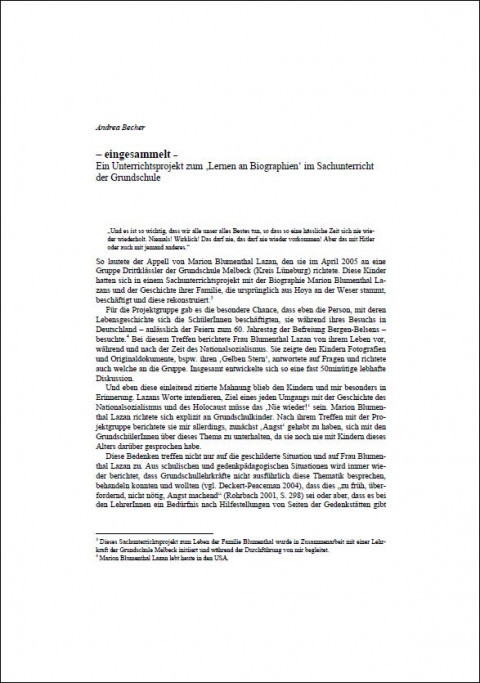 Collected: Educational Project about “Learning from Biographies” in General Sciences in Primary School Год публикации: 2006 Автор: A. Becher Original Title: Eingesammelt: Ein Unterrichtsprojekt zum‚ “Lernen an Biographien” im Sachunterricht der Grundschule(In D. Pech, M. Rauterberg, & K. Stocklas, (Eds.). Möglichkeiten und Relevanz der Auseinandersetzung mit dem Holocaust im Sachunterricht der Grundschule, Supplement 3, pp. 17–34) The article presents a project aimed at developing suitable methods for Holocaust Education already in the German primary school. Based on Ido Abram’s three-step-program as well as Wolfgang Klafki’s critical didactics, the project has developed a biographical approach to create possibilities for identification among the students. This is tested in a 3rd grade class and is thereafter evaluated.The above abstract is taken from the International Holocaust Remembrance Alliance Education Research Project. Please also consult the full list of abstracts in 15 languages and the accompanying publication Research in Teaching and Learning about the Holocaust: A Dialogue Beyond Borders. Ed: IHRA, Monique Eckmann, Doyle Stevick, Jolanta Ambrosewicz-Jacobs, 2017, Metropol Verlag at www.holocaustremembrance.com/resources/publications.
  La Enseñanza del Holocausto en América Latina: los desafíos para los educadores y legisladores Год публикации: 2017 Организация-автор: UNESCO Santiago La Enseñanza del Holocausto en América Latina: los desafíos para los educadores y legisladores
 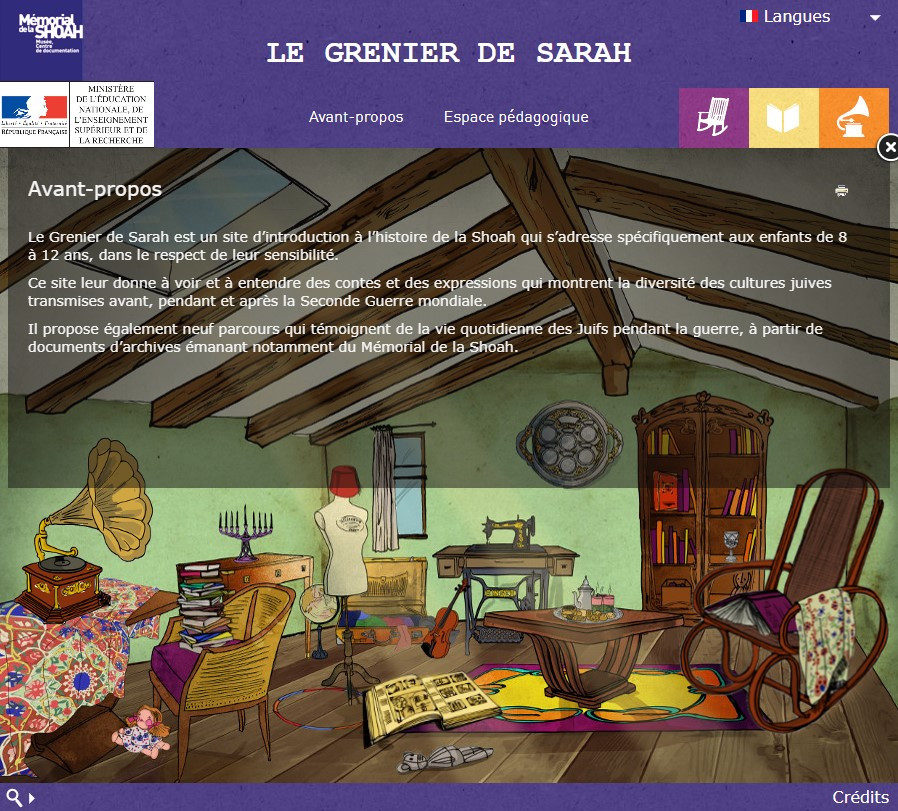 Le grenier de Sarah Автор: Jacques Fredj | Barbara Mellul | Adeline Salmon | Barbara Mellul | Adeline Salmon | Tralalère | Alliance concept | Judith Panijel | Alban Perrin | Iannis Roder Lior Lalieu-Smadja | Karen Taieb | Ariel Sion Организация-автор: Memorial de la Shoah Le Grenier de Sarah est un site d’introduction à l’histoire de la Shoah, créé spécifiquement pour les enfants de 8 à 12 ans, dans le respect de la sensibilité des jeunes visiteurs. Les choix éditoriaux et iconographiques du site traduisent scrupuleusement cette volonté de ne pas les choquer. Le site a été conçu à partir du questionnement des enfants sur cette période.- Qui étaient ces personnes que les nazis ont voulu assassiner ?- Dans quels pays vivaient-elles ? Quelles langues parlaient-elles ?- Quels ont été les parcours propres à chacune d’entre-elles ?Le Grenier de Sarah permet aux enfants de naviguer sur le site de façon autonome. Toutefois, il est conseillé aux adultes de les accompagner lors de leur première visite afin d’instaurer un dialogue et de répondre à d’éventuelles questions.Pour y répondre, trois rubriques, « Il était une fois », « Des mots à l’oreille » et « En noir et blanc », donnent des clefs de compréhension.- Dans « Il était une fois », des contes donnent un aperçu de la diversité des cultures juives. - Dans « Des mots à l’oreille », des expressions en hébreu, yiddish, judéo-espagnol et judéo-arabe ouvrent une fenêtre sur la pluralité du judaïsme. - Dans « En noir en blanc », neuf parcours témoignent de la vie quotidienne des Juifs pendant la guerre. En cliquant sur l’album photo, l’enfant choisit d’entendre un des récits de vie proposés.Tout au long de chaque parcours, des définitions et des documents, sont à la disposition du jeune visiteur. Pour les enseignants, un espace pédagogique spécifique a été créé afin d’y trouver des ressources complémentaires et des pistes de travail. Sarah’s attic is a website introducing to the Shoah History. It was specifically created for children from age 8 to 12 and respects their sensibility as young visitors. The contents and iconography are carefully intended to suit their emotional and cognitive abilities.The website was designed and elaborated from questions asked by children in History classes teaching this time period - Who were these persons the Nazis wanted to murder?- In which countries did they live? Which languages did they speak?- What were their personal experiences? Sarah’s attic enables children to navigate through the website on their own. Nevertheless, we recommend that adults accompany them on their first visit in order to create a dialog and answer possible questions.As part of a school or extra-curricular framework, this program can be used in small groups with the guidance of an adult.In order to answer these questions, three sections “Once upon a time”, “Words to my ear” and “In black and white” give keys to understanding the event.- In “Once upon a time”, tales give a glimpse of the diversity of Jewish cultures. - In “Words to my ear”, expressions in Hebrew, Yiddish, Judeo-Spanish and Judeo-Arabic open a window on the pluralism of Judaism. - In “In Black and white”, nine personal itineraries bear witness of the daily life of Jews during the war. Along each personal story, definitions and documents are available to the young visitor.For teachers and educators, a specific educational section contains additional resources, guidelines and teaching materials.
 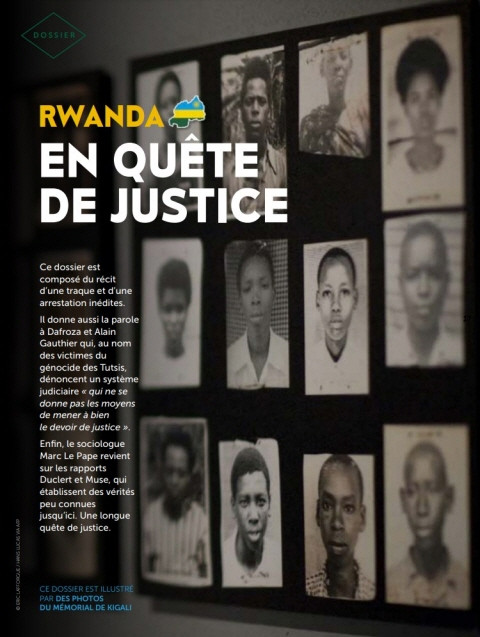 Rwanda: In Search of Justice(Humains; no.30) Год публикации: 2024 Организация-автор: Action by Christians for the Abolition of Torture (ACAT France) On the thirtieth anniversary of the genocide of the Tutsis in Rwanda, ACAT-France looks back at this tragic event for human rights. Discover the dossier in the magazine Humains #32 devoted to this subject. Rwanda: En quête de justice (Humains; n° 30) Год публикации: 2024 Организация-автор: Action by Christians for the Abolition of Torture (ACAT France) À l’occasion du trentième anniversaire du génocide des Tutsis au Rwanda, l’ACAT-France revient sur cet événement tragique pour les droits de l’Homme. Découvrez le dossier de la revue Humains #32 consacré à ce sujet.
  Genocide Timeline Год публикации: 2024 Организация-автор: United States Holocaust Memorial Museum (USHMM) This timeline proposed by the United States Holocaust Memorial Museum shows the major conceptual and legal advances in the evolution of the term "genocide" . It does not seek to detail every case that could be considered genocide, but to show how the term has entered the political, legal and ethical vocabulary from 1900 to 2016 to express threats of violence against groups. Chronologie du génocide Год публикации: 2024 Организация-автор: United States Holocaust Memorial Museum (USHMM) Cette chronologie proposée par le Musée du mémorial américain sur la Shoah montre les avancées conceptuelles et juridiques majeures dans l’évolution du terme « génocide » . Elle ne cherche pas à détailler tous les cas pouvant être considérés comme des génocides, mais à montrer comment le terme a intégré le vocabulaire politique, juridique et éthique de 1900 à 2016 pour exprimer les menaces de violences contre des groupes.
 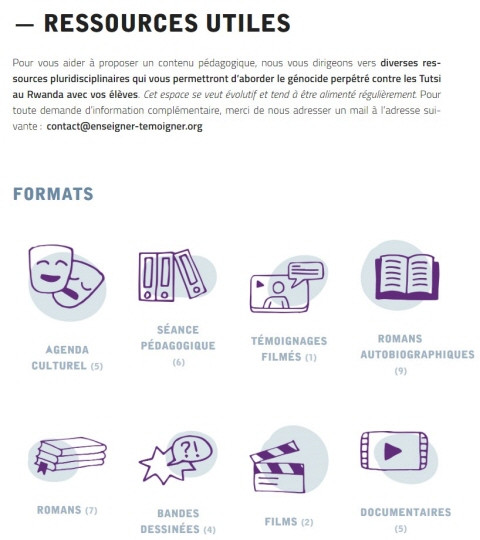 Enseigner Témoigner Год публикации: 2024 Организация-автор: Ligue de l'enseignement, Fédération de Paris & Ibuka France En 1994, environ 1 million de Tutsi ont été tués au Rwanda. Le génocide perpétré contre les Tutsi au Rwanda constitue l’une des principales tueries du XXème siècle. Elle a été rendue possible par l’action d’extrémistes qui ont, pendant des années, attisé la haine anti-tutsi au sein de la population rwandaise à coup de préjugés, de fausses informations, d’accusations en miroir, de stratégie de manipulation et de conditionnement des esprits à la peur, à la haine et à la violence meurtrière.Avec l’inscription récente de son enseignement dans les programmes scolaires, de plus en plus d’enseignants travaillent avec leurs élèves sur cet événement majeur de l’histoire du XXème siècle. Parallèlement, des rescapés ressentent le besoin de témoigner pour partager leur histoire avec la jeune génération et prévenir ainsi les mécanismes qui ont rendu ce drame possible. Dans ce contexte, l’association Ibuka France et la Ligue de l’enseignement engagent une action commune pour proposer un accompagnement dans l’organisation et la gestion pédagogique d’une rencontre avec un témoin-rescapé en classe. Cet accompagnement vise à créer un cadre à la fois utile et sécurisant pour l’ensemble des acteurs engagés et impactés par le témoignage en classe. In 1994, around 1 million Tutsis were killed in Rwanda. The genocide perpetrated against the Tutsis in Rwanda is one of the major killings of the twentieth century. It was made possible by the actions of extremists who, for years, stirred up anti-Tutsi hatred among the Rwandan population by means of prejudice, false informations, mirror-image accusations, a strategy of manipulation and the conditioning of minds to fear, hatred and murderous violence.With the recent inclusion of the subject in school curricula, more and more teachers are working with their pupils on this major event in the history of the 20th century. At the same time, survivors are feeling the need to share their stories with the younger generation and prevent the mechanisms that made this tragedy possible. Against this backdrop, Ibuka France and the Ligue de l'enseignement have joined forces to offer support in organising and managing a meeting with a survivor-witness in the classroom. The aim of this support is to create a framework that is both useful and reassuring for all those involved and affected by the testimonial in the classroom.