
Ресурсы
Изучайте широкий спектр ценных ресурсов ВГГ, чтобы углубить своё понимание и повысить эффективность исследований, просветительской деятельности, преподавания и обучения.
Найдено: 276
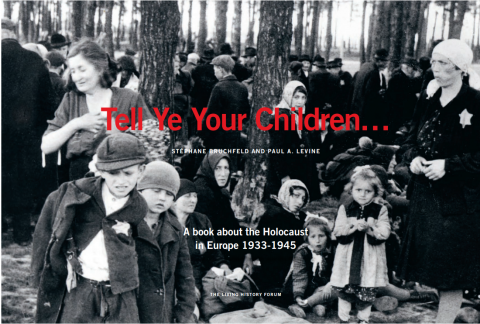 Dites-le à vos enfants - Un livre sur l'Holocauste en Europe 1933-1945 Год публикации: 2012 Автор: Stephane Bruchfeld, Paul. A. Levine Ce livre est publié par le Forum d'histoire vivante. Cette autorité publique suédoise utilise l'enseignement de l'Holocauste et d'autres crimes contre l'humanité pour promouvoir la tolérance, la démocratie et les droits de l'homme. Ce livret couvre la montée du national-socialisme jusqu'à la fin de la guerre, fournissant des faits et de l'information pour encourager les discussions.
  Learning the lessons of the Holocaust? A critical consideration of the antiracist and citizenship potential of Holocaust education in English secondary schools Год публикации: 2010 Автор: Alice Pettigrew In this paper I draw upon data collected as part of a national study of current practice in Holocaust education within English secondary schools. The paper emphasises the importance placed by teachers from a variety of subject backgrounds upon study of the Holocaust as an opportunity to explore citizenship related and antiracist concerns. However, the paper also identifies and discusses a number of potential challenges and possible limitations apparent in this approach. (By the author) Tirer les leçons de l'Holocauste? Un examen critique du racisme et de la citoyenneté potentiel anti enseignement de l'Holocauste dans les écoles secondaires anglaises Год публикации: 2010 Автор: Alice Pettigrew Dans cet article, je dessine sur les données recueillies dans le cadre d'une étude nationale de la pratique actuelle dans l'enseignement de l'Holocauste dans les écoles secondaires anglaises. Le document met l'aCECnt sur l'importance accordée par les enseignants à partir d'une variété de sujets d'horizons sur l'étude de l'Holocauste comme une occasion d'explorer la citoyenneté préoccupations connexes et antiracistes. Toutefois, le document identifie et examine un certain nombre de défis potentiels et les limites possibles apparentes dans cette approche également. (Par l'auteur)
 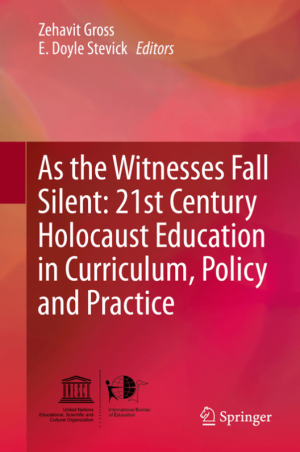 As the witnesses fall silent : 21st century Holocaust education in curriculum, policy and practice Год публикации: 2015 Организация-автор: UNESCO International Bureau of Education (IBE) This UNESCO/IBE publication represents the most comprehensive collection ever produced of empirical research on Holocaust education around the world. It comes at a critical time, as the world observes the 70th anniversary of the liberation of Auschwitz. The policies and practices of Holocaust education around the world are as diverse as the countries that grapple with its history and its meaning. Educators around the globe struggle to reconcile national histories and memories with the international realities of the Holocaust and its implications for the present. These efforts take place at a time when scholarship about the Holocaust itself has made great strides. In this book, these issues are framed by some of the leading voices in the field, including Elie Wiesel and Yehuda Bauer, and then explored by many distinguished scholars who represent a wide range of expertise. (By the publisher) Comme les témoins se taire: 21e siècle Holocauste éducation dans les programmes, les politiques et la pratique Год публикации: 2015 Организация-автор: UNESCO International Bureau of Education (IBE) Cette publication de l'UNESCO/BIE représente la collection la plus complète jamais produit de la recherche empirique sur l'Holocauste dans le monde entier. Il arrive à un moment critique, alors que le monde observe le 70e anniversaire de la libération d'Auschwitz. Les politiques et les pratiques de l'Holocauste dans le monde sont aussi diverses que les pays qui se débattent avec son histoire et sa signification. Les éducateurs autour de la lutte globe pour réconcilier des histoires et des mémoires nationales avec les réalités internationales de l'Holocauste et de ses implications pour le présent. Ces efforts ont lieu à un moment où la bourse de l'Holocauste lui-même a fait de grands progrès. Dans ce livre, ces questions sont encadrées par quelques-unes des principales voix dans le domaine, y compris Elie Wiesel et Yehuda Bauer, puis exploré par de nombreux spécialistes éminents qui représentent un large éventail d'expertise. (Par l'éditeur) Fearful symmetry: Palestinian and Jewish teachers confront contested narratives in integrated bilingual education The present paper deals with Jewish and Palestinian teachers who work in an integrated school in Israel, and shows the challenges and possibilities by examining these teachers' powerful historical narratives in the context of in-service training sessions. It is shown how these teachers essentially remain firmly rooted in the hegemonic historical narratives of their own community, even when their attitudes are challenged and clearer alternatives are considered to the reigning narratives. The findings highlight predominantly the failures, concerning the potential of educational efforts to help overcome situations of intractable conflict, even within contexts specifically devised for this purpose; yet, some openings also become apparent in the process of negotiating competing narratives and inventing new dialogic possibilities. The paper suggests that schools with their historical tradition are places where it is difficult to reach change or to produce it—even in integrated schools in which partial structural change takes place—and teacher training may not always be the answer. However, it also indicates that an ongoing agonistics of raising critical issues regarding one's identifications with hegemonic narratives does offer openings to take responsibility for both the challenges and the dialogic possibilities that are created in the process.
 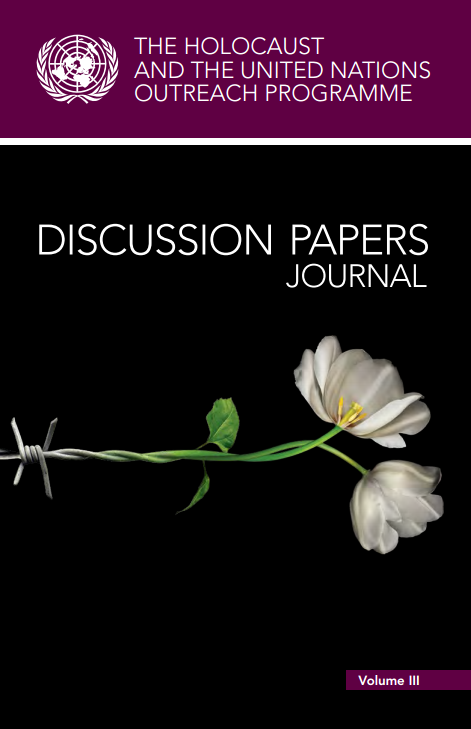 Discussion Papers Journal (Vol 3) Volume III presents a diverse group of authors writing on a wide range of topics. Among the contributors are academics, researchers, and sociologists, the chairman of a world-renowned Holocaust museum, the Special Advisers to the Secretary-General on the Prevention of Genocide and the Responsibility to Protect, a Hollywood filmmaker, and a former United Nations intern. They are from Canada, Denmark, Israel, Morocco, Senegal, Serbia, the United Kingdom and the United States. Their articles deal with a fascinating wide range of issues including Holocaust education in Denmark, and in Morocco; the International Holocaust Remembrance Alliance; music and the Holocaust; rescue; the preservation of former Nazi concentration and death camps; crimes committed against the Roma and Sinti during the Second World War; the post-Holocaust memory of German-Jewish achievements; and the prevention of atrocity crimes. (By the publisher) Discussion Papers Journal (Vol 3) Volume III présente un groupe diversifié d'auteurs écrivant sur un large éventail de sujets. Parmi les contributeurs sont des universitaires, des chercheurs et des sociologues, le président d'un musée de l'Holocauste de renommée mondiale, les Conseillers spéciaux du Secrétaire général sur la prévention du génocide et la responsabilité de protéger, un cinéaste d'Hollywood, et un ancien stagiaire des Nations Unies . Ils sont du Canada, le Danemark, Israël, le Maroc, le Sénégal, la Serbie, le Royaume-Uni et aux États-Unis. Leurs articles traitent d'un large éventail fascinant de questions, y compris l'Holocauste au Danemark et au Maroc; l'Alliance internationale Holocauste; la musique et l'Holocauste; porter secours; la préservation des anciens camps de concentration et d'extermination nazis; les crimes commis contre les Roms et les Sintis pendant la Seconde Guerre mondiale; la mémoire post-Holocauste des réalisations juifs allemands; et la prévention des crimes atroces. (Par l'éditeur)
 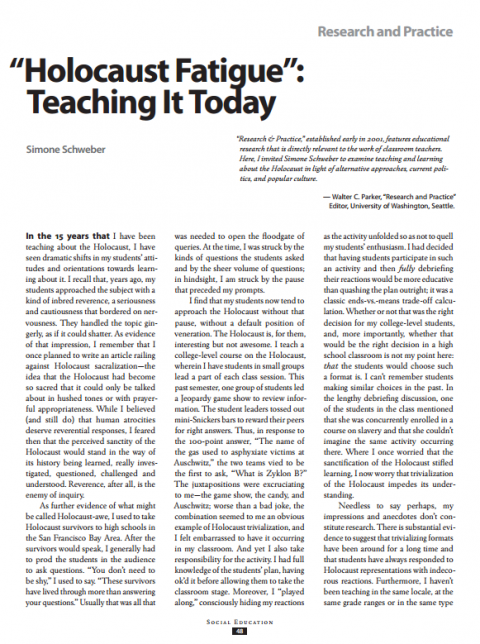 ´Holocaust Fatigue': Teaching it today The review "Research & Practice", established early in 2001, features educational research that is directly relevant to the work of classroom teachers. Here, I invited Simone Schweber to examine teaching and learning about the Holocaust in light of alternative approaches, current politics, and popular culture. (By the publisher) L'enseignement de la Shoah dans les écoles juives In this article, Katy Hazan studies the teaching of the Holocaust in Jewish schools. First, she portrays the educational systems of these specific schools and second, she establishes all the ethical, philosophical issues this theme entails. In the third part, she takes inventory of alternative ways of teaching the Holocaust, to conclude on the danger of emotional approaches.