
Ресурсы
Изучайте широкий спектр ценных ресурсов ВГГ, чтобы углубить своё понимание и повысить эффективность исследований, просветительской деятельности, преподавания и обучения.
Найдено: 451
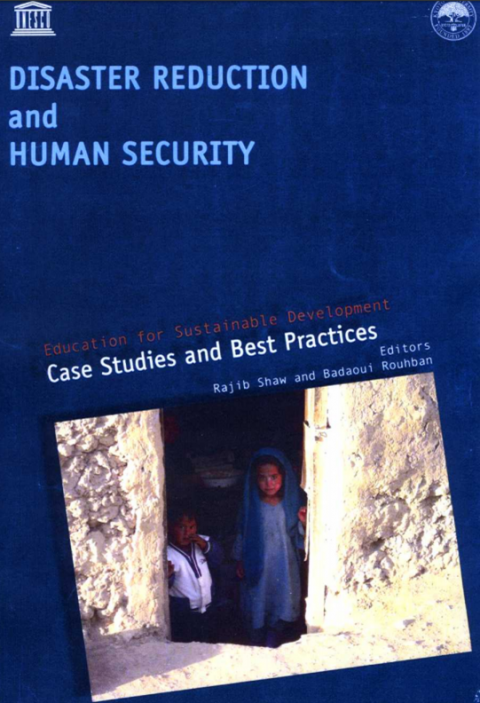 Disaster reduction and human security: education for sustainable development; case studies and best practices Год публикации: 2005 Организация-автор: Kyoto University. Graduate School of Global Environmental Studies Disaster reduction, human security, education and sustainable development are the four key issues, which are considered in the current compilation. A quick glance of the case studies will tell us the varieties of focus areas. WCD R Thematic Cluster 3 (Knowledge, Innovation and Education: To Build a Culture of Safety and Resilience) identifies four themes under the cluster: Education, Research, Public Awareness and Community Empowerment. A majority of case studies focus on community activities, especially on ho w the communities were able to cope with different types of disasters in different socio-economic context. These are all learning processes for the community, especially to enhance the resilience among its members. A number of these studies include public awareness, training and capacity building programmes. Quite a number of case studies focus on professional expertise, like microzonation, mapping, planning, hazard assessment, and development of risk reduction tools. These are all related to education and research. There are some case studies, which focus on formal education at school and colleges, but are linked to practical learning exercise. Distance learning has appeared as one of the possible media to reach the global mass, and to reach the farthest and the most needy group. The link between on-site testing and on-line learning has been emphasized by several case studies. La prévention des catastrophes et de la sécurité humaine: l'éducation pour le développement durable; études de cas et les meilleures pratiques Год публикации: 2005 Организация-автор: Kyoto University. Graduate School of Global Environmental Studies La prévention des catastrophes, la sécurité humaine, l'éducation et le développement durable sont les quatre questions clés, qui sont pris en compte dans la compilation actuelle. Un rapide coup d'œil des études de cas va nous dire les variétés de domaines d'intervention. WCD R thématique Cluster 3 (Connaissance, innovation et éducation: construire une culture de la sécurité et la résilience) identifie quatre thèmes du groupe: l'éducation, la recherche, la sensibilisation du public et l'autonomisation des communautés. La majorité des études de cas se concentrent sur les activités communautaires, en particulier sur ho w les communautés ont pu faire face à différents types de catastrophes dans le contexte socio-économique différent. Ce sont tous les processus d'apprentissage pour la communauté, en particulier pour améliorer la résilience parmi ses membres. Un certain nombre de ces études comprennent des programmes de sensibilisation du public, la formation et le renforcement des capacités. Un certain nombre d'études de cas se concentrer sur l'expertise professionnelle, comme microzonage, la cartographie, la planification, l'évaluation des risques, et le développement d'outils de réduction des risques. Ceux-ci sont tous liés à l'éducation et à la recherche. Il y a quelques études de cas, qui mettent l'aCECnt sur l'éducation formelle à l'école et les collèges, mais sont liés à la pratique d'exercice d'apprentissage. L'enseignement à distance est apparu comme l'un des médias possibles pour atteindre la masse globale, et d'atteindre le plus loin et le groupe le plus nécessiteux. Le lien entre les tests sur site et l'apprentissage en ligne a été soulignée par plusieurs études de cas.
  ‘We saw inhumanity close up’. What is gained by school students from Scotland visiting Auschwitz? As the education for citizenship agenda continues to make an impact on schools in the UK, and with the Holocaust Educational Trust (HET) in conjunction with the Scottish Government introducing its Lessons From Auschwitz (LFA) project for students and teachers in Scotland, this article focuses on the Scottish context and investigates the school processes by which students are chosen to participate in the LFA project, the impact the LFA project has on student personal growth, and the range of follow‐up activities in their schools and communities. The methodology employed online questionnaires and face‐to‐face interviews, which were designed to ascertain student perceptions of the LFA project and the impact that this project had on student participants, their schools, and their communities. Findings demonstrate that the student cohort were highly academic students who took their responsibilities on return to their schools very seriously and organized a wide range of events, both in their schools and in their communities. There was clear evidence that the LFA project had led to extra teaching and awareness of the Holocaust, racism and human rights; and that students’ citizenship values had been enhanced. (By the publisher)
 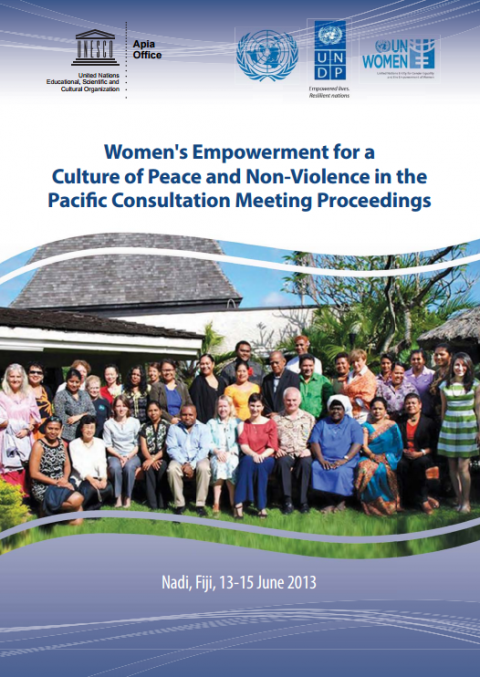 Women's empowerment for a culture of peace and non-violence in the pacific consultation meeting proceedings Год публикации: 2013 Организация-автор: UNESCO Apia The Consultation on Women’s Empowerment for a Culture of Peace and Non Violence in the Pacific was held in Nadi, Fiji, from 13 to 15 June 2013. The consultation was an interagency collaboration between the United Nations Educational, Scientific and Cultural Organization (UNESCO), the United Nations Entity for Gender Equality and the Empowerment of Women (UN WOMEN) and the United Nations Development Programme (UNDP) Pacific Centre as part of the United Nations strategy “Delivering as One”. This collaboration focused on efforts to design, promote and strengthen a culture of peace in the Pacific at the country and regional levels. The consultation brought together 30 senior representatives, including development professionals and community members, from governments, regional organizations, women’s organizations, faith-based groups, academic institutions and development partners from the Cook Islands, Fiji, Kiribati, Palau, Papua New Guinea, Samoa, Solomon Islands, Tonga and Vanuatu. The consultation ended with an agreement on a range of actions that could be adopted at the local, national and regional levels to promote increased dialogue between leaders and policy makers on the contributions that culture and heritage can make to addressing issues of gender inequality and reducing GBV. The outcome statement identifies the importance of building positive cultural models, using a range of key factors, including female leaders, faith-based leaders and traditional leaders as well as political leaders and parties. The statement also emphasized education as a means of promoting a culture of peace and non-violence. The consultation’s outcome statement noted that the school curriculum should place a stronger emphasis on values, gender equality, sexual and reproductive health and rights, and the building of positive cultural models. The follow up actions identified include increasing public awareness on achieving equality for Pacific women, including women at the grassroots level, in bringing peace to conflict-affected communities; targeting young people as the next generation of leaders; using the arts and cultural and sports events to break down gender stereotypes; actions relating to economic empowerment, access to justice and service delivery; and intangible cultural heritage capacity building incorporating substantive gender equality components. L'autonomisation des femmes pour une culture de paix et de non-violence dans la procédure de réunion de consultation pacifique Год публикации: 2013 Организация-автор: UNESCO Apia La Consultation sur l'Autonomisation des Femmes pour une Culture de la Paix et de la Non-Violence dans le Pacifique a eu lieu à Nadi, Fidji, du 13 au 15 Juin 2013. La consultation a été une collaboration interinstitutions entre la culture (UNESCO) Organisation des Nations Unies pour l'éducation, la science et l'Entité des Nations Unies pour l'égalité des sexes et l'autonomisation des femmes (ONU Femmes) et le Programme des Nations Unies pour le développement (PNUD) Centre du Pacifique dans le cadre de la stratégie des Nations Unies «Delivering as One». Cette collaboration a porté sur les efforts pour concevoir, promouvoir et renforcer une culture de paix dans le Pacifique au niveau national et régional. La consultation a réuni 30 représentants de haut niveau, y compris les professionnels du développement et des membres de la communauté, des gouvernements, des organisations régionales, des organisations de femmes, les groupes religieux, les institutions académiques et les partenaires de développement des îles Cook, Fidji, Kiribati, Palau, Papouasie-Nouvelle-Guinée, Samoa , Îles Salomon, Tonga et Vanuatu. La consultation a pris fin avec un accord sur une série d'actions qui pourraient être adoptées aux niveaux local, national et régional pour promouvoir le dialogue accru entre les dirigeants et les décideurs politiques sur les contributions que la culture et le patrimoine peuvent apporter à résoudre les problèmes d'inégalité entre les sexes et la réduction de GBV . L'énoncé de résultat souligne l'importance de la construction de modèles culturels positifs, en utilisant une gamme de facteurs clés, y compris les femmes leaders, des dirigeants religieux et les chefs traditionnels ainsi que des dirigeants et partis politiques. La déclaration a également souligné l'éducation comme un moyen de promouvoir une culture de paix et de non-violence. La déclaration des résultats de la consultation a noté que le programme scolaire devrait mettre davantage l'aCECnt sur les valeurs, l'égalité des sexes, la santé et les droits sexuels et de la reproduction, et la construction de modèles culturels positifs. Les actions de suivi identifiées comprennent la sensibilisation du public sur la réalisation de l'égalité pour les femmes du Pacifique, y compris les femmes au niveau local, pour ramener la paix dans les communautés touchées par le conflit; ciblant les jeunes comme la prochaine génération de leaders; en utilisant les arts et et des événements culturels de sport pour briser les stéréotypes de genre; les actions relatives à l'autonomisation économique, l'accès à la justice et la prestation des services; et immatériel renforcement des capacités du patrimoine culturel incorporant fond composantes égalité entre les sexes.
  Studying the Holocaust Through Film and Literature: Human Rights and Social Responsibility Through film and literature, this book shows students the moral and ethical lessons that have evolved from the Holocaust so they can connect them with the moral dilemmas they face in their own lives. The authors focus on 3 main lessons of the Holocaust ‒ thou shalt not be a victim, thou shalt not be a perpetrator and thou shalt not be a bystander ‒ and address the issues of courage, compassion, character and civility. (By the author) Address by Irina Bokova, Director-General of UNESCO, on the occasion of the Inaugural Lecture on: Diverse Societies, Inclusive Democracies: New Skills for a Sustainable World, Organized by the Mahatma Gandhi Institute of Education for Peace Год публикации: 2014 Организация-автор: UNESCO. Director-General, 2009-2017 (Bokova, I.G.) This document is the address of Irina Bokova, Director-General of UNESCO, on the occasion of the inaugural lecture on: Diverse Societies, Inclusive Democracies: New Skills for a Sustainable World, organized by the Mahatma Gandhi Institute of Education for Peace in Delhi, India, 25 November 2014. She insisted the importance of social integration, the human rights for all and education for sustainable development. Address by Irina Bokova, Director-General of UNESCO, on the occasion of the Inaugural Lecture on: Diverse Societies, Inclusive Democracies: New Skills for a Sustainable World, Organized by the Mahatma Gandhi Institute of Education for Peace Год публикации: 2014 Организация-автор: UNESCO. Director-General, 2009-2017 (Bokova, I.G.) Ce document est le discours de Irina Bokova, Directrice générale de l'UNESCO, à l'occasion de la conférence inaugurale sur: les sociétés diversifiées, les démocraties inclusives: De nouvelles compétences pour un monde durable, organisé par l'Institut Mahatma Gandhi d'Éducation pour la Paix à Delhi, Inde, le 25 Novembre 2014. Elle a insisté sur l'importance de l'intégration sociale, le droit de l'homme pour tous et éudcation pour le développement durable. 이리나 보코바 유네스코 사무총장의 취임 기념 공개 강연: 다양한 사회, 포괄적 민주주의: 지속가능한 세계를 위한 새로운 기술, ‘마하트마 간디 평화와 지속가능발전 교육연구소’(Mahatma Gandhi Institute of Education for Peace and Sustainable Development)주최, 2014년 11월 25일 인도, 델리. Год публикации: 2014 Организация-автор: UNESCO. Director-General, 2009-2017 (Bokova, I.G.) 이 문서는 2014년 11월 25일, 인도 델리에서 ‘다양한 사회, 포괄적 민주주의: 지속가능한 세계를 위한 새로운 기술’을 주제로 ‘마하트마 간디 평화와 지속가능발전 교육연구소’(Mahatma Gandhi Institute of Education for Peace and Sustainable Development)가 주최한 이리나 보코바 유엔 사무총장의 취임 기념 공개 강연의 내용이다. 여기에서 그녀는 사회 통합의 중요성과 모든 사람을 위한 인권, 지속가능한 발전을 위한 교육을 주장했다.
  تعزيز سيادة القانون عن طريق التعليم: دليل لواضعي السياسات Год публикации: 2019 Организация-автор: UN. Office on Drugs and Crime (UNODC) | UNESCO لمنشور المشترك الجديد لليونسكو ومكتب الأمم المتحدة المعني بالمخدرات والجريمة بعنوان "تعزيز سيادة القانون من خلال التعليم: دليل لواضعي السياسات" يستكشف الدور الذي يمكن أن تلعبه المؤسسات التعليمية في تعزيز سيادة القانون وبناء أشكال جديدة من المشاركة على أساس المواطنة العالمية وحقوق الإنسان والإدماج - - جميعها حيوية للمضي قدمًا في تحقيق الهدف 4 من أهداف التنمية المستدامة بشأن التعليم ، في صميم خطة التنمية المستدامة لعام 2030.تعزيز سيادة القانون من خلال التعليم: دليل صانعي السياسات موجه لواضعي السياسات التعليمية وغيرهم من المهنيين العاملين في قطاع التعليم الرسمي ، داخل وزارات التعليم وخارجها ، والذين يسعون إلى تعزيز سيادة القانون وثقافة احترام القانون.قد يكون الدليل مفيدًا أيضًا للمهنيين العاملين في أماكن التعليم غير النظامي أو القطاعات الأخرى - وبالتحديد قطاعات العدالة والاجتماعية والصحية - في مجال منع الجريمة والعنف ، الذين يسعون إلى العمل بشكل أوثق مع قطاع التعليم.