
Ресурсы
Изучайте широкий спектр ценных ресурсов ВГГ, чтобы углубить своё понимание и повысить эффективность исследований, просветительской деятельности, преподавания и обучения.
Найдено: 451
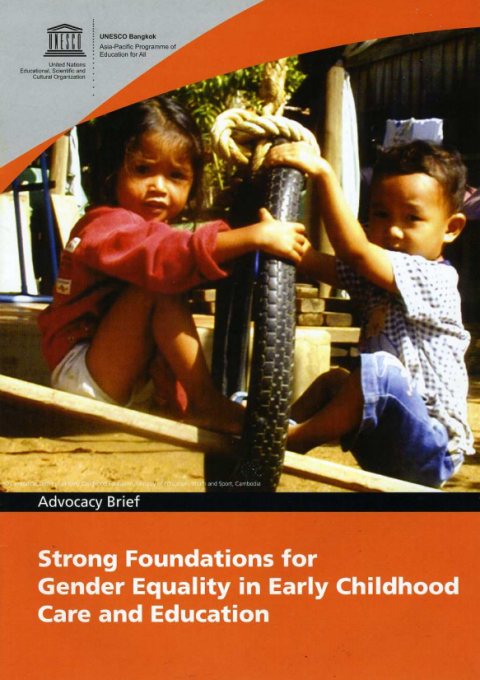 De solides fondations pour l'égalité des sexes dans les soins de la petite enfance et de l'éducation: le plaidoyer bref Год публикации: 2007 Организация-автор: UNESCO Le terme de l’éducation et la protection de la petite enfance (EPPE) fait référence aux services pour les enfants de la naissance à huit ans. Ceux-ci incluent l'éducation des parents dans la façon de prendre soin de leurs enfants et de les aider à apprendre, ainsi que de fournir des programmes formels préscolaires gérés par la communauté et pour les garçons et les filles d'âge scolaire pré-primaire. Compte tenu des divers besoins des enfants de la naissance à huit ans, les éducateurs ont trouvé préférable d'avoir des politiques et des stratégies pour les enfants de moins et de plus de trois ans. Ce bref se concentre sur les questions de genre dans les services fournis aux enfants qui sont de trois ans ou plus dans la région Asie-Pacifique. Son champ d'application est informé par l'engagement de l'UNESCO aux services pré-primaires holistiques pour ce groupe d'âge. L'objectif est de fournir une éducation de la petite enfance qui aide les filles et les garçons à réussir à l'école primaire et dans l'apprentissage tout au long de leur vie. Les brèves commence par la recherche dans la croissance de l'EPPE dans la région Asie-Pacifique et ce qui est le moteur de cette croissance. Il explore pourquoi le genre de réaction est important dans l'éducation de la petite enfance, donne des exemples concrets de ce que cela ressemble, et examine les défis de fournir EPPE que de façon égale les valeurs et les avantages de chaque fille et chaque garçon. Découlant de cela, le mémoire se termine par des recommandations sur la façon de rendre sensible EPPE plus le sexe.
 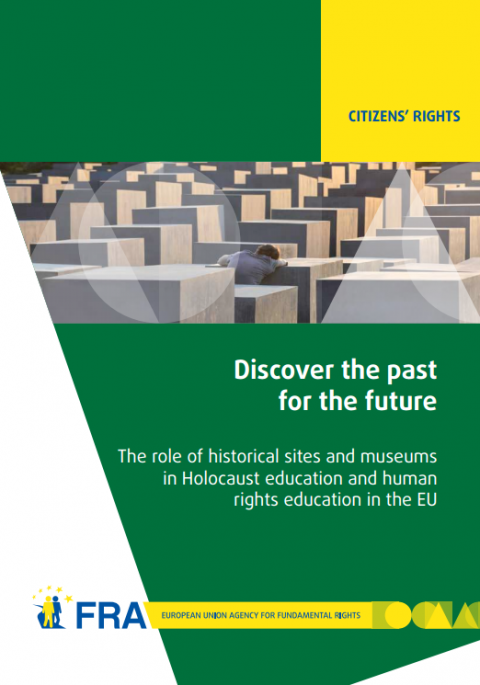 Discover the past for the future: The role of historical sites and museums in Holocaust education and human rights education in the EU The Holocaust has rightfully become an integral part of the collective cultural memory of Europe and the world. This report outlines the findings of the first EU-wide research on the role of Holocaust-related sites and exhibitions in educating young Europeans about the Holocaust and human rights. With this research, the European Union Agency for Fundamental Rights (FRA) brings the two fields of Holocaust education and human rights education together and suggests how the merging of the two could develop into a new knowledge of past and present. The report highlights that attempts to expand knowledge of human rights and to establish links between Holocaust education and human rights education need a broader focus than the memorial sites or museums can offer. Much of the work on linking Holocaust education and human rights education needs to be accomplished in schools. This requires teachers to have opportunities to gain a better understanding of human rights education, and human rights education to be better integrated into school curricula in the EU. Visits to memorial sites and museums can stimulate, support and supplement such work. (By the publisher)
  The Holocaust and Education for Citizenship: the teaching of history, religion and human rights in England The importance of the Holocaust is undeniable. It seems that this truism has long been accepted by teachers and education policy makers. A superficial prediction would be that the Holocaust will continue to have both a high profile and a high status in the schools and colleges of England and Wales. However, on the basis of small‐scale work using data from teachers’ perceptions, we draw attention to certain problems in learning about the Holocaust and begin to suggest issues which should be investigated further. The issues which need further investigation are related to the possibilities that there may be too little time devoted to teaching about the Holocaust; the events of the Holocaust may sometimes be used as a mere context for understanding World War Two; teachers may not perceive the Holocaust as being significantly unique; teachers may not collaborate effectively; there may be a lack of clarity about the nature of the affective and cognitive aims of such work. (By the author)
  Exploration on the Developmental Track of Chinese Civil Educational Outlook Год публикации: 2006 Автор: Zhu Xiaoman, Feng Xiujun By tracking down the development of Chinese civil education outlook, we can see that Chinese civil educational outlook and western civil educational outlook show the trend of moving vis-à-vis in the relations among the citizens, the country and social relations, between civil rights and duties and between civil education and moral education. They have the possibility of mutual congelation with Chinese traditional moral educational ideology in ontological foundation, educational mechanism and value orientation. 中国公民教育观发展脉络探析 Год публикации: 2006 Автор: Zhu Xiaoman, Feng Xiujun 通过对中国公民教育观的发展脉络进行溯源性追寻, 可以看到,中国公民教育观与西方公民教育观在公民与国家、社会关系,公民权利与义务关系,公民教育与道德教育关系等方面呈现相向运动的趋势,与中国传统道德教育思想在本体基础、教育机制、价值取向等方面存在相互融通的可能。
 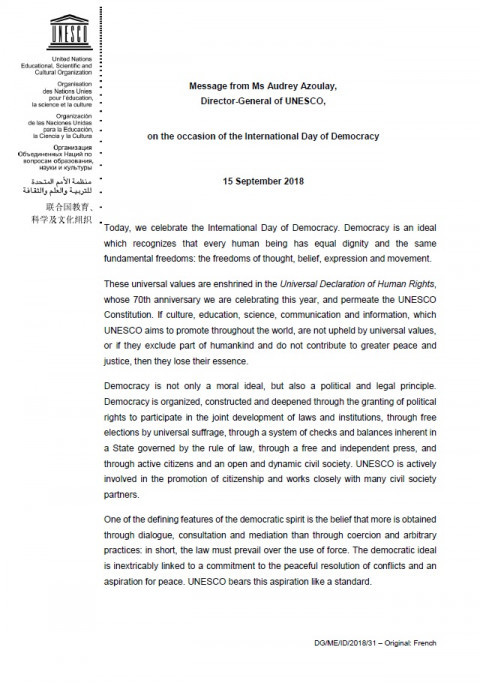 Message from Ms Audrey Azoulay, Director-General of UNESCO, on the occasion of International Day of Democracy, 15 September 2018 Год публикации: 2018 Организация-автор: UNESCO. Director-General, 2017- (Azoulay, A.)UNESCO. Director-General, 2017- (Azoulay, A.)UNESCO. Director-General, 2017- (Azoulay, A.) This message was delivered by Audrey Azoulay, Director-General of UNESCO, on the occasion of the International Day of Democracy, on 15 September 2018. 联合国教科文组织总干事奥德蕾·阿祖莱 国际民主日致辞 Год публикации: 2018 Организация-автор: UNESCO. Director-General, 2017- (Azoulay, A.)UNESCO. Director-General, 2017- (Azoulay, A.)UNESCO. Director-General, 2017- (Azoulay, A.) 2018年9月15日,联合国教科文组织总干事奥德蕾·阿祖莱国际民主日致辞
 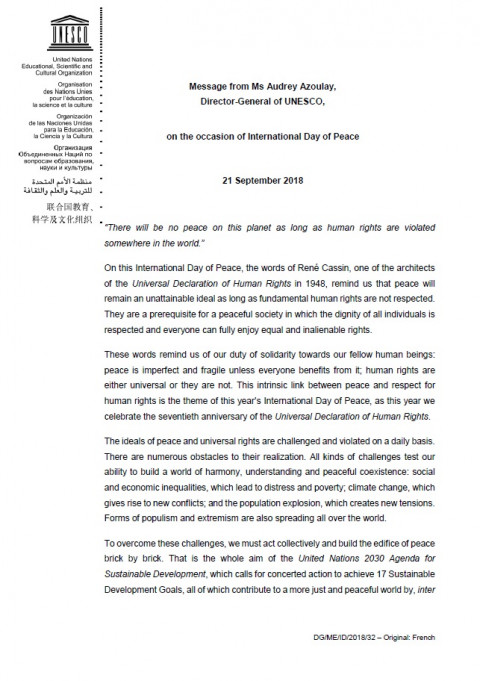 Message from Ms Audrey Azoulay, Director-General of UNESCO, on the occasion of International Day of Peace, 21 September 2018 Год публикации: 2018 Организация-автор: UNESCO. Director-General, 2017- (Azoulay, A.) This message was delivered by Audrey Azoulay, Director-General of UNESCO, on the occasion of the International Day of Peace, on 21 September 2018. 联合国教科文组织总干事奥德蕾·阿祖莱国际和平日致辞 Год публикации: 2018 Организация-автор: UNESCO. Director-General, 2017- (Azoulay, A.) 2018年9月21号,联合国教科文组织总干事奥德蕾·阿祖莱国际和平日致辞
  UNESCO's work on education for peace and non-violence: building peace through education Год публикации: 2008 Организация-автор: UNESCO The promotion of peace through education is at the heart of UNESCO’s mission. As stated in its constitution of 1945, UNESCO advances international peace and the common welfare of humanity through educational, scientific and cultural relations between peoples of the world. Though the world has changed over the past sixty years and continues to change at an ever increasing rate, UNESCO’s mission - a commitment to promoting universal values of peace and nonviolence, human rights and social justice, intercultural dialogue and mutual understanding – persists with growing urgency. UNESCO’s approach to educating for peace is multidimensional, in that it links education with a range of activities that address the root causes of violence, from human security to sustainable development. The goal of UNESCO’s education programmes and partnerships is the development of comprehensive systems of education that embrace the values of human rights, intercultural understanding and tolerance. Education for peace and non-violence promotes the knowledge, skills, attitudes and behaviours that reflect and inspire these values. As the lead agency within the UN system for the International Decade for a Culture of Peace and Non-Violence for the Children of the World, 2001- 2010, UNESCO is responsible for coordinating and directly implementing activities that promote the objectives of the Decade through education, the sciences, culture, communication and information. The culture of peace is defined as a set of values, attitudes, modes of behaviour and ways of life that reject violence and aim to prevent conflicts by tackling their root causes through dialogue and negotiation between individuals, groups and nations. UNESCO promotes the culture of peace through an intersectoral platform. This platform involves all five sectors of UNESCO: education, natural sciences, social and human sciences, culture, and communication and information. It seeks to mainstream intercultural dialogue in policies and actions with the aim of promoting mutual understanding, tolerance and respect, all of which are considered to be creative forces for a sustainable future. The intersectoral platform will also develop tools based on good practices in intercultural dialogue.