
Ресурсы
Изучайте широкий спектр ценных ресурсов ВГГ, чтобы углубить своё понимание и повысить эффективность исследований, просветительской деятельности, преподавания и обучения.
Найдено: 451
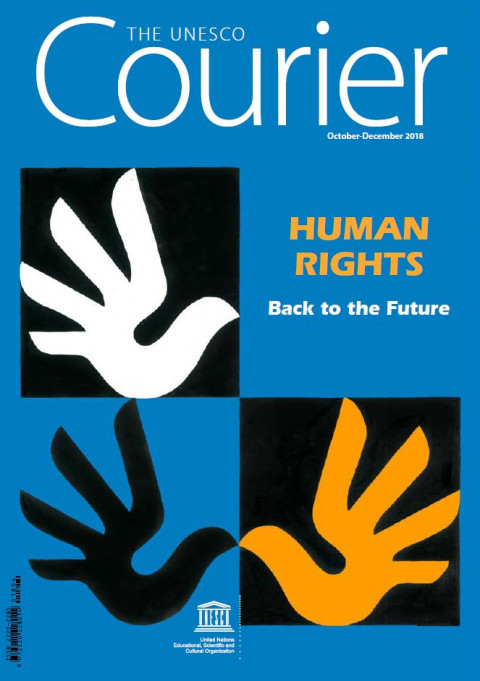 Derechos humanos: regreso al futuro (El Correo de la UNESCO no. 4, Octubre-Diciembre 2018) Год публикации: 2018 Организация-автор: UNESCO Benedetto Croce, Aldous Huxley, Humayun Kabir, Harold J. Laski, Lo Chung-Shu, Salvador de Madariaga, Jacques Maritain, F. S. C. Northrop, Arnold Schoenberg, Pierre Teilhard de Chardin: estos son algunos de los colaboradores de este número de El Correo. Para conmemorar el 70 aniversario de la Declaración universal de los derechos humanos, adoptada el 10 de diciembre de 1948, decidimos hacer un recorrido por el pasado para orientarnos mejor en el futuro, lo cual explica el título de este número: “Regreso al futuro”. Nos encontramos pues en 1946. Mientras el espectro de la guerra mundial atormenta todas las conciencias, “la comunidad internacional necesita formular un enunciado moral que exprese adecuadamente su indignación colectiva y su esperanza (por utópica que fuese) de un futuro mejor”, explica Mark Goodale, autor del artículo introductorio y consultor para nuestra sección Gran angular. Una sección que desvela toda una parte desconocida de la historia de la Declaración universal de los derechos humanos: la encuesta mundial sobre los fundamentos filosóficos de los derechos del hombre, decidida durante la primera Conferencia General de la UNESCO (noviembre-diciembre de 1946), enviada el año siguiente por el primer Director General, Julian Huxley, y coordinada por el joven filósofo francés Jacques Havet. La UNESCO reunió en torno a este proyecto a la élite intelectual del mundo de la posguerra y aportó así una contribución fundamental a la reflexión sobre los derechos humanos. Una encuesta que aún hoy resulta de sorprendente actualidad. Igual de actuales son los dibujos de Nuestro invitado, el artista peruano Fernando Bryce, que encuentra su inspiración en este período histórico “donde la idea de progreso abría realmente múltiples perspectivas”. Su serie The Book of Needs (El libro de las necesidades), que transfigura en obras de arte algunas páginas de El Correo de los años 1948 - 1954, es objeto del suplemento de este número. Droits de l’homme : retour vers le futur (Le Courrier de l’UNESCO no. 4, octobre-décembre 2018) Год публикации: 2018 Организация-автор: UNESCO Benedetto Croce, Aldous Huxley, Humayun Kabir, Harold J. Laski, Lo Chung-Shu, Jacques Maritain, F. S. C. Northrop, Arnold Schoenberg, Pierre Teilhard de Chardin : voici quelques-uns des contributeurs de ce numéro du Courrier. Pour marquer le soixante-dixième anniversaire de la Déclaration universelle des droits de l’homme, adoptée le 10 décembre 1948, nous avons décidé de faire un détour par le passé, afin de mieux nous orienter dans l’avenir. Ce qui explique le titre de ce numéro : « Retour vers le futur ». Nous sommes donc en 1946. Alors que le spectre de la guerre totale hante tous les esprits, « la communauté internationale a besoin de formuler un énoncé moral qui exprime adéquatement son indignation collective et son espoir (pour utopique qu'il fût) d'un avenir meilleur », explique Mark Goodale, auteur de l’article introductif et consultant pour Grand angle. Un dossier qui dévoile tout un pan méconnu de l’histoire de la Déclaration universelle des droits de l’homme : l’enquête mondiale sur les fondements philosophiques des droits de l’homme, décidée lors de la première Conférence générale de l’UNESCO (novembre-décembre 1946), lancée l’année suivante par le premier Directeur général, Julian Huxley, et coordonnée par le jeune philosophe français Jacques Havet. L’UNESCO a réuni autour de ce projet l’élite intellectuelle du monde de l'après-guerre et apporté ainsi une contribution essentielle à la réflexion sur les droits de l’homme. Elle demeure aujourd’hui d’une étonnante actualité. Tout aussi actuels sont les dessins de Notre invité, l’artiste péruvien Fernando Bryce qui puise son inspiration dans cette période historique « où l'idée de progrès ouvrait réellement de multiples perspectives ». Sa série The Book of Needs (Le livre des nécessités), qui transfigure en œuvres d’art des pages du Courrier des années 1948 - 1954, fait l’objet du supplément à ce numéro. Права человека: назад в будущее (Курьер ЮНЕСКО no. 4, октябрь-декабрь 2018 года) Год публикации: 2018 Организация-автор: UNESCO Среди авторов этого номера «Курьера ЮНЕСКО» – Морис Добб, Гарольд Дж. Ласки, Бенедетто Кроче, Олдос Хаксли, Ло Чун-Шу, Арнольд Шёнберг и другие выдающиеся деятели прошлого столетия. По случаю 70-летия Всеобщей декларации прав человека, принятой 10 декабря 1948 года, мы решили вернуться в прошлое, чтобы с большей ясностью смотреть в будущее. Поэтому текущий номер так и называется: «Назад в будущее». Представим же, что сейчас вновь 1946 год. Над миром витает жуткий призрак тотальной войны, и международное сообщество испытывает «потребность выступить с совместным заявлением морального характера, в котором оно могло бы в должной мере выразить всеобщее негодование и надежду на лучшее будущее, какой бы утопичной она ни казалась», – поясняет специалист по социальной антропологии Марк Гудэйл во вступительной статье к подготовленной с его помощью рубрике «Широкий обзор». Материалы этой рубрики знакомят читателей с малоизвестным фактом из истории Всеобщей декларации прав человека – всемирным опросом, проведенным ЮНЕСКО по инициативе первого Генерального директора Джулиана Хаксли с целью определения философских принципов, лежащих в основе прав человека. Решение о его проведении было принято на 1-й сессии Генеральной конференции ЮНЕСКО, состоявшейся в ноябре-декабре 1946 года, а сам опрос был проведен годом позже. Руководство этим масштабным проектом осуществлял молодой французский философ Жак Аве. В опросе, призванном заложить основы для размышлений о правах человека, приняли участие яркие представители интеллектуальной элиты послевоенного общества. Несмотря на прошедшие с тех пор 70 лет, поднятые в ходе этого проекта вопросы по-прежнему чрезвычайно актуальны. Столь же актуальны и рисунки нашего гостя, перуанского художника Фернандо Брисе, черпающего вдохновение в «том особом периоде, когда идея прогресса действительно открывала многочисленные перспективы». Этому периоду он посвятил серию под названием The Book of Needs («Книга потребностей»), рисунки из которой виртуозно воспроизводят страницы «Курьера ЮНЕСКО» за 1948-1954 год. Большую часть из них можно увидеть в приложении к текущему номеру журнала.
  COVID-19 and Human Rights: We Are All in This Together Год публикации: 2020 Организация-автор: United Nations (UN) Human rights are key in shaping the pandemic response, both for the public health emergency and the broader impact on people’s lives and livelihoods. Human rights put people centre-stage. Responses that are shaped by and respect human rights result in better outcomes in beating the pandemic, ensuring healthcare for everyone and preserving human dignity. But they also focus our attention on who is suffering most, why, and what can be done about it. They prepare the ground now for emerging from this crisis with more equitable and sustainable societies, development and peace.This paper aims to translate this Call into concrete action to assist with the response to the pandemic. It presents six key messages that must be central to an effective response to the COVID-19 pandemic.
  Learning to live together: education for conflict resolution, responsible citizenship, human rights and humanitarian norms Год публикации: 2013 Автор: Margaret Sinclair Организация-автор: Education Above All (Qatar) Education cannot offer immediate remedies to the local and global problems that we see on the news screens every day, but it can contribute to solving them over the longer term. This book examines specifically the contribution that education for learning to live together can make, even in countries where teacher training and classroom resources are limited. Many countries have diverse populations (ethnic, linguistic, religious, etc) and seek to maintain harmony among the different groups. In some countries, however, especially where economic stress or climate change have intensified arguments over resources, tensions have led to armed conflict. This brings with it all the misery of death, injury, displacement and poverty, along with disruption of education systems. In some instances education itself has been a contributory factor to the outbreak of conflict, notably through unequal education opportunities for different groups, and through biased school curricula.Civil conflict has brought untold suffering in recent years, and in a globalised world it has negative spill-over effects to neighbouring and other countries. It is vital to develop education policies and curricular reforms that can help convey values and skills for learning to live together to young people, to help lessen tensions, within and between countries.Education policy-makers can help lay the foundations for a better future by adjusting the content and process of education to reflect skills and values for human rights, humanitarian norms, peaceful resolution of conflicts, sustainable development and other issues as elements of local, national and global citizenship.Education reform is not enough, of course, to resolve the numerous problems of our times. The focus of this volume is on the contribution that can be made through aligning the content of education to the goal of learning to live together. This work will have greater impact when it takes place within education systems and policies that are consistent with human rights values and of course when other sectors besides education make their respective contributions.This book shows that transformative education for conflict resolution and peace, for local, national and global citizenship, for human rights and humanitarian values can be implemented even under difficult conditions if there is a policy commitment to do so. Authors have provided examples and lessons learned from their own experiences as eminent practitioners in the field. Learning to live together: education for conflict resolution, responsible citizenship, human rights and humanitarian norms Год публикации: 2013 Автор: Margaret Sinclair Организация-автор: Education Above All (Qatar) L'éducation ne peut offrir des remèdes immédiats aux problèmes locaux et mondiaux que nous voyons sur les écrans d'information tous les jours, mais elle peut contribuer à les résoudre sur le long terme. Ce livre examine spécifiquement la contribution que l'éducation peut apporter pour vivre ensemble même dans les pays où la formation des enseignants et les ressources en classe sont limitées.De nombreux pays ont des populations diverses (ethniques, linguistiques, religieuses, etc.) cherchent à maintenir l'harmonie entre les différents groupes. Dans certains pays, cependant, en particulier lorsque le stress économique ou les changements climatiques ont intensifié les arguments sur les ressources, les tensions ont conduit à des conflits armés. Cela apporte avec elle toute la misère de la mort, les blessures, le déplacement et la pauvreté, ainsi que la perturbation des systèmes éducatifs. Dans certains cas, l'éducation elle-même a été un facteur contributif à l'éclatement du conflit, notamment grâce à des possibilités d'éducation inégales pour les différents groupes, et à travers les programmes scolaires biaisés.La guerre civile a causé des souffrances indicibles au cours des dernières années, et dans un monde globalisé, il a des effets négatifs de débordement vers les pays voisins et d'autres pays. Il est essentiel d'élaborer des politiques de l'éducation et la réforme des programmes qui peuvent aider à transmettre les valeurs et les compétences pour apprendre à vivre ensemble pour les jeunes, pour aider à réduire les tensions, à l'intérieur et entre les pays.Education décideurs politiques peuvent aider à jeter les bases d'un avenir meilleur en ajustant le contenu et le processus de l'éducation afin de refléter les compétences et les valeurs des droits de l'homme, des normes humanitaires, la résolution pacifique des conflits, le développement durable et d'autres questions comme éléments de local, national et citoyenneté mondiale.Réforme de l'éducation ne suffit pas, bien sûr, de résoudre les nombreux problèmes de notre temps. L'objectif de ce volume est sur la contribution qui peut être faite par le biais d'aligner le contenu de l'éducation à l'objectif d'apprendre à vivre ensemble. Ce travail aura un plus grand impact quand il a lieu au sein des systèmes et politiques d'éducation qui sont conformes aux valeurs des droits de l'homme et bien sûr, quand d'autres secteurs en dehors de l'éducation font leurs contributions respectives.Ce livre montre que l'éducation transformatrice pour la résolution des conflits et la paix, à la citoyenneté locale, nationale et mondiale, des droits de l'homme et des valeurs humanitaires peut être appliqué même dans des conditions difficiles, s'il y a un engagement politique de le faire. Les auteurs ont fourni des exemples et les enseignements tirés de leurs propres expériences en tant que praticiens éminents dans le domaine. Guide d'utilisation du manuel d'apprentissage de la démocratie pour les jeunes en Tunisie, à l'attention des formateurs et adultes-relais Год публикации: 2013 Организация-автор: UNESCO Rabat As part of its project to support education for democracy for young people in Tunisia, UNESCO has developed in cooperation with the Ministry of Education, the National Commission for Education, Science and Culture, CAWTAR, IADH, CNIPRE and UNI, a handbook on democracy for young people in Tunisia.This handbook is composed of twenty factsheets illustrated with drawings by Plantu. It popularizes the standards and universal principles, as well as major international instruments that protect and emphasize the national legal framework, key issues and challenges and good practices in Tunisia. One of the comparative advantages of this module is the fact that it highlights local issues and ongoing legal reforms in Tunisia.The present handbook has been developed as a pedagogical tool to help adult intermediaries (teachers, social educators etc…) responsible for the training of young people in school and community settings. It provides a series of exercises and situations to facilitate the learning and acquisition of knowledge in the field of democracy.The contents of this guidebook develops an approach based on "the discovery by oneself" which offers to participants activities, exercises and situations that require the mobilization of resources and contents of the training handbook on democracy for young people in Tunisia.Its use requires flexibility and creativity on the part of the trainer to enrich and/ or adapt the proposed exercises. It is in the light of the training context, prior knowledge of the concerned learners, the level of engagement of participants and according to thematic representations, that the trainer designs the training content.
 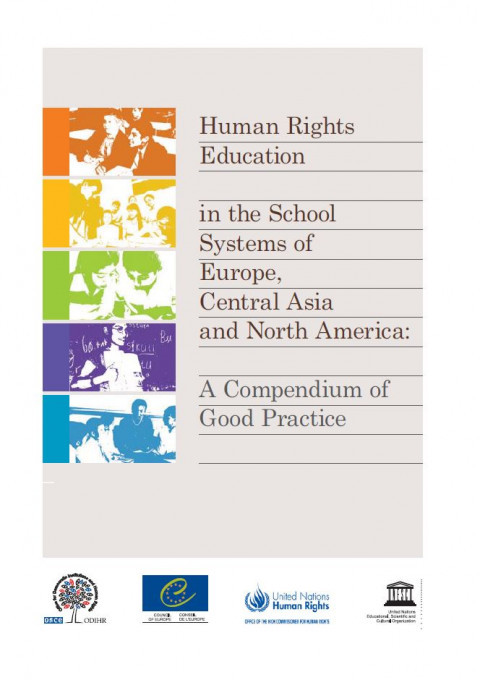 Human rights education in the school systems of Europe, Central Asia and North America: a compendium of good practice Год публикации: 2009 Организация-автор: Council of Europe | OSCE. Office for Democratic Institutions and Human Rights | UNESCO | UN. Office of the United Nations High Commissioner for Human Rights (UN. OHCHR) “Human Rights Education in the School Systems of Europe, Central Asia and North America: A Compendium of Good Practice” is a compilation of 101 examples of good practice in human rights education in primary schools, secondary schools and teacher training institutions in the Organization for Security and Co-operation in Europe (OSCE) area, which is also covered by the United Nations Educational, Scientific and Cultural Organization (UNESCO), the Office of the United Nations High Commissioner for Human Rights (OHCHR) and, partially, the geographical mandate of the Council of Europe (CoE).The term “human rights education” is often used in this resource in a broader sense, to also include educationfor democratic citizenship and education for mutual respect and understanding, which are all based on internationally agreed human rights standards. These three areas are seen as interconnected and essential within educational systems in order to prepare youth to be active, responsible and caring participants in their communities, as well as at the national and global levels.Human rights education has been defined as education, training and information aimed at building a universal culture of human rights. A comprehensive education in human rights not only provides knowledge about human rights and the mechanisms that protect them, but also imparts the skills needed to promote, defend and apply human rights in daily life. Education for democratic citizenship focuses on educational practices and activities designed to help young people and adults to play an active part in democratic life and exercise their rights and responsibilities in society. Education for mutual respect and understanding highlights self-respect, respect for others, and the improvement of relationships between people of differing cultural traditions.This book aims to support quality teaching in these areas and to inspire educational policymakers (those working in education ministries and local school boards) and administrators, teachers, teacher trainers, non-formal educators and all other interested actors, as well as to facilitate networking and the exchange of experience among education professionals.
  Re|shaping cultural policies: a decade promoting the diversity of cultural expressions for development Год публикации: 2015 Организация-автор: UNESCO This Report presents the work of fourteen independent experts, as well as the Secretary of the Convention and the Principal Editor, who have analysed the implementation of the Convention on the Protection and Promotion of the Diversity of Cultural Expressions. Its purpose is to move forward the process of monitoring the Convention’s implementation that was put in place by a mechanism of Quadrennial Periodic Reports (QPRs) approved by the Convention’s Conference of Parties in 2011. The contributors have consulted the 71 reports submitted by Parties, but have also used data derived from other, non-official sources and have drawn upon their own expert experience. Re|pensar las politicas culturales: 10 anos de promocion de la diversidad de las expresiones culturales para el desarrollo Год публикации: 2015 Организация-автор: UNESCO This Report presents the work of fourteen independent experts, as well as the Secretary of the Convention and the Principal Editor, who have analysed the implementation of the Convention on the Protection and Promotion of the Diversity of Cultural Expressions. Its purpose is to move forward the process of monitoring the Convention’s implementation that was put in place by a mechanism of Quadrennial Periodic Reports (QPRs) approved by the Convention’s Conference of Parties in 2011. The contributors have consulted the 71 reports submitted by Parties, but have also used data derived from other, non-official sources and have drawn upon their own expert experience.