
Ресурсы
Изучайте широкий спектр ценных ресурсов ВГГ, чтобы углубить своё понимание и повысить эффективность исследований, просветительской деятельности, преподавания и обучения.
Найдено: 451
 From words to action; Des paroles aux actes Год публикации: 2014 Организация-автор: UNESCO Since its creation in 1945, UNESCO has been working to enhance mutual understanding between peoples, founded on an ever more subtle knowledge of cultures in their rich diversity in order to promote the dignity of all through the affirmation of the principles, rights and values of our common humanity. The era of globalization characterizes our societies, in a cultural landscape which, more than ever, is permeated with diversity because of the mutual influences of peoples, communities, and of their cultural and religious practices. A major issue remains: the need to demonstrate the benefits of promoting both respect for human rights and cultural diversity, recognizing the importance of genuine intercultural dialogue in order to fight against new forms of racism, discrimination, intolerance, extremism and radicalization. UNESCO, with lengthy practical experience as an international laboratory of ideas, monitors respect for universal values, in particular by initiating research and producing various kinds of teaching tools designed for the acquisition of intercultural skills. Which skills should be mobilized or acquired in order to be able not only to respect but also to appreciate the Other in all his or her diversity. How many of these skills can be useful on both a collective level and an individual one in order to protect cultural rights, protect oneself from, or to transcend prejudice? Intercultural sensibility and aptitudes have to be explored since they refer to the willingness and capacity of people to step outside of their own logic and systems of thought in order to engage with others, and appreciate different cultural narratives especially if they are not equally valorized or recognized in a given societal context. This portfolio proposes a basic tool for capacity building in support of exchange, communication and cooperation beyond cultural, religious and national borders, allowing the emergence of a global citizenship in a safer world for all. In this perspective, this set of key resources consists of papers by international experts exploring the linkage between respect for cultural diversity and human rights, with all that that implies. It brings together other publications such asIntercultural Competences, Conceptual and Operational Framework, published by UNESCO in 2013, and documents such as Dire la Tolérance (Defining Tolerance), published in 1997 and translated into English and into Arabic, and, finally, UNESCO’s Programme of Action for a Culture of Peace and Non-Violence, A Vision in Action, published in English in 2012 and in French in 2013. Symbolically released on 10 December 2014, Human Rights Day, this multilingual and evolving publication is designed primarly to be an Open Access tool, a flagship project of the International Decade for the Rapprochement of Cultures (2013-2022). In the same spirit, its content will be enriched and developed in an e-learning format, throughout the Decade.
 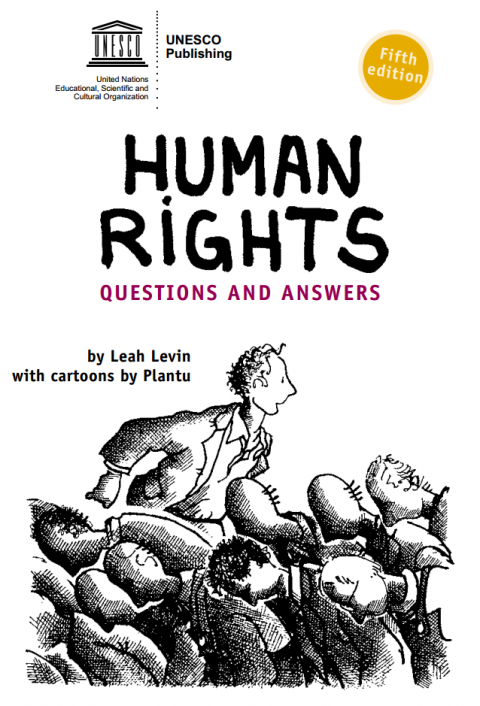 حقوق الإنسان ـ أسئلة و إجابات Год публикации: 2009 Автор: Leah Levin Организация-автор: UNESCO This 5th edition presents an overview of the scope and content of international human rights law, procedures to monitor its implementation, organizations and institutions working for human rights, major international events, as well as new developments and challenges. It also offers a brief commentary on the articles of the Universal Declaration of Human Rights explaining their meaning and providing examples on their practical implications. A permanent feature of this publication, and one of the reasons of its success, are the cartoons of Plantu, a well-known French political cartoonist and a devoted human rights activist.
  الحقوق الاقتصادية والاجتماعية والثقافية: دليل للمؤسسات الوطنية لحقوق الإنسان Год публикации: 2005 Организация-автор: UN. Office of the United Nations High Commissioner for Human Rights (UN. OHCHR) يستعرض المنشور حقوق الانسان الاقتصادية والاجتماعية والثقافية، وهو دليل للمؤسسات الوطنية انتجته الأمم المتحدة. ويعتبر الدليل مرجع في جميع ما يخص الحقوق لإيجاد حياة كريمة للإنسان، وتوضيح الدور الذي يجب أن تلعبه الحكومات في ذلك.مهام والصلاحيات الممنوحة لها في مجال الحقوق الاقتصادية والاجتماعية والثقافية، وهدفه هو مساعدة تلك المؤسسات على تطوير سياسات وعمليات ومهارات لمواصلة إدماج تلك الحقوق في عملها، وبالتالي تمكينها من معالجة الفقر والتنمية، وذلك على سبيل المثال، من خلال إطار قوامه الحقوق الاقتصادية والاجتماعية والثقافية.يتناول الدليل الطرق التي يمكن بها للمؤسسات الوطنية لحقوق الإنسان أن تصبح أكثر فعالية في حماية وتعزيز الحقوق الاقتصادية والاجتماعية والثقافية، ويطرح الكيفية التي تفسر بها ولايتها القانونية، بحيث يتسنى لها إدماج الحقوق الاقتصادية والاجتماعية والثقافية ضمن نطاق سلطتها، والكيفية التي يمكنها أن تحسن بها أداء مهامها وصلاحياتها فيما يتعلق بهذه الحقوق. وعلى الرغم من أن الدليل يستهدف حماية وتعزيز الحقوق ااقتصادية والاجتماعية والثقافية على وجه التحديد، إلا أنه يهتم ـ أيضا ـ بعمل المؤسسات الوطنية لحقوق الإنسان فيما يتعلق بالحقوق المدنية والسياسية. Economic, Social and Cultural Rights: Handbook for National Human Rights Institutions (Professional Training Series No.12) Год публикации: 2005 Организация-автор: UN. Office of the United Nations High Commissioner for Human Rights (UN. OHCHR) This publication reviews economic, social and cultural human rights. It is a guide to national institutions produced by the United Nations. The guide is a reference in all matters related to human rights to create a decent life for people, and to clarify the role that governments should play in this regard.This handbook is intended to help national human rights institutions maximize the effectiveness of their functions and powers in addressing economic, social and cultural rights. Its aim is to assist national human rights institutions in the development of policies, processes and skills to integrate economic, social and cultural rights further into their work, thereby enabling them to address poverty and development, for example, through an economic, social and cultural rights framework.This handbook will discuss ways in which national human rights institutions can become more effective in protecting and promoting economic, social and cultural rights. It will examine how national institutions’ legal mandates can be interpreted to incorporate economic, social and cultural rights within their jurisdictions, how their functions and powers can be exercised more appropriately in regard to these rights, how they can use their resources most efficiently and effectively and how they can implement economic, social and cultural rights in the political and social contexts in which they operate.
  Global Monitoring of Target 4.7: Themes in National Curriculum Frameworks; Background Paper Prepared for the 2016 Global Education Monitoring Report Год публикации: 2016 Организация-автор: UNESCO International Bureau of Education (IBE) This study is an initial attempt to monitor ESD and GCED content in curricula globally. The goal here is to analyse national curriculum documents to reveal if, how, and to what extent ESD and GCED content is present across the globe. For this purpose, the research team developed a coding scheme based on key ESD and GCED knowledge, skills, behaviours and pedagogies that was used in evaluating the various national curriculum documents for evidence of ESD and GCED content. In this paper, we present the study in the following order. Further explanation of ESD and GCED, and a discussion of issues relating to their implementation and monitoring will come first. Then we will review similar studies that have also attempted to monitor GCED and ESD through content analysis. The study’s methods and findings will then be presented, followed by a discussion of the challenges addressed in developing a coding system to monitor curricula effectively. Finally, we share a series of recommendations that will focus on ways for moving forward in monitoring GCED and ESD effectively, both at a curricular level and beyond. Human rights: questions and answers Год публикации: 2009 Автор: Leah Levin Организация-автор: UNESCO This 5th edition presents an overview of the scope and content of international human rights law, procedures to monitor its implementation, organizations and institutions working for human rights, major international events, as well as new developments and challenges. It also offers a brief commentary on the articles of the Universal Declaration of Human Rights explaining their meaning and providing examples on their practical implications. A permanent feature of this publication, and one of the reasons of its success, are the cartoons of Plantu, a well-known French political cartoonist and a devoted human rights activist.
  L'éducation aux droits de l'homme dans les systèmes scolaires d'Europe, d'Asie centrale et en Amérique du Nord: un recueil de bonnes pratiques Год публикации: 2009 Организация-автор: Council of Europe | UNESCO | UN. Office of the United Nations High Commissioner for Human Rights (UN. OHCHR) | OSCE. Office for Democratic Institutions and Human Rights (ODIHR) “L'Éducation aux Droits de l'Homme dans les systèmes scolaires de l'Europe, l'Asie centrale et en Amérique du Nord: Un Recueil de Bonnes Pratiques" est une compilation de 101 exemples de bonnes pratiques dans l'éducation aux droits de l'homme dans les écoles primaires, les écoles secondaires et les établissements de formation des enseignants de l'Organisation pour Sécurité et la Coopération dans la zone Europe (OSCE), qui est également couvert par l'Organisation des Nations Unies pour l'éducation, la science et la culture (UNESCO), le Bureau du Haut Commissariat des Nations Unies aux Droits de l'Homme (HCDH) et, en partie, la situation géographique mandat du Conseil de l'Europe (CoE). Le terme «éducation aux droits de l'homme» est souvent utilisé dans cette ressource dans un sens plus large, pour inclure également l'éducation à la citoyenneté démocratique et l'éducation pour le respect et la compréhension mutuelle, qui sont toutes basées sur les normes des droits humains internationalement convenus. Ces trois domaines sont considérés comme interconnectés et essentiel dans les systèmes éducatifs afin de préparer les jeunes à être des participants actifs, responsables et dans leur communautés, ainsi qu'aux niveaux national et mondial. L'éducation aux droits de l'homme a été défini comme l'éducation, la formation et de l'information visant à la construction d'une culture universelle des droits de l'homme. Une formation approfondie dans les droits de l'homme fournit non seulement des connaissances sur les droits humains et les mécanismes qui les protègent, mais confère également les compétences nécessaires pour promouvoir, défendre et appliquer les droits de l'homme dans la vie quotidienne. L'éducation à la citoyenneté démocratique met l'aCECnt sur les pratiques et les activités visant à aider les jeunes et les adultes à jouer un rôle actif dans la vie démocratique et à exercer leurs droits et responsabilités dans la société de l'éducation. L'éducation pour le respect et la compréhension mutuelle met en évidence le respect de soi, respect des autres, et l'amélioration des relations entre les gens de différentes traditions culturelles. Ce livre vise à soutenir l'enseignement de qualité dans ces domaines et d'inspirer les décideurs éducatifs (ceux qui travaillent dans les ministères de l'éducation et les conseils scolaires locaux) et les administrateurs, les enseignants, les formateurs d'enseignants, les éducateurs non formels et tous les autres acteurs intéressés, ainsi que pour faciliter la mise en réseau et l'échange d'expériences entre les professionnels de l'éducation. Образование в области прав человека в школьной системе Европы, Центральной Азии и Северной Америки: сборник примеров успешных практик Год публикации: 2009 Организация-автор: Council of Europe | UNESCO | UN. Office of the United Nations High Commissioner for Human Rights (UN. OHCHR) | OSCE. Office for Democratic Institutions and Human Rights (ODIHR) Сборник примеров успешных практик «Образование в области прав человека в школьной системе Европы, Центральной Азии и Северной Америки» включает 101 пример успешных практик в сфере образования в области прав человека в начальной, средней школе и в педагогических учебных заведениях в регионе ОБСЕ, на который также распространяются полномочия ЮНЕСКО, УВКПЧ ООН и, частично, географический мандат СЕ.Настоящее издание состоит из пяти основных разделов:Раздел I. Законодательные акты, руководящие принципы и стандарты; Раздел II. Подходы и практики улучшения учебной атмосферы; Раздел III. Учебные пособия для преподавателей и учащихся; Раздел IV. Повышение квалификации преподавателей; Раздел V. Методы оценки.Образование в области прав человека определяют как образование, обучение и информирование, направленное на формирование всеобщей культуры прав человека. Комплексное образование в области прав человека дает не только знания о правах человека и действующих механизмах их защиты, но и навыки, необходимые для продвижения, защиты и реализации прав человека в повседневной жизни. Воспитание демократической гражданственности нацелено на осуществление образовательных практик и мероприятий, призванных помочь молодым людям и взрослым принимать активное участие в жизни общества, основанного на принципах демократии, а также осуществлять свои права и обязанности в обществе. Воспитание в духе взаимного уважения и понимания подчеркивает важность самоуважения, уважения других людей и улучшения отношений между людьми, представляющими различные культурные традиции.Настоящая книга задумана как средство поддержки качества обучения в этих областях, как стимул для лиц, ответственных за формирование политики в области образования (сотрудников министерств образования и местных школьных советов), директоров, учителей, преподавателей педагогических учебных заведений, преподавателей, специалистов неформальной сферы образования и всех других заинтересованных лиц, а также как инструмент, содействующий формированию сетей и обмену опытом между специалистами в сфере образования.
  All human beings... a manual for human rights education Год публикации: 1998 Автор: Kaisa Savolainen | Francine Best | Patrice Meyer-Bisch | Betty Reardon Организация-автор: UNESCO The World Conference on Human Rights (Vienna, 1993) took the position that human rights education, training and public information were essential in order to create and promote stable and harmonious relations among different communities and to foster mutual understanding, tolerance and peace.UNESCO has prepared this Manual for Human Rights Education as a contribution to the fiftieth anniversary of the Universal Declaration of Human Rights on 10 December 1998 and to the United Nations Decade for Human Rights Education (1995–2004). While intended mainly for educators, it may also be useful to secondary-school students and in the context of non-formal education.The Manual is the result of teamwork, with participation by numerous educators and experts from various regions of the world. A preliminary version was submitted to the delegates of UNESCO Member States at the 29th session of the Organization’s General Conference and has since been tested in several schools throughout the world.The Manual is addressed to primary- and secondary-school teachers and to instructors in non-formal education for children and adults. It is a teaching aid providing both theory and practical advice. However, parts of it can be used directly, without any teacher, by young people from the age of 14 upwards.Part 1 sets out an approach to the concepts essential if human rights education is to be rigorous, have a scientific basis, expand knowledge and promote thought. This part is to be read by teachers who wish to impart human rights education. It can be understood by secondary students aged 14 and over. It incorporates the basic components of the Declaration and Integrated Framework of Action on Education for Peace, Human Rights and Democracy (1994).Part 2 is addressed to schoolteachers and those in positions of responsibility. It is essentially a tool for teaching. It opens up avenues, makes suggestions and gives advice on how all educational disciplines can embrace the objectives inherent in human rights education. Obviously all teachers are free, in the light of their own cultures and individual pedagogical choices, to invent and create approaches and situations different from those suggested here.Part 3 presents a number of pedagogical examples that have been tried out and that provide an approach for educational work concerning a specific right. The plan follows that of the Universal Declaration of Human Rights, which is quoted and referred to at length. This part may be regarded as an educational demonstration of the features of this declaration, the fiftieth anniversary of which is being celebrated by UNESCO and the United Nations in 1998.All teachers and organizers can be guided by the experiments presented here to encourage information, training and reflection. There is no need to follow any particular order. As the need arises, a particular right (such as the right to health care or the right to live in a well-balanced environment) can be introduced before or after another right, or the focus may be on a single right.The Manual does not seek to be exhaustive but rather to propose material which can be developed and supplemented in an ongoing process. It will be for educators and learners, in their own cultural contexts, to discover how human rights can acquire meaning in their daily lives. Tous les êtres humains ... un manuel pour l'éducation aux droits de l'homme Год публикации: 1998 Автор: Kaisa Savolainen | Francine Best | Patrice Meyer-Bisch | Betty Reardon Организация-автор: UNESCO La Conférence Mondiale sur les Droits de l'Homme (Vienne, 1993) a pris la position que l'éducation aux droits de l'homme, la formation et l'information du public sont essentiels afin de créer et de promouvoir des relations stables et harmonieuses entre les différentes communautés et de favoriser la compréhension mutuelle, la tolérance et la paix. L'UNESCO a préparé ce manuel pour l'éducation aux droits de l'homme en tant que contribution au cinquantième anniversaire de la Déclaration Universelle des Droits de l'Homme, le 10 Décembre,1998 et à la Décennie des Nations Unies pour l'Éducation aux Droits Humains (1995-2004). Bien que destiné principalement aux éducateurs, il peut également être utile pour les élèves du secondaire et dans le cadre de l'éducation non formelle. Le manuel est le résultat du travail d'équipe, avec la participation de nombreux éducateurs et experts de différentes régions du monde. Une version préliminaire a été soumis aux délégués des Etats membres de l'UNESCO à la 29e session de la Conférence générale de l'Organisation et a depuis été testé dans plusieurs écoles à travers le monde. Le manuel est adressé au primaire et les enseignants du secondaire et aux instructeurs dans l'éducation non formelle pour les enfants et les adultes. Il est un outil pédagogique fournissant à la fois la théorie et des conseils pratiques. Toutefois, certaines parties peuvent être utilisées directement, sans enseignant, par les jeunes dès l'âge de 14 vers le haut. Partie 1 énonce une approche des concepts essentiels si l'éducation aux droits de l'homme est d'être rigoureux, ont une base scientifique, développer les connaissances et promouvoir la pensée. Cette partie doit être lu par les enseignants qui souhaitent donner une éducation aux droits de l'homme. Il peut être compris par les élèves du secondaire âgés de 14 ans et plus. Il intègre les composants de base de la Déclaration et Cadre d'action intégré concernant l'éducation pour la paix, droits de l'homme et la démocratie (1994). Partie 2 est adressée aux enseignants et ceux des postes de responsabilité. Il est essentiellement un outil pour l'enseignement. Il ouvre des pistes, fait des suggestions et donne des conseils sur la façon dont toutes les disciplines d'enseignement peuvent embrasser les objectifs inhérents à l'éducation des droits de l'homme. Il est évident que tous les enseignants sont libres, à la lumière de leurs propres cultures et les choix pédagogiques individuels, d'inventer et de créer des approches et des situations différentes de celles suggérées ici. Partie 3 présente un certain nombre d'exemples pédagogiques qui ont été expérimentées et qui fournissent une approche pour le travail éducatif concernant un droit spécifique. Le plan suit celle de la Déclaration universelle des droits de l'homme, qui est cité et renvoyé à la longueur. Cette partie peut être considérée comme une démonstration éducative des caractéristiques de cette déclaration, le cinquantième anniversaire de ce qui est célébrée par l'UNESCO et l'Organisation des Nations Unies en 1998. Tous les enseignants et les organisateurs peuvent être guidés par les expériences présentées ici pour encourager l'information, la formation et de réflexion. Il n'y a pas besoin de suivre un ordre particulier. Comme le besoin, un droit particulier (tel que le droit aux soins de santé ou le droit de vivre dans un environnement bien équilibré) peut être introduit avant ou après un autre droit, ou la mise au point peut être sur une seule droite. Le manuel ne cherche pas à être exhaustive, mais plutôt de proposer du matériel qui peut être développée et complétée en un processus continu. Ce sera pour les éducateurs et les apprenants, dans leurs propres contextes culturels, de découvrir comment les droits humains peuvent acquérir un sens dans leur vie quotidienne.