
Ресурсы
Изучайте широкий спектр ценных ресурсов ВГГ, чтобы углубить своё понимание и повысить эффективность исследований, просветительской деятельности, преподавания и обучения.
Найдено: 83
 Recommendation on Education for Peace, Human Rights and Sustainable Development: An Implementation Guide Год публикации: 2025 Организация-автор: UNESCO There is no peace without education. With conflicts rising on so many fronts, there has never been a more urgent need for a transformed education geared towards building and sustaining peace.The Recommendation on Education for Peace and Human Rights, International Understanding, Cooperation, Fundamental Freedoms, Global Citizenship and Sustainable Development, adopted by all 194 Member States of UNESCO in 2023, articulates a humanistic and transformative vision of education that can help address contemporary and future affronts to peace. These challenges range from the resurgence of conflicts driven by systemic inequalities and injustices, the rise and spread of hate speech, racism and discrimination particularly online, to the adverse effects of digital technologies and the existential threat of climate change.UNESCO has developed this Guide as the first of several tools to assist Member States in unpacking and fully implementing the 2023 Recommendation. The Guide elaborates its contents, integrating the 2023 Recommendation’s transdisciplinary lens to connect key concepts and issues. It also provides concrete ideas and curated resources for action at different levels and types of education, while calling for a multi-stakeholder and whole-of-society approach that includes everyone and builds on existing positive efforts.The Guide is a timely addition to the pool of available collective resources to fully implement the 2023 Recommendation and foster an education that is transformative for a just and peaceful world.
 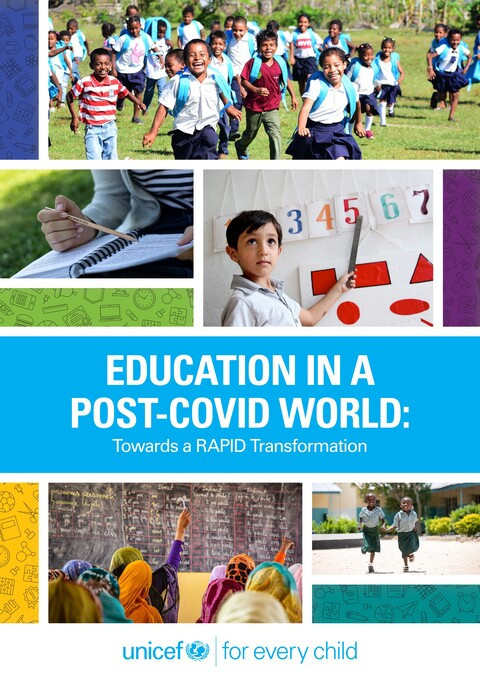 Education in a Post-COVID World: Towards a Rapid Transformation; Main Report Год публикации: 2023 Организация-автор: United Nations Children's Fund (UNICEF) On March 11, 2020, the World Health Organization declared COVID-19 a global pandemic, resulting in disruptions to education at an unprecedented scale. In response to the urgent need to recover learning losses, countries worldwide have taken RAPID actions to: Reach every child and keep them in school; Assess learning levels regularly; Prioritize teaching the fundamentals; Increase the efficiency of instruction; and Develop psychosocial health and wellbeing. Marking three years since the onset of the pandemic, this report looks back at policy measures taken during school closures and reopening based on country survey data, initiatives implemented by countries and regions to recover and accelerate learning, and their emerging lessons within each RAPID action. With schools now reopened worldwide, this report also looks ahead to longer-term education transformation, offering policy recommendations to build more resilient, effective and equitable education systems.
 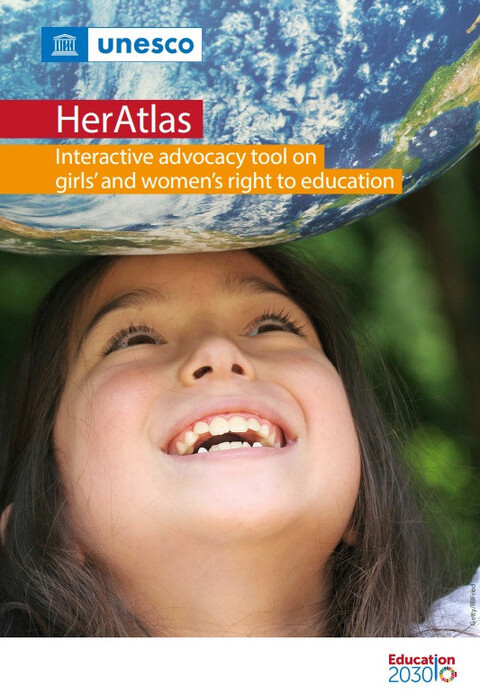 Her Atlas: Interactive Advocacy Tool on Girls’ and Women’s Right to Education Год публикации: 2023 Организация-автор: UNESCO Many girls and women cannot exercise their right to education due to gender inequality and discriminatory practices. Poverty, early marriage, and gender-based violence are just some of the many reasons behind the high percentage of global female illiteracy and school drop-outs. Strengthening the right of girls and women to quality education is key to eliminate discrimination and to achieve equal rights between genders. This cannot be achieved without solid national legal frameworks that are rightsbased, gender responsive and inclusive. This is where HerAtlas comes in. HerAtlas, is a first of its kind online tool that maps the right to education of girls and women. It aims to enhance public knowledge and monitor the status of national constitutions, legislation and regulations related to education rights for girls and women to encourage countries to take action, strengthen their laws and policies, and lead to long term change. Concrete changes are already apparent. In 2019, 4% of countries were explicitly restricting the right to education of married, pregnant, and parenting girls. This has dropped to 2% in 2022, benefiting millions of girls who can now legally attend school when they marry or become pregnant. Son Atlas: Outil de plaidoyer interactif sur le droit à l’éducation des filles et des femmes Год публикации: 2023 Организация-автор: UNESCO De nombreuses filles et femmes ne peuvent pas exercer leur droit à l'éducation en raison des inégalités entre les genres et des pratiques discriminatoires. La pauvreté, les mariages précoces et les violences basées sur le genre ne sont que quelques-unes des nombreuses raisons qui expliquent le pourcentage élevé d'analphabétisme et de décrochage scolaire chez les filles et les femmes dans le monde. Le renforcement du droit des filles et des femmes pour une éducation de qualité est essentiel pour éliminer la discrimination et parvenir à l'égalité des droits entre les genres. Ceci ne peut être réalisé sans des cadres juridiques nationaux solides, basés sur les droits, sensibles au genre et inclusifs. C'est là qu'intervient SonAtlas. SonAtlas est un outil en ligne, le premier du genre, qui cartographie le droit à l'éducation des filles et des femmes. Il vise à améliorer les connaissances du public et à surveiller le statut des constitutions, législations et réglementations nationales relatives aux droits à l'éducation des filles et des femmes, afin d'encourager les pays à agir, à renforcer leurs lois et leurs politiques et à entraîner un changement à long terme. Des changements concrets sont déjà visibles. En 2019, 4 % des pays restreignaient explicitement le droit à l'éducation des filles mariées, enceintes et jeunes mères. Ce chiffre a chuté à 2 % en 2022, au profit de millions de filles qui peuvent désormais aller à l'école en toute légalité lorsqu'elles se marient ou sont enceintes ou jeunes mères.
 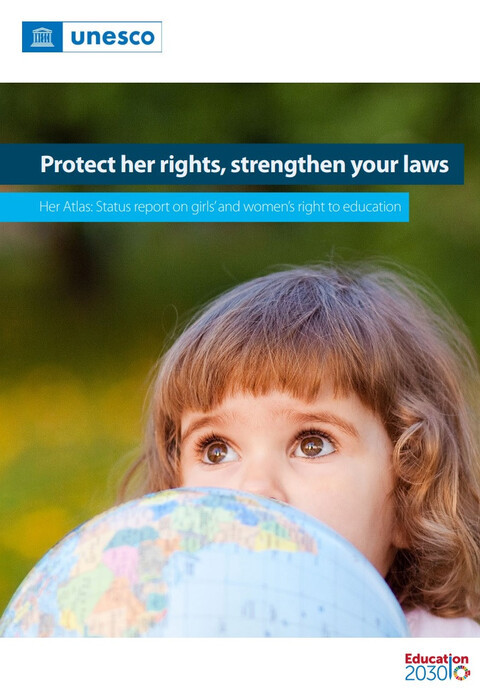 Protect Her Rights, Strengthen Your Laws: Her Atlas; Status Report on Girls’ and Women’s Right to Education Год публикации: 2022 Организация-автор: UNESCO UNESCO’s Her Education, our future initiative, Her Atlas was launched in 2019 with the aim to enhance public knowledge and monitor the status of national constitutions, legislation and regulations related to girls’ and women’s education rights in order to encourage countries to take actions to improve their legal frameworks. Three years after its launch, the research phase has been completed: overall, the legal frameworks of 196 countries have been thoroughly analyzed to evaluate the level of protection of girls’ and women’s right to education around the world. In an interactive world map format, Her Atlas uses a color-coded scoring system to monitor 12 indicators of legal progress towards gender equality in the right to education. This report marks the completion of the first research phase and intends to highlight some key trends outlined by the research work, and to emphasize examples of legal provisions regarding some aspects of girls’ and women’s right to education guaranteed by States’ domestic laws.
 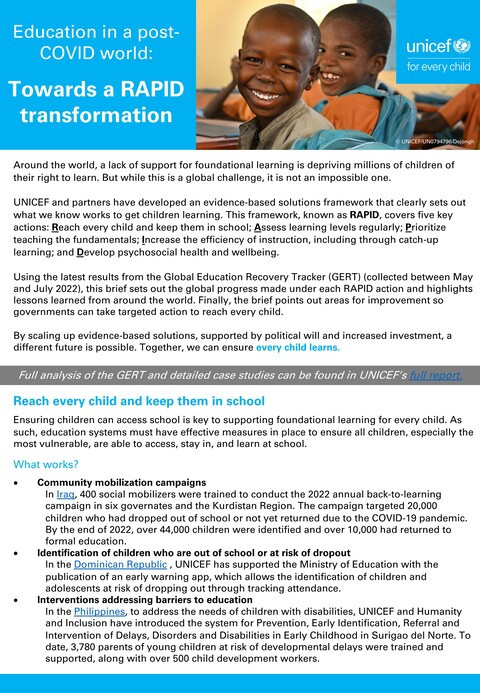 Education in a Post-COVID World: Towards a Rapid Transformation; Advocacy Brief Год публикации: 2023 Организация-автор: United Nations Children's Fund (UNICEF) Around the world, a lack of support for foundational learning is depriving millions of children of their right to learn. But while this is a global challenge, it is not an impossible one. UNICEF and partners have developed an evidence-based solutions framework that clearly sets out what we know works to get children learning. This framework, known as RAPID, covers five key actions: Reach every child and keep them in school; Assess learning levels regularly; Prioritize teaching the fundamentals; Increase the efficiency of instruction, including through catch-up learning; and Develop psychosocial health and wellbeing. Using the latest results from the Global Education Recovery Tracker (GERT) (collected between May and July 2022), this brief sets out the global progress made under each RAPID action and highlights lessons learned from around the world. Finally, the brief points out areas for improvement so governments can take targeted action to reach every child.
 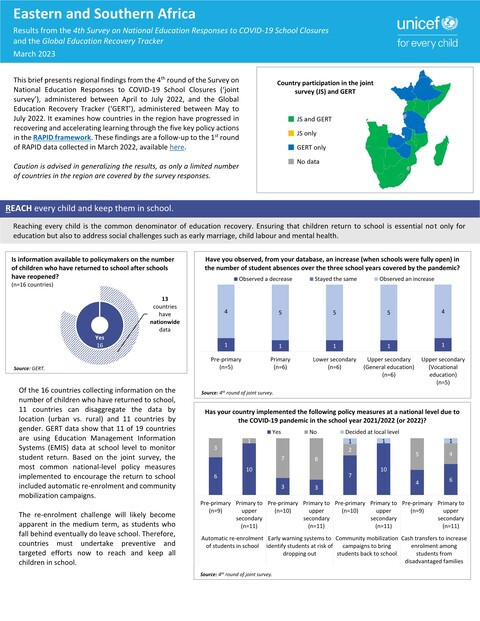 Education in a Post-COVID World: Towards a Rapid Transformation; Eastern and Southern Africa Regional Brief Год публикации: 2023 Организация-автор: United Nations Children's Fund (UNICEF) On March 11, 2020, the World Health Organization declared COVID-19 a global pandemic, resulting in disruptions to education at an unprecedented scale. In response to the urgent need to recover learning losses, countries worldwide have taken RAPID actions to: Reach every child and keep them in school; Assess learning levels regularly; Prioritize teaching the fundamentals; Increase the efficiency of instruction; and Develop psychosocial health and wellbeing. This brief presents regional findings from the 4th round of the Survey on National Education Responses to COVID-19 School Closures (‘joint survey’), administered between April to July 2022, and the Global Education Recovery Tracker (‘GERT’), administered between May to July 2022. It examines how countries in the region have progressed in recovering and accelerating learning through the five key policy actions in the RAPID framework. These findings are a follow-up to the 1st roundof RAPID data collected in March 2022.
 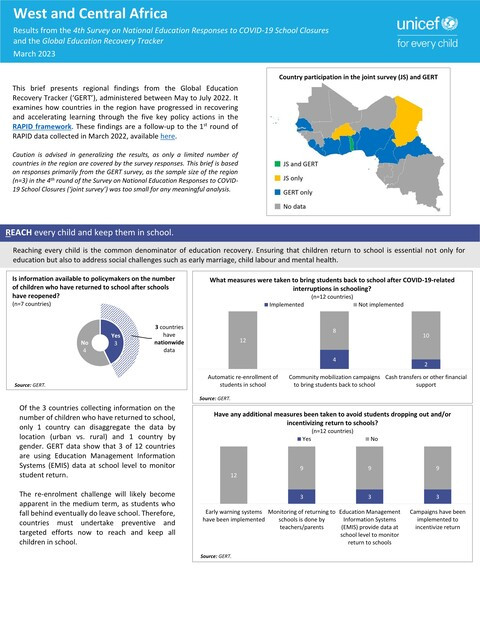 Education in a Post-COVID World: Towards a Rapid Transformation West and Central Africa Regional Brief Год публикации: 2023 Организация-автор: United Nations Children's Fund (UNICEF) On March 11, 2020, the World Health Organization declared COVID-19 a global pandemic, resulting in disruptions to education at an unprecedented scale. In response to the urgent need to recover learning losses, countries worldwide have taken RAPID actions to: Reach every child and keep them in school; Assess learning levels regularly; Prioritize teaching the fundamentals; Increase the efficiency of instruction; and Develop psychosocial health and wellbeing. This brief presents regional findings from the Global Education Recovery Tracker (‘GERT’), administered between May to July 2022. It examines how countries in the region have progressed in recovering and accelerating learning through the five key policy actions in the RAPID framework. These findings are a follow-up to the 1st round of RAPID data collected in March 2022.
 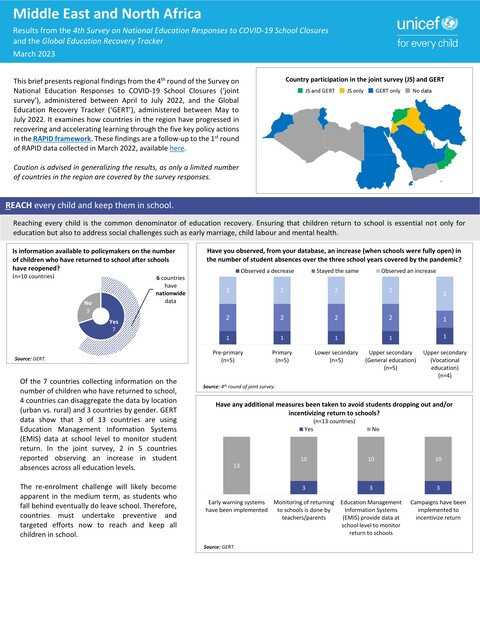 Education in a Post-COVID World: Towards a Rapid Transformation; Middle East and North Africa; Regional Brief Год публикации: 2023 Организация-автор: United Nations Children's Fund (UNICEF) On March 11, 2020, the World Health Organization declared COVID-19 a global pandemic, resulting in disruptions to education at an unprecedented scale. In response to the urgent need to recover learning losses, countries worldwide have taken RAPID actions to: Reach every child and keep them in school; Assess learning levels regularly; Prioritize teaching the fundamentals; Increase the efficiency of instruction; and Develop psychosocial health and wellbeing. This brief presents regional findings from the 4th round of the Survey on National Education Responses to COVID-19 School Closures (‘joint survey’), administered between April to July 2022, and the Global Education Recovery Tracker (‘GERT’), administered between May to July 2022. It examines how countries in the region have progressed in recovering and accelerating learning through the five key policy actions in the RAPID framework. These findings are a follow-up to the 1st round of RAPID data collected in March 2022.
 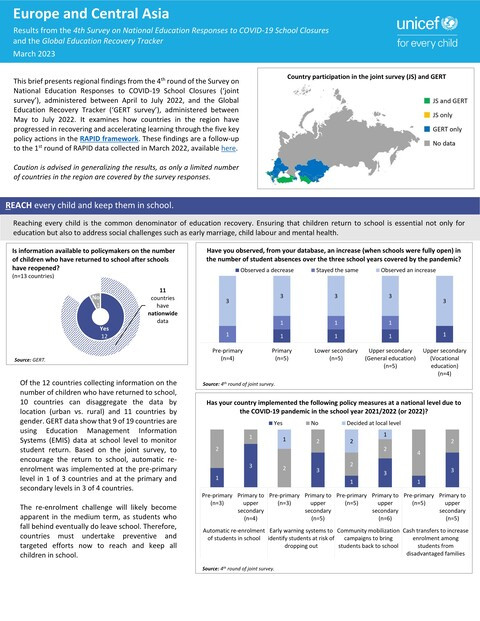 Education in a Post-COVID World: Towards a Rapid Transformation; Europe and Central Asia Regional Brief Год публикации: 2023 Организация-автор: United Nations Children's Fund (UNICEF) On March 11, 2020, the World Health Organization declared COVID-19 a global pandemic, resulting in disruptions to education at an unprecedented scale. In response to the urgent need to recover learning losses, countries worldwide have taken RAPID actions to: Reach every child and keep them in school; Assess learning levels regularly; Prioritize teaching the fundamentals; Increase the efficiency of instruction; and Develop psychosocial health and wellbeing. This brief presents regional findings from the 4th round of the Survey on National Education Responses to COVID-19 School Closures (‘joint survey’), administered between April to July 2022, and the Global Education Recovery Tracker (‘GERT survey’), administered between May to July 2022. It examines how countries in the region have progressed in recovering and accelerating learning through the five key policy actions in the RAPID framework. These findings are a follow-up to the 1st round of RAPID data collected in March 2022.