
Ресурсы
Изучайте широкий спектр ценных ресурсов ВГГ, чтобы углубить своё понимание и повысить эффективность исследований, просветительской деятельности, преподавания и обучения.
Найдено: 83
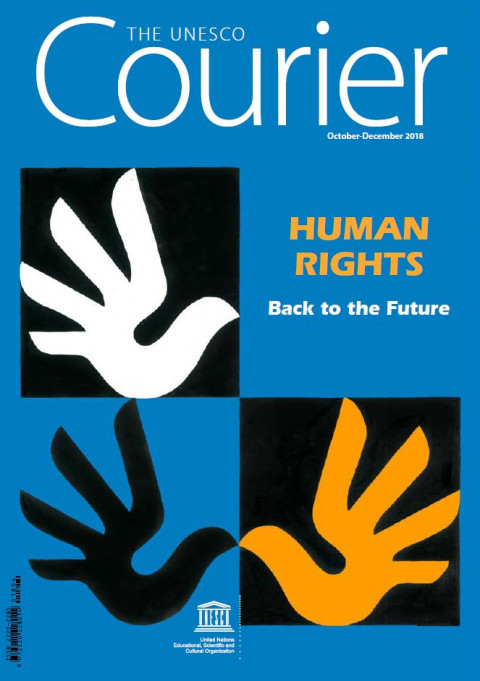 Droits de l’homme : retour vers le futur (Le Courrier de l’UNESCO no. 4, octobre-décembre 2018) Год публикации: 2018 Организация-автор: UNESCO Benedetto Croce, Aldous Huxley, Humayun Kabir, Harold J. Laski, Lo Chung-Shu, Jacques Maritain, F. S. C. Northrop, Arnold Schoenberg, Pierre Teilhard de Chardin : voici quelques-uns des contributeurs de ce numéro du Courrier. Pour marquer le soixante-dixième anniversaire de la Déclaration universelle des droits de l’homme, adoptée le 10 décembre 1948, nous avons décidé de faire un détour par le passé, afin de mieux nous orienter dans l’avenir. Ce qui explique le titre de ce numéro : « Retour vers le futur ». Nous sommes donc en 1946. Alors que le spectre de la guerre totale hante tous les esprits, « la communauté internationale a besoin de formuler un énoncé moral qui exprime adéquatement son indignation collective et son espoir (pour utopique qu'il fût) d'un avenir meilleur », explique Mark Goodale, auteur de l’article introductif et consultant pour Grand angle. Un dossier qui dévoile tout un pan méconnu de l’histoire de la Déclaration universelle des droits de l’homme : l’enquête mondiale sur les fondements philosophiques des droits de l’homme, décidée lors de la première Conférence générale de l’UNESCO (novembre-décembre 1946), lancée l’année suivante par le premier Directeur général, Julian Huxley, et coordonnée par le jeune philosophe français Jacques Havet. L’UNESCO a réuni autour de ce projet l’élite intellectuelle du monde de l'après-guerre et apporté ainsi une contribution essentielle à la réflexion sur les droits de l’homme. Elle demeure aujourd’hui d’une étonnante actualité. Tout aussi actuels sont les dessins de Notre invité, l’artiste péruvien Fernando Bryce qui puise son inspiration dans cette période historique « où l'idée de progrès ouvrait réellement de multiples perspectives ». Sa série The Book of Needs (Le livre des nécessités), qui transfigure en œuvres d’art des pages du Courrier des années 1948 - 1954, fait l’objet du supplément à ce numéro. Права человека: назад в будущее (Курьер ЮНЕСКО no. 4, октябрь-декабрь 2018 года) Год публикации: 2018 Организация-автор: UNESCO Среди авторов этого номера «Курьера ЮНЕСКО» – Морис Добб, Гарольд Дж. Ласки, Бенедетто Кроче, Олдос Хаксли, Ло Чун-Шу, Арнольд Шёнберг и другие выдающиеся деятели прошлого столетия. По случаю 70-летия Всеобщей декларации прав человека, принятой 10 декабря 1948 года, мы решили вернуться в прошлое, чтобы с большей ясностью смотреть в будущее. Поэтому текущий номер так и называется: «Назад в будущее». Представим же, что сейчас вновь 1946 год. Над миром витает жуткий призрак тотальной войны, и международное сообщество испытывает «потребность выступить с совместным заявлением морального характера, в котором оно могло бы в должной мере выразить всеобщее негодование и надежду на лучшее будущее, какой бы утопичной она ни казалась», – поясняет специалист по социальной антропологии Марк Гудэйл во вступительной статье к подготовленной с его помощью рубрике «Широкий обзор». Материалы этой рубрики знакомят читателей с малоизвестным фактом из истории Всеобщей декларации прав человека – всемирным опросом, проведенным ЮНЕСКО по инициативе первого Генерального директора Джулиана Хаксли с целью определения философских принципов, лежащих в основе прав человека. Решение о его проведении было принято на 1-й сессии Генеральной конференции ЮНЕСКО, состоявшейся в ноябре-декабре 1946 года, а сам опрос был проведен годом позже. Руководство этим масштабным проектом осуществлял молодой французский философ Жак Аве. В опросе, призванном заложить основы для размышлений о правах человека, приняли участие яркие представители интеллектуальной элиты послевоенного общества. Несмотря на прошедшие с тех пор 70 лет, поднятые в ходе этого проекта вопросы по-прежнему чрезвычайно актуальны. Столь же актуальны и рисунки нашего гостя, перуанского художника Фернандо Брисе, черпающего вдохновение в «том особом периоде, когда идея прогресса действительно открывала многочисленные перспективы». Этому периоду он посвятил серию под названием The Book of Needs («Книга потребностей»), рисунки из которой виртуозно воспроизводят страницы «Курьера ЮНЕСКО» за 1948-1954 год. Большую часть из них можно увидеть в приложении к текущему номеру журнала.
 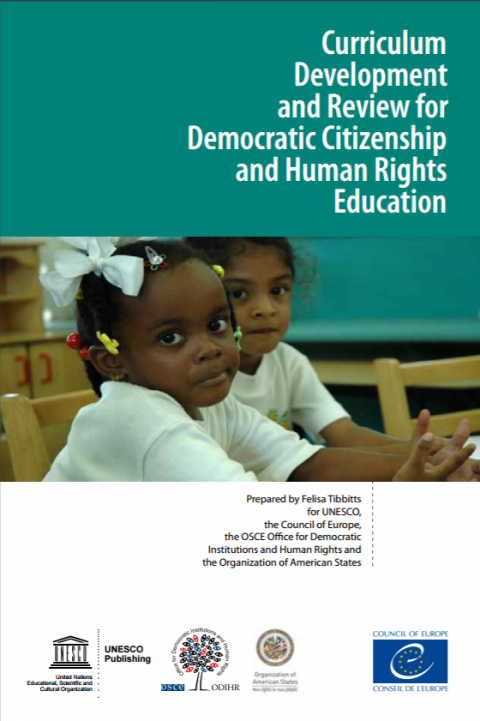 Curriculum Development and Review for Democratic Citizenship and Human Rights Education Год публикации: 2016 Организация-автор: UNESCO | Council of Europe | Organization of American States (OAS) | OSCE. Office for Democratic Institutions and Human Rights (ODIHR) Education for democratic citizenship and human rights education are vital for peaceful, sustainable and inclusive societies based on respect for the human rights of every person. Effective teaching and learning processes require well-trained teachers, positive learning environments and high-quality learning materials. This is underpinned by education policy, including curriculum development and review, which is the main focus of this book. The strengthening of education policies in the fields of education for democratic citizenship and human rights lies at the very heart of the efforts of the Council of Europe, the United Nations Educational, Scientific and Cultural Organization, the Office for Democratic Institutions and Human Rights of the Organization for Security and Co-operation in Europe, and the Organization of American States. These organisations have jointly produced this publication in order to support states’ commitment to fostering citizenship and human rights education and improving access to quality education for all. Élaboration et révision des programmes d'enseignement pour l'éducation à la citoyenneté démocratique et aux droits de l'homme Год публикации: 2016 Организация-автор: UNESCO | Council of Europe | Organization of American States (OAS) | OSCE. Office for Democratic Institutions and Human Rights (ODIHR) Education for democratic citizenship and human rights education are vital for peaceful, sustainable and inclusive societies based on respect for the human rights of every person. Effective teaching and learning processes require well-trained teachers, positive learning environments and high-quality learning materials. This is underpinned by education policy, including curriculum development and review, which is the main focus of this book. The strengthening of education policies in the fields of education for democratic citizenship and human rights lies at the very heart of the efforts of the Council of Europe, the United Nations Educational, Scientific and Cultural Organization, the Office for Democratic Institutions and Human Rights of the Organization for Security and Co-operation in Europe, and the Organization of American States. These organisations have jointly produced this publication in order to support states’ commitment to fostering citizenship and human rights education and improving access to quality education for all. Разработка и пересмотр учебных программ по воспитанию демократической гражданственности и образованию в области прав человека Год публикации: 2016 Организация-автор: UNESCO | Council of Europe | Organization of American States (OAS) | OSCE. Office for Democratic Institutions and Human Rights (ODIHR) Education for democratic citizenship and human rights education are vital for peaceful, sustainable and inclusive societies based on respect for the human rights of every person. Effective teaching and learning processes require well-trained teachers, positive learning environments and high-quality learning materials. This is underpinned by education policy, including curriculum development and review, which is the main focus of this book. The strengthening of education policies in the fields of education for democratic citizenship and human rights lies at the very heart of the efforts of the Council of Europe, the United Nations Educational, Scientific and Cultural Organization, the Office for Democratic Institutions and Human Rights of the Organization for Security and Co-operation in Europe, and the Organization of American States. These organisations have jointly produced this publication in order to support states’ commitment to fostering citizenship and human rights education and improving access to quality education for all.
  Teacher Training for Multicultural Education in Favour of Democracy and Sustainable Development: the Territorial Approach Год публикации: 1995 Автор: Raúl Galiardi | Paula Bernadini Mosconi Организация-автор: UNESCO This publication is part of the book Teacher Training and Multiculturalism: National Studies. This book presents the outcomes concerning the initial training systems of teachers in eight countries at different levels of development in different regions of the world but who are faced with a common challenge to educate for cultural diversity. Both the conclusions of each particular study and the general outcomes demonstrate the complexity of the problems and the benefits of comparative analysis. Overcoming prejudices and stereotypes is not an easy task nor likely to be achieved in the short term. Mentalities change far more slowly than knowledge and, because of this, educational strategies need to be applied in the long term. This study also shows that it is necessary to improve the exchange of experiences as well as contacts between people and institutions who are confronted with the same problems in different contexts. The publication of the initial outcomes of this project is intended to enrich the quality of discussions between specialists and institutions who, in different parts of the world, are concerned by multicultural education as an instrument to promote understanding, respect and dialogue between cultures.
 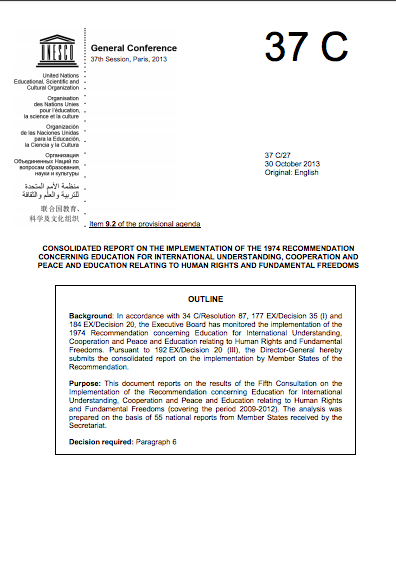 التقرير الجامع عن تنفيذ توصية عام ١٩٧٤ بشأن التربية من أجل التفاهم والتعاون والسلام على الصعيد الدولي والتربية في مجال حقوق الإنسان وحرياته الأساسية Год публикации: 2013 Организация-автор: UNESCO Background: In accordance with 34 C/Resolution 87, 177 EX/Decision 35 (I) and 184 EX/Decision 20, the Executive Board has monitored the implementation of the 1974 Recommendation concerning Education for International Understanding, Cooperation and Peace and Education relating to Human Rights and Fundamental Freedoms. Pursuant to 192 EX/Decision 20 (III), the Director-General hereby submits the consolidated report on the implementation by Member States of the Recommendation.Purpose: This document reports on the results of the Fifth Consultation on the Implementation of the Recommendation concerning Education for International Understanding, Cooperation and Peace and Education relating to Human Rights and Fundamental Freedoms (covering the period 2009-2012). The analysis was prepared on the basis of 55 national reports from Member States received by the Secretariat. Consolidated Report on the Implementation of the 1974 Recommendation Concerning Education for International Understanding, Cooperation and Peace and Education Relating to Human Rights and Fundamental Freedoms Год публикации: 2013 Организация-автор: UNESCO Background: In accordance with 34 C/Resolution 87, 177 EX/Decision 35 (I) and 184 EX/Decision 20, the Executive Board has monitored the implementation of the 1974 Recommendation concerning Education for International Understanding, Cooperation and Peace and Education relating to Human Rights and Fundamental Freedoms. Pursuant to 192 EX/Decision 20 (III), the Director-General hereby submits the consolidated report on the implementation by Member States of the Recommendation.Purpose: This document reports on the results of the Fifth Consultation on the Implementation of the Recommendation concerning Education for International Understanding, Cooperation and Peace and Education relating to Human Rights and Fundamental Freedoms (covering the period 2009-2012). The analysis was prepared on the basis of 55 national reports from Member States received by the Secretariat. Informe de síntesis sobre la aplicación por los Estados Miembros de la Recomendación de 1974 sobre la Educación para la Comprensión, la Cooperación y la Paz Internacionales y la Educación relativa a los Derechos Humanos y las Libertades Fundamentales Год публикации: 2013 Организация-автор: UNESCO Background: In accordance with 34 C/Resolution 87, 177 EX/Decision 35 (I) and 184 EX/Decision 20, the Executive Board has monitored the implementation of the 1974 Recommendation concerning Education for International Understanding, Cooperation and Peace and Education relating to Human Rights and Fundamental Freedoms. Pursuant to 192 EX/Decision 20 (III), the Director-General hereby submits the consolidated report on the implementation by Member States of the Recommendation.Purpose: This document reports on the results of the Fifth Consultation on the Implementation of the Recommendation concerning Education for International Understanding, Cooperation and Peace and Education relating to Human Rights and Fundamental Freedoms (covering the period 2009-2012). The analysis was prepared on the basis of 55 national reports from Member States received by the Secretariat.
  Programa Mundial para Educação em Direitos Humanos: terceira fase, plano de ação Год публикации: 2015 Организация-автор: UNESCO Brasilia | UN. Office of the United Nations High Commissioner for Human Rights (UN. OHCHR) De acordo com a Resolução 24/15 do Conselho de Direitos Humanos, o Escritório do Alto Comissariado das Nações Unidas para os Direitos Humanos (ACNUDH) elaborou, no primeiro trimestre de 2014, um esboço de plano de ação para a terceira fase (2015-2019) do Programa Mundial para Educação em Direitos Humanos (PMEDH) tomando como base, entre outros, importantes instrumentos e documentos das Nações Unidas, os planos de ação da primeira (2005- 2009) e da segunda (2010-2014) fases do PMEDH e outros materiais publicados pelo ACNUDH e pelas Nações Unidas. Em abril e maio, o esboço de plano de ação foi submetido à análise dos Estados, organizações intergovernamentais relevantes, incluindo a Organização das Nações Unidas para a Educação, a Ciência e a Cultura (UNESCO), instituições nacionais de direitos humanos e sociedade civil. Em 4 de julho, o ACNUDH recebeu 30 respostas com os comentários, os quais foram levados em consideração no texto final e que constituem as Seções de II a V do presente relatório.