
Ресурсы
Изучайте широкий спектр ценных ресурсов ВГГ, чтобы углубить своё понимание и повысить эффективность исследований, просветительской деятельности, преподавания и обучения.
Найдено: 78
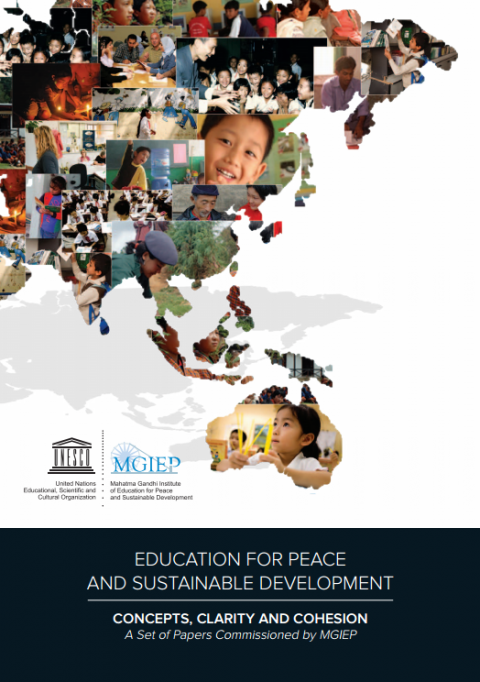 Education for peace and sustainable development: concepts, clarity and cohesion Год публикации: 2013 Организация-автор: Mahatma Gandhi Institute of Education for Peace and Sustainable Development (MGIEP) UNESCO MGIEP's focus lies in exploring and engaging with the strong interlinkages between peace and sustainable development and making interventions in the education systems to impart these principles. The first publication from the Institute Education for Peace and Sustainable Development: Concepts, Clarity and Cohesion explores the interlinkages and interdependencies of Education for Peace and Education for Sustainable Development. The monograph contains four concept papers which elaborate on the interlinkages between education, peace and sustainable development, define the gaps in the current approach to education for peace and sustainable development and argue for a comprehensive approach to issues of peace and sustainability to be incorporated in education systems. UNESCO MGIEP aims to develop a theoretical framework to look at the interlinkages between peace and sustainability in a holistic manner and this monograph is the first exercise towards building this discourse. L'éducation pour la paix et le développement durable: concepts, la clarté et la cohésion Год публикации: 2013 Организация-автор: Mahatma Gandhi Institute of Education for Peace and Sustainable Development (MGIEP) La mise au point de l'UNESCO MGIEP réside dans l'exploration et la collaboration avec les liens étroits entre la paix et le développement durable et faire des interventions dans les systèmes éducatifs pour communiquer ces principes. La première publication de «L'éducation pour la paix et le développement durable: concepts, la clarté et la cohésion de l'Institut explore les liens et les interdépendances de l'éducation pour la paix et l'éducation pour le développement durable. La monographie contient quatre documents de réflexion qui élaborent sur les liens entre l'éducation, la paix et le développement durable, définissent les lacunes dans l'approche actuelle de l'éducation pour la paix et le développement durable et plaident en faveur d'une approche globale des questions de paix et de développement durable à incorporer dans l'éducation systèmes. UNESCO MGIEP vise à développer un cadre théorique pour examiner les liens entre la paix et le développement durable d'une manière holistique et cette monographie est le premier exercice à la construction de ce discours.
  Education for conflict prevention and peacebuilding: meeting the global challenges of the 21st century Год публикации: 2012 Автор: Phyllis Kotite Организация-автор: UNESCO International Institute for Educational Planning (IIEP) The 21st century is witnessing global concern over the interrelated effects of climate change, the economic crisis, energy depletion, food and water shortages, natural disasters and conflicts all of which have devastating effects on humanity and the future of the planet. These events impact education systems and can impair the ability of governments to provide quality education for their citizens. However, when governments and ministries of education analyse and anticipate the risk of such events through careful planning, education can play an important role in preventing violent conflict, and in supporting peacebuilding efforts. An estimated 1.5 billion people live in countries affected by repeated cycles of political and other forms of violence, and the same population is often affected by hunger and poverty. Furthermore, such countries have difficulty meeting development goals. For example, no low-income fragile or conflict-affected country has yet achieved a single MDG (World Bank, 2011). In 2010 world military expenditures reached US$1.6 trillion as a result of fifteen ongoing conflicts (SIPRI, 2011). Yet, it is estimated that only US$16 billion is needed to fill the education gap to reach the EFA goals (UNESCO, 2011b: 11). This paper argues that we have the knowledge, legal instruments and mechanisms to prevent conflict and to transfer resources to sustainable development and education to meet the challenges of the 21st century. The paper describes a range of conflict prevention initiatives and examines the role of policy-makers, youth, women, and the media in maintaining and restoring peace as part of a holistic vision of education. International institutions, governments and civil society are increasingly developing conflict prevention mechanisms and utilizing political and economic incentives to avoid conflicts. They are also creating new technology for sustainable development, adaptation to climate change and renewable forms of energy. Educational planning must therefore go beyond traditional mechanisms. It must take into consideration the unpredictable nature of our times; be flexible and rapid in implementation and responsive to local needs. Training and research in sustainable development; and skills for peaceful inter-human relations, good governance, the prevention of conflict and peacebuilding are priorities elaborated in the paper. In addition, specific recommendations are highlighted such as: capacity development for conflict prevention within the education sector and other ministries, analysing the root causes of conflict and the role that education can play in mitigating tensions. This paper is an elaboration of Chapter 1.2 of the IIEP-UNESCO Guidebook for Planning Education in Emergencies and Reconstruction (IIEP-UNESCO, 2010). A brief treatment of additional global challenges (e.g. water scarcity, food insufficiency, energy depletion and economic instability), which are beyond the educational focus of this paper, may be found in Annex I. Education for conflict prevention and peacebuilding: meeting the global challenges of the 21st century Год публикации: 2012 Автор: Phyllis Kotite Организация-автор: UNESCO International Institute for Educational Planning (IIEP) Le 21ème siècle est témoin de préoccupation mondiale sur les effets interdépendants du changement climatique, la crise économique, l'épuisement de l'énergie, la pénurie de nourriture et d'eau, les catastrophes naturelles et les conflits qui ont tous des effets dévastateurs sur l'humanité et l'avenir de la planète. Ces événements influent sur les systèmes d'éducation et peuvent nuire à la capacité des gouvernements à fournir une éducation de qualité pour leurs citoyens. Toutefois, lorsque les gouvernements et les ministères de l'éducation analysent et anticipent le risque de ces événements à travers une planification minutieuse, l'éducation peut jouer un rôle important dans la prévention des conflits violents, et à soutenir les efforts de consolidation de la paix. On estime que 1,5 milliard de personnes vivent dans des pays touchés par des cycles répétés de formes politiques et autres de la violence, et la même population est souvent affectée par la faim et la pauvreté. En outre, ces pays ont des difficultés à atteindre les objectifs de développement. Par exemple, aucun pays à faible revenu fragiles ou touchés par un conflit n'a encore atteint un seul OMD (Banque mondiale, 2011). En 2010 dépenses militaires mondiales ont atteint US $ 1,6 trillions en raison de quinze conflits en cours (SIPRI, 2011). Pourtant, on estime que seulement 16 milliards $ US est nécessaire pour combler le déficit de l'éducation pour atteindre les objectifs de l'EPT (UNESCO, 2011b: 11). Ce document fait valoir que nous avons les connaissances, les instruments juridiques et des mécanismes de prévention des conflits et de transférer des ressources pour le développement durable et l'éducation pour relever les défis du 21e siècle. Le document décrit une série d'initiatives de prévention des conflits et examine le rôle des décideurs politiques, les jeunes, les femmes et les médias dans le maintien et le rétablissement de la paix dans le cadre d'une vision holistique de l'éducation. Les institutions internationales, les gouvernements et la société civile sont de plus en plus de développer des mécanismes de prévention des conflits et de l'utilisation des incitations politiques et économiques pour éviter les conflits. Ils créent également une nouvelle technologie pour le développement durable, l'adaptation aux changements climatiques et les énergies renouvelables. Planification de l'éducation doit donc aller au-delà des mécanismes traditionnels. Il doit prendre en considération la nature imprévisible de notre temps; être flexible et rapide et répondre aux besoins locaux. Formation et recherche dans le développement durable; et les compétences pour les relations inter-humaines pacifiques, la bonne gouvernance, la prévention des conflits et de consolidation de la paix sont des priorités élaborées dans le document. En outre, des recommandations spécifiques sont mis en évidence, tels que: le renforcement des capacités de prévention des conflits dans le secteur de l'éducation et d'autres ministères, l'analyse des causes profondes des conflits et le rôle que l'éducation peut jouer pour atténuer les tensions. Ce document est une élaboration du Chapitre 1.2 du Guide de l'IIPE-UNESCO pour l'Éducation de la Planification en situation d'Urgence et de Reconstruction (IIPE-UNESCO, 2010).
  An intercultural program from a Balkan perspective Год публикации: 2003 Автор: Emilia Ilieva The author focuses on the particular case of the Bosporus International Network as an intercultural program. Bosporus International Network is a network of five independent and registered NGOs in Germany, Bulgaria, Romania, Greece and Turkey and four local groups in Albania, Macedonia/FYROM, Slovenia and Hungary that share the same name, goals and aims. The goal of the network can best be described as “building bridges" between cultures.
 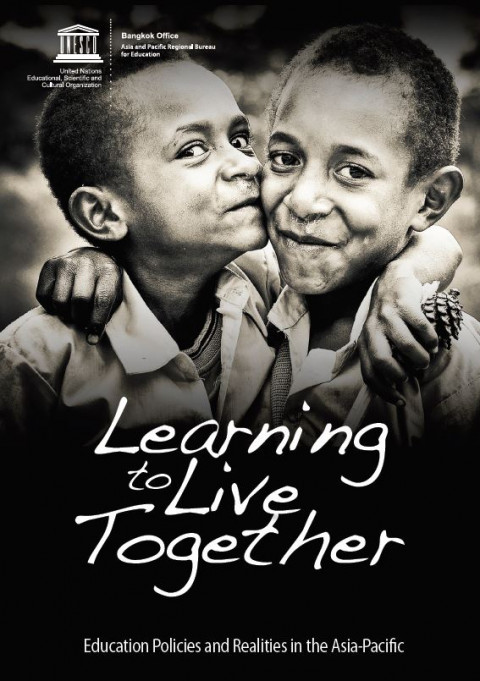 Learning to live together Год публикации: 2014 Организация-автор: UNESCO Bangkok The importance of LTLT has increased in recent years. Indeed, relevant competencies appear to be gaining focus in international frameworks and educational initiatives across countries. This is all the more necessary as Voogt and Roblin (2012) argue, given the demands of our increasingly knowledge-based society in which “ideas and knowledge function as commodities” (p. 299 –300) and to which effective social and emotional skills are critical. It is perhaps all the more critical given the multivariate global challenges in the 21st Century and the need for unified global commitment to effectively combat these challenges. In this context, the significance of LTLT is reflected in both the rise of and growing interest in Global Citizenship Education (GCE), Education for Sustainable Development (ESD), Education for International Understanding (EIU) as well as peace and human rights education. The UN Secretary-General’s Global Education First Initiative, which lists ‘Fostering Global Citizenship’ as one of its three global priorities, also implicitly recognizes the significance of LTLT as a precursor to the building of a more peaceful society, one in which discrimination is intolerable and common challenges such as climate change and abject poverty are tackled together.Yet despite the significance of LTLT in the 21st Century, and despite numerous international initiatives to foster LTLT competencies, there is a large gap of evidence identifying how this supposition is translated into effective policy and curricula, and eventually into the reality of schools, teachers and learners. This report is a response to this gap, and attempts to understand how ten selected countries in the Asia-Pacific region – Afghanistan, Australia, Indonesia, Malaysia, Myanmar, Nepal, The Philippines, Republic of Korea, Sri Lanka and Thailand – have reflected and integrated LTLT into their education policies and initiatives. This variety of countries aims to reflect their diverse experiences in terms of reflecting LTLT through their education systems. By exploring a number of areas, namely policy, curricula, teachers and assessment, this study aims to identify what has so far been achieved in education systems of the Asia-Pacific region in the area of LTLT.This report is therefore targeted predominantly at education policy makers, researchers, academics as well as education practitioners of the Asia-Pacific region. Given its connection to Global Citizenship Education and other relevant international initiatives around sustainability and peace education, this report is also relevant to UNESCO’s partner organizations and the broader educational development community.This report will first present the research framework for the study, before exploring the social and economic contexts in the ten selected countries and wider regional factors in the Asia-Pacific in relation to global challenges in Chapter Two. Chapter Three will then examine national policy frameworks, including the vision of those policies in defining LTLT in education. Chapter Four focuses on the national curriculum in selected countries and the extent to which they incorporate learning objectives, subjects, and extra-curricular activities reflecting the concept of LTLT and related skills and competencies. In Chapter Five, teaching practices are examined, including the role of teachers and teacher education, as well as teaching methods and application of media and information literacy (MIL) in the classroom. Chapter Six then looks at assessment, and how far countries have attempted to develop assessment frameworks that measure the skills and competencies related to LTLT. Finally, Chapter Seven provides reflections and conclusions based on the main findings of the study, while also identifying trends across policy domains, shortcomings and some policy considerations. Aprender a vivir juntos: un programa intercultural e interreligioso para la educacion ética Год публикации: 2008 Организация-автор: Arigatou Foundation (Switzerland) | Interfaith Council on Ethics Education for Children Learning to Live Together has been developed for use in different religious and secular contexts as a resource for everyone concerned with promoting ethics and values. The objective has been to develop a resource that is relevant on a global level and yet flexible enough to be interpreted within different cultural and social contexts. The resource has been tested in many different regions and cultural contexts to assure that it is relevant in regional and local contexts (see ‘We did it like this’, p.187). Test workshops have been held in 10 different countries, where the GNRC was able to bring together various religious and secular organisations working with children. During the test workshops, this resource manual was used to the benefit of more than 300 children and youth, representing African Traditional Religions, Bahá’í Faith, Buddhism, Christianity, Hinduism, Islam, Judaism, members of Brahma Kumaris and a number of people of secular thinking. Test workshops as well as input and comments from experts in the area of education, ethics, spirituality, intercultural and interfaith learning and child rights have contributed important experiences and opportunities for learning for the development of this resource. Learning to Live Together is already having an impact. In a GNRC programme in Israel, the resource material was used during a six-day journey made by a group of Jewish, Christian, and Muslim youth to the historical sites of Israel and Palestine, all of which have symbolic relevance to the conflict in their region. At each stop, youth participants discussed their values and their differing perceptions of their shared history. Learning to Live Together is an adaptable resource that can be used with children from many different cultural, religious and social contexts to nurture common values and a mutual respect for different backgrounds and traditions. The resource provides space for enhancing children’s innate potential for spirituality and hope for a better world, as a contribution to changing the situation for children worldwide. The Users Guide provides all necessary information for its use. UNESCO and UNICEF have been closely involved in developing Learning to Live Together and have endorsed the material as an important contribution to a quality education, which takes a multicultural and multi-religious society into consideration. UNESCO’s Guidelines for Intercultural Education underpin the philosophy and the approach of the resource: “Religious education can be described as learning about one’s own religion or spiritual practices, or learning about other religions or beliefs. Interfaith education, in contrast, aims to actively shape the relations between people from different religions”. Apprendre à vivre ensemble: un programme interculturel et interreligieux pour l'enseignement de l'éthique Год публикации: 2008 Организация-автор: Arigatou Foundation (Switzerland) | Interfaith Council on Ethics Education for Children Learning to Live Together has been developed for use in different religious and secular contexts as a resource for everyone concerned with promoting ethics and values. The objective has been to develop a resource that is relevant on a global level and yet flexible enough to be interpreted within different cultural and social contexts. The resource has been tested in many different regions and cultural contexts to assure that it is relevant in regional and local contexts (see ‘We did it like this’, p.187). Test workshops have been held in 10 different countries, where the GNRC was able to bring together various religious and secular organisations working with children. During the test workshops, this resource manual was used to the benefit of more than 300 children and youth, representing African Traditional Religions, Bahá’í Faith, Buddhism, Christianity, Hinduism, Islam, Judaism, members of Brahma Kumaris and a number of people of secular thinking. Test workshops as well as input and comments from experts in the area of education, ethics, spirituality, intercultural and interfaith learning and child rights have contributed important experiences and opportunities for learning for the development of this resource. Learning to Live Together is already having an impact. In a GNRC programme in Israel, the resource material was used during a six-day journey made by a group of Jewish, Christian, and Muslim youth to the historical sites of Israel and Palestine, all of which have symbolic relevance to the conflict in their region. At each stop, youth participants discussed their values and their differing perceptions of their shared history. Learning to Live Together is an adaptable resource that can be used with children from many different cultural, religious and social contexts to nurture common values and a mutual respect for different backgrounds and traditions. The resource provides space for enhancing children’s innate potential for spirituality and hope for a better world, as a contribution to changing the situation for children worldwide. The Users Guide provides all necessary information for its use. UNESCO and UNICEF have been closely involved in developing Learning to Live Together and have endorsed the material as an important contribution to a quality education, which takes a multicultural and multi-religious society into consideration. UNESCO’s Guidelines for Intercultural Education underpin the philosophy and the approach of the resource: “Religious education can be described as learning about one’s own religion or spiritual practices, or learning about other religions or beliefs. Interfaith education, in contrast, aims to actively shape the relations between people from different religions”. تعلم العيش معا: برنامج التواصل بين الثقافات والأديان لتعليم الأخلاق Год публикации: 2008 Организация-автор: Interfaith Council on Ethics Education for Children | Arigatou Foundation (Switzerland) Learning to Live Together has been developed for use in different religious and secular contexts as a resource for everyone concerned with promoting ethics and values. The objective has been to develop a resource that is relevant on a global level and yet flexible enough to be interpreted within different cultural and social contexts. The resource has been tested in many different regions and cultural contexts to assure that it is relevant in regional and local contexts (see ‘We did it like this’, p.187). Test workshops have been held in 10 different countries, where the GNRC was able to bring together various religious and secular organisations working with children. During the test workshops, this resource manual was used to the benefit of more than 300 children and youth, representing African Traditional Religions, Bahá’í Faith, Buddhism, Christianity, Hinduism, Islam, Judaism, members of Brahma Kumaris and a number of people of secular thinking. Test workshops as well as input and comments from experts in the area of education, ethics, spirituality, intercultural and interfaith learning and child rights have contributed important experiences and opportunities for learning for the development of this resource. Learning to Live Together is already having an impact. In a GNRC programme in Israel, the resource material was used during a six-day journey made by a group of Jewish, Christian, and Muslim youth to the historical sites of Israel and Palestine, all of which have symbolic relevance to the conflict in their region. At each stop, youth participants discussed their values and their differing perceptions of their shared history. Learning to Live Together is an adaptable resource that can be used with children from many different cultural, religious and social contexts to nurture common values and a mutual respect for different backgrounds and traditions. The resource provides space for enhancing children’s innate potential for spirituality and hope for a better world, as a contribution to changing the situation for children worldwide. The Users Guide provides all necessary information for its use. UNESCO and UNICEF have been closely involved in developing Learning to Live Together and have endorsed the material as an important contribution to a quality education, which takes a multicultural and multi-religious society into consideration. UNESCO’s Guidelines for Intercultural Education underpin the philosophy and the approach of the resource: “Religious education can be described as learning about one’s own religion or spiritual practices, or learning about other religions or beliefs. Interfaith education, in contrast, aims to actively shape the relations between people from different religions”.
 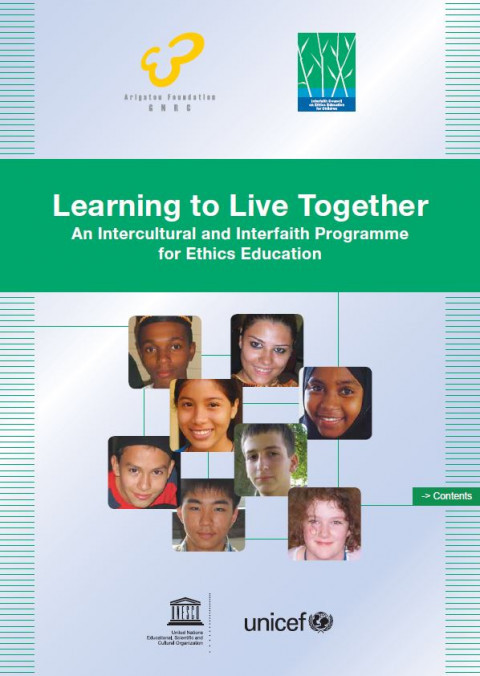 Learning to live together: an intercultural and interfaith programme for ethics education Год публикации: 2008 Организация-автор: Interfaith Council on Ethics Education for Children | Arigatou Foundation (Switzerland) Learning to Live Together has been developed for use in different religious and secular contexts as a resource for everyone concerned with promoting ethics and values. The objective has been to develop a resource that is relevant on a global level and yet flexible enough to be interpreted within different cultural and social contexts. The resource has been tested in many different regions and cultural contexts to assure that it is relevant in regional and local contexts (see ‘We did it like this’, p.187).Test workshops have been held in 10 different countries, where the GNRC was able to bring together various religious and secular organisations working with children. During the test workshops, this resource manual was used to the benefit of more than 300 children and youth, representing African Traditional Religions, Bahá’í Faith, Buddhism, Christianity, Hinduism, Islam, Judaism, members of Brahma Kumaris and a number of people of secular thinking. Test workshops as well as input and comments from experts in the area of education, ethics, spirituality, intercultural and interfaith learning and child rights have contributed important experiences and opportunities for learning for the development of this resource. Learning to Live Together is already having an impact. In a GNRC programme in Israel, the resource material was used during a six-day journey made by a group of Jewish, Christian, and Muslim youth to the historical sites of Israel and Palestine, all of which have symbolic relevance to the conflict in their region. At each stop, youth participants discussed their values and their differing perceptions of their shared history.Learning to Live Together is an adaptable resource that can be used with children from many different cultural, religious and social contexts to nurture common values and a mutual respect for different backgrounds and traditions. The resource provides space for enhancing children’s innate potential for spirituality and hope for a better world, as a contribution to changing the situation for children worldwide. The Users Guide provides all necessary information for its use. UNESCO and UNICEF have been closely involved in developing Learning to Live Together and have endorsed the material as an important contribution to a quality education, which takes a multicultural and multi-religious society into consideration. UNESCO’s Guidelines for Intercultural Education underpin the philosophy and the approach of the resource: “Religious education can be described as learning about one’s own religion or spiritual practices, or learning about other religions or beliefs. Interfaith education, in contrast, aims to actively shape the relations between people from different religions”.