
Ресурсы
Изучайте широкий спектр ценных ресурсов ВГГ, чтобы углубить своё понимание и повысить эффективность исследований, просветительской деятельности, преподавания и обучения.
Найдено: 371
 상호 문화 간 이해 교육 Год публикации: 2010 Автор: Joy de Leo Организация-автор: UNESCO Bangkok 상호 문화 간 이해와 문화 다양성에 대한 존중이라는 주제는 문화적 맥락에 기반을 둔 인권과 평등 및 평화의 사회적 영역에 속하며 학습 안에서 또한, 그 과정을 통해 이루어지며, 다양한 지속가능한 영역내에서 다양한 문화 간 상호 연계의 기반(즉, 사회·정치적, 환경적, 경제적으로)을 구축한다. 국제 실행계획(International Implementation Scheme)내에서, 존중의 가치는 지속가능한 발전의 모든 측면에서 핵심적인 것으로 간주된다. 곧, 자기 존중, 타인과 지구상의 모든 삶에 대한 존중을 의미한다.
 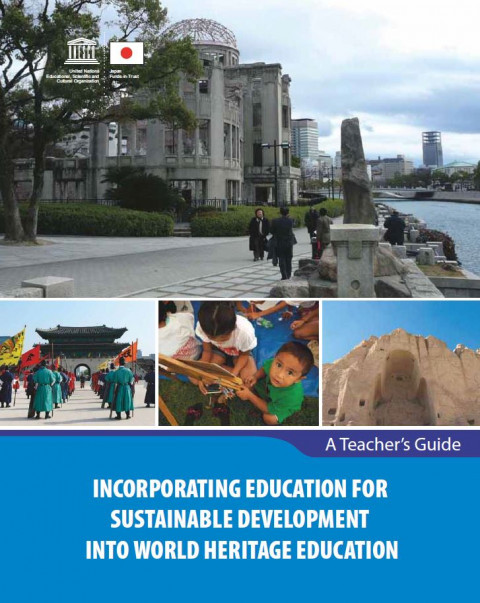 Incorporating education for sustainable development into world heritage education: a teacher's guide Год публикации: 2010 Организация-автор: UNESCO Bangkok This publication, A Teacher’s Guide: Incorporating Education for Sustainable Development into World Heritage Education, represents the collective efforts of workshop participants to produce a practical tool for teachers to modify available curricula and incorporate ESD concepts and principles into WHE. It has taken a long time for the guide to be available in print. Nonetheless, the content of the guide remains practical and relevant in incorporating Education for Sustainable Development into World Heritage Education. Intégrer l'éducation au développement durable dans l'éducation au patrimoine mondial: un guide pour l'enseignant Год публикации: 2010 Организация-автор: UNESCO Bangkok Cette publication, intitulée Un guide pour les enseignants: intégrer l'éducation au développement durable dans l'éducation au patrimoine mondial, représente les efforts collectifs des participants à l'atelier pour produire un outil pratique pour les enseignants afin de modifier les programmes disponibles. Le guide a mis du temps à être disponible en version imprimée. Néanmoins, le contenu du guide reste pratique et pertinent pour intégrer l'éducation au développement durable dans l'éducation au patrimoine mondial.
  Fostering safer and resilient communities: a natural disaster preparedness and climate change education program Год публикации: 2009 Организация-автор: UNESCO Jakarta The Asia and the Pacific region is vulnerable to many natural disaster and expected impacts from climate change. In 2006, 74% of people killed by natural disasters were in Asia, with Afghanistan, India, Indonesia, Pakistan, the Philippines, and Vietnam among the countries most badly affected. Natural disasters such as windstorms, floods, droughts, earthquakes in combination with human-induced conditions such as deforestation, pollution, soil erosion collectively contribute to serious challenges for communities and governments. Climate change impacts are imminent and inevitable. The consensus among natural and social scientists, economists, and policymakers is that climate change is the most important challenge that this planet faces. It is pervasive, touching on every facet of the environment and human life including the environment, economy, transportation, communication, food production, and health. The temporal and geographic scale is wide. The projected economic, health, and societal costs put forth by experts are extraordinary. For example, the total economic cost of climate change threats could be an annual loss of 6-7% of Southeast Asian countries’ GDP by the end of the century, and the Pacific sub-region will see a sea-level rise of 0.19-0.58 meter by 2100 severely changing the lives of more than 50% of the people that live within 1.5 km of the shoreline leading to relocation, water and power shortages, and submerged infrastructure. Climate change impacts in Asia and the Pacific is particularly serious because of the fact that: 1) over 60% of the global population reside in Asia and the Pacific; 2) it has the most extensive coastline of any geographic region; and, 3) many of the world’s largest cities are located along Asian coasts. The impact of climate change in sea level rise would impact small island states such as the Maldives and Kiribati, and many of Asia’s largest coastal cities, such as Jakarta, Bangkok, Manila, Shanghai, and Ho Chi Minh City. Tens of millions of people in Asia may have to be resettled. Further, the expected greater intensity of cyclones and typhoons could have a larger impact than before on Bangladesh, China, India, Vietnam, and the Philippines, whose coastal areas already encounter among the world’s worst weather-related disasters year after year. Parts of many countries in Asia, including Northwestern India, Western China, and almost all of Pakistan, are already suffering from shortages of water, as well as land degradation and desertification, which will be further exacerbated by climate change. The World Conference on Disaster Reduction held in January 2005 in Kobe, Japan, adopted the Framework for Action 2005-2015: Building the Resilience of Nations and Communities to Disasters (referred as the “Hyogo Framework for Action” – HFA). The framework emphasizes the need to understand the linkages between disaster risk reduction and climate change adaptation, and that stakeholders work toward reducing disaster vulnerabilities of communities by helping them build their capacity to deal with disasters. Favoriser des collectivités sûres et solides: un programme d'éducation à la préparation aux catastrophes naturelles et le changement climatique Год публикации: 2009 Организация-автор: UNESCO Jakarta L'Asie et la région du Pacifique est vulnérable à de nombreuses catastrophes naturelles et les impacts attendus du changement climatique. En 2006, 74% des personnes tuées par des catastrophes naturelles ont été en Asie, avec l'Afghanistan, l'Inde, l'Indonésie, le Pakistan, les Philippines et le Vietnam parmi les pays les plus durement touchés. Les catastrophes naturelles telles que les tempêtes, les inondations, les sécheresses, les tremblements de terre en combinaison avec des conditions d'origine humaine telles que la déforestation, la pollution, l'érosion des sols contribuent collectivement aux défis graves pour les communautés et les gouvernements. les impacts du changement climatique sont imminente et inévitable. Le consensus entre les sciences naturelles et sociales, les économistes et les décideurs est que le changement climatique est le défi le plus important que cette planète est confrontée. Il est omniprésent, touchant à toutes les facettes de l'environnement et de la vie humaine, y compris l'environnement, l'économie, le transport, la communication, la production de l'alimentation et de la santé. L'échelle temporelle et géographique est large. La projection économique, la santé et les coûts sociaux mis en avant par les experts sont extraordinaires. Par exemple, le coût économique total des menaces du changement climatique pourrait être une perte annuelle de 6-7% du PIB des pays d'Asie du Sud-Est de la fin du siècle, et la sous-région du Pacifique verra une élévation du niveau de la mer de 0.19- 0,58 mètre d'ici 2100 modifiant gravement la vie de plus de 50% des personnes qui vivent à moins de 1,5 km de la côte menant à des pénuries de réinstallation, de l'eau et d'énergie, et l'infrastructure submergée. les impacts du changement climatique en Asie et dans le Pacifique est particulièrement grave en raison du fait que: 1) plus de 60% de la population mondiale réside en Asie et dans le Pacifique; 2) il a le littoral le plus étendu de toute région géographique; et 3) plusieurs des plus grandes villes du monde sont situés le long des côtes d'Asie. L'impact du changement climatique en élévation du niveau marin aurait un impact sur les petits États insulaires comme les Maldives et Kiribati, et bon nombre des plus grandes villes côtières d'Asie, telles que Jakarta, Bangkok, Manille, Shanghai, et Ho Chi Minh-Ville. Des dizaines de millions de personnes en Asie peuvent être réinstallés. En outre, la plus grande intensité attendue des cyclones et typhons pourrait avoir un impact plus important que jamais sur le Bangladesh, la Chine, l'Inde, le Vietnam et les Philippines, dont les zones côtières déjà rencontrer parmi les plus liés aux conditions météorologiques catastrophes année du monde après année. Pièces de nombreux pays d'Asie, y compris le Nord-Ouest de l'Inde, la Chine occidentale, et la quasi-totalité du Pakistan, souffrent déjà d'une pénurie d'eau, ainsi que la dégradation des terres et la désertification, qui sera encore aggravé par le changement climatique. La conférence mondiale sur la prévention des catastrophes, tenue en Janvier 2005 à Kobe, au Japon, a adopté le Cadre d'action 2005-2015: Renforcer la résilience des nations et des collectivités face aux catastrophes (dénommé le «Cadre d'action de Hyogo» - HFA). Le cadre met l'aCECnt sur la nécessité de comprendre les liens entre la réduction des risques et adaptation au changement climatique, et que les parties prenantes travaillent en vue de réduire la vulnérabilité aux catastrophes des communautés en les aidant à renforcer leur capacité à faire face aux catastrophes. Address by Mr Koïchiro Matsuura, Director-General of UNESCO, on the occasion of the Valedictory session of the 4th International Conference on Environmental Education; Ahmedabad, India, 28 November 2007 Год публикации: 2007 Организация-автор: UNESCO. Director-General, 1999-2009 (Matsuura, K.) This address was given by Mr Koïchiro Matsuura, Director-General of UNESCO, on the occasion of the Valedictory Session of the 4th International Conference on Environmental Education. Discours de M. Koïchiro Matsuura, Directeur Général de l'UNESCO, à l'occasion de la session Valedictory de la 4e Conférence Internationale sur l'Éducation Environnementale; Ahmedabad, en Inde, le 28 Novembre 2007 Год публикации: 2007 Организация-автор: UNESCO. Director-General, 1999-2009 (Matsuura, K.) Cette adresse a été donnée par M. Koïchiro Matsuura, Directeur général de l'UNESCO, à l'occasion de la Valedictory session de la 4e Conférence Internationale sur l'Éducation Environnementale.
 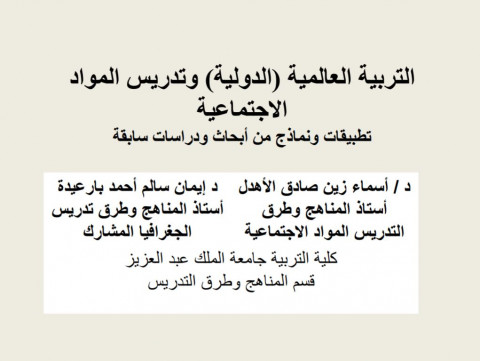 Global Education (International) and Teaching Social Subjects: Applications and Models from Previous Research and Studies Год публикации: 2018 Автор: Asmaa Al-Ahdal | Iman Eida Организация-автор: King Abdulaziz University A lecture from a Saudi university, dealing with what is international education as a science, and its applications in social studies curricula. The two lectures discuss the concept of international education, its characteristics and the history of its inception as a science. التربية العالمية (الدولية) وتدريس المواد الاجتماعية: تطبيقات ونماذج من أبحاث ودراسات سابقة Год публикации: 2018 Автор: Asmaa Al-Ahdal | Iman Eida Организация-автор: King Abdulaziz University محاضرة من أحد الجامعات السعودية، تتطرق لماهية التربية الدولية كعلم، وتطبيقاتها في مناهج الدراسات الاجتماعية. يناقش الماحضران مفهوم التربية الدولية وخصائصها وتأريخ نشأتها كعلم.
 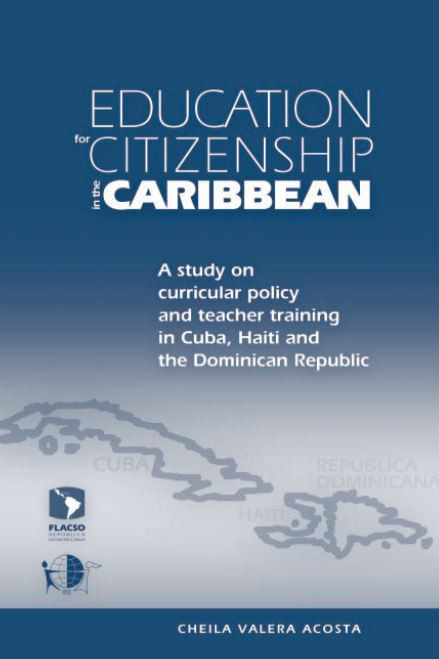 Education for Citizenship in the Caribbean: A Study on Curricular Policy and Teacher Training in Cuba, Haiti and the Dominican Republic Год публикации: 2005 Автор: Cheila Valera Acosta Организация-автор: UNESCO International Bureau of Education (IBE) | Facultad Latinoamericana de Ciencias Sociales (FLACSO) This study aims to describe teacher training and curricular policy for the primary and secondary levels in relation to education for citizenship in Cuba, Haiti and the Dominican Republic and make practical recommendations for improvements in the quality of design and implementation of these initiatives in the three countries.The following are some of the conclusions: At the start of the twenty-first century, Cuba, the Dominican Republic and Haiti share a context in which the processes of democratization have encountered obstacles connected with their colonial heritage, the hegemony of the European nations and the influence and direct interference from United States geopolitical, economic and cultural power.These democracies have developed from long and violent political dictatorships, which established authoritarian and restrictive institutional mechanisms for the day-to-day administration of public affairs. Public policies on education for citizenship should therefore take account of the contradictions faced by the democratizing processes and of the complex cultural impact on the development of social identities brought about by the phenomenon of mass migration.These issues and the tensions arising from social and economic inequalities are inadequately addressed in the three countries’ curricula and teacher training policies.There are legal bases integrating education for citizenship as part of the State’s educational responsibilities in all three countries. Education for citizenship is intended as a specific subject for the primary and secondary school levels.Educational proposals are required that can provide the population with greater understanding of community life, skills for confronting traditional ideological indoctrination, and for learning to live together while recognizing differences, and for helping to educate the imagination for a broader view of human affairs and our responsibilities with regard to them.The actors involved in teacher training in the three countries consider it a key tool for the democratic development of societies. Their main criticisms indicate that there is a need to improve the contents and the approaches to teacher training so that they can respond to the current challenges of these societies from an interdisciplinary standpoint consistent with the stated educational goals.