
Ресурсы
Изучайте широкий спектр ценных ресурсов ВГГ, чтобы углубить своё понимание и повысить эффективность исследований, просветительской деятельности, преподавания и обучения.
Найдено: 371
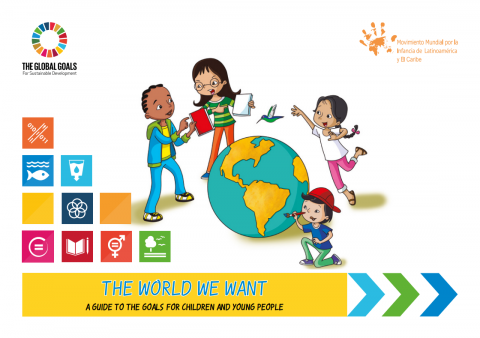 The World We Want: A Guide to the Goals for Children and Young People Год публикации: 2015 Автор: Dora Bardales | Paola Arenas Организация-автор: Global Movement for Children of Latin America and Caribbean | United Nations Children's Fund (UNICEF) The purpose of this guide is to help children and young people understand the Sustainable Development Goals, how they impact their life and what they can do every day to help their government achieve the Goals.
  The Road to the SDGs: A discussion with students Год публикации: 2015 Организация-автор: United Nations Children's Fund (UNICEF) Animated video to help children learn about important concepts for people and planet as covered in the Sustainable Development Goals (SDGs) Le chemin vers les objectifs de developpement durable Год публикации: 2015 Организация-автор: United Nations Children's Fund (UNICEF) Animated video to help children learn about important concepts for people and planet as covered in the Sustainable Development Goals (SDGs) El camino hacia los Objetivos de Desarrollo Sostenible Год публикации: 2015 Организация-автор: United Nations Children's Fund (UNICEF) Animated video to help children learn about important concepts for people and planet as covered in the Sustainable Development Goals (SDGs)
  Integrating education for sustainable development & education for international understanding: conceptual issues and pedagogical principles for teacher education to address sustainability Год публикации: 2006 Автор: Swee-Hin Toh Организация-автор: UNESCO Bangkok It is in this spirit that this essay seeks to “integrate” two active and expanding fields of 2 educational innovation and transformation worldwide, namely ESD (education for sustainable development or sustainability) and EIU (education for international understanding). The key conceptual issues and themes of both of these movements will be clarified and shared values and understandings highlighted. It will also be argued that both ESD and EIU , in order to effectively fulfill their goals of building a peaceful, just and sustainable world order, rests on some key common pedagogical principles and processes. Another introductory caveat is also essential here, namely the question of paradigm. Among policy-makers, theorists and practitioners, there may well be and often are distinct differences in conceptualization according to their paradigmatic interpretations, with consequently alternative implications for policies and practices. Integrating education for sustainable development & education for international understanding: conceptual issues and pedagogical principles for teacher education to address sustainability Год публикации: 2006 Автор: Swee-Hin Toh Организация-автор: UNESCO Bangkok Il est dans cet esprit que cet essai vise à «intégrer» deux champs actifs et en expansion de 2 innovations pédagogiques et de transformation dans le monde entier, à savoir l'EDD (éducation pour le développement durable ou la durabilité) et ECI (éducation pour la compréhension internationale). Les principaux problèmes conceptuels et les thèmes de ces deux mouvements seront clarifiés et des valeurs et une compréhension partagées mis en évidence. Il sera fait également valoir que les deux EDD et ECI, en vue de remplir efficacement leurs objectifs de construction, un ordre pacifique juste et durable monde, repose sur quelques principes pédagogiques communs clés et des processus. Une autre mise en garde d'introduction est également essentiel ici, à savoir la question de paradigme. Parmi les décideurs, les théoriciens et les praticiens, il pourrait bien être souvent des différences distinctes dans la conceptualisation en fonction de leurs interprétations paradigmatiques, ayant des implications en conséquence alternatives pour les politiques et les pratiques. 지속가능발전교육과 국제이해교육의 통합: 지속가능성 문제 해결에 대한 교사 교육의 개념적 문제와 교육학적 원칙 Год публикации: 2006 Автор: Swee-Hin Toh Организация-автор: UNESCO Bangkok 이것은 ESD(지속가능한발전 혹은 지속가능성을 위한 교육)와 EIU(국제이해교육)이라는 교육 혁신과 전 세계의 변화, 이 두 가지 확장 개념과 활동을 ‘통합’하고자 한다. 아울러 이 두 운동의 주요 개념적 문제와 주제는 명확히 되고, 공유된 가치와 이해가 강조될 것이다. 또한 평화롭고 지속가능한 세계 질서 구축이라는 목표를 효과적으로 수행하기 위해서, ESD와 EIU는 몇 가지 주요 공통 교수법과 과정에 그 성패가 달려있다고 보인다. 여기에 또 다른 입문주의 사항(introductory caveat), 즉 패러다임의 문제가 필수적이다. 정책 입안자, 이론가 및 실무자 사이에선 결과적으로 정책과 관행에 대한 대안적 함의와 함께 그들의 패러다임 해석에 따른 개념화의 뚜렷한 차이점이 종종 나타날 수 있다. Address by Irina Bokova, Director-General of UNESCO, on the occasion of Senior Official Meeting on the Role of Education and Countering Violent Extremism organized by the International Centre of Excellence for Countering Violent Extremism (Hedayah) Год публикации: 2013 Организация-автор: UNESCO. Director-General, 2009-2017 (Bokova, I.G.) This address was presented by Irina Bokova, Director-General of UNESCO, on the occasion of Senior Official Meeting on the Role of Education and Countering Violent Extremism organized by the International Centre of Excellence for Countering Violent Extremism (Hedayah). Address by Irina Bokova, Director-General of UNESCO, on the occasion of Senior Official Meeting on the Role of Education and Countering Violent Extremism organized by the International Centre of Excellence for Countering Violent Extremism (Hedayah) Год публикации: 2013 Организация-автор: UNESCO. Director-General, 2009-2017 (Bokova, I.G.) Cette adresse a été présentée par Irina Bokova, Directrice générale de l'UNESCO, à l'occasion de la Réunion des Hauts Fonctionnaires sur le Rôle de l'Éducation et de la Lutte contre l'Extrémisme Violent organisé par le Centre International d'Excellence pour la Lutte contre l'Extrémisme Violent (Hedayah). 폭력적 극단주의(Hedayah) 대응을 위한 국제우수연구센터(International Centre of Excellence)가 주최한 ‘교육의 역할과 폭력적 극단주의의 대응’ 고위급 회의에서 이리나 보코바 유네스코 사무총장의 연설. 2013년 9월 25일, 뉴욕. Год публикации: 2013 Организация-автор: UNESCO. Director-General, 2009-2017 (Bokova, I.G.) 이 연설은 폭력적 극단주의(Hedayah)에 대응하기 위한 국제우수연구센터(International Centre of Excellence)가 주최한 ‘교육의 역할과 폭력적 극단주의의 대응’에 관한 고위급 회의에서 이리나 보코바 유네스코 사무총장이 발표한 것이다.