
Ресурсы
Изучайте широкий спектр ценных ресурсов ВГГ, чтобы углубить своё понимание и повысить эффективность исследований, просветительской деятельности, преподавания и обучения.
Найдено: 19
 Полиязычное образование на основе родного языка. Ключ к реализации ЦУР 4 - качественное образование для всех Год публикации: 2017 Автор: Matt Wisbey Организация-автор: UNESCO Bangkok Полиязычное образование на основе родного языка - это образование, начинающееся на языке, которым ученик владеет свободно и затем постепенно вводит другие языки.Справедливое качественное образование и непрерывное обучение для всех возможно только тогда, когда образование учитывает и отражает полиязычный характер общества. Дети, молодежь и взрослые нуждаются в образовательных возможностях, основанных на их образе жизни и потребностях, на родном языке и посредством него.Поскольку ЦУР 4 является основополагающей для других целей устойчивого развития, без полиязычного образования на основе родного языка остальные 16 целей так и останутся недостижимыми.Информация в этой брошюре частично основана на презентациях и дискуссиях с 5-й Международной конференции по языку и образованию: устойчивое развитие посредством многоязычного образования, которая состоялась в Бангкоке, Таиланд, в октябре 2016 года.Для получения дополнительной информации о конференции или просмотра оригинальных презентаций и ключевых сообщений, пожалуйста, посетите: http://www.lc.mahidol.ac.th/mleconf/2016/program.htm
 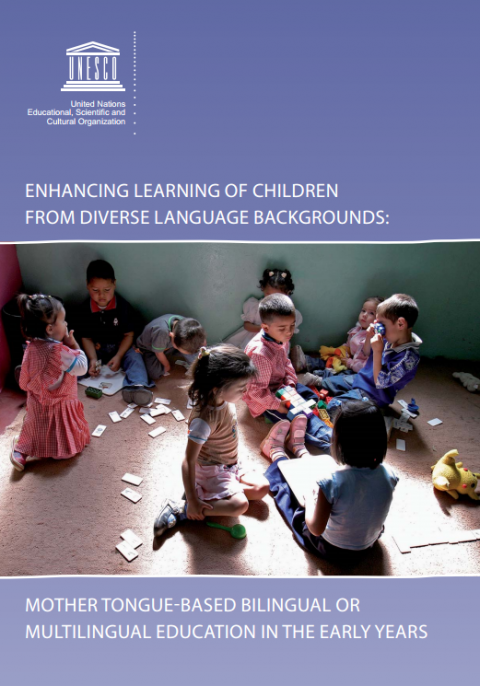 Enhancing learning of children from diverse language backgrounds: mother tongue-based bilingual or multilingual education in the early years Год публикации: 2011 Автор: Jessica Ball Организация-автор: UNESCO This literature review discusses mother tongue based bilingual or multilingual education for children starting in early childhood. The report: (1) informs policy-makers of existing research and practices in mother-tongue instruction in early childhood and early primary school years; and (2) raises awareness of the value of maintaining the world’s languages and cultures by promoting and resourcing mother tongue-based education for young children. This analysis of current literature is framed within UNESCO’s mandate and strong commitment to quality education for all and to cultural and linguistic diversity in education (UNESCO, 2003a). This discussion is especially timely, given the slow and uneven progress (UNESCO, 2000) in meeting international targets for universal education articulated in the Education for All Goals 1 (ECCE), Goal 2 (Primary Education), and Goal 6 (Quality of Education) (World Declaration on Education for All, 1990).1 Impetus for the current report is provided by the UNESCO (2008a) ‘Global Monitoring Report on Education for All: Will we make it?’ The 2008 GMR report calls for unwavering political will to ensure that education from early childhood onwards is a priority of national governments, civil society and the private sector in order to ensure educational inclusion for the 72 million children out of school and to reduce the numbers of young learners who leave school without acquiring essential skills and knowledge. The report calls for increased investments in the provision of pre-primary education for children aged 3 and above, and for policy measures to provide care and education to children below age 3. UNESCO (2007a) emphasizes the role of early childhood care and development in laying the foundation for learning and setting the stage for successful engagement in formal education. UNESCO has encouraged mother tongue instruction in early childhood and primary education since 1953 (UNESCO, 1953). Yet, monolingualism in official or dominant languages is still the norm around the world (Arnold, Bartlett, Gowani, & Merali, 2006; Wolff & Ekkehard, 2000). In its report, ‘Strong Foundations: Early Childhood Care and Education’, UNESCO (2007a) points out the overlooked advantages of multilingual education in the early years. When children are offered opportunities to learn in their mother tongue, they are more likely to enrol and succeed in school (Kosonen, 2005) and their parents are more likely to communicate with teachers and participate in their children’s learning (Benson, 2002). Mother tongue based education especially benefits disadvantaged groups, including children from rural communities (Hovens, 2002), and girls, who tend to have less exposure to an official language and tend to stay in school longer, achieve better, and repeat grades less oft en when they are taught in their mother tongue (UNESCO Bangkok, 2005). Renforcer l'apprentissage des enfants issus de milieux linguistiques diverses: basée sur la promotion de l'enseignement en langue maternelle ou de l'éducation bilingue multilingue Год публикации: 2011 Автор: Jessica Ball Организация-автор: UNESCO Cette revue de la littérature aborde la langue maternelle basée éducation bilingue ou multilingue pour les enfants à partir de la petite enfance. Le rapport: (1) informe les décideurs de la recherche et des pratiques en enseignement en langue maternelle dans la petite enfance et les premières années de l'école primaire existante; et (2) soulève conscience de la valeur du maintien des langues et des cultures du monde par la promotion et de ressourcement mère éducation fondée sur la langue, pour les jeunes enfants. Cette analyse de la littérature actuelle est encadrée au sein de l'UNESCO mandat et engagement fort à l'éducation de qualité pour tous et à la diversité culturelle et linguistique dans l'éducation (UNESCO, 2003a). Cette discussion est particulièrement opportune, compte tenu des progrès lents et inégaux (UNESCO, 2000) pour atteindre les objectifs internationaux pour l'Éducation Universelle énoncée dans l'Éducation Pour Tous les Objectifs 1, Objectifs 2 (enseignement primaire), et Objectifs 6 (qualité de l'éducation ) (déclaration mondiale sur l'éducation pour tous, 1990) .1 Impetus pour le rapport actuel est fourni par l'UNESCO (2008a) «Rapport mondial de suivi sur l'éducation pour tous: Allons-nous faire?» le rapport GMR 2008 appelle à une volonté politique sans faille veiller à ce que l'éducation de la petite enfance est en avant une priorité des gouvernements nationaux, la société civile et le secteur privé afin d'assurer l'insertion scolaire pour les 72 millions d'enfants de l'école et de réduire le nombre de jeunes apprenants qui quittent l'école sans avoir acquis les compétences essentielles et de la connaissance.
  Multilingual education: Why is it important? How to implement it? Год публикации: 2014 Организация-автор: UNESCO Mother tongue instruction is in the context of bilingual education / multilingual education (MLE) because it lays a solid foundation for learning, improves access to education (especially for girls), improves learning outcomes, raises the quality of education by emphasizing understanding and creativity rather than repetitive memorization. Furthermore, learners who are excluded from the education system are those who mosk likely benefit from multilingual education. There are several ways to implement MLE, such as by creating a favourable environment, using appropriate materials, training teachers and educators, and taking into account the learners' knowledge.
  EIU Best Practices Series No. 26: Promotion of EIU through Multilingual Education Год публикации: 2011 Автор: Narayan Prasad Subedi Организация-автор: APCEIU This monograph is one of APCEIU's EIU Best Practices Series, which aims to encourage educators, scholars, and activists to implement and share local initiatives on EIU. The Series No.26 showcases a Multilingual Education Programme initiated by the Magar community in Nepal, that fosters EIU and multiculturalism. As there are over 200 local languages within Nepal, the MEP seeks to address the educational needs of non-Nepali speaking population. The program helps to enhance teacher capacity building, training manual development, and curriculum development, thereby allowing non-Nepali students to study in respective mother tongue.
  Action Research to Improve Youth and Adult Literacy: Empowering Learners in a Multilingual World Год публикации: 2015 Организация-автор: UNESCO Institute for Lifelong Learning (UIL) | UNESCO Abuja This guidebook is about the quest for quality, which is a lifelong pursuit linked to social justice. As we move in time and space new challenges emerge, but our vision is that no one should be left behind in the quest for self- and collective realization. We have to consider all possible means for enabling the active participation of all citizens in education. We must look at both challenges and opportunities, such as those that technology offers us for making linkages and improving access to information, knowledge and skills. We must seek out possibilities for retaining positive values and acquiring new ones which foster deeper appreciation for human, linguistic, cultural and ecological diversity.
  Communication and Information Programme Год публикации: 2021 Организация-автор: UNESCO UNESCO is the UN specialized agency building peace in the minds of people through education, the sciences, culture, communication and information. Our mission is to foster intercultural dialogue and sustainable development, by promoting the free flow of ideas.By adopting a multi-disciplinary and inclusive approach, UNESCO works with both duty-bearers and rights-holders across the world to develop and implement targeted actions that are born out of local needs, which ensures a holistic and results-based approach for sustainable change.In the field of communication and information, UNESCO defends and promotes freedom of expression, media independence and pluralism, and the building of inclusive knowledge societies underpinned by universal access to information and the innovative use of digital technologies.Through capacity-building, policy advice, international cooperation, monitoring and foresight in the fields of freedom of expression, access to information, and digital transformation, UNESCO will continue to empower key actors with a view to ensuring that fundamental freedoms are guaranteed online and offline, in line with international standards.This is all the more relevant to ensure the ethical development and use of emerging technologies, which have a growing impact on all aspects of the world’s societies. Citizens will also be empowered to enjoy these fundamental freedoms through the development of 21st century skills and the fostering of enabling environments for media pluralism and diversity.
 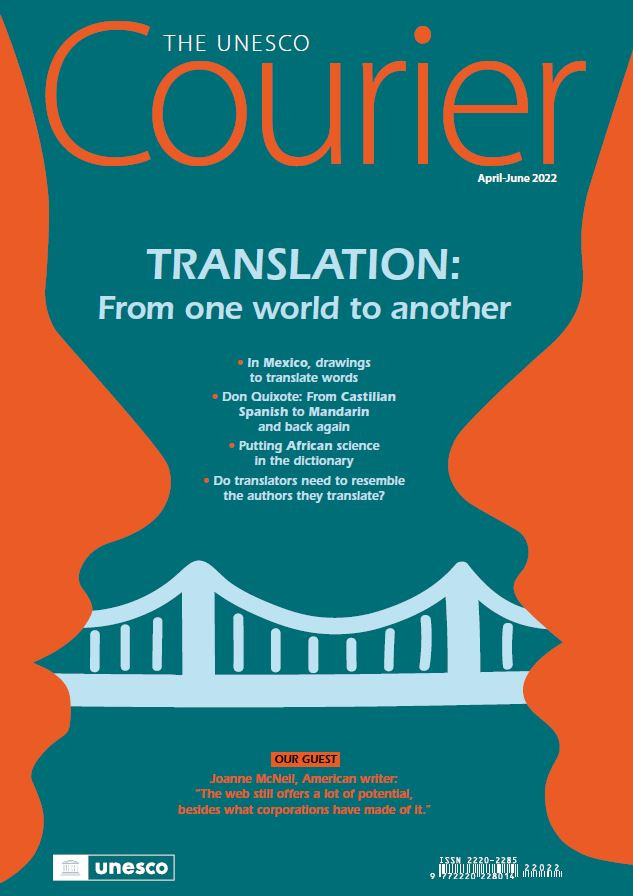 Translation: From One World to Another (The UNESCO Courier No. 2; April-June 2022) Год публикации: 2022 Организация-автор: UNESCO To translate is “to say almost the same thing”, in the words of the Italian writer Umberto Eco. A whole world is contained in this “almost”. To translate is to confront the other, the different, the unknown. It is often the essential prerequisite for those who want to access a universal, multiple, diverse culture. It is therefore no coincidence that the League of Nations took up the issue in the 1930s, envisaging the creation of an Index Translationum.Taken over by UNESCO in 1948, this Index allowed the first census of translated works in the world. Two years later, the Representative Works programme was launched to translate masterpieces of world literature. UNESCO’s support for the publication last year of a lexicon of words from indigenous languages of Mexico that are untranslatable into Spanish is a continuation of these efforts.Although their disappearance was predicted as early as the 1950s, translators – who are most often women – have never been as numerous as they are today. The machines developed in the aftermath of the war have not been able to outdo this behind-the-scenes profession. Nor have digital translation tools, which have become the standard feature of our globalized conversations, even if they have contributed to transforming the job.This is because language is more than just a means of communication. It is that, and much more. It is what written or oral works make of it, contributing to forge what is sometimes called the ‘genius of the language’, which the most powerful applications cannot restore.
 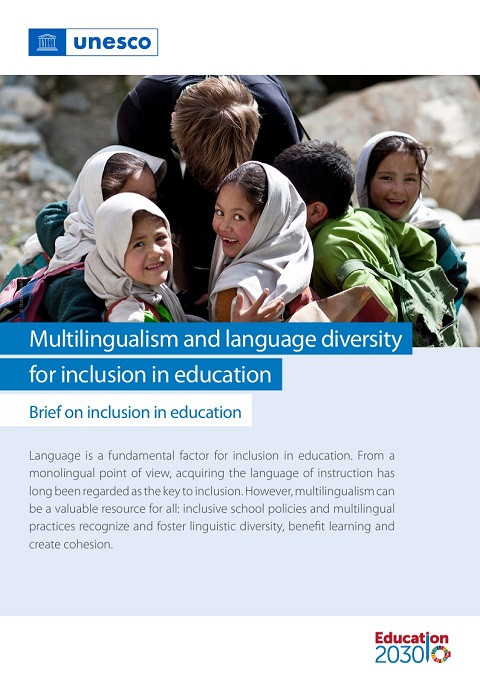 Multilingualism and Language Diversity for Inclusion in Education: Brief on Inclusion in Education Год публикации: 2024 Автор: Piet Van Avermart Организация-автор: UNESCO Language is a fundamental factor for inclusion in education. From a monolingual point of view, acquiring the language of instruction has long been regarded as the key to inclusion. However, multilingualism can be a valuable resource for all: inclusive school policies and multilingual practices recognize and foster linguistic diversity, benefit learning and create cohesion.