
Ресурсы
Изучайте широкий спектр ценных ресурсов ВГГ, чтобы углубить своё понимание и повысить эффективность исследований, просветительской деятельности, преподавания и обучения.
Найдено: 116
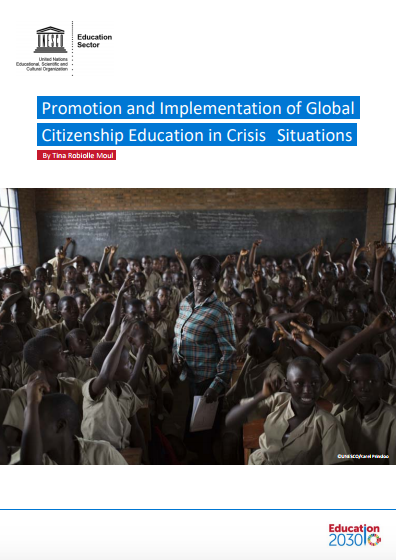 Promotion and implementation of global citizenship education in crisis situations Год публикации: 2017 Автор: Robiolle Moul, Tina Организация-автор: UNESCO Crisis situations affect the realization of human rights of many people and communities across all regions of the world. Within UNESCO’s relevant areas of work, GCED is a powerful approach to education that can empower people to recover from crises and transform their communities into peaceful and sustainable societies. UNESCO commissioned a desk study that aimed at reviewing existing research on the promotion and implementation of GCED and related programs in countries affected by crisis situations, with particular attention to initiatives benefiting the refugee population. This study unveils the key challenges these programs encounter in such contexts, as well as promising practices that can guide the design and implementation of future GCED in crisis situations.This report is a synthesis of this desk study and supports the evidence that, after analyzing the context and the available means, GCED and related programs can and should be systematically adapted and implemented in crisis situations, including in response to refugee crises.
 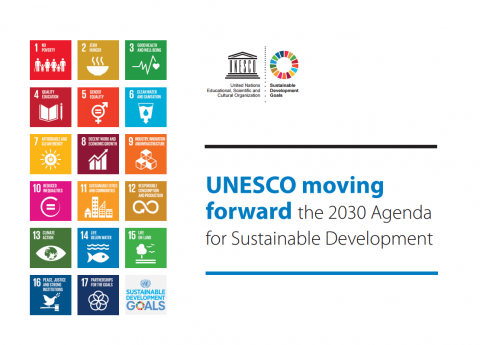 UNESCO moving forward the 2030 Agenda for Sustainable Development Год публикации: 2017 Организация-автор: UNESCO The United Nations 2030 Agenda for Sustainable Development, with its 17 Sustainable Development Goals, sets forth a bold new framework for development cooperation over the next 15 years. This agenda aspires to ensure prosperity and well-being for all women and men, while protecting our planet and strengthening the foundations for peace.
  The Influence of education on conflict and peace building Год публикации: 2010 Автор: Alan Smith Организация-автор: UNESCO The purpose of this paper is to identify aspects of education that may have a positive influence on the dynamics of conflict or make a contribution to peacebuilding. The UN Secretary-General’s (2009) report on peacebuilding identifies a number of recurring priorities in conflict-affected situations, ‘establishing security, building confidence in a political process, delivering initial peace dividends and expanding core national capacity’. These priorities include ‘the provision of basic services, such as water and sanitation, health and primary education’. However, in conflict-affected situations education is also about more than service delivery because it is a means of socialization and identity development through the transmission of knowledge, skills, values and attitudes across generations. Education may therefore be a driver of conflict (fuelling grievances, stereotypes, xenophobia and other antagonisms), but can also be a way of contributing to ‘conflict transformation’ and ‘peacebuilding’.
  Thinkpiece on education and conflict Год публикации: 2009 Автор: Lynn Davies Организация-автор: UNESCO This paper looks first at the learning sites generally (violent schools, schools as a weapon of war, curriculum and textbooks). It then focuses on specific groups in conflict – gender, language, refugees, child soldiers. Thirdly it discusses education policy and donor intervention; and finally talks of the role of research. All these overlap hugely. This is not a prescription for how the Global Monitoring Report should be structured, but identification of themes and lessons learned that seem the most significant.
 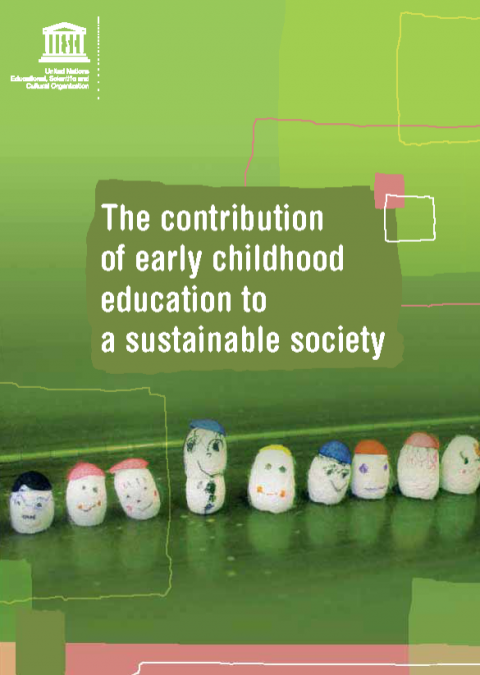 The contribution of early childhood education to a sustainable society Год публикации: 2008 Организация-автор: UNESCO This report originates from the international workshop, ‘The Role of Early Childhood Education for a Sustainable Society’, jointly organized in Göteborg, Sweden, by Göteborg University, Chalmers University of Technology and the City of Göteborg, from 2 to 4 May 2007. It was attended by thirty-five participants from sixteen different countries (see ‘List of Participants’). The workshop was a follow-up to the international conference on education for sustainable development, ‘Learning to Change Our World’, held in May 2004, in Göteborg. It was one of four preparatory workshops leading to another international conference on education for sustainable development, to be organized in 2008 or 2009, in the same city. The aim of the four workshops is to discuss promoters and barriers related to learning for sustainability, and to propose recommendations for the upcoming international conference. The present workshop was conceived for the following reasons. First, our societies urgently require new kinds of education that can help prevent further degradation of our planet, and that foster caring and responsible citizens genuinely concerned with and capable of contributing to a just and peaceful world. Second, these new kinds of education must be available to all – not only a handful of people – and take place in various settings, including families and communities. Third, they must begin in early childhood, as the values, attitudes, behaviours and skills acquired in this period may have a long-lasting impact in later life. Thus, early childhood education clearly has an important place in the efforts to bring about sustainable development.
 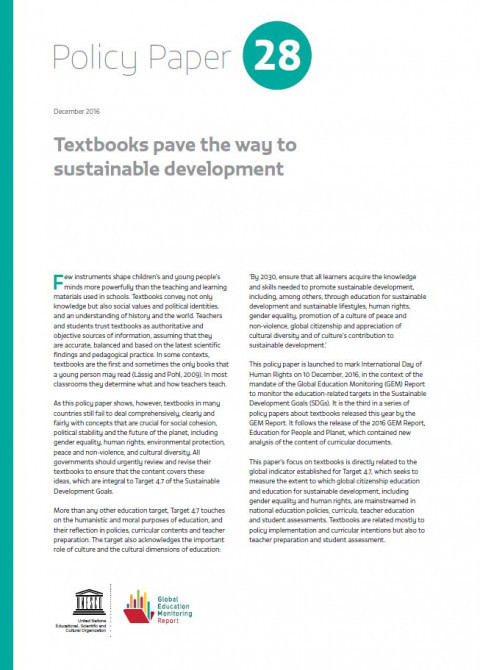 Textbooks pave the way to sustainable development (Policy paper 28) Год публикации: 2016 Организация-автор: UNESCO This paper’s focus on textbooks is directly related to the global indicator established for Target 4.7, which seeks to measure the extent to which global citizenship education and education for sustainable development, including gender equality and human rights, are mainstreamed in national education policies, curricula, teacher education and student assessments. Textbooks are related mostly to policy implementation and curricular intentions but also to teacher preparation and student assessment.
 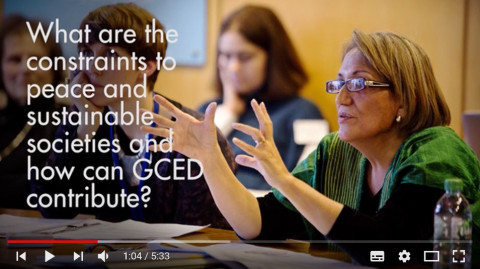 [Video] Second UNESCO Forum on Global Citizenship Education Год публикации: 2015 Организация-автор: UNESCO Highlights of the Second UNESCO Forum on Global Citizenship Education (GCED) Building peaceful and sustainable societies: preparing for post-2015 (28-30 January 2015,UNESCO HQ, Paris). The Forum was organized by the Division for Teaching, Learning and Content, Education Sector, UNESCO, with the support of Austria, the Sultanate of Oman and the Republic of Korea, and the UN Secretary-General’s Global Education First Initiative (GEFI).
 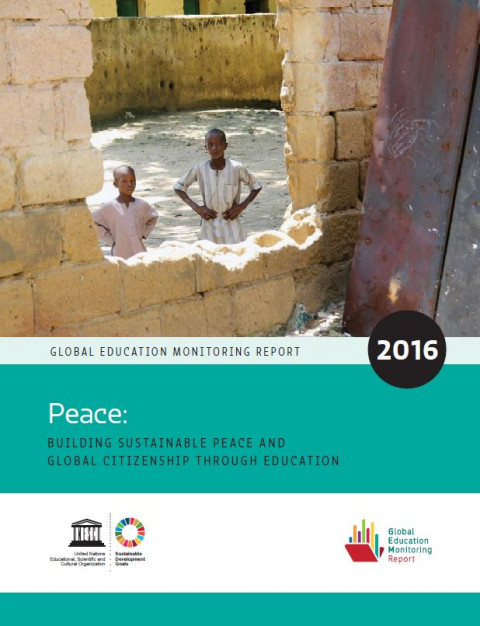 Peace: building sustainable peace and global citizenship through education;Global education monitoring report summary 2016 Год публикации: 2017 Организация-автор: UNESCO The 2016 GEM Report, the first of a new 15-year series, shows that education will not deliver its full potential to catapult the world forward unless rates of improvement dramatically shift, and education systems consider sustainable development in the way services are delivered. This Peace: Building sustainable peace and global citizenship through education publication is a select extract from the full 2016 Global Education Monitoring (GEM) Report: Education for people and planet: Creating sustainable futures for all. It contains two chapters from that full Report – one on peace, political participation and access to justice and the other on education for global citizenship and sustainable development — , along with the associated policy recommendations and a short section of a recent GEM Report Policy Paper Textbooks pave the way to sustainable development.
 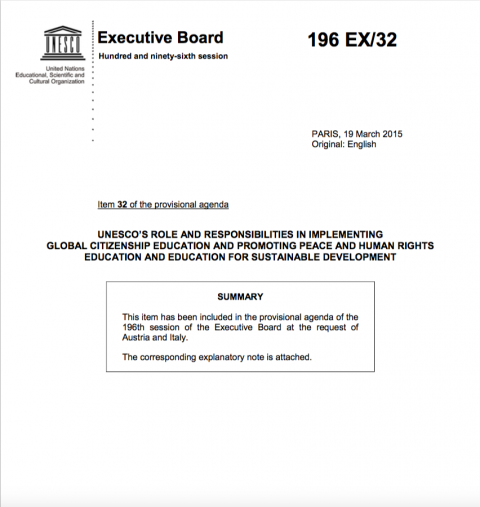 UNESCO's Role and Responsibilities in Implementing Global Citizenship Education and Promoting Peace and Human Rights Eudcation and Education for Sustainable Development Год публикации: 2015 Организация-автор: UNESCO This document is an addendum to document 196 EX/32. This item was included in the provisional agenda of the 196th session of the Executive Board at the request of Austria and Italy
 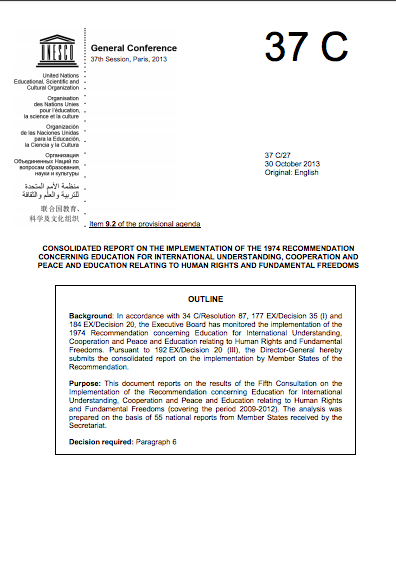 Consolidated Report on the Implementation of the 1974 Recommendation Concerning Education for International Understanding, Cooperation and Peace and Education Relating to Human Rights and Fundamental Freedoms Год публикации: 2013 Организация-автор: UNESCO Background: In accordance with 34 C/Resolution 87, 177 EX/Decision 35 (I) and 184 EX/Decision 20, the Executive Board has monitored the implementation of the 1974 Recommendation concerning Education for International Understanding, Cooperation and Peace and Education relating to Human Rights and Fundamental Freedoms. Pursuant to 192 EX/Decision 20 (III), the Director-General hereby submits the consolidated report on the implementation by Member States of the Recommendation.Purpose: This document reports on the results of the Fifth Consultation on the Implementation of the Recommendation concerning Education for International Understanding, Cooperation and Peace and Education relating to Human Rights and Fundamental Freedoms (covering the period 2009-2012). The analysis was prepared on the basis of 55 national reports from Member States received by the Secretariat.