
Ресурсы
Изучайте широкий спектр ценных ресурсов ВГГ, чтобы углубить своё понимание и повысить эффективность исследований, просветительской деятельности, преподавания и обучения.
Найдено: 116
 UNESCO's Contribution to the Prevention of Violant Extremism Год публикации: 2016 Организация-автор: UNESCO This document provides a summary of recent efforts by UNESCO to step up its action to prevent violent extremism, in the context of the United Nations Secretary-General’s Plan of Action on Violent Extremism, launched in January 2016. Building on its mandate and existing activities, UNESCO has adopted an intersectoral approach, paying particular attention to the needs of young people particularly at risk of radicalization.
  UNESCO's work on education for peace and non-violence: building peace through education Год публикации: 2008 Организация-автор: UNESCO The promotion of peace through education is at the heart of UNESCO’s mission. As stated in its constitution of 1945, UNESCO advances international peace and the common welfare of humanity through educational, scientific and cultural relations between peoples of the world. Though the world has changed over the past sixty years and continues to change at an ever increasing rate, UNESCO’s mission - a commitment to promoting universal values of peace and nonviolence, human rights and social justice, intercultural dialogue and mutual understanding – persists with growing urgency. UNESCO’s approach to educating for peace is multidimensional, in that it links education with a range of activities that address the root causes of violence, from human security to sustainable development. The goal of UNESCO’s education programmes and partnerships is the development of comprehensive systems of education that embrace the values of human rights, intercultural understanding and tolerance. Education for peace and non-violence promotes the knowledge, skills, attitudes and behaviours that reflect and inspire these values. As the lead agency within the UN system for the International Decade for a Culture of Peace and Non-Violence for the Children of the World, 2001- 2010, UNESCO is responsible for coordinating and directly implementing activities that promote the objectives of the Decade through education, the sciences, culture, communication and information. The culture of peace is defined as a set of values, attitudes, modes of behaviour and ways of life that reject violence and aim to prevent conflicts by tackling their root causes through dialogue and negotiation between individuals, groups and nations. UNESCO promotes the culture of peace through an intersectoral platform. This platform involves all five sectors of UNESCO: education, natural sciences, social and human sciences, culture, and communication and information. It seeks to mainstream intercultural dialogue in policies and actions with the aim of promoting mutual understanding, tolerance and respect, all of which are considered to be creative forces for a sustainable future. The intersectoral platform will also develop tools based on good practices in intercultural dialogue.
  UNESCO prize for peace education, 2008 Год публикации: 2009 Организация-автор: UNESCO The UNESCO Prize for Peace Education 2008 was awarded to the Institute for Justice and Reconciliation (South Africa) by Mr Koïchiro Matsuura, Director-General of UNESCO, on the recommendation of the International Jury of the Prize. The prize-giving ceremony, organized as part of the celebrations of the International Day of Peace (21 September), the International Decade for a Culture of Peace and Non-Violence for the Children of the World (2001- 2010) and the 60th anniversary of the Universal Declaration of Human Rights, was held at UNESCO Headquarters on 18 September 2008 in the presence of Mr Mohammed Arkoun, President of the International Jury, and H.E. Mr Javier Pérez de Cuéllar, member of the International Jury, former Prize laureates, Permanent Delegates of Member States and representatives of governmental and non-governmental organizations. The award ceremony was preceded by the screening of an excerpt from the documentary Truth, Justice, Memory: South Africa’s Truth and Reconciliation Process and by a video message from Archbishop Emeritus Desmond Tutu, winner of the 1984 Nobel Peace Prize for his role as a unifying leader in the campaign to resolve the problem of apartheid in South Africa, and former Chairperson of South Africa’s Truth and Reconciliation Commission
  UNESCO's role in promoting education as a tool to prevent violent extremism Год публикации: 2015 Организация-автор: UNESCO This item has been included in the provisional agenda of the 197th session of the Executive Board at the request of the United States of America and co-sponsored by Bosnia and Herzegovina, Bulgaria, Costa Rica, Côte d’Ivoire, Djibouti, Finland, France, Germany, Jordan, Kenya, Latvia, Nigeria, Norway, Pakistan, Philippines, Republic of Korea, Rwanda, Senegal, Slovenia, Suriname, Switzerland and Turkey
  Recommendation concerning Education for International Understanding, Cooperation and Peace and Education Relating to Human Rights and Fundamental Freedoms, adopted by the General Conferences at its 18th session, Paris, 19 November 1974 Год публикации: 1974 Организация-автор: UNESCO Following is the authentic text of the Recommendation duly adopted by the General Conference of the United Nations Educational, Scientific and Cultural Organization during its eighteenth session, which was held in Paris and declared closed the twenty-third day of November 1974. The General Conference recommends that Member States should submit to provisions as follows: to apply the following provisions by taking whatever legislative or other steps may be required in conformity with the Constitutional practice of each State to give effect within their respective territories to the principles set forth in this recommendation; to bring this recommendation to the attention of the authorities, departments or bodies responsible for school education, higher education and out-of-school education, of the various organizations carrying out educational work among young people and adults such as student and youth movements, associations of pupils’ parents, teachers’ unions and other interested parties; to submit to it, by dates and in the form to be decided upon by the Conference, reports concerning the action taken by them in pursuance of this recommendation. Declaração e Plano de Ação Integrado sobre a Educação para a Paz, os Direitos Humanos e a Democracia Год публикации: 1995 Организация-автор: UNESCO This document is Declaration of the 44th session of the International Conference on Education (Geneva, October 1994) endorsed by the General Conference Declaration of the 44th session of the International Conference on Education (Geneva, October 1994) endorsed by the General Conference of UNESCO at its twenty-eight session Paris, November 1995 of UNESCO at its twenty-eight session Paris, November 1995.
  Declaration and Integrated Framework of Action on Education for Peace, Human Rights and Democracy Год публикации: 1995 Организация-автор: UNESCO This document is Declaration of the 44th session of the International Conference on Education (Geneva, October 1994) endorsed by the General Conference Declaration of the 44th session of the International Conference on Education (Geneva, October 1994) endorsed by the General Conference of UNESCO at its twenty-eight session Paris, November 1995 of UNESCO at its twenty-eight session Paris, November 1995.
  UNESCO's role in promoting education as a tool to prevent violent extremism Год публикации: 2016 Организация-автор: UNESCO The Director-General reports on the progress made on the implementation of 197 EX/Decision 46 on “UNESCO’s role in promoting education as a tool to prevent violent extremism”. This report presents the activities that have been implemented as well as those that are underway to take forward the Decision.
 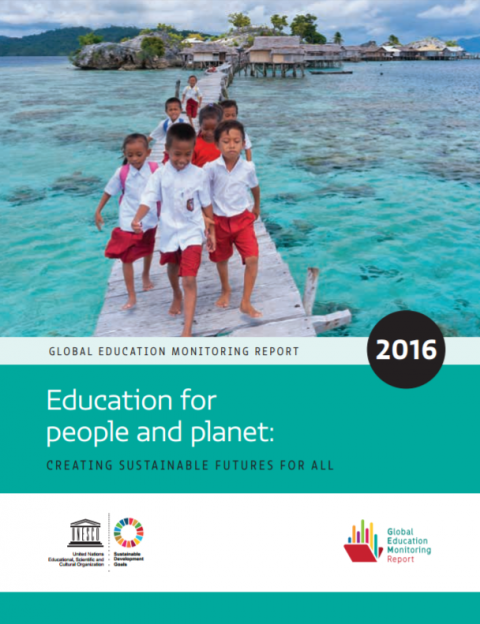 Education for People and Planet: Creating Sustainable Futures for All, Global Education Monitoring Report, 2016 Год публикации: 2016 Организация-автор: UNESCO | Global Education Monitoring Report Team Education for People and Planet: Creating Sustainable Futures for All explores the complex relationship between education and the new 2030 Agenda for Sustainable Development, covering six fundamental pillars – Planet, Prosperity, People, Peace, Place and Partnerships. This report shows that education will not deliver its full potential unless participation rates increase dramatically and sustainable development guides education system reform. It also warns of the destructive impact that climate change, conflict, unsustainable consumption and the increasing gap between rich and poor have on education. A huge transformation is needed if we are to create sustainable futures for all.
 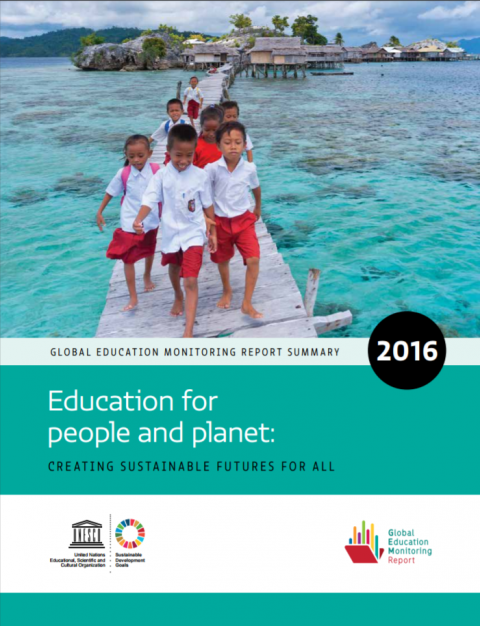 [Summary] Education for People and Planet: Creating sustainable Futures for All, Global Education Monitoring Report, 2016; Summary Год публикации: 2016 Организация-автор: UNESCO Education for People and Planet: Creating Sustainable Futures for All explores the complex relationship between education and the new 2030 Agenda for Sustainable Development, covering six fundamental pillars – Planet, Prosperity, People, Peace, Place and Partnerships. This report shows that education will not deliver its full potential unless participation rates increase dramatically and sustainable development guides education system reform. It also warns of the destructive impact that climate change, conflict, unsustainable consumption and the increasing gap between rich and poor have on education. A huge transformation is needed if we are to create sustainable futures for all.