
Ресурсы
Изучайте широкий спектр ценных ресурсов ВГГ, чтобы углубить своё понимание и повысить эффективность исследований, просветительской деятельности, преподавания и обучения.
Найдено: 109
 教育部门应对恐同欺凌 Год публикации: 2013 Организация-автор: UNESCO This publication is part of a Good Policy and Practice series that addresses key themes of UNESCO’s work with the education sector including HIV and AIDS and safe, healthy educational environments for all learners. This volume, on the theme of homophobic bullying in educational institutions, builds on UNESCO’s work on gender, discrimination and violence in schools. Odpowiedzi sektora edukacji na homofobiczna przemoc rówiesnicza Год публикации: 2014 Организация-автор: UNESCO This publication is part of a Good Policy and Practice series that addresses key themes of UNESCO’s work with the education sector including HIV and AIDS and safe, healthy educational environments for all learners. This volume, on the theme of homophobic bullying in educational institutions, builds on UNESCO’s work on gender, discrimination and violence in schools.
  Teacher Training for Multicultural Education in Favour of Democracy and Sustainable Development: the Territorial Approach Год публикации: 1995 Автор: Raúl Galiardi | Paula Bernadini Mosconi Организация-автор: UNESCO This publication is part of the book Teacher Training and Multiculturalism: National Studies. This book presents the outcomes concerning the initial training systems of teachers in eight countries at different levels of development in different regions of the world but who are faced with a common challenge to educate for cultural diversity. Both the conclusions of each particular study and the general outcomes demonstrate the complexity of the problems and the benefits of comparative analysis. Overcoming prejudices and stereotypes is not an easy task nor likely to be achieved in the short term. Mentalities change far more slowly than knowledge and, because of this, educational strategies need to be applied in the long term. This study also shows that it is necessary to improve the exchange of experiences as well as contacts between people and institutions who are confronted with the same problems in different contexts. The publication of the initial outcomes of this project is intended to enrich the quality of discussions between specialists and institutions who, in different parts of the world, are concerned by multicultural education as an instrument to promote understanding, respect and dialogue between cultures.
 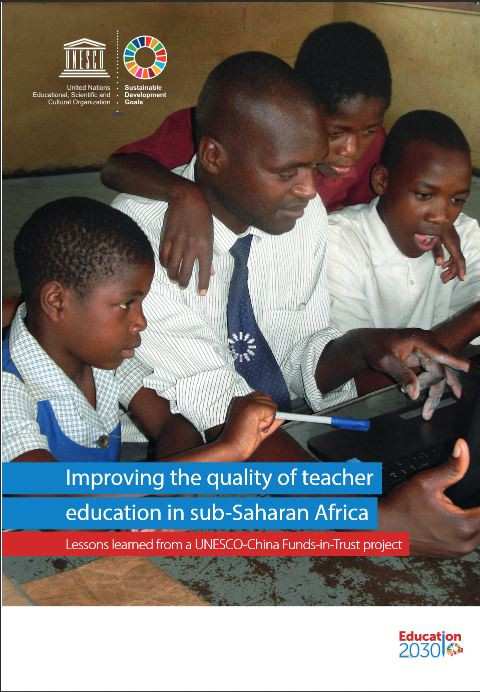 Improving the quality of teacher education in Sub-Saharan Africa: lessons learned from a UNESCO-China Funds-in-Trust project Год публикации: 2018 Организация-автор: UNESCO The booklet describes how the project started, the choice of beneficiary countries, the implementation strategies and its achievements. The different sections numbered one to four describe particular aspects of the project, using country cases to illustrate how the success of the project was due to strong country ownership and leadership. UNESCO, in partnership with the Government of the People’s Republic of China, initiated the project to enhance the institutional capacity and the professional development of teacher educators through ICT-supported learning, teaching and research. This technology aided the transformation of capacity teacher training through digitalization of instructional materials. Réponses du secteur de l'éducation au harcèlement homophobe Год публикации: 2012 Организация-автор: Organisation des Nations Unies pour l'éducation, la science et la culture (UNESCO) Cette publication fait partie d'une bonne politique et une série de pratiques portant sur des thèmes clés du travail de l'UNESCO avec le secteur de l'éducation, y compris le VIH et le SIDA et les milieux éducatifs, sains et sécuritaires pour tous les apprenants. Ce volume, sur le thème de l'intimidation homophobe dans les établissements d'enseignement, se fonde sur le travail de l'UNESCO sur l'égalité, la discrimination et la violence dans les écoles. Ответные меры системы образования на буллинг, вызванный гомофобией Год публикации: 2014 Организация-автор: UNESCO This publication is part of a Good Policy and Practice series that addresses key themes of UNESCO’s work with the education sector including HIV and AIDS and safe, healthy educational environments for all learners. This volume, on the theme of homophobic bullying in educational institutions, builds on UNESCO’s work on gender, discrimination and violence in schools. Réponses du secteur de l'éducation au harcèlement homophobe Год публикации: 2013 Организация-автор: UNESCO This publication is part of a Good Policy and Practice series that addresses key themes of UNESCO’s work with the education sector including HIV and AIDS and safe, healthy educational environments for all learners. This volume, on the theme of homophobic bullying in educational institutions, builds on UNESCO’s work on gender, discrimination and violence in schools. Education sector responses to homophobic bullying Год публикации: 2012 Организация-автор: UNESCO This publication is part of a Good Policy and Practice series that addresses key themes of UNESCO’s work with the education sector including HIV and AIDS and safe, healthy educational environments for all learners. This volume, on the theme of homophobic bullying in educational institutions, builds on UNESCO’s work on gender, discrimination and violence in schools. Respuestas del sector de educación frente al bullying homofóbico Год публикации: 2013 Организация-автор: UNESCO This publication is part of a Good Policy and Practice series that addresses key themes of UNESCO’s work with the education sector including HIV and AIDS and safe, healthy educational environments for all learners. This volume, on the theme of homophobic bullying in educational institutions, builds on UNESCO’s work on gender, discrimination and violence in schools.
  فيكف مهفت لا تنك اذإ ؟مَّلعتت نأ كل Год публикации: 2016 Организация-автор: UNESCO Key Messages:1. Children should be taught in a language they understand, yet as much as 40% of the global population does not have access to education in a language they speak or understand.2. Speaking a language that is not spoken in the classroom frequently holds back a child’s learning, especially for those living in poverty.3. At least six years of mother tongue instruction is needed to reduce learning gaps for minority language speakers.4. In multi-ethnic societies, imposing a dominant language through a school system has frequently been a source of grievance linked to wider issues of social and cultural inequality.5. Education policies should recognize the importance of mother tongue learning. 6. Linguistic diversity creates challenges within the education system, notably in areas of teacher recruitment, curriculum development and the provision of teaching materials.