
Ресурсы
Изучайте широкий спектр ценных ресурсов ВГГ, чтобы углубить своё понимание и повысить эффективность исследований, просветительской деятельности, преподавания и обучения.
Найдено: 43
 Methods of Teaching the Holocaust to Secondary Students as Implemented by Tennessee Recipients of the Belz-Lipman Holocaust Educator of the Year Awards The purpose of this qualitative study was to explore methods of teaching Holocaust education in a variety of subject areas to secondary students in grades 7 through 12, as implemented by recipients of Tennessee’s Belz-Lipman Holocaust Educator of the Year Awards. These individuals have been recognized, through an application and committee selection process, as outstanding and successful teachers in this field. The findings of this study included the importance of teacher training in this area; participants spoke of regularly attending sessions offered by reputable Holocaust organizations. This study also found commonalities in resources and materials used, such as specific titles of poetry, literature, and movie selections. Additionally, instructional methods such as group discussions, writing assignments, student project activities, and assessment strategies were frequently discussed. The importance of personalizing Holocaust history was emphasized throughout the study. The results indicate that students and teachers benefited from these lessons. While the findings of this study significantly contribute to the field of Holocaust education in Tennessee, the need for additional research is also addressed. To ensure successful, meaningful, pedagogically sound lessons, attention to this topic must be an on-going endeavour. (By the author)
 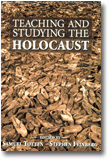 Teaching and Studying the Holocaust - Annoted version Teaching and Studying the Holocaust is comprised of thirteen chapters by some of the most noted Holocaust educators in the United States. In addition to chapters on establishing clear rationales for teaching this history and Holocaust historiography, the book includes individual chapters on incorporating primary documents, first person accounts, film, literature, art, drama, music, and technology into a study of the Holocaust. It concludes with an extensive and valuable annotated bibliography especially designed for educators. Chapter Ten instructs how to make effective use of technology in teaching and learning about the Holocaust. The final section of the book includes a bibliography especially developed for teachers that lists invaluable resources. (By the publisher)
 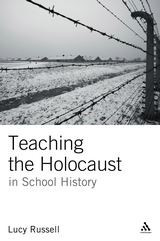 Teaching the Holocaust in School History: Teachers or Preachers? If we expose students to a study of human suffering we have a responsibility to guide them through it. But is this the role of school history? Is the rationale behind teaching the Holocaust primarily historical, moral or social? Is the Holocaust to be taught as a historical event, with a view to developing students' critical historical skills, or as a tool to combat continuing prejudice and discrimination? These profound questions lie at the heart of Lucy Russell's fascinating analysis of teaching the Holocaust in school history. She considers how the topic of the Holocaust is currently being taught in schools in the UK and overseas. Drawing on interviews with educationalists, academics and teachers, she discovers that there is in fact a surprising lack of consensus regarding the purpose of, and approaches to, teaching the Holocaust in history. Indeed the majority view is distinctly non-historical: there is a tendency to teach the Holocaust from a social and moral perspective and not as history. This book attempts to explain and debate this phenomenon. (By the publisher)
 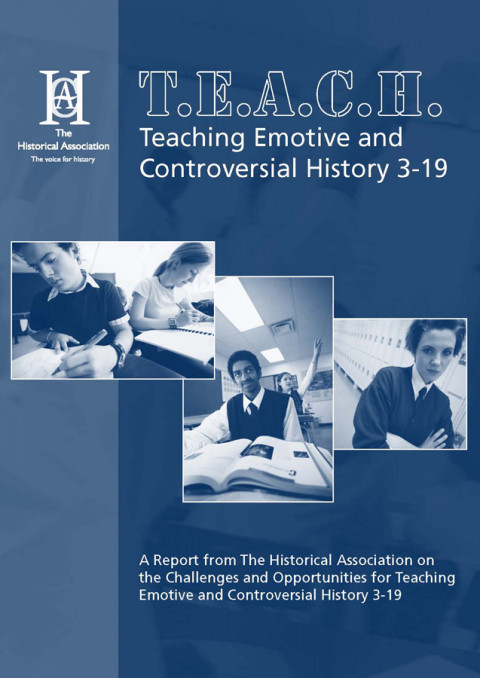 T.E.A.C.H : Teaching emotive and controversial History 3-19 Many historical topics, including the Crusades, the Transatlantic Slave Trade or the Arab-Israeli conflict, can be considered emotive and controversial. The TEACH report found, in interviews with teachers carried out before 2007, that some teachers sometimes feel uncertain how best to approach such topics in such a way as to do the topics justice while respecting the feelings of particular groups of pupils. At no point did any teacher interviewed for the TEACH report claim to have avoided teaching about the Holocaust at Key Stage 3 for fear of offending Muslim children. The TEACH report outlines the sort of good practice in teaching sensitive topics which is available for teachers to share, not least through the Historical Association's programme of subject-specific training. (By the publisher) Fearful symmetry: Palestinian and Jewish teachers confront contested narratives in integrated bilingual education The present paper deals with Jewish and Palestinian teachers who work in an integrated school in Israel, and shows the challenges and possibilities by examining these teachers' powerful historical narratives in the context of in-service training sessions. It is shown how these teachers essentially remain firmly rooted in the hegemonic historical narratives of their own community, even when their attitudes are challenged and clearer alternatives are considered to the reigning narratives. The findings highlight predominantly the failures, concerning the potential of educational efforts to help overcome situations of intractable conflict, even within contexts specifically devised for this purpose; yet, some openings also become apparent in the process of negotiating competing narratives and inventing new dialogic possibilities. The paper suggests that schools with their historical tradition are places where it is difficult to reach change or to produce it—even in integrated schools in which partial structural change takes place—and teacher training may not always be the answer. However, it also indicates that an ongoing agonistics of raising critical issues regarding one's identifications with hegemonic narratives does offer openings to take responsibility for both the challenges and the dialogic possibilities that are created in the process. Teaching the Holocaust at a distance : reflections from the field As technology continues to improve and online learning programs continue to proliferate each year throughout the United States, it is necessary for teachers to establish a sound understanding of proper pedagogical techniques for a digital environment. This phenomenon has ushered in a new era of education, thus bringing forth a myriad of new questions and issues that must be addressed. For instance, how should online instructors properly transfer and teach traditional core subjects in an online milieu? Social studies educators are faced with additional quandaries, such as teaching democratic processes for effective citizenship and the teaching of controversial issues/topics like the Holocaust. Undeniably, controversial topics elicit strong emotions and come with a plethora of concerns that seem only possible to address in a face-to-face classroom. This current exploration draws upon the scholarship and experience of experts in the field of social studies education, distance learning, and Holocaust Studies to provide suggestions as to how teachers should approach controversial topics in a digital learning environment. An example lesson plan is also provided to showcase a successful integration of controversial issues into an online high school social studies classroom. (By the author) Teaching the Holocaust in Primary Schools in Scotland: Modes, methodology and content Most consideration of teaching the Holocaust in Britain is based on teaching pupils aged 12-15 in England (Supple, 1993; Short, 1995; Carrington & Short, 1997; Brown & Davies, 1998). This paper directs attention to some experiences of teaching the Holocaust to pupils of primary stages 5-7 in Scotland (i.e. those aged between 9 and 11) and considers the significance of teaching Holocaust history in the primary context. The rationale for teaching this area is examined both in terms of the topicality, the universality of its lessons and the suggestions in various documentation about developing positive values in pupils. Eight primary teachers, five of whom regularly teach aspects of the Holocaust to this age group in Scottish schools when allocated the upper primary stages, were interviewed at length to ascertain the nature of the integration of the Holocaust into the Scottish 5-14 curriculum, the methodologies applied and the content of their studies. These findings are analysed and their implications discussed. (By the author) Making sense of the Holocaust: Lessons from classroom practice Featuring the close examination of different narrative treatments of the Holocaust by experienced teachers working with diverse groups of students in American public high schools, the book focuses on curricular enactments within particular classroom settings and examines what students in each class learned (and didn't learn) about the Holocaust. (By the author) Teaching, Learning, and the Holocaust: An Integrative Approach Classroom study of the Holocaust evokes strong emotions in teachers and students. Teaching, Learning, and the Holocaust assesses challenges and approaches to teaching about the Holocaust through history and literature. Howard Tinberg and Ronald Weisberger apply methods and insights of the Scholarship of Teaching and Learning to examine issues in interdisciplinary teaching, with a focus on the community college setting. They discuss student learning and teacher effectiveness and offer guidance for teaching courses on the Holocaust, with relevance for other contexts involving trauma and atrocity. (By the author) Lignes directrices pour l'éducation mondiale: manuel pour les éducateurs à comprendre et à mettre en œuvre l'éducation globale Год публикации: 2008 Организация-автор: North-South Centre of the Council of Europe Ces lignes directrices Éducation de Globale sont le résultat d'un besoin exprimé par (NSC) Réseau d'éducation Globale praticiens du Centre Nord-Sud - le réseau de la semaine de l'éducation globale - d'avoir un outil commun, construit sur l'expérience acquise par le réseau et d'autres partenaires, à éducateurs de soutien pour comprendre et mettre en œuvre avec succès les initiatives de l’éducation globale. En offrant des perspectives sur l'éducation globale, ainsi que les méthodes et critères d'évaluation - y compris le partage des pratiques, des outils et des ressources - ces lignes directrices visent à renforcer l'ensemble des travaux pour l'éducation mondiale. Il vise à soutenir les praticiens Présent dans les formels et non formels paramètres général en introduisant des éléments qui peuvent être développés par eux aux besoins et selon en fonction de leurs propres expériences; les aider dans l'éducation globale Identifier les approches et pratiques existantes; les aider à réfléchir et à devenir plus conscients de leurs activités d'éducation globales propres; Augmenter le partage mondial de la pratique de l'éducation et de créer des synergies entre les parties prenantes; Contribuer aux politiques d'éducation au niveau local, régional, national et international. Les lignes directrices Éducation globalesont une initiative du Programme d’Éducation Globale du Centre Nord-Sud du Conseil de l'Europe, impliquant une équipe d'éducateurs du réseau Semaine de l'éducation mondiale qui a constitué l'équipe de rédaction avec le mandat de rédiger collectivement, les lignes directrices Education Mondiale. Le processus d'écriture a inclus une méthode participative à plusieurs niveaux de l'éducation conseil mondial parmi les éducateurs et les praticiens activement impliqués dans le Centre Nord-Sud de Éducation Globale et Jeunesse. En outre, un groupe de mentors a été identifié parmi les partenaires européens et internationaux de NSC, qui comprenait, entre autres, une équipe de formateurs de l'Université du NSC Jeunesse & Développement. Sujets présentés dans les lignes directrices visent à clarifier des questions clés liées à l'éducation globale; Il suggère à élaborer des stratégies sur la façon dont le contenu; mettre en avant AIMS, les compétences, les valeurs et les attitudes; offrir des conseils sur les méthodes, la conception des programmes et de l'évaluation et la liste des contacts, des liens utiles et bibliographie. Les lignes directrices doivent être considérées comme un processus continu de l'évolution, qui devrait être régulièrement revue avec de nouvelles idées, des intrants et des pratiques brought à partir d'une diversité de partenaires et de leurs expériences.