
Ресурсы
Изучайте широкий спектр ценных ресурсов ВГГ, чтобы углубить своё понимание и повысить эффективность исследований, просветительской деятельности, преподавания и обучения.
Найдено: 30
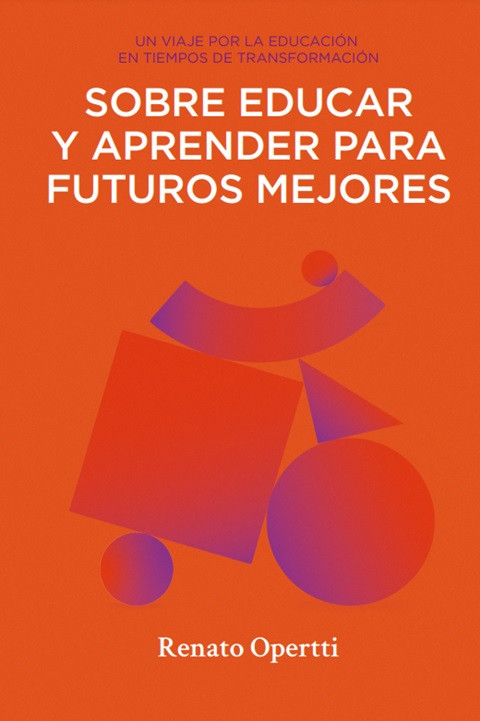 On Educating and Learning for Better Futures: A Journey Through Education in Times of Transformation Год публикации: 2024 Автор: Renato Opertti The author of the book, Renato Opertti, president of the OEI Advisory Board, presents this publication divided into six chapters: On the global and the local, On Ibero-America, opportunities and pending challenges, On thinking, educating and learning, PISA findings and the resilience of educational systems, Regarding Meirieu and educators and On the new generations and the future of education in Uruguay. Sobre educar y aprender para futuros mejores: Un viaje por la educación en tiempos de transformación Год публикации: 2024 Автор: Renato Opertti El autor del libro, Renato Opertti presidente del Consejo Asesor de la OEI, nos presenta esta publicación que divide en seis capítulos: Sobre lo global y lo local, Sobre Iberoamérica, oportunidades y desafíos pendientes, Sobre pensar, educar y aprender, Hallazgos de pisa y la resiliencia de los sistemas educativos, A propósito de Meirieu y los educadores y Sobre las nuevas generaciones y los futuros de la educación en Uruguay.
 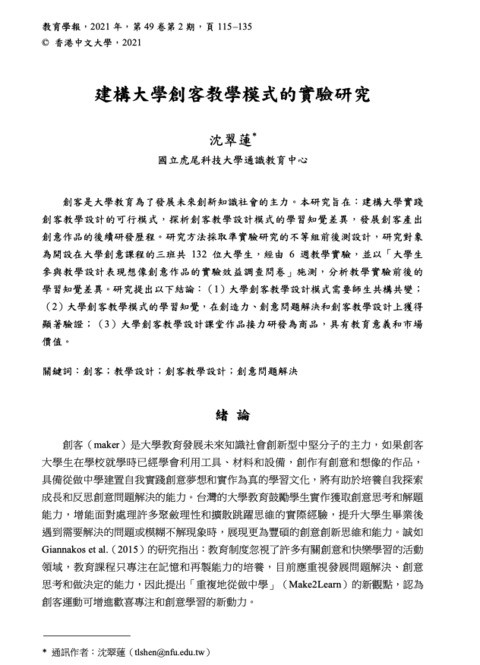 An Experimental Study of Constructing Maker Teaching Model (Educational Journal ; Vol.49, No.2) Год публикации: 2021 Автор: 沈翠莲 Makers studying at university are the main powerful pioneers for developing innovative knowledge society. This research aimed to construct a feasible model of maker teaching, to explore the differences of learning perception of the maker instructional model, and to develop the subsequent process of product creation. Nonequivalent pretest-posttest designs of the quasi-experimental research was employed. Research participants included 132 college students from three classes of creativity-related courses, who participated a 6-week experiment. They were divided into the experimental group and two control groups. A questionnaire was employed to test their differences of learning perception. Results found that: (a) for the maker instructional model, CEO-I2M2E2-SF, a collaborative constructive relationship should be built between instructor and makers; (b) in terms of the performances of learning perception under the maker instructional model, significant differences were found in the dimensions of creativity, creative problem solving, and maker instructional design; (c) there were educational and marketing values in the subsequent process of product creation by makers. 建构大学创各教学模式的实验研究 (教育学报; Vol.49, No.2) Год публикации: 2021 Автор: 沈翠莲 创客是大学教育为了发展未来创新知识社会的主力。本研究旨在:建构大学实践创客教学设计的可行模式,探析创客教学设计模式的学习知觉差异,发展创客产出创意作品的后续研发历程。研究方法采取准实验研究的不等组前后测设计,研究对象为开设在大学创意课程的三班共132位大学生,经由6周教学实验,并以「大学生参与教学设计表现想像创意作品的实验效益调查问卷」施测,分析教学实验前后的学习知觉差异。研究提出以下结论:(1)大学创客教学设计模式需要师生共构共变;(2)大学创客教学模式的学习知觉,在创造力、创意问题解决和创客教学设计上获得显着验证;(3)大学创客教学设计课堂作品接力研发为商品,具有教育意义和市场价值。
 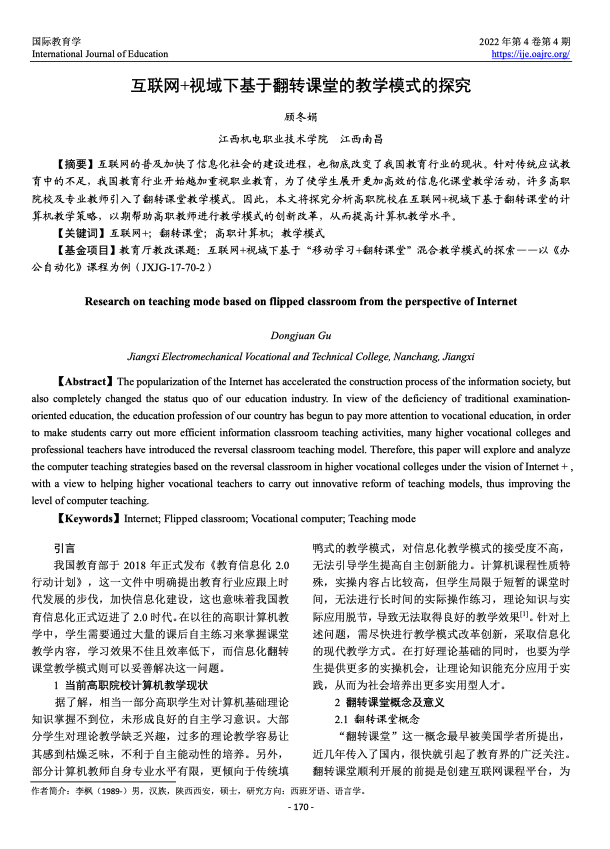 互联网+视域下基于翻转课堂的教学模式的探究 Год публикации: 2022 Автор: 顾冬娟 互联网的普及加快了信息化社会的建设进程,也彻底改变了我国教育行业的现状。针对传统应试教育中的不足,我国教育行业开始越加重视职业教育,为了使学生展开更加高效的信息化课堂教学活动,许多高职院校及专业教师引入了翻转课堂教学模式。因此,本文将探究分析高职院校在互联网+视域下基于翻转课堂的计算机教学策略,以期帮助高职教师进行教学模式的创新改革,从而提高计算机教学水平。
 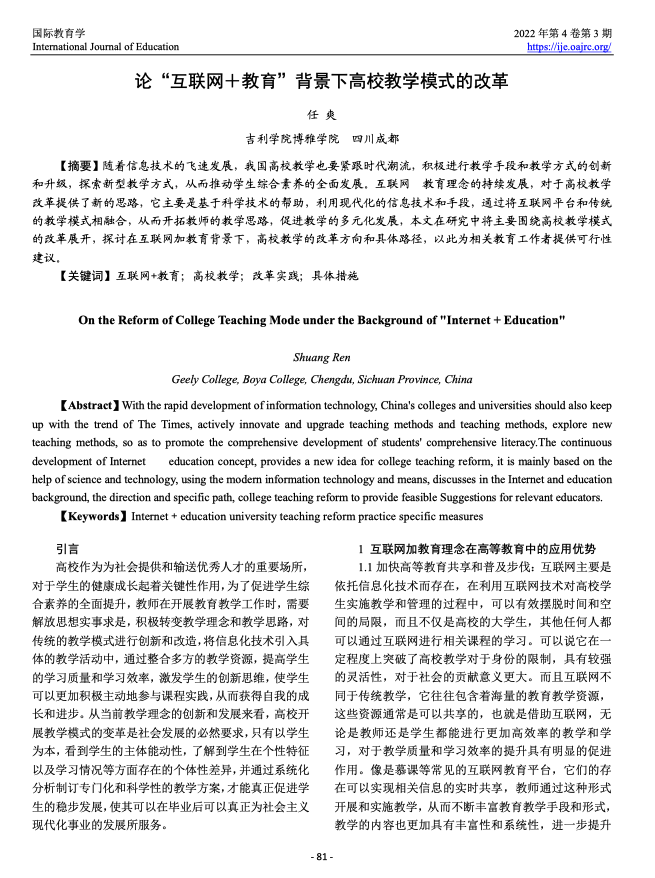 论“互联网+教育”背景下高校教学模式的改革 Год публикации: 2022 Автор: 任爽 随着信息技术的飞速发展,我国高校教学也要紧跟时代潮流,积极进行教学手段和教学方式的创新和升级,探索新型教学方式,从而推动学生综合素养的全面发展。互联网➕教育理念的持续发展,对于高校教学改革提供了新的思路,它主要是基于科学技术的帮助,利用现代化的信息技术和手段,通过将互联网平台和传统的教学模式相融合,从而开拓教师的教学思路,促进教学的多元化发展,本文在研究中将主要围绕高校教学模式的改革展开,探讨在互联网加教育背景下,高校教学的改革方向和具体路径,以此为相关教育工作者提供可行性建议。
  Strengthening Social and Emotional Learning in Hybrid Modes of Education: Building Support for Students, Teachers, Schools and Families Год публикации: 2024 Организация-автор: UNESCO International Bureau of Education (IBE) This Discussion Paper focuses on the essential role of social and emotional learning (SEL) in the global movement to transform education and amplify its social, economic, environmental and personal impacts in a rapidly changing world. It explores how the mainstreaming of SEL into educational policies and practices can contribute to realizing future visions of education that are flexible, reflective, innovative, and impactful. Specifically, the Paper focuses on six topics that, as a whole, reflect global experiences in integrating and implementing SEL in its various forms both during and in the wake of the COVID-19 pandemic. Its main objective is to animate discussion on how to integrate a SEL dimension in hybrid modes of teaching and learning. This introductory overview presents the overall purpose and scope of the Paper, defines its underlying concepts and introduces the topics brought to this forum through the lenses of a diverse group of educators from Africa, the Arab States, Asia, Europe, and Latin America.
  Technology and Values-Driven Transformation in Education (Journal of Southeast Asian Education: The Official Journal Of SEAMEO; Vol. 1, Special issue) Год публикации: 2023 Организация-автор: Southeast Asian Ministers of Education Organization (SEAMEO) The 11th SEAMEO-University of Tsukuba Symposium under the theme Technology and Values Driven Transformation in Education held on 20-22 February 2023 successfully engaged over 19,860 participants from 45 countries. With 30 speakers from 10 countries, the symposium provided the platform to share and exchange best practices carried out by schools and universities apart from identifying the challenges encountered by teachers, students and academicians. SEAMEO and UT have selected quality articles emerging from the symposium and put them together in the Journal of Southeast Asian Education. For example: - Lifelong Learning in the Digital Age- A Breakthrough of Values-Driven Strategies in Using Multimedia-Based Instruction (MMBI): A Course Towards Sustainable Transformative Education- Leave No One Behind: The Solution to an Inclusive Future- Unplugged Computational Thinking with Colouring Books
  “Can Education Transform Our World?: Global Citizenship Education and the UN’s 2030 Agenda for Sustainable Development” Год публикации: 2020 Автор: Joel Westheimer Организация-автор: Brill This book chapter is taken from the book Grading Goal Four: Tensions, Threats, and Opportunities in the Sustainable Development Goal on Quality Education, which aims to support the immplementation of Sustainable Development Goal 4 by exploreing various tensions, threats, and opportunities. This chapter specifically focuses on the role of eucation in fostering global citizenship and how educational systems and policies can be improved to facilitate creating a sustainable society and contribute to the 2030 SDG Agenda.
 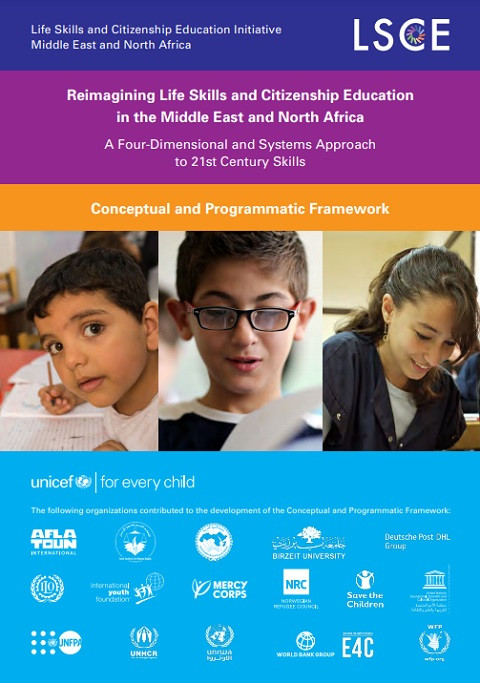 Reimagining Life Skills and Citizenship Education in the Middle East and North Africa: A Four-Dimensional and Systems Approach to 21st Century Skills; Conceptual and Programmatic Framework Год публикации: 2017 Организация-автор: UNICEF Middle East and North Africa The situation of learning in MENA calls for a holistic, lifelong and rights-based vision of education that maximizes the potential of all children and youth in the region and better equips them to create meaning out of knowledge and to face the transitions from childhood to adulthood, from education to work, and from unreflective development to responsible and active citizenship. This is what drives the MENA Life Skills and Citizenship Education (LSCE) Initiative, kicked off in 2015 with the aim of supporting the countries of the region – conceptually, programmatically and technically – to improve learning and to better invest such learning in individual, social and economic development.The LSCE Conceptual and Programmatic Framework (CPF) puts forth a roadmap to guide policies, strategies and programmes on life skills and citizenship education supporting the region-wide efforts to provide children and youth with opportunities to learn, transition from childhood to adulthood, move from school to work settings, and become responsible and active citizens of their communities.A set of twelve core life skills for MENA has been identified using the four-dimensional learning model: ‘Learning to Know’ (Cognitive Dimension), ‘Learning to Do’ (Instrumental Dimension), ‘Learning to Be’ (Individual Dimension), and ‘Learning to Live Together’ (Social Dimension). The twelve core life skills are life-long, and they build on evidence that underlines the importance of skills acquisition from an early age. Furthermore, the twelve core life skills are acquired and sustained through all forms of learning in a systems approach that recognizes multiple pathways of learning, formal, non-formal and informal.