
Ресурсы
Изучайте широкий спектр ценных ресурсов ВГГ, чтобы углубить своё понимание и повысить эффективность исследований, просветительской деятельности, преподавания и обучения.
Найдено: 141
 La Educación encierra un tesoro, informe a la UNESCO de la comisión Internacional sobre la Educación para el Siglo XXI (compendio) Год публикации: 1996 Автор: Jacques Delors Организация-автор: International Commission on Education for the Twenty-first Century Learning: The Treasure Within, commonly referred to as the 'Delors Report', proposes a holistic and integrated vision of education based on the paradigms of lifelong learning, and the four pillars of learning to be, to know, to do, and to live together. L'Education: un trésor est caché dedans, rapport à l'UNESCO de la commission internationale sur l'éducation pour le vingt et unième siècle (extraits) Год публикации: 1996 Автор: Jacques Delors Организация-автор: International Commission on Education for the Twenty-first Century Learning: The Treasure Within, commonly referred to as the 'Delors Report', proposes a holistic and integrated vision of education based on the paradigms of lifelong learning, and the four pillars of learning to be, to know, to do, and to live together. 教育:财富蕴藏其中国际二十一世纪教育委员会向教科文组织提交的报告(要点) Год публикации: 1996 Автор: Jacques Delors Организация-автор: International Commission on Education for the Twenty-first Century Learning: The Treasure Within, commonly referred to as the 'Delors Report', proposes a holistic and integrated vision of education based on the paradigms of lifelong learning, and the four pillars of learning to be, to know, to do, and to live together. التعلّم: ذلك الكنز المكنون؛ تقرير قدمته الى اليونسكو اللجنة الدولية المعنية بالتربية للقرن الحادي والعشرين (مقتطفات) Год публикации: 1996 Автор: Jacques Delors Организация-автор: International Commission on Education for the Twenty-first Century Learning: The Treasure Within, commonly referred to as the 'Delors Report', proposes a holistic and integrated vision of education based on the paradigms of lifelong learning, and the four pillars of learning to be, to know, to do, and to live together.
 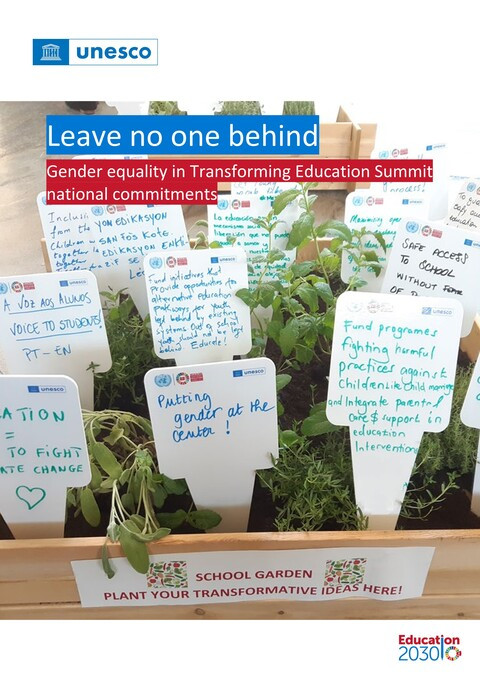 Leave No One Behind: Gender Equality in Transforming Education Summit National Commitments Год публикации: 2023 Организация-автор: UNESCO The Transforming Education Summit was convened in response to a global crisis in education – one of equity and inclusion, quality and relevance. This paper applies a gender lens to the national statements of commitments made by countries during the Summit. It considers the scope of commitments to gender equality and gender- transformative education, common gender themes and considerations emerging across commitments, and notable gaps. It aims to inform future actions by the Global Platform to Drive Leadership and Accountability for Gender Equality and Girls’ and Women’s Empowerment in and through Education, and support to country action to transform education systems to advance gender equality.
 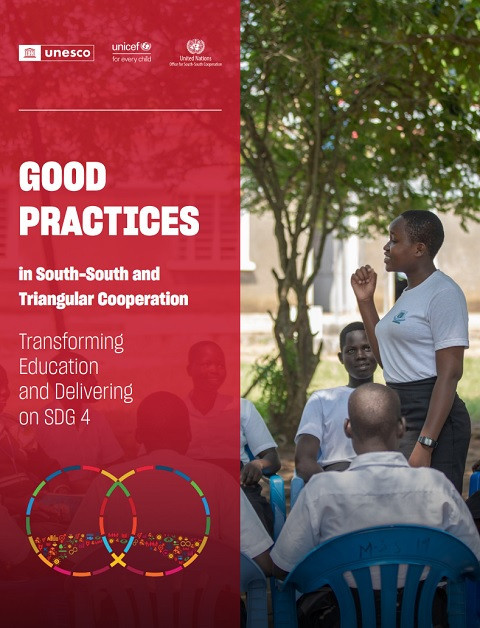 Good Practices in South-South and Triangular Cooperation: Transforming Education and Delivering on SDG 4 Год публикации: 2023 Организация-автор: UNESCO | United Nations Children's Fund (UNICEF) | UN. Office for South-South Cooperation (UNOSSC) Quality Education: South-South cooperation as a lever for action. This publication showcases 40 innovative solutions on how South-South and Triangular Cooperation can transform education.South-South and triangular cooperation is at the heart of SDG4 implementation on Quality Education. As demonstrated in the last few years, this kind of cooperation can mobilize action, ambition, solidarity and solutions to transform education in a rapidly changing world. From the inclusive approach to digital learning in Lao People’s Democratic Republic to distance learning and teacher training strategies in Caribbean SIDS, South-South cooperation is a key modality of cooperation for transforming education and supporting internationally agreed development goals, including the 2030 Agenda. This publication showcases 40 innovative solutions on how South-South and Triangular Cooperation can transform education.This publication presents forty innovative solutions from around the world which showcase how South-South and triangular cooperation can support the development of more efficient, equitable and resilient education systems that are adapted to the challenges of the 21st century. Countries of the South, with the support of partners, must enhance South-South and triangular cooperation to exchange resources, technology, skills and knowledge to realize the promise of making inclusive, quality education available to all.
 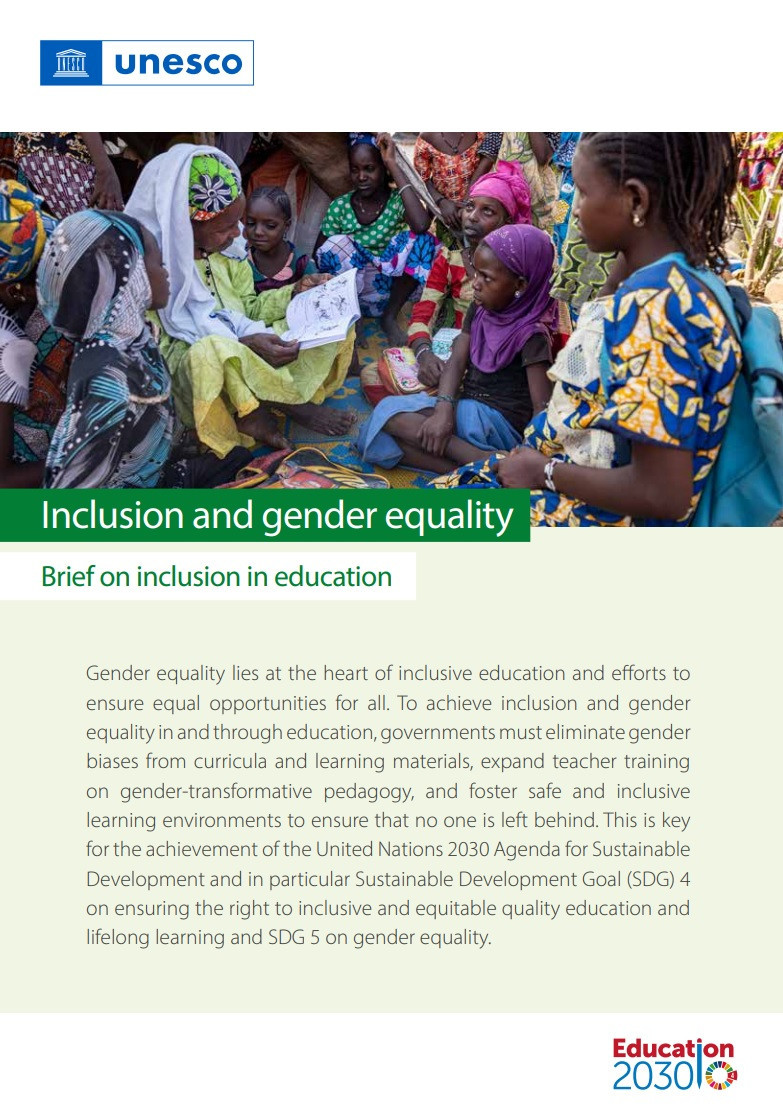 Inclusion and gender equality: brief on inclusion in education Год публикации: 2023 Организация-автор: UNESCO <Brief on inclusion in education>Gender equality lies at the heart of inclusive education and efforts to ensure equal opportunities for all. To achieve inclusion and gender equality in and through education, governments must eliminate gender biases from curricula and learning materials, expand teacher training on gender-transformative pedagogy, and foster safe and inclusive learning environments to ensure that no one is left behind. This is key for the achievement of the United Nations 2030 Agenda for Sustainable Development and in particular Sustainable Development Goal (SDG) 4 on ensuring the right to inclusive and equitable quality education and lifelong learning and SDG 5 on gender equality.<Introduction>Gender refers to the socially constructed roles and relationships, personality traits, attitudes, behaviours, values, relative power and influence that society ascribes to the two sexes on a differential basis. Gender affects people’s lives every day in myriad ways. Gendered expectations, whether of oneself or of others, impact the choices people make. They structure people’s relationships and have the power to shape what people believe they can and should accomplish. Gendered power structures distribute and influence power, often resulting in systemic inequalities (UNESCO, 2021).Gender also intersects with other characteristics which can exacerbate education exclusion, such as age, geography, poverty, disability, ethnicity, indigeneity, language, religion, and migration or displacement status. Addressing the overlapping differences that create disadvantage and marginalization can help to build more inclusive and equitable education systems.Achieving gender equality in and through education is essential for inclusive education and inclusive societies. It is key to the achievement of the United Nations 2030 Agenda for Sustainable Development and in particular Sustainable Development Goal (SDG) 4 on ensuring the right to inclusive and equitable quality education and lifelong learning and SDG 5 on gender equality. In any country’s context, this means ensuring all learners have equal access to all levels of education, equal educational pathways and equal opportunities to apply the outcomes of their education. A world where inclusion and gender equality in and through education is achieved allows girls and boys, women and men and non-binary people to have equal rights and opportunities to education and the power and agency to shape their lives and futures.This brief discusses how gender equality impacts learners’ inclusion and the ways in which gender equality and inclusion are interconnected in education.
 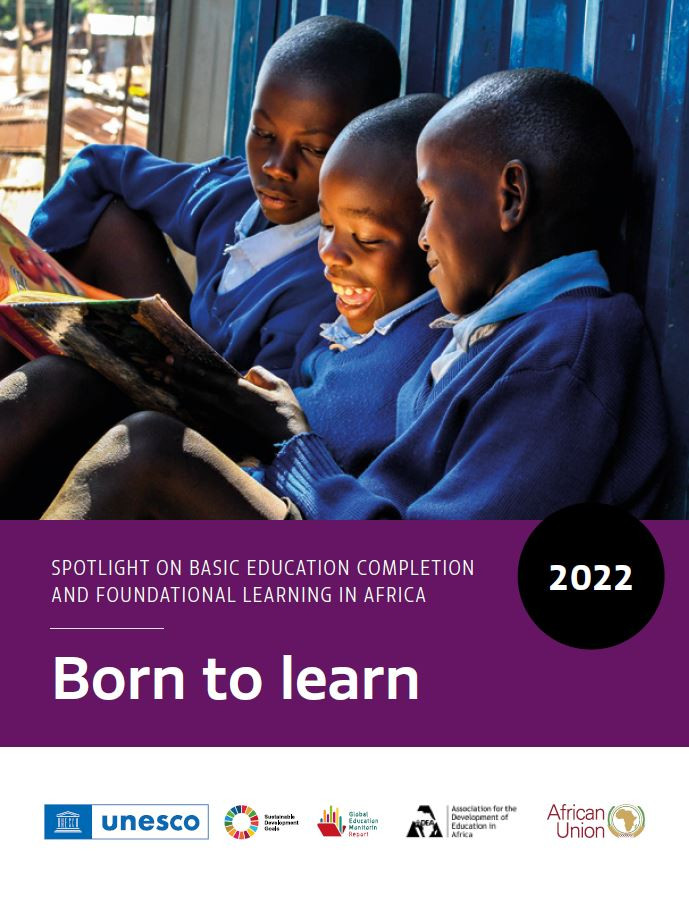 Spotlight on Basic Education Completion and Foundational Learning in Africa, 2022: Born to Learn Год публикации: 2022 Организация-автор: UNESCO | Association for the Development of Education in Africa (ADEA) | African Union This publication is the first in a three-part Spotlight series. It is produced by a partnership between the Global Education Monitoring Report, the Association for the Development of Education in Africa and the African Union.The report focuses on why learning levels in the region are low. All children are born to learn yet only one in five children in Africa who reach the end of primary school achieve the minimum proficiency level required to continue their education and fulfil their potential. Combining completion and learning statistics, the report shows that children in Africa are at least five times less likely than children in the rest of the world to be prepared for the future.Given the historically low levels of learning on the continent, fresh thinking is needed to translate the CESA and SDG 4 commitments into focused, coordinated, well-informed and appropriately funded actions. The report contains eight policy-oriented recommendations for driving change.
 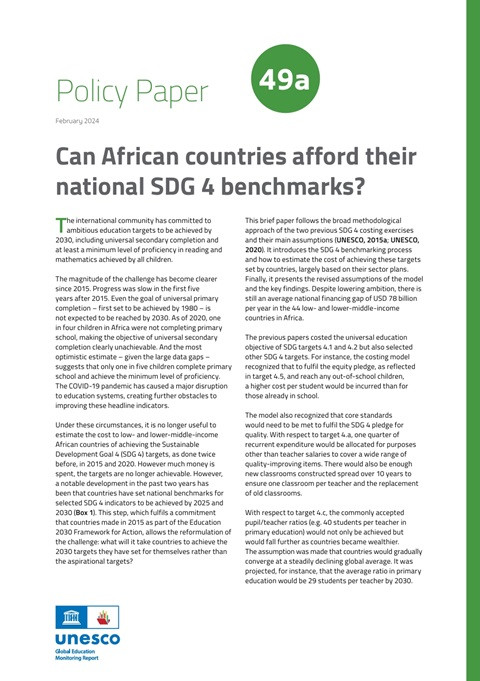 Can African Countries Afford Their National SDG 4 Benchmarks? Год публикации: 2024 Организация-автор: UNESCO | Global Education Monitoring Report Team This brief paper follows the broad methodological approach of the two previous SDG 4 costing exercises and their main assumptions (UNESCO, 2015a; UNESCO, 2020). It introduces the SDG 4 benchmarking process and how to estimate the cost of achieving these targets set by countries, largely based on their sector plans. Finally, it presents the revised assumptions of the model and the key findings. Despite lowering ambition, there is still an average national financing gap of USD 78 billion per year in the 44 low- and lower-middle-income countries in Africa.
 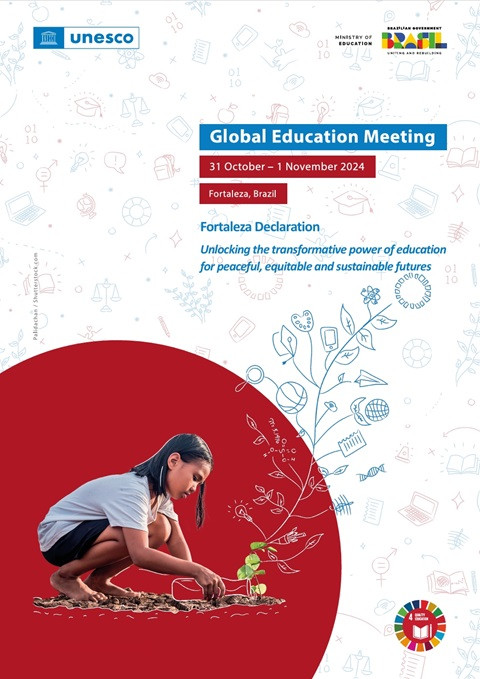 Global Education Meeting: Fortaleza Declaration; Unlocking the Transformative Power of Education for Peaceful, Equitable and Sustainable Futures Год публикации: 2024 Организация-автор: UNESCO | Brazil. Ministry of Education The 2024 Global Education Meeting (GEM), held in Fortaleza, Brazil, marked a significant milestone in the global pursuit of education equity and financing, with the adoption of the powerful Fortaleza Declaration by over 650 participants including over 50 Ministers from across the globe.