
Ресурсы
Изучайте широкий спектр ценных ресурсов ВГГ, чтобы углубить своё понимание и повысить эффективность исследований, просветительской деятельности, преподавания и обучения.
Найдено: 1,330
 AI Competency Framework for Teachers Год публикации: 2024 Автор: Fengchun Miao | Mutlu Cukurova Организация-автор: UNESCO AI processes vast information, generates new content, and helps decision-making through predictive analyses. In education, AI has transformed the traditional teacher–student relationship into a teacher–AI–student dynamic.This shift requires a re-examination of teachers’ roles and the competencies they need in the AI era. Yet, few countries have defined these competencies or developed national programmes to train teachers in AI, leaving many educators without proper guidance.The AI competency framework for teachers addresses this gap by defining the knowledge, skills, and values teachers must master in the age of AI. Developed with principles of protecting teachers’ rights, enhancing human agency, and promoting sustainability, the publication outlines 15 competencies across five dimensions: Human-centred mindset, Ethics of AI, AI foundations and applications, AI pedagogy, and AI for professional learning. These competencies are categorized into three progression levels: Acquire, Deepen, and Create.As a global reference, this tool guides the development of national AI competency frameworks, informs teacher training programmes, and helps in designing assessment parameters. It also provides strategies for teachers to build AI knowledge, apply ethical principles, and support their professional growth.
  الإرشادات التوجيهية لتخضير مناهج التعليم والتعلّم من أجل العمل المناخيّ Год публикации: 2024 Организация-автор: UNESCO This Guidance responds to the calls from young people for a holistic approach to climate change and sustainability in the curriculum. It outlines a common language on how quality climate change and sustainability can be reflected in the curriculum by setting expected learning outcomes per age group (from 5-year olds and up to 18+ age group, including a lifelong learning approach).This is crucial for accelerating country-level action and ensuring joint monitoring of progress. The objective is to have 90 per cent of all countries include climate change in their curricula by 2030, as established by the Greening Education Partnership.This Guidance aims to support countries, schools or individual practitioners in reassessing their ongoing practices to adopt a more action-oriented, holistic, scientifically accurate, justice-driven and lifelong learning approach to climate change.
 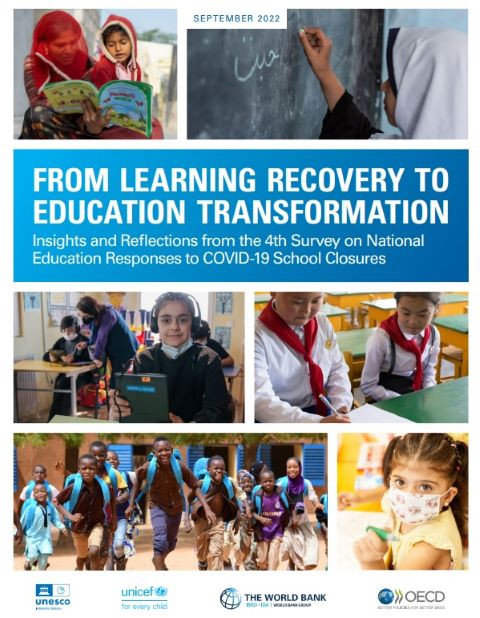 From Learning Recovery to Education Transformation: Insights and Reflections from the 4th Survey on National Education Responses to COVID-19 School Closures Год публикации: 2022 Организация-автор: UNESCO | UNESCO Institute for Statistics (UIS) | United Nations Children's Fund (UNICEF) | World Bank | Organisation for Economic Co-operation and Development (OECD) From Learning Recovery to Education Transformation, a new joint report by UNESCO, UNESCO Institute for Statistics (UIS), UNICEF, The World Bank and The OECD, presents findings from the fourth round of the Survey on National Education Responses to COVID-19 School Closures, administered between April–July 2022 with responses from Ministries of Education in 93 countries. It explores how countries are progressing in the RAPID actions to recover learning: Reach every child and keep them in school; Assess learning levels regularly; Prioritize teaching the fundamentals; Increase the efficiency of instruction; and Develop psychosocial health and wellbeing.
 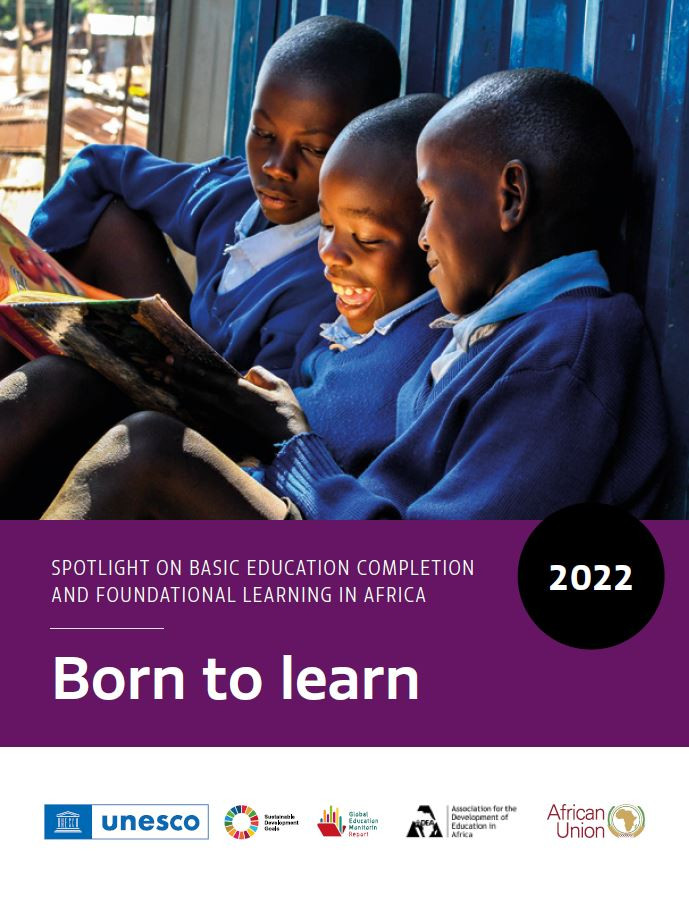 Spotlight on Basic Education Completion and Foundational Learning in Africa, 2022: Born to Learn Год публикации: 2022 Организация-автор: UNESCO | Association for the Development of Education in Africa (ADEA) | African Union This publication is the first in a three-part Spotlight series. It is produced by a partnership between the Global Education Monitoring Report, the Association for the Development of Education in Africa and the African Union.The report focuses on why learning levels in the region are low. All children are born to learn yet only one in five children in Africa who reach the end of primary school achieve the minimum proficiency level required to continue their education and fulfil their potential. Combining completion and learning statistics, the report shows that children in Africa are at least five times less likely than children in the rest of the world to be prepared for the future.Given the historically low levels of learning on the continent, fresh thinking is needed to translate the CESA and SDG 4 commitments into focused, coordinated, well-informed and appropriately funded actions. The report contains eight policy-oriented recommendations for driving change.
 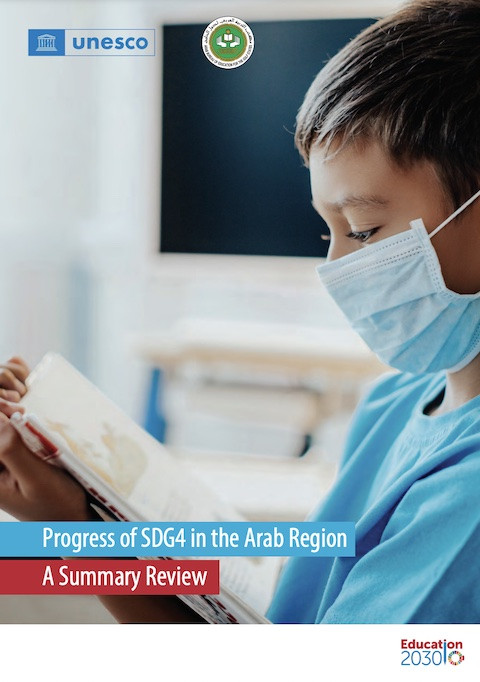 Progress of SDG4 in the Arab Region: A Summary Review Год публикации: 2022 Организация-автор: UNESCO This report is a snapshot review of the progress of SDG 4 in the Arab region, based upon the national reports of the countries of the region and the valuable inputs from the regional education institutes of the region. In this review, SDG 4 is looked at as an essential part of an interconnected whole of all SDGs. However, it focuses on selected targets and indicators of SDG 4 because of difficulties of accessing consistent data pertaining to the region covering the period from 2010 to 2020. Therefore, internationally comparable data from various sources have been taken into consideration, highlighting at the same time the overall pictures as revealed by the country reports and flagging their selected best practices.
 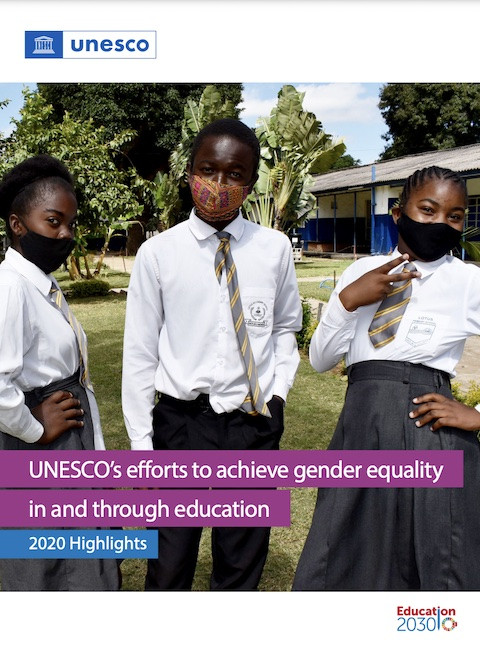 UNESCO’s Efforts to Achieve Gender Equality in and Through Education: 2020 Highlights Год публикации: 2022 Организация-автор: UNESCO This report presents highlights of UNESCO’s work in 2020 to advance gender equality in and through education.UNESCO's work in this area is guided by the UNESCO strategy for gender equality in and through education 2019–2025, and supported by Her Education, Our Future, which was launched in parallel with the strategy, to leverage political and financial commitments, cooperation and joint action for girls’ and women’s education.
 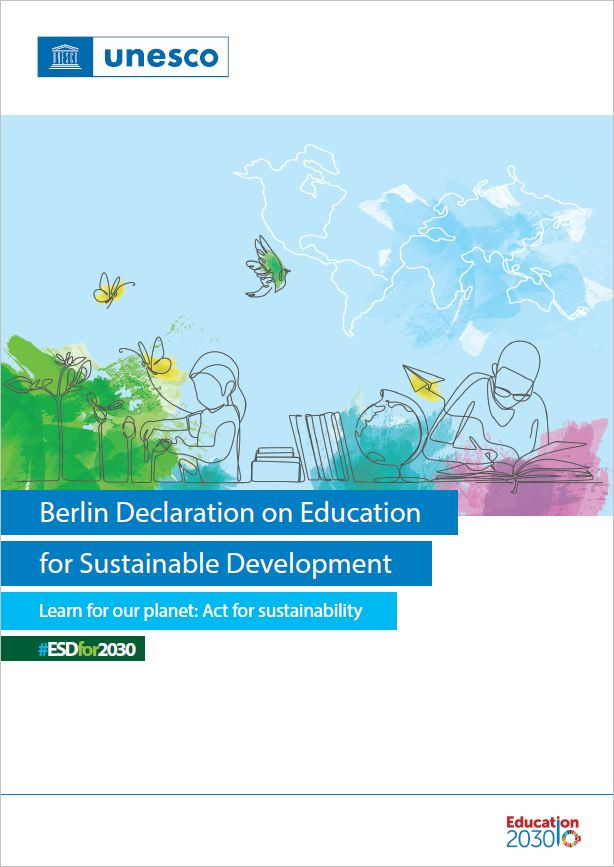 Berlin Declaration on Education for Sustainable Development; Learn for Our Planet: Act for Sustainability Год публикации: 2022 Организация-автор: UNESCO From 17 May to 19 May 2021 around 2800 people – politicians, business people, youth leaders, scientists, Non-governmental organizations, and many more - from 160 countries came together virtually at the UNESCO World Conference on Education for Sustainable Development (ESD) 2021. During the conference, they expressed their commitment to use the transformative power of education in order to address the global challenges we face. The Berlin Declaration was the main result of the conference.The Berlin Declaration on Education for Sustainable Development is an important document that emphasizes the significance of ESD for each and every one of us. It identifies concrete challenges the global community is facing and calls for changes that are urgently needed in order to fully integrate and strengthen ESD in all educational contexts.
 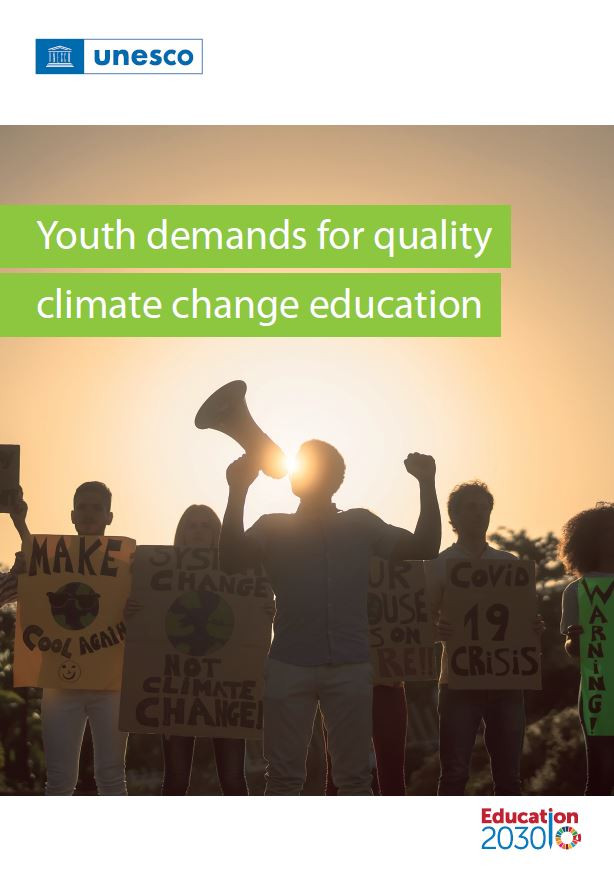 Youth Demands for Quality Climate Change Education Год публикации: 2022 Организация-автор: Organización de las Naciones Unidas para la Educación, la Ciencia y la Cultura (UNESCO) This document summarizes the findings of a global survey and focus group discussions on young people’s learning experiences and demands on quality climate change education, based on responses from about 17,500 young people across 166 countries. The findings shed light on how young people are currently experiencing climate change education and what they want to see differently in the future around five key aspects: learning content, ways of teaching and learning, the learning environment, school management and learning partnerships.
 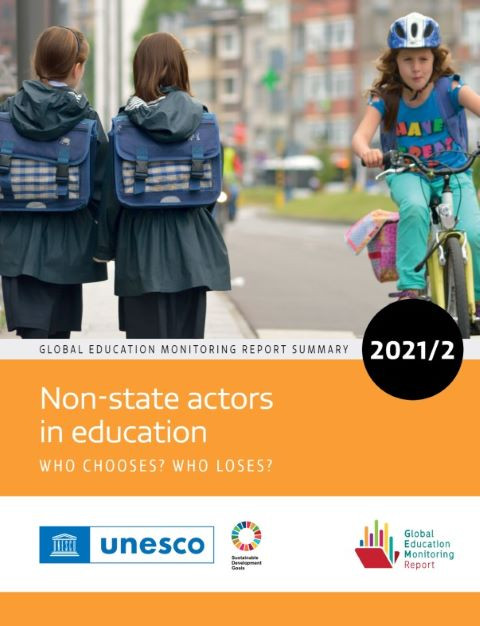 [Resumen] Informe de seguimiento de la educación en el mundo 2021/2: Los actores no estatales en la educación; ¿quién elige? ¿quién pierde? Год публикации: 2022 Организация-автор: UNESCO El papel de los actores no estatales se extiende más allá de la escolarización a las intervenciones en diferentes niveles educativos y esferas de influencia. Junto con su revisión del progreso hacia el ODS 4, incluida la evidencia emergente sobre el impacto de la pandemia de COVID-19, el Informe de Seguimiento de la Educación en el Mundo 2021/2 insta a los gobiernos a considerar a todas las instituciones, estudiantes y docentes como parte de un solo sistema. Los estándares, la información, los incentivos y la rendición de cuentas deberían ayudar a los gobiernos a proteger, respetar y cumplir el derecho a la educación para todos, sin apartar la vista de los privilegios o la explotación. La educación financiada por el estado no tiene que ser proporcionada por el estado, pero se debe abordar la disparidad en los procesos educativos, los resultados de los estudiantes y las condiciones de trabajo de los maestros. La eficiencia y la innovación, en lugar de ser secretos comerciales, deben ser compartidos y practicados por todos. Con este fin, se debe mantener la transparencia e integridad del proceso de formulación de políticas de educación pública para bloquear los intereses creados. El grito de guerra del informe: ¿Quién elige? ¿Quién pierde? – invita a los responsables de la toma de decisiones políticas a cuestionar las relaciones con los actores no estatales en términos de elecciones fundamentales: entre equidad y libertad de elección; entre fomentar la iniciativa y establecer estándares; entre grupos de diferentes medios y necesidades; entre los compromisos inmediatos bajo el ODS 4 y los que se lograrán gradualmente (por ejemplo, educación postsecundaria); y entre la educación y otros sectores sociales. [Résumé] Rapport mondial de suivi sur l’éducation, 2021-2022: Les acteurs non étatiques dans l’éducation; Qui décide? qui est perdant? Год публикации: 2022 Организация-автор: UNESCO Le rôle des acteurs non étatiques s'étend au-delà de la scolarisation à des interventions à différents niveaux d'éducation et sphères d'influence. Parallèlement à son examen des progrès vers l'ODD 4, y compris les preuves émergentes sur l'impact de la pandémie de COVID-19, le Rapport mondial de suivi sur l'éducation 2021/2 exhorte les gouvernements à considérer tous les établissements, étudiants et enseignants comme faisant partie d'un système unique. Les normes, l'information, les incitations et la responsabilité devraient aider les gouvernements à protéger, respecter et réaliser le droit à l'éducation de tous, sans détourner les yeux des privilèges ou de l'exploitation. L'éducation financée par l'État n'a pas à être fournie par l'État, mais la disparité dans les processus éducatifs, les résultats des élèves et les conditions de travail des enseignants doit être abordée. L'efficacité et l'innovation, plutôt que d'être des secrets commerciaux, doivent être diffusées et pratiquées par tous. À cette fin, la transparence et l'intégrité du processus d'élaboration des politiques d'éducation publique doivent être maintenues pour bloquer les intérêts acquis. Le cri de ralliement du rapport – Qui choisit ? Qui perd ? – invite les décideurs politiques à questionner les relations avec les acteurs non étatiques en termes de choix fondamentaux : entre équité et liberté de choix ; entre l'incitation à l'initiative et l'établissement de normes ; entre des groupes aux moyens et aux besoins variés ; entre les engagements immédiats au titre de l'ODD 4 et ceux à concrétiser progressivement (par exemple, l'enseignement postsecondaire) ; et entre l'éducation et les autres secteurs sociaux.