
Ресурсы
Изучайте широкий спектр ценных ресурсов ВГГ, чтобы углубить своё понимание и повысить эффективность исследований, просветительской деятельности, преподавания и обучения.
Найдено: 1,330
 Los efectos de la IA en la vida laboral de las mujeres Год публикации: 2022 Автор: Clementine Collett | Gina Neff | Livia Gouvea Gomes Организация-автор: UNESCO | Inter-American Development Bank | Organisation for Economic Co-operation and Development (OECD) El uso de tecnologías de IA afectará las oportunidades de las mujeres en el trabajo y su posición, status y tratamiento en el ámbito laboral. Alrededor del mundo, en la fuerza laboral las mujeres ganan menos que los varones, dedican más tiempo a trabajo no remunerado cuidando a niños y ancianos, tienen menos puestos sénior, participan menos en los campos de ciencia, tecnología, ingeniería y matemáticas (STEM por sus siglas en inglés) y tienden, en general, a tener trabajos más precarios. Al utilizar la IA, los gobiernos, las instituciones y las empresas deberán achicar las brechas de género y no perpetuarlas o exacerbarlas. Este informe del BID, la OCDE y UNESCO resume el conocimiento actual respecto del impacto que tienen los sistemas de IA sobre las oportunidades laborales de las mujeres, y sobre su posición, tratamiento y estatus en la fuerza laboral. En esta línea, el informe explora cómo se usa la IA dentro y fuera del ámbito laboral y cómo podría ser usada en el futuro. Mira el impacto potencial de las tecnologías de IA nuevas y emergentes sobre las habilidades que requerirán los empleadores, la manera en que las mujeres buscan empleo y son contratadas y cómo se estructuran los empleos a través del monitoreo y la supervisión automatizados. El informe presenta un mapa de las oportunidades y los desafíos que presenta la IA para la vida laboral de las mujeres y pone de manifiesto las complejidades que los diversos contextos nacionales y regionales presentan para comprender el impacto de la IA sobre el trabajo de las mujeres. El informe también toma nota de que la investigación actual no ofrece una mirada completa o definitiva respecto de cómo impacta la IA sobre la vida laboral de las mujeres e insta a la realización de más investigación y análisis en este campo. Les effets de l’IA sur la vie professionnelle des femmes Год публикации: 2022 Автор: Clementine Collett | Gina Neff | Livia Gouvea Gomes Организация-автор: UNESCO | Inter-American Development Bank | Organisation for Economic Co-operation and Development (OECD) L'utilisation des technologies d'IA aura une incidence sur les opportunités de travail des femmes, ainsi que sur leur position, leur statut et leur traite,ent sur le lieu de travail. Partout dans le monde, les femmes dans la population active gagnent moins que les hommes, passent plus de temps à s'occuper des enfants et des personnes âgées sans être rémunérées, occupent moins de postes à responsabilités, sont moins présentes dans les domaines des sciences, de la technologie, de l'ingénierie et des mathématiques(STEM) et ont tendance à occuper des emplois plus précaires dans l'ensemble. En exploitant l'IA, les gouvernements, les institutions et les entreprises doivent réduire les inégalités femmes-hommes plutôt que les perpétuer ou de les exacerber. Ce rapport, rédigé par la BID, l'OCDE et l'UNESCO, présente les connaissances actuelles sur position, leur traitement et leur statut dans la population active. Pour ce faire, il explore à l'avenir. Il examine l'impact potentiel des technologies d'IA nouvelles et naissantes sur les cométences dont les employeurs auront besoin, sur la manière dont les femmes structurés grâce à un contrôle et une surveillance automatisée. Le rapport dresse la liste des opportunités et des défis que l'IA présente pour la vie professionnelle des femmes et souligne les complexités que présentent les différents contextes nationaux et régionaux pour comprendre l'impact de l'IA sur le travail des femmes. Le rapport note également que les recherches actuelles ne permettent pas de dresser un tableau complet ou précis de l'impact de l'IA sur la vie professionnelle des femmes et appelle à poursuivre les recherches et les analyses dans ce domaine.
  Mapping Cultural Policies in Small Island Developing States: Amplifying SIDS Voices in the Global Policy Dialogue on Culture and Sustainable Development Год публикации: 2025 Организация-автор: UNESCO Mapping Cultural Policies in Small Island Developing StatesSpanning three sub-regions – the Atlantic, Indian Ocean and South China Sea (AIS), the Caribbean, and the Pacific – the Small Island Developing States (SIDS) represent 39 UNESCO Member States and 9 Associate Members. Countries and regional organizations have increasingly demonstrated their commitment in the context of fast-evolving policy landscape and cultural ecosystems, encompassing the different dimensions of culture through its diversity and a wide spectrum of concerned stakeholders. Today, a SIDS-specific, culture-led development vision is on the rise.Culture has a multifaceted impact on sustainable development pathways of the SIDS, from climate action, biodiversity protection and food security to economic diversification, social inclusion, gender equality or urban sustainability. The voices and aspirations of SIDS must be heard in the global policy dialogue, in acknowledgement of their priorities, opportunities and insights. International cooperation efforts by UNESCO and other organizations are also essential in identifying areas for future policy investment and adaptation at the national and regional levels.Following the UNESCO World Conference on Cultural Policies and Sustainable Development – MONDIACULT 2022, SIDS are championing culture for sustainable development towards the adoption of a new Programme of Action, the Antigua and Barbuda Agenda for SIDS 2024-2034.
  Recommendation on Education for Peace and Human Rights, International Understanding, Cooperation, Fundamental Freedoms, Global Citizenship and Sustainable Development Год публикации: 2023 Организация-автор: UNESCO Building more peaceful, just, and sustainable societies starts with education. It influences all aspects of our daily lives and our overall prospects while being impacted by our health and environment. In the global landscape of worsening climate change, democratic backsliding, persistent inequalities, rising discrimination, hate speech, violence and conflict, it can be a tool to address and prevent these problems in the future. And it can also be a long-term investment with increasing returns if shaped and deployed effectively. The new UNESCO Recommendation on Education for Peace and Human Rights, International Understanding, Cooperation, Fundamental Freedoms, Global Citizenship and Sustainable Development, which is commonly referred to as the Recommendation on Education for Peace, Human Rights and Sustainable Development is a landmark guidance document that defines what needs to evolve in and through education to accomplish these goals. 평화, 인권, 국제이해, 협력, 기본적 자유, 세계시민성, 지속가능발전을 위한 교육 권고 Год публикации: 2023 Организация-автор: 유네스코 이 권고는 ‘국제이해, 협력, 평화를 위한 교육과 인권, 기본적 자유에 관한 교육 권고(1974)’를 개정하여 2023년 제42차 유네스코 총회가 채택한 것이다.
  Marco de competencias para docentes en materia de IA Год публикации: 2025 Автор: Fengchun Miao | Mutlu Cukurova Организация-автор: UNESCO Orientación para docentes sobre el uso y el mal uso de la IA en la educaciónLa IA procesa enormes cantidades de información, genera nuevos contenidos y ayuda a la toma de decisiones mediante análisis predictivos. En el ámbito educativo, la IA ha transformado la relación tradicional docente-estudiante, creando una nueva dinámica docente-IA-estudiante. Este cambio exige replantear los roles de los docentes y las competencias que necesitan en la era de la IA. Sin embargo, son pocos los países que han definido estas competencias o desarrollado programas nacionales para capacitar a los docentes en IA, lo que deja a muchos educadores sin una orientación adecuada.El Marco de competencias en materia de IA para docentes aborda esta brecha al definir los conocimientos, habilidades y valores que los docentes deben dominar en la era de la IA. Desarrollada bajo los principios de protección de los derechos de los docentes, del fortalecimiento de la capacidad de acción humana y de la promoción de la sostenibilidad, la publicación describe 15 competencias que atraviesan cinco dimensiones: una forma de pensar centrada en el ser humano, la ética de la IA, los fundamentos y aplicaciones de la IA, la pedagogía de la IA, y la IA para el aprendizaje profesional. Estas competencias se clasifican en tres niveles de progresión: adquirir, profundizar y crear.Como una referencia global, esta herramienta orienta el desarrollo de marcos nacionales de competencias en IA, brinda insumos para los programas de formación docente y ayuda a diseñar parámetros de evaluación. También ofrece estrategias para que los docentes desarrollen conocimientos sobre IA, apliquen principios éticos y apuntalen su crecimiento profesional.
  Référentiel de compétences en IA pour les enseignants Год публикации: 2025 Автор: Fengchun Miao | Mutlu Cukurova Организация-автор: UNESCO Guider les enseignants à propos de l’usage judicieux ou problématique de l’IA en éducationL’intelligence artificielle (IA) traite une grande quantité d’informations, génère de nouveaux contenus et aide à la prise de décision grâce à des analyses prédictives. Dans le domaine de l’éducation, l’IA a transformé la relation traditionnelle entre l’enseignant et l’apprenant en un triptyque dynamique entre l’enseignant, l’IA et l’apprenant. Cette évolution exige de repenser le rôle des enseignants et les compétences dont ils ont besoin à l’ère de l’IA. Pourtant, peu de pays ont défini ces compétences ou élaboré des programmes nationaux pour former les enseignants à l’IA, ce qui prive de nombreux éducateurs d’un cadre adéquat.Le Référentiel de compétences en IA pour les enseignants comble cette lacune : il définit les connaissances, les habiletés et les valeurs que les enseignants doivent maîtriser à l’ère de l’IA. Élaborée dans le respect de la protection des droits des enseignants, de l’accroissement de l’agentivité humaine et de la promotion de la durabilité, la publication présente 15 compétences réparties en cinq composantes : une approche de l’IA centrée sur l’humain, l’éthique de l’IA, les fondements et les applications de l’IA, la pédagogie de l’IA et l’IA pour l’apprentissage professionnel. Ces compétences sont classées selon trois niveaux de progression : acquérir, approfondir, créer.En tant que référence internationale, cet outil sert de guide pour l’élaboration de référentiels nationaux de compétences en IA, apporte des informations sur les programmes de formation des enseignants et aide à définir des paramètres d’évaluation des apprentissages. Il fournit également aux enseignants des stratégies pour développer leurs connaissances en matière d’IA, respecter des principes éthiques et soutenir leur développement professionnel.
 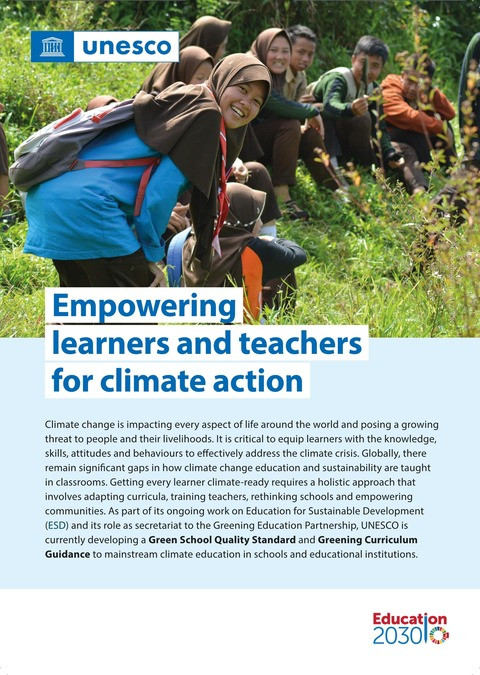 Empowering Learners and Teachers for Climate Action Год публикации: 2023 Организация-автор: UNESCO Climate change is impacting every aspect of life around the world and posing a growing threat to people and their livelihoods. It is critical to equip learners with the knowledge, skills, attitudes and behaviours to effectively address the climate crisis. Globally, there remain significant gaps in how climate change education and sustainability are taught in classrooms. Getting every learner climate-ready requires a holistic approach that involves adapting curricula, training teachers, rethinking schools and empowering communities. As part of its ongoing work on Education for Sustainable Development (ESD) and its role as secretariat to the Greening Education Partnership, UNESCO is currently developing a Green School Quality Standard and Greening Curriculum Guidance to mainstream climate education in schools and educational institutions.
 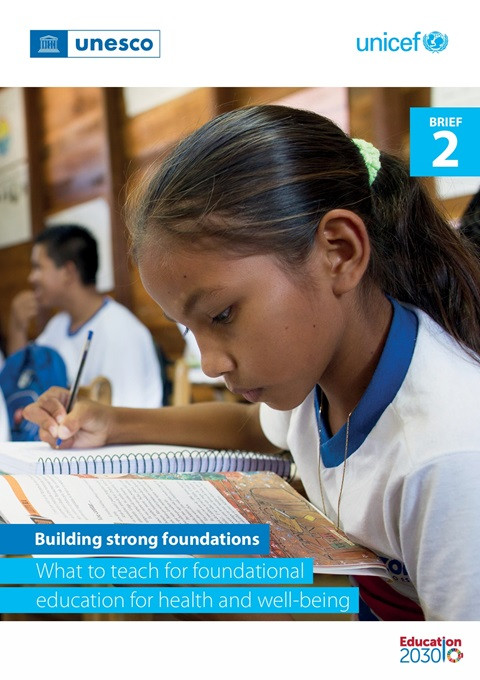 Building Strong Foundations: What to Teach for Foundational Education for Health and Well-being (Building Strong Foundations Brief; 2) Год публикации: 2024 Организация-автор: UNESCO | United Nations Children's Fund (UNICEF) In a rapidly changing world, establishing strong foundations for children is vital for their well-being and resilience. Quality education is central to this endeavour and is the key to lifelong health and success. Recognizing that children thrive in the classroom when they are in good health, it is crucial to learn about health and well-being early on in primary schools. The Building strong foundations briefs, developed jointly by UNESCO and UNICEF, provide evidence-based guidance to support primary school-aged children to thrive through foundational education for health and well-being. Drawing from extensive research and consultations with leading experts from various fields and across the world, these briefs serve as a roadmap for education stakeholders to equip learners with the requisite knowledge and skills to navigate their current and future health and well-being needs. The present document is the second of four briefs. It is a go-to resource to better understand what makes a primary school curriculum effective in supporting health, well-being and learning. The brief provides practical tips and insights on integrating core thematic concepts for health and well-being into the curriculum, including concrete examples of learning objectives for lower primary and upper primary curricula. Whether a seasoned curriculum designer, a passionate educator or an individual involved in primary school curriculum processes, this brief equips readers with the tools to design impactful curricula for transformative learning, health and well-being.
 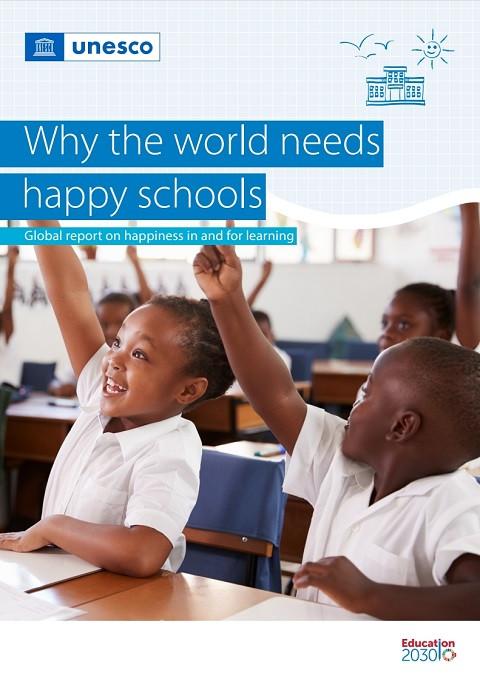 Why the World Needs Happy Schools: Global Report on Happiness In and For Learning Год публикации: 2024 Организация-автор: UNESCO Seeing a teacher smile. Hearing students laugh. Feeling a hug from a friend. Smelling fresh air. Tasting a nutritious school meal. These five senses can stimulate happiness at school and improve the learning experiences, outcomes and well-being of students. Through the ‘Happy Schools’ initiative, UNESCO is placing happiness at the core of the transformation of education. It encourages education systems to recognize happiness as both a means to and a goal of quality learning. The initiative is informed by a growing evidence base linking happiness with better learning, teaching, well-being and overall system resilience. This report presents the UNESCO global Happy Schools framework consisting of 4 pillars – people, process, place and principles – and 12 high-level criteria to guide the transformation of learning. It offers a holistic model for embedding happiness into education policies and cultivating it in schools through systemic changes. The report illustrates how the ‘Happy Schools’ initiative aims to create top-down and bottom-up transformation, encouraging governments to recognize happiness as a core objective of education. It supports the scaling of promising practices of joyful learning from the school to the policy level.