
Ресурсы
Изучайте широкий спектр ценных ресурсов ВГГ, чтобы углубить своё понимание и повысить эффективность исследований, просветительской деятельности, преподавания и обучения.
Найдено: 3,158
 Using archival documents, memoir, and testimony to teach about Jewish families during and after the Holocaust Carson Phillips suggests the use of archival documents, memoir and recorded testimony to engage students in learning. Use the three survivor testimonies below, from Czechoslovakia, Hungary and Croatia, in conjunction with those in the Gurewitsch essay (pp. 48–55) for a rich and varied look at the fraught experiences of Jewish families struggling to survive and, ultimately, rebuild their lives. (By the publisher) Holocaust Education in Post-Communist Romania As Israeli historian Leon Volovici noted in a recent article, Romania today is marked by the concurrent presence of a prolific nationalistic media with strong anti-Semitic accents and a swell of events dedicated to the history of its Jews. This remarkable paradox is perhaps just one more example of the originality of Romania’s post-communist transition, the more so since the object of both trends is becoming less and less numerous every day: there are only about 9,000, mostly elderly Jews living in contemporary Romania. After 45 years of “relative silence” imposed by the communists and eight more years of “relevant silence” imposed by the neo-communists, as of 1998 the Holocaust is finally mentioned and discussed, but “in the third person”, as it were: it’s true, it happened, but not in Romania! (By the author) Entering the World of a Holocaust Victim: Schoolchildren Discuss a Ghetto Memoir – a Case Study Despite Adorno's famous dictum, the memory of the Shoah features prominently in the cultural legacy of the 20th century and beyond. It has led to a proliferation of works of representation and re-memorialization which have brought in their wake concerns about a 'holocaust industry' and banalization. This volume sheds fresh light on some of the issues, such as the question of silence and denial, of the formation of contemporary identities — German, East European, Jewish or Israeli, the consequences of the legacy of the Shoah for survivors and for the 'second generation,' and the political, ideological, and professional implications of Shoah historiography. One of the conclusions to be drawn from this volume is that the 'Auschwitz code’, invoked in relation to all 'unspeakable' catastrophes, has impoverished our vocabulary; it does not help us remember the Shoah and its victims, but rather erases that memory. (By the author)
  School and Culture: An Analysis of Justifications for Educational-Cultural Partnerships Год публикации: 2010 Автор: Héloïse Côté Организация-автор: Revue des sciences de l’éducation Governments legislate to favour cultural partnerships. What meaning do official texts and actors give to these partnerships ? We analysed the content of Québec official texts and of semi-structured interviews conducted with twelve actors (n = 12) from the perspective of the justifications they presented. The author found that 30,9 % of the official texts and 28,4 % of the actors’ discourse justify cultural partnerships on the basis of the exploration of networks and the elaboration of projects. Nonetheless, since other adequate justifications are also mentioned, cultural partnerships stem from a compromise between several justifications. Escuela y cultura : un análisis de las justificaciones de los colaboradores educativos con carácter cultural Год публикации: 2010 Автор: Héloïse Côté Организация-автор: Revue des sciences de l’éducation Los gobiernos legislan para fomentar las colaboraciones educativas con carácter cultural. ¿Qué sentido los textos oficiales y los actores otorgan a estas colaboraciones ? Hemos analizado el contenido de los textos oficiales quebequenses y de entrevistas semi-directivas realizadas con doce actores (n = 12) desde la perspectiva de las justificaciones presentadas. Unos 30,9 % de los textos oficiales y 28,4 % del discurso de los actores justifican estas colaboraciones con base a las actividades de exploración de redes y de la instauración de proyectos. Sin embargo, dado que se evocan también otras justificaciones pertinentes, las colaboraciones educativas con carácter cultural derivan de un compromiso entre justificaciones múltiples.
  2018년도 SDG4-교육2030 협의체 운영보고서 Год публикации: 2019 Организация-автор: 유네스코한국위원회 2018년도 교육부, 유네스코한국위원회와 9개 교육전문기관(한국교육과정평가원, 유아정책연구소, 한국대학교육협의회, 한국직업능력개발원, 한국여성정책연구원, 국가평생교육진흥원, 유네스코 아시아태평양 국제이해교육원, 한국교육학술정보원, 한국교육개발원) 으로 구성된 SDG 4-교육2030 협의체 운영(회의, 포럼 등) 내용을 담은 보고서이다.
  [Video] The Global Goals Food Project: Every Plate Tells a Story Год публикации: 2017 Организация-автор: World’s Largest Lesson The World’s Largest Lesson brings the Global Goals to children all over the world, reaching over 130 countries and millions of children since its launch in September 2015.Produced by Project Everyone and delivered in partnership with UNICEF and many NGOs, private sector organisations and foundations, the World’s Largest Lesson reaches students through multiple channels. Ministries of Education are invited annually to take part. NGOs distribute digital content through their networks and education organisations, both for and non-profit, encourage participation through their communities.
  [Video] The World’s Largest Lesson Part 2 - With Thanks to Sir Ken Robinson and Emma Watson Год публикации: 2016 Организация-автор: World’s Largest Lesson Sir Ken Robinson, Emma Watson and Aardman Animations invite children to get involved in the Global Goals for Sustainable Development by inventing, innovating and campaigning.To show the version with English subtitles please go to: vimeo.com/181766755
 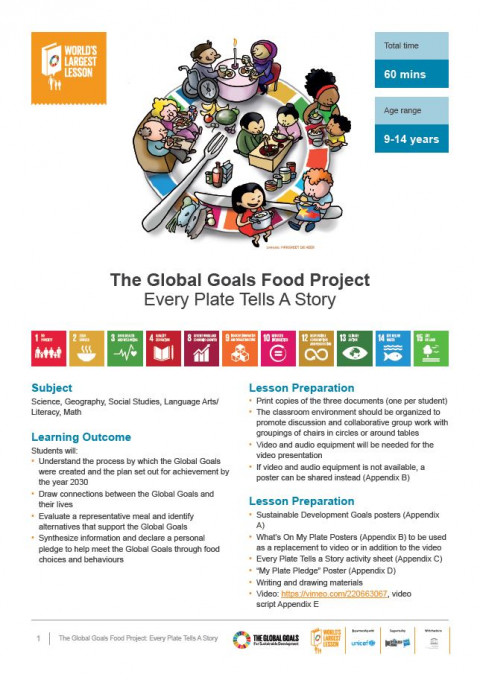 The Global Goals Food Project: Every Plate Tells a Story Год публикации: 2017 Организация-автор: World’s Largest Lesson This lesson plan, “Every Plate Tells a Story,” provides a guided activity for teachers and students to work together in efforts to bring the Global Goals to classrooms and learning.The lesson begins by broadly introducing the term “goal” and invites students to make personal connections to people, places, and environments by considering goals in their lives. Learners build knowledge as they integrate understanding of the Global Goals and the processes in which they were designed.During the lesson, students will engage in a process of inquiry through dialogue, collaboration, and research and will establish concrete realizations of the sustainability of the food they eat. Multiple sources of evidence/formative assessments can be used throughout the lesson to document learning, guide conversation, and inform future instruction.
  [Video] Citizenship and Human Rights Education for Change Год публикации: 2019 Организация-автор: Global Campus of Human Rights In increasingly selective, violent and intolerant times, it becomes crucial to reinforce our capacities to deal with topical, controversial and contested issues undermining our human dignity and to promote the supportive values of non-discrimination, democracy, intercultural dialogue and peace. Teaching and learning about democratic citizenship, human rights and EU common values represents an opportunity to react and counter the negative forces of our time.This MOOC aims to foster the promotion of Human Rights Education and EU common values through the transfer of knowledge about the definitions, frameworks and content of Human Rights Education as well as the analysis of existing and innovative practices on teaching styles, approaches and methods.