
Ресурсы
Изучайте широкий спектр ценных ресурсов ВГГ, чтобы углубить своё понимание и повысить эффективность исследований, просветительской деятельности, преподавания и обучения.
Найдено: 3,158
 Mission impossible ? Créer un cadre de suivi pour l’éducation à la citoyenneté mondiale Год публикации: 2015 Автор: Amy Skinner Организация-автор: Éducation des Adultes et Développement Il faut considérer l’éducation à la citoyenneté mondiale (ECM) comme un processus complexe et multidimensionnel. L’ECM peut être une force transformatrice au niveau personnel, au niveau local et au niveau du système. Parvenir à effectuer un suivi de l’ECM en tenant compte de cette complexité serait d’une grande utilité. Cet article présente les résultats d’une recherche sur le suivi et explique les défi s que représente la mise en place d’un cadre de suivi.
  How Networking Can Help Build Global Citizenship in Japan Год публикации: 2015 Автор: Hideki Maruyama Организация-автор: Éducation des Adultes et Développement The article explains and outlines some of the challenges facing schools in Japan when teaching about sustainable development. These challenges are many and diverse. Concrete examples are given, and some proposals for action are presented.
  Fear and deference in Holocaust education. The pitfalls of “engagement teaching” according to a report by the British Historical Association This article questions the effectiveness of “engagement teaching” when dealing with controversial subjects by exploring the role of fear in contemporary education about the Holocaust in the United Kingdom. It begins by assessing a governmental report about education and a series of related press reports and chain emails, whose assumption that secondary school teachers are afraid of teaching controversial subjects triggered an international scandal about Holocaust education in the UK in April 2007. The author argues that three forms of respectful fear or deference are undermined in Holocaust teaching: epistemological; political; and intergenerational . The article further demonstrates that the object of fear expressed by journalists and the public was not the Holocaust itself, but the reversal of deferential relations between teachers and pupils in the school classroom and the supposition that we may not learn from history. Whereas history education is held up by policy-makers as a safeguard of social stability and of the transmission of values, the application of “engagement teaching” to controversial subjects may in fact undermine the authority of historical education and the enlightenment principles on which it is founded. (By the author) L’enseignement de l’histoire et les mémoires douloureuses du XXe siècle. Enquête sur les représentations enseignantes This article discusses the teaching of sensitive topics related to the memory and history of the 20th century, mainly the issues of the extermination of Jews and the wars of national liberation. The survey, conducted between 2000 and 2003 at the Academie de Versailles, highlights the specific difficulties in this teaching from primary school to secondary school, in different disciplines ‒ literature, history and philosophy. The report also leads to an analysis of the representations that are formed on these subjects, both by students and teachers. (By the author - Translation)
  Portée et limites de l'éducation à la citoyenneté démocratique Год публикации: 2007 Автор: Charles Heimberg Организация-автор: Université de Genève L’éducation à la citoyenneté démocratique est une dimension du projet éducatif de l’institution scolaire à la fois fortement proclamé et très problématique dans sa réalité quotidienne. Le fait qu’il s’agisse d’une première possibilité de prise de contact avec la notion de citoyenneté pour tous les élèves incite en tout cas la réflexion. La notion de citoyenneté est polysémique et ambiguë par les représentations dont elle fait l’objet comme par les pratiques concrètes qu’elle suscite à l’école ; elle oscille notamment entre la dimension normative de civilité, le civisme politique et participatif, et l’analyse critique de problèmes de société. Cette dimension de citoyenneté, à la fois partout et nulle part au sein de l’école, devrait faire l’objet de recherches empiriques approfondies. Elle laisse forcément ouverte l’épineuse question de savoir comment faire valoir sans prescrire.
  L'éducation à la citoyenneté Год публикации: 2008 Автор: Audric Vitiello Организация-автор: Raisons politiques Notion récente, l'éducation à la citoyenneté se présente comme une inflexion de la formation civique, visant un renouvellement de sa forme pour mieux assurer sa fonction institutionnelle d'intégration des individus au collectif. Mais, l'éducation ôtant une praxis où moyens et fins sont interdépendants, une modification des modalités de l'éducation induit logiquement celle de la finalité. De fait, l'éducation à la citoyenneté s'indexe à une conception originale du politique pensé non plus comme lieu, mais comme moment spécifique dédié à la régulation de tout collectif. Le mécanisme d'abstraction civique perdure, mais il s'effectue à partir des situations concrètes dans lesquelles l'individu est inscrit, et par une réflexion à fondement dialogique. Se dessine alors une forme de démocratie générale et dialogique, où le politique est déconcentré et démultiplié mais où la décision prise en commun après délibération reste le mode de structuration privilégié du collectif. Mais la démocratie procédurale et dialogique a des limites, dans la mesure où elle suppose d'être fondée dans un corpus substantiel de valeurs qui lui confère sa légitimité.
 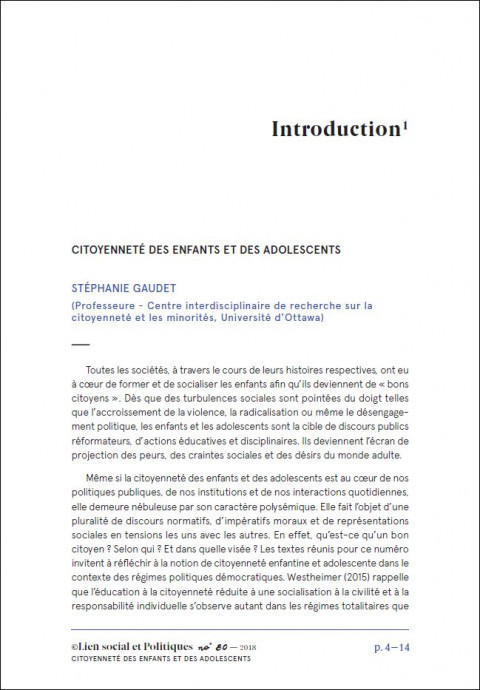 Citoyenneté des enfants et des adolescents Год публикации: 2018 Автор: Stéphanie Gaudet Организация-автор: Lien social et Politiques Chacune des contributions de ce numéro révèle clairement un ou plusieurs de ces défis selon différences échelles d’analyse. La première partie du numéro porte sur les normativités et les représentations sociales de la citoyenneté enfantine et adolescente véhiculées par les instruments de politiques publiques en France et au Québec. La deuxième section porte sur les institutions qui répondent directement des politiques publiques et qui ont pour mandat de socialiser et d’éduquer les enfants et les adolescents aux pratiques de citoyenneté démocratique. La troisième section de ce numéro présente deux contributions qui rendent compte de l’agencéité (agency) des jeunes et de leurs pratiques citoyennes, c’est-à-dire leur capacité à développer des intentions politiques et à les mettre en action les uns avec les autres. Ce terme se distingue de celui d’agentivité qui est utilisé davantage en sciences cognitives et s’intéresse plus spécifiquement aux mécanismes de l’action individuelle (Glossaire, 2009). Finalement, nous terminons le numéro par des analyses à l’échelle des quartiers et des organisations jeunesse. On y voit comment les intervenants de première ligne, et leurs organisations locales, négocient différentes visions de l’éducation citoyenne, allant de l’éducation à la civilité jusqu’à l’intervention démocratique. Ces échelles d’analyse nous permettent d’observer les représentations de la citoyenneté en fonction des rapports de classe et d’ethnicité. Quand les mémoires déstabilisent l’école. Mémoire de la Shoah et enseignement This work is based primarily on the subject of the Holocaust, but it attempts to define cross-cutting issues in the category of teaching “sensitive” subjects, assuming we can build a common paradigm. To do this, it brings together the perspectives of historians, philosophers, teachers and participating witnesses, inviting us to return to the fundamental questions underlying the act of transmission. Each contribution brings us to reflect on what it is we are trying to transmit, and suggests a systematic exploration of the difficulties inherent in these transmissions: the magnitude and complexity of the historical problem, the extreme moral and political exigencies, the intricate intermingling of memory, the historian’s work, and civic commitment. What to do with negative commemorations? We cannot forget, repent, deny or trivialize. We can only question our modern societies and their ambivalence. (By the author - Translation) The Holocaust Explained The Holocaust Explained website, prepared by the London Jewish Cultural Centre, aims to help students with their school work, both in school and at home. It is designed to support the school curriculum. The site has images (pictures, maps, videos, diagrams) to help explain concepts and events. There is text to describe the historical events and 'reflective learning activities' to enhance students' understanding of the issues and concepts. Dallas Holocaust Museum Center for Education and Tolerance The Dallas Holocaust Museum Center for Education contains resources for teaching about the Holocaust : questions/answers, a timeline, key definitions, etc.