
Ресурсы
Изучайте широкий спектр ценных ресурсов ВГГ, чтобы углубить своё понимание и повысить эффективность исследований, просветительской деятельности, преподавания и обучения.
Найдено: 3,158
 Teaching and Learning about the Holocaust through Visiting an Exhibition This article evaluates a teaching initiative that aimed to teach about the Holocaust through a traveling exhibit on Anne Frank. Data from 10 case study schools show the success of the approach and some ways in which the teaching relevance might have been strengthened. (By the author) History at the gates: How teacher and school characteristics relate to implementation of a state mandate on Holocaust education This quantitative study examines implementation by one Florida school district's fifth grade teachers of a state mandate to teach about the Holocaust. Teachers' responses to survey questions were analyzed to determine the relationships between choosing to teach about the Holocaust and factors like exposure to Holocaust content and teacher/school demographics. In addition, this study explores descriptive data about the nature of resources, materials, and teaching methods used to teach about the Holocaust in elementary classrooms. The findings of this study demonstrate the background knowledge and resources that teachers need to increase their implementation of Holocaust education in the classroom. Suggestions for the development of more effective workshops, information dissemination strategies, and teacher resources for Holocaust education and other mandated areas are also included in this study. To provide the necessary background for the exploration of the implementation of Florida's Holocaust education mandate, this study examines: the importance of Holocaust education; effective instructional practices in Holocaust education; connections between Holocaust education and multicultural goals; and the history of the passage of legislation related to Holocaust education. As the title suggests, teachers are the final "gatekeepers" of the curriculum: their decisions determine the extent to which topics will be taught. For this reason, this study examines the connections between teachers, their experiences, and their decisions to teach about crucial, mandated subjects like the Holocaust. (By the author)
  A Whole School Approach: Involving the School Community in Reducing its Carbon Footprint Год публикации: 2010 Организация-автор: Carbon Trust Reducing energy use has many advantages for schools – it saves money, reduces carbon emissions (helping to combat climate change), improves the learning environment and can enhance a school’s reputation.To be really effective, the whole school must be involved in energy saving. This guide outlines an approach to energy management which involves pupils, teachers and other staff. By motivating staff and pupils through lessons, as well as providing practical advice on how to go about saving energy, a whole school approach to energy management can reduce the school’s carbon footprint and provide long-term benefits for the school, its people and the environment.
 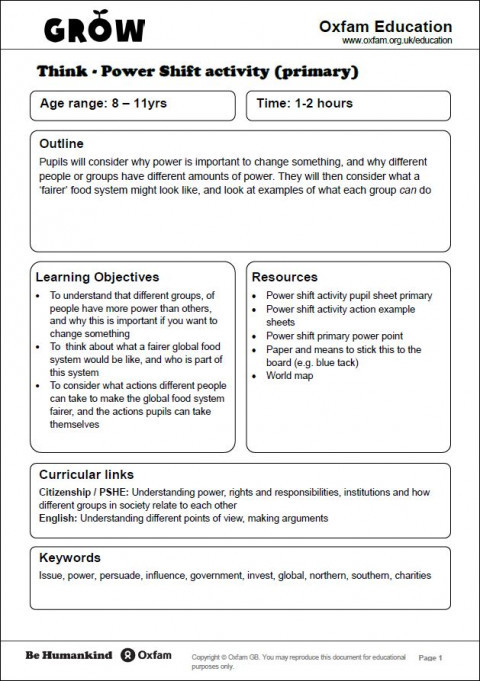 Think: Power-Shift Activity Teachers Guide for Primary Schools Организация-автор: Oxfam GB Linked to Oxfam's GROW campaign, the Food for Thought school resources get young people learning, thinking and taking action for a fairer food system.Through this activity pupils will consider why power is important to change something, and why different people or groups have different amounts of power. They will then consider what a ‘fairer’ food system might look like, and look at examples of what each group can do.
 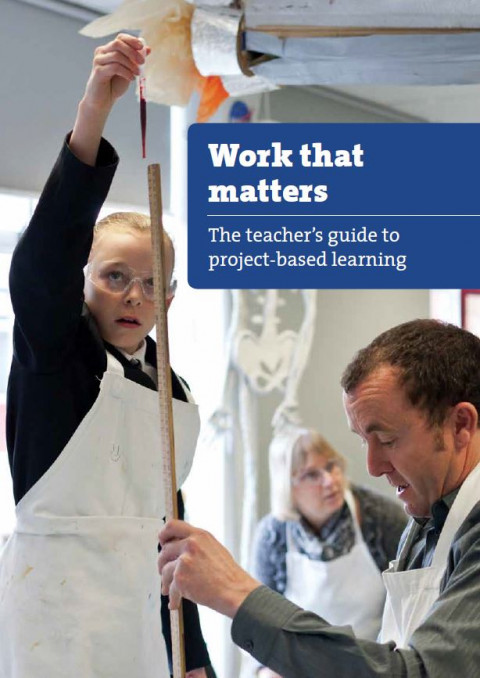 Work that Matters: The Teacher’s Guide to Project-Based Learning Год публикации: 2012 Организация-автор: Paul Hamlyn Foundation A guide on project-based learning and advice for teachers, published by the Learning Futures Special Initiative in partnership with the Innovation Unit.Developed by the Learning Futures project in partnership with High Tech High, this guide offers step-by-step advice on planning and managing extended, interdisciplinary projects, as well as useful protocols for critique sessions, templates for important documents such as project plans, and examples of high-impact projects.
  The Education We Want: An Advocacy Toolkit Год публикации: 2014 Автор: James Edleston | Dan Smith | Sumaya Saluja | David Crone | Chernor Bah | Emily Laurie Организация-автор: A World at School | UN Global Education First Initiative - Youth Advocacy Group (YAG) | Plan International Developed by Plan International, A World at School and the Youth Advocacy Group of the Global Education First Initiative, this toolkit was made for and by young people to advocate for quality education.Packed full of ideas, tools and inspiring stories, it helps children and youth to effectively carry out their own advocacy campaign.Although this advocacy toolkit focuses on education, its tips and ideas are applicable to young people advocating for a variety of development and rights issues.
  The Education We Want: Workshop Facilitator Guide For the Advocacy Toolkit Год публикации: 2014 Автор: Daniel Smith | James Edleston | Tom Burke | Emily Laurie Организация-автор: A World at School | UN Global Education First Initiative - Youth Advocacy Group (YAG) | Plan International This guide is intended as a resource to accompany the ‘Education we want: An Advocacy’. It aims to provide a wide range of workshop activities for those who intend to Understand, Plan or Do their education advocacy using workshop based approaches.Workshops are an effective way of involving others in advocacy. They can support you in carrying out research, drafting a plan and building skills for action.The successful delivery of workshops relies on effective preparation, good facilitation skills and a commitment to support people’s learning and development.
  Ocean Literacy and the IOC: Fostering Ocean-related Education and the Culture of Conservation, Restoration and Sustainable Use of Our Blue Planet Год публикации: 2017 Организация-автор: Intergovernmental Oceanographic Commission (IOC) The general public is not aware of the full extent of the medical, economic, social, political and environmental importance of the sea.Many of us are not aware that our day-to-day actions can have a cumulative effect on the health of the ocean and seas – a necessary resource that must be protected for all life on planet earth to exist.In other words, people lack a sense of ‘Ocean Literacy’ i.e. an understanding of the ocean’s influence on us and our influence on the ocean.In more detail, ocean literacy is more than just educating or informing the public and the marine and maritime stakeholders about the importance of oceans.Ocean literacy, through the use of behavioral change methods and by adopting a system approach, aims at facilitating the creation of an ocean literate society.
  Rewiring the Brain to be Future-ready: Integrating 21st Century Skills in Education Systems Towards Developing Peaceful & Sustainable Societies (The Blue Dot Issue 6, 2017) Год публикации: 2017 Организация-автор: Mahatma Gandhi Institute of Education for Peace and Sustainable Development (MGIEP) In the sixth issue of the Blue Dot, we focus on the importance of these 21st century skills for the young. The issue includes a foreword by the Minister of Human Resource Development, Government of India on the importance of inculcating 21st century skills in education systems and our Cover Story, which introduces UNESCO MGIEP’s LIBRE programme that follows an ‘integrated brain’ approach to education.Additionally, we feature opinions by specialists from academia, research and the industry on the lacuna present in existing education systems and the opportunities available to address this gap by introducing socio-emotional skills and inquiry oriented learning into curricula. Amongst various experts, we hear from Ines Kudo and Joan Hartley from The World Bank on the importance of ‘Teaching empathy and compassion in schools’; Prof. K.P. Mohanan on ‘Critical Inquiry and Inquiry oriented education’ and Dr. Marilee Bresciani Ludvik on how mindfulness forms the foundation for cultivating compassion.Further, we present excerpts from a collection of ‘Ask me Anything’ sessions focused on socioemotional skills, hosted on Knowledge Commons, UNESCO MGIEP’s knowledge sharing platform.We have been honoured to have the opportunity to host and learn from experts such as Dr. Richard Davidson, recognised as one of ‘The 100 most influential people in the world’ in 2006 by the Time Magazine and Chade-Meng Tan, currently the Chairman of Search Inside Yourself Leadership Institute and Co-chair of One Billion Acts of Peace, which has been nominated eight times for the Nobel Peace Prize.
  One Voice for All: Education Pack Год публикации: 2013 Организация-автор: British Council One Voice for All is a set of resources designed to help teachers work on the Connecting Classrooms themes of Rights and Responsibilities and Fairness and Equality through an exploration of human rights and street children. Its focus is the UN Convention on the Rights of the Child and it aims to allow learners to develop understanding of the key concepts of global citizenship, universal rights and justice.This resource aims to give young people the opportunity to understand the complexity of the wider world in which they live by exploring inequality and steps to address it.