
Ресурсы
Изучайте широкий спектр ценных ресурсов ВГГ, чтобы углубить своё понимание и повысить эффективность исследований, просветительской деятельности, преподавания и обучения.
Найдено: 3,158
 Pedagogical Guides: Let's Educate With Equality Год публикации: 2016 Организация-автор: Chile. Ministry of Education This publication includes four pedagogical guides, the first seeks to generate reflection of teachers and managers about their role in gender constructions, the second one seeks critical reflection of elementary school students on how gender constructions affect decisions, the third guide looks the sdame for high school students, and the fourth guide goes around the reflection of parents / guardians on how gender roles affect the vocational decisions of boys and girls. Guías pedagógicas: Eduquemos con igualdad Год публикации: 2016 Организация-автор: Chile. Ministry of Education Esta publicación reune cuatro guías, en la primera se busca generar reflexión de docentes y directivos en torno a su rol en las construcciones de género, en la segunda se pretende la reflexión critica de los estudiantes de enseñanza básica sobre como inciden las construcciones de género en las decisiones vocacionales al igual que en la tercera guía en estudiantes de enseñanza mediay la cuarta guía gira entorno a la reflexión de padres/madres/ apoderados sobre como afectan los roles de género en las decisiones vocacionales de niños y niñas.
  온라인 수업 시대의 디지털 시민성 함양교육 (2020 이슈페이퍼 6호) Год публикации: 2020 Автор: 김승호 Организация-автор: 한국교육개발원 교육정책네트워크 신종 코로나바이러스 감염증(코로나19)으로 인하여 교육 현장은 격변의 시대에 접어 들게 되었다. 별다른 준비 없이 원격수업이 시작되었고 한 학기가 흘렀다. 이 과정에서 온라인상에서의 윤리성 문제가 지적되었다. 본고에서는 온라인 상황에서의 윤리성에 대한 기존의 연구를 바탕으로 디지털 시민성으로 명명되는 온라인 윤리교육의 논의를 점검하고, 디지털 시민교육이 이루어질 수 있는 구체적 방안에 대해 제시하였다. 본 저작물은 한국교육개발원에서 2020년 작성하여 공공누리 제 4유형으로 개방한 ‘온라인 수업 시대의 디지털 시민성 함양교육 (김승호)’을 이용하였으며 해당 저작물은 교육정책네트워크 정보센터(edpolicy.kedi.re.kr)에서 무료로 다운받으실 수 있습니다.
  Les autres, mon corps et moi Год публикации: 2020 Автор: Aline Bosuma | Audrey Boucksom Организация-автор: Belgïk Mojaïk Le dossier pédagogique "Les autre, mon corps et moi" a pour objectif de mettre en évidence les processus des stéréotypes et de la discrimination, d'y réfléchir et de permettre d’amener du changement dans les comportements. Il est composé de 2 activités introductives et généralistes ainsi que de 5 activités thématiques. Les enseignants peuvent utiliser celles qu'ils·elles souhaitent et dans n'importe quel ordre.
  L’Éducation aux médias en 12 questions Год публикации: 2019 Автор: Olivier Gobert | Philippe Delmotte | Catherine Soudon | Corine Dufour | Laurent Abraham | Aurore Leprêtre Организация-автор: Conseil supérieur de l’éducation aux médias (CSEM) La brochure "L'éducation aux médias en 12 questions" a pour objectif de vous aider à mieux appréhender l’éducation aux médias dans divers contextes. Les 12 questions et leurs réponses sont accompagnées d’activités qui, bien qu’elles ne soient pas forcément liées aux questions qui les précèdent, servent à illustrer le champ de l’éducation aux médias.
 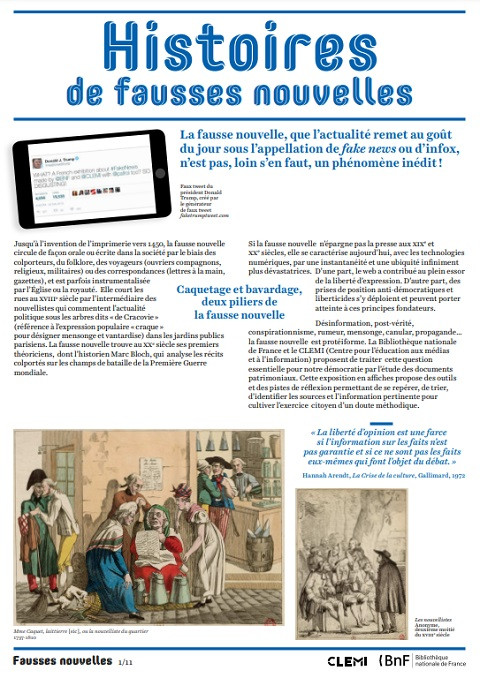 Histoires de fausses nouvelles Организация-автор: Centre pour l’éducation aux médias et à l’information (CLEMI) | Bibliothèque nationale de France (BnF) Désinformation, mensonge, canular, propagande, la « fausse nouvelle » a été remise au goût du jour sous l’appellation de « fake news » puis de« infox ». Mais elle ne date pourtant pas d'hier. Le CLEMI s’est associé a Bibliothèque nationale de France pour traiter cette question essentielle pour notre démocratie par l’étude des documents patrimoniaux. Cette exposition pédagogique en affiches propose des outils et des pistes de réflexion permettant de se repérer, de trier, d’identifier les sources et l’information pertinente pour cultiver l’exercice citoyen d’un doute méthodique.
  Éducation aux médias et à l’information: École primaire Год публикации: 2018 Организация-автор: Centre pour l’éducation aux médias et à l’information (CLEMI) | Réseau Canopé Dans un monde complexe où l’information est surabondante, instantanée et en flux continu, l’éducation aux médias et à l’information (EMI) est devenue une priorité. À l’école primaire, elle peut s'intégrer à tous les enseignements. Son objectif est de favoriser la compréhension et un usage raisonné des médias, notamment numériques.Avec cette brochure, nous souhaitons encourager les professeurs des écoles à mettre en œuvre des activités en EMI, tout en répondant à leurs besoins spécifiques. Chaque fiche pédagogique propose des références aux programmes, un déroulement avec des activités concrètes, une durée indicative, des repères pour l’évaluation, des suggestions de traces écrites et des ressources. Ces fiches ont été validées et enrichies par un comité pédagogique, garant de la qualité et de la pertinence du contenu. Nous remercions les membres de ce comité pour leur implication active et leur engagement dans ce projet collectif.Cette brochure présente également une diversité de témoignages et d’entretiens qui démontrent que l’éducation aux médias et à l’information est une priorité éducative partagée. Apprendre à chercher, vérifier et publier l’information de manière responsable est essentiel au développement de l’esprit critique des élèves. Pensée comme outil de formation et support pour l’action, nous espérons vivement que cette brochure saura répondre efficacement aux besoins des enseignements.
  서울 세계시민교육 이행현황 및 향후 추진 과제 연구 Год публикации: 2021 Автор: 김동택 | 서용덕 | 고선규 | 김지영 | 임재민 | 장경원 | 홍윤빈 Организация-автор: 서울특별시교육청 교육연구정보원 이 연구는 서울시 교육청이 추진하고 있는 세계시민교육 이행 현황을 객관지표와 주관지표를 통해 분석하고 이를 바탕으로 향후 추진되어야 할 정책 과제들(협업체계, 교육 내실화, 내용·동력·변인, 데이터 축적 및 활동 플랫폼 구축 등)을 연구하는 데 목적이 있다. 이를 위하여 2015년부 터 시작되어 현재까지 진행된 세계시민교육의 성과를 확인하기 위해 객관 지표와 주관지표를 점검하였으며, 여기서 나타난 결과들을 바탕으로 앞으 로의 정책 방향을 설정하기 위해 정책 제안을 시도하였다. 서울특별시교육청교육연구정보원이(가) 창작한 서교연 2020-33 위탁연구(서울 세계시민교육 이행현황 및 향후 추진 과제 연구) 최종보고서 저작물은 "공공누리 제4유형(출처표시-상업적 이용금지-변경금지)" 조건에 따라 이용 할 수 있습니다.
  2020년 국가수준 초·중학생 디지털 리터러시 수준 측정 연구 Год публикации: 2021 Автор: 정진명 | 이현숙 | 김주환 | 이운지 | 류기곤 | 김경아 | 조규복 | 구찬동 Организация-автор: 한국교육학술정보원 2020년 국가수준 초중등학생의 디지털 리터러시 수준 측정 연구는 우리나라 초·중학생의 디지털 리터러시를 측정하고, 초·중학생의 디지털 리터러시 수준에 영향을 미치는 학교 환경과 관련 수업 및 교사 인식 등을 비교분석하여 주요 특징과 과제 및 개선방안을 제시하는 것이라고 할 수 있다. 또한 2020년 코로나19로 인하여 전면적인 원격교육이 일정기간 동안 시행되는 등 교육 환경에 기존과 다른 특수한 환경적 변수가 있었던 만큼 그로 인하여 학생의 디지털 리터러시와 교수학습 및 교사 인식에 어떠한 변화가 있었는지를 조사 분석하여 포스트 코로나19 교육 환경 변화에 대응하고자 하는 목적이 있다. 본 저작물은 한국교육학술정보원에서 2021년 작성하여 공공누리 제 4유형으로 개방한 ‘2020년 국가수준 초·중학생 디지털 리터러시 수준 측정 연구(정진명 외)’를 이용하였으며 해당 저작물은 한국교육학술정보원(www.keris.or.kr)에서 무료로 다운받으실 수 있습니다.
  Cultura de paz y resolución de conflictos Год публикации: 2018 Автор: Patricia García Maza | Luis Miguel Ferrer Bueno Организация-автор: Asociación Conexión Tejiendo Cuidados | Global Schools | Comisión Europea La primera tarea está enfocada hacia el trabajo con uno mismo, fundamental a la hora de resolver conflictos. Saber cómo reacciono, cuáles son mis potencialidades y debilidades, aprender a manejar mis emociones, facilitará la interacción con el otro. La segunda tarea se centra en esa interacción, somos personas diferentes, reaccionamos de distintas maneras, por lo que ver al otro, descubrir qué siente y piensa, exige la suficiente flexibilidad para tolerar la diferencia. 4 La tercera tarea está más enfocada a la cultura de paz para una ciudadanía global, pues esta también debe ser abordada desde una visión de bien común. Su línea estratégica es relacional hacia el bien común; solamente así se pueden enfrentar conflictos más globales.