
Ресурсы
Изучайте широкий спектр ценных ресурсов ВГГ, чтобы углубить своё понимание и повысить эффективность исследований, просветительской деятельности, преподавания и обучения.
Найдено: 3,158
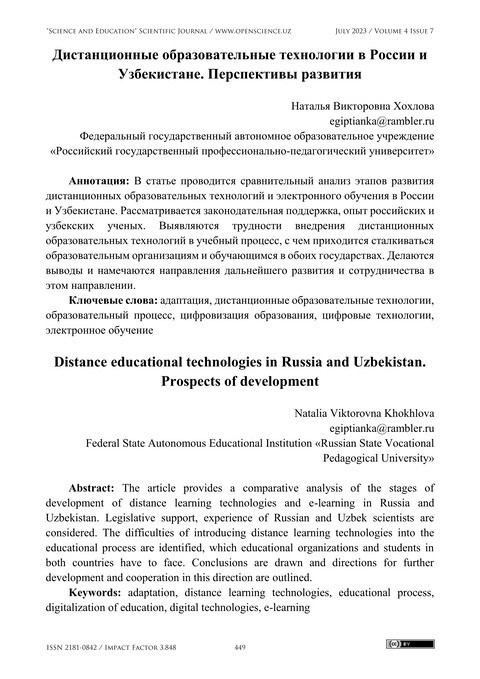 Distance educational technologies in Russia and Uzbekistan: Prospects of development (Science and Education; Vol.4, Issue.7) Год публикации: 2023 Автор: Наталья Викторовна Хохлова The article provides a comparative analysis of the stages of development of distance learning technologies and e-learning in Russia and Uzbekistan. Legislative support, experience of Russian and Uzbek scientists are considered. The difficulties of introducing distance learning technologies into the educational process are identified, which educational organizations and students in both countries have to face. Conclusions are drawn and directions for further development and cooperation in this direction are outlined. Дистанционные образовательные технологии в России и Узбекистане: Перспективы развития (Science and Education; Vol.4, Issue.7) Год публикации: 2023 Автор: Наталья Викторовна Хохлова В статье проводится сравнительный анализ этапов развития дистанционных образовательных технологий и электронного обучения в России и Узбекистане. Рассматривается законодательная поддержка, опыт российских и узбекских ученых. Выявляются трудности внедрения дистанционных образовательных технологий в учебном процессе, с чем приходится сталкиваться образовательными организациями и обучающимися в обоих государствах. Делаются выводы и намечаются направления дальнейшего развития и сотрудничества в этом направлении.
 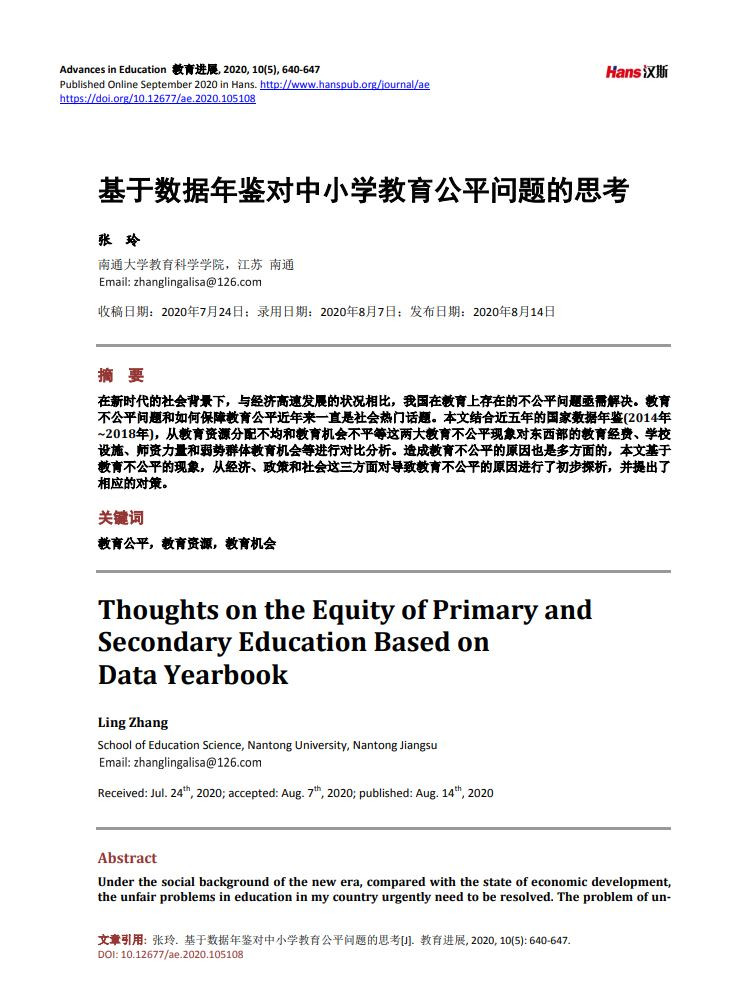 Thoughts on the Equity of Primary and Secondary Education Based on Data Yearbook Год публикации: 2020 Автор: Zhang Ling This paper uses the Chinese national dateset (2014-2018) to discuss the issue of education inequality, and provides suggestions for improvement. 基于数据年鉴对中小学教育公平问题的思考 Год публикации: 2020 Автор: Zhang Ling 文章依据2014-2018年中国国家数据年鉴分析中国的教育不平等议题,并提出了相应的对策。
  The Art of Inclusive Exclusions: Educating the Palestinian Refugee Students in Lebanon (Refugee Survey Quarterly, Vol. 33, No. 2) Год публикации: 2014 Автор: Maha Shuayb Организация-автор: Centre for Arab Unity Studies For more than 65 years, Palestinian refugees have been living in Lebanon in a “temporary” State in over-crowded camps, deprived of basic rights such as the right to have a professional job. It has been argued that these restrictions have had a major effect on the fair provision and quality of education, an effect manifested in the increasing number of Palestinian students who are dropping out of school. This article examines the quality of education offered in United Nations Relief and Works Agency for Palestine Refugees schools and the impact of Lebanese legal restrictions on students’ educational motivation and aspirations.A quantitative survey of the educational experiences and aspirations of 404 secondary students and 48 teachers in five secondary schools of the United Nations Relief and Works Agency for Palestine Refugees was carried out. An in-depth study of a primary school also took place. The findings revealed that Palestinian refugee students are confronted by a paradox: forced inclusion because of having to learn the Lebanese curriculum, but exclusion because of simultaneously being pushed to the periphery of Lebanese society as a result of the Lebanon’s discriminatory laws and regulations. فن الإقصاء الإدماجي : تعليم الطلاب الفلسطينيين اللاجئين في لبنان Год публикации: 2014 Автор: Maha Shuayb Организация-автор: Centre for Arab Unity Studies ترمي هذه الدراسة إلى إبراز المفارقة التي تواجه اللاجئين الفلسطينيين في لبنان مُتَجَلّيةً في إدماجهم قسراً عبر تلقّي المقرر الدراسي اللبناني مع اضطرارهم في الوقت ذاته إلى البقاء على هامش المجتمع اللبناني نتيجة للقوانين والترتيبات اللبنانية التمييزية. بغية استقصاء ذلك؛ فحصتِ هذه الدراسة، نوعية التربية المتوافرة للفلسطينيين الدارسين في مدارس الأنروا (وكالة الأمم المتحدة لغوث وتشغيل اللاجئين الفلسطينيين) ووَقْع التضييقات القانونية اللبنانية على حافزهم التعليمي وتطلعاتهم التربوية. يتوزّع محتوى الورقة على قسمين اثنين يعرض الأوّل منهما تقويماً عامّاً للظروف الاجتماعية والسياسية والاقتصادية والتعليمية التي يعيشها اللاجئون الفلسطينيون في لبنان.
  2025 세계시민교육 기본 계획 Год публикации: 2025 Организация-автор: 서울특별시교육청 <목차> Ⅰ. 추진 배경 및 목적Ⅱ. 추진 근거Ⅲ. 추진 과제Ⅳ. 세부 추진 계획핵심과제 1. 학교교육과정을 통한 세계시민성 함양 핵심과제 2. 세계시민교육 실천역량 강화 핵심과제 3. 세계시민교육 네트워크 구축Ⅴ. 기대 효과<부록> 참고자료 8
 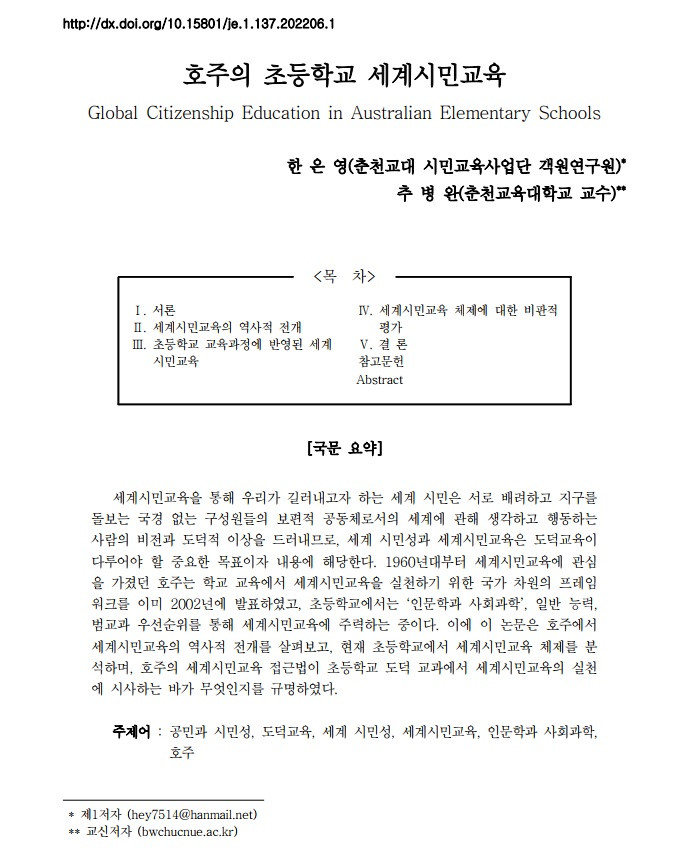 Global Citizenship Education in Australian Elementary Schools(Journal of Ethics; Vol. 137, No 1) Год публикации: 2022 Автор: 한은영 | 추병완 Организация-автор: 한국윤리학회 Global citizens think and act about the world as a universal community of borderless members who care for each other and are dedicated to taking care of the earth. Considering these visions and moral ideals, global citizenship education is an important goal and content of moral education. However, at present, we do not have a framework for dealing with global citizenship education in moral education. In this regard, Australia is the country we should pay attention to. Australia declared a national statement for global citizenship education in 2002. Since 2009, it has been reflected in the Australian curriculum. This article examines the historical development of global citizenship education in Australia, analyzes the current systems of global citizenship education system in primary schools, and investigates what Australia's approach to global citizenship education suggests for elementary moral education in Korea. In conclusion, we proposed three things. First, we must develop and apply a framework for the practice of global civic education in moral education. Second, we should emphasize the aspects of knowledge and understanding, skills and processing, behavior and participation as well as values and attitudes. Third, we must seek a balance between moderate global citizenship education and critical global citizenship education. 호주의 초등학교 세계시민교육(윤리연구; Vol. 137, No 1) Год публикации: 2022 Автор: 한은영 | 추병완 Организация-автор: 한국윤리학회 세계시민교육을 통해 우리가 길러내고자 하는 세계 시민은 서로 배려하고 지구를 돌보는 국경 없는 구성원들의 보편적 공동체로서의 세계에 관해 생각하고 행동하는 사람의 비전과 도덕적 이상을 드러내므로, 세계 시민성과 세계시민교육은 도덕교육이 다루어야 할 중요한 목표이자 내용에 해당한다. 1960년대부터 세계시민교육에 관심을 가졌던 호주는 학교 교육에서 세계시민교육을 실천하기 위한 국가 차원의 프레임워크를 이미 2002년에 발표하였고, 초등학교에서는 ‘인문학과 사회과학’, 일반 능력, 범교과 우선순위를 통해 세계시민교육에 주력하는 중이다. 이에 이 논문은 호주에서 세계시민교육의 역사적 전개를 살펴보고, 현재 초등학교에서 세계시민교육 체제를 분석하며, 호주의 세계시민교육 접근법이 초등학교 도덕 교과에서 세계시민교육의 실천에 시사하는 바가 무엇인지를 규명하였다.
  교사를 위한 안내서: 세계시민교육 Год публикации: 2025 Организация-автор: 옥스팜 빠르게 변하는 ‘세계화’의 세상은 청소년들에게 엄청난 기회와 함께 그에 못지 않은 수많은 도전 과제를 주고 있습니다. 옥스팜은 세계 시민 교육을 통해 청소년들에게 교육분쟁, 기후변화, 불평등과 빈곤 등 전 세계에서 일어나고 있는 기회와 도전을 받아들이고, 나아가 자신이 살고 싶은 세상을 만들어 나갈 수 있도록 관련된 지식, 기술, 가치를 교육받을 권리를 실현시킬 수 있도록 지원합니다. 이슈 트리, 결과의 바퀴, 역할 놀이 등 옥스팜이 소개하는 구체적인 활동안을 활용해 학생들과 함께 유익한 세계 시민 교육을 진행해 보세요. 주요 내용 세계 시민의식 키우기 세계 시민의식에서 중요한 개념들 교실 수업에서 세계 시민의식 키우기 학습과 의사 결정에 참여하기 질문하기 연관성 찾기 관점과 가치 탐구하기 세계 시민으로서 적극적으로 행동하기 수업 평가하기