
Ресурсы
Изучайте широкий спектр ценных ресурсов ВГГ, чтобы углубить своё понимание и повысить эффективность исследований, просветительской деятельности, преподавания и обучения.
Найдено: 3,158
 Bibliographie: Éducation à la citoyenneté Год публикации: 2021 Организация-автор: France Education International Réalisée à la demande de l’Institut français des Pays-Bas, cette sélection de ressources numériques en accès libre s’adresse aux enseignants de FLE désireux d’éduquer leurs élèves à la citoyenneté. Centrée sur la laïcité et les valeurs de la République française, elle comprend des rapports internationaux, des articles et des podcasts, des ressources didactiques et pédagogiques ainsi qu’une présentation de projets européens et de projetsacadémiques et d’établissement français, transposables en différents contextes.
  Good Practices in Education for Global Citizenship: XI Edition of the “Vicente Ferrer” National Prize for Education for Development Год публикации: 2021 Автор: Rosa Elena Román Pajares | Concepción Aránzazu Vilor Barros | Jose Manuel de Frutos San Miguel | Lara Ormeño Vasco | Uxua Azpiroz Armendáriz | Susana Álvarez Martínez | Liliana Piñeiro Piñeiro | Silvia Lijó López | Clara Díaz-Salazar de la Flor | Susana Gómez Garzón | Encarnación Díaz Carmona | Isabel Santacruz Prieto | José Antonio Guillén Medina | Raquel Jiménez Gutiérrez | Josefa Mª Amorós Campos | Raimundo Fenoll Pellin | Mª Teresa García de Dios | Juan Antonio Pérez Orquín | Mª José Amorós Martínez | Mª Paz Ruiz Barrero | María Soledad Aneas Franco | Isabel Hermoso Lorente | José Julio Fuentes López | Mª Covadonga Villimer Sandoval | Luis Agudo Jiménez | David Jiménez Góme Организация-автор: Spain. Ministry of Foreign Affairs, European Union and Cooperation (MAEUEC) | Spanish Agency for International Development Cooperation (AECID) This publication is part of the Collection of good practices in education for global citizenship that the MEFP and the AECID have been publishing since the first edition of the “Vicente Ferrer” National Education Award for development and includes, in this new format, the 15 winning proposals from the 11th edition of 2019. The “Vicente Ferrer” National Development Education Award aims to empower students so that the 2030 Agenda and the Sustainable Development Goals are the engine of change that the planet needs for its advancement and transformation, both on the social and environmental levels. The Award promotes the sense of global citizenship, respect and care for the environment, as well as the values of social justice, solidarity, equality, inclusion and peace. Buenas prácticas en educación para la ciudadanía global: XI edición Premio Nacional de Educación para el Desarrollo "Vicente Ferrer" Год публикации: 2021 Автор: Rosa Elena Román Pajares | Concepción Aránzazu Vilor Barros | Jose Manuel de Frutos San Miguel | Lara Ormeño Vasco | Uxua Azpiroz Armendáriz | Susana Álvarez Martínez | Liliana Piñeiro Piñeiro | Silvia Lijó López | Clara Díaz-Salazar de la Flor | Susana Gómez Garzón | Encarnación Díaz Carmona | Isabel Santacruz Prieto | José Antonio Guillén Medina | Raquel Jiménez Gutiérrez | Josefa Mª Amorós Campos | Raimundo Fenoll Pellin | Mª Teresa García de Dios | Juan Antonio Pérez Orquín | Mª José Amorós Martínez | Mª Paz Ruiz Barrero | María Soledad Aneas Franco | Isabel Hermoso Lorente | José Julio Fuentes López | Mª Covadonga Villimer Sandoval | Luis Agudo Jiménez | David Jiménez Góme Организация-автор: Spain. Ministry of Foreign Affairs, European Union and Cooperation (MAEUEC) | Spanish Agency for International Development Cooperation (AECID) Esta publicación forma parte de la Colección de buenas prácticas en educación para la ciudadanía global que el MEFP y la AECID han venido publicando desde la primera edición del Premio Nacional de Educación para el desarrollo "Vicente Ferrer" y recoge, en este nuevo formato, las 15 propuestas ganadoras de la XI edición del 2019. El Premio Nacional de Educación para el Desarrollo "Vicente Ferrer" pretende empoderar al alumnado para que la Agenda 2030 y los Objetivos de Desarrollo Sostenible sean el motor de cambio que el planeta necesita para su avance y transformación, tanto en el plano social, como en el ambiental. El Premio impulsa el sentido de ciudadanía global, el respeto y el cuidado del medio ambiente, así como los valores de justicia social, solidaridad, igualdad, inclusión y paz.
  The Development of Asian Primary Students’ Global Citizenship Literacy Scales: An Exploratory Study of Taiwan Primary Student (Educational Journal ; Vol.45, No.1) Год публикации: 2017 Автор: 吴时省 | 蔡清华 This study aimed to develop an instrument to measure the effect of Taiwan’s policy on global education. Four constructs were developed, namely rights and responsibilities of global citizenship, competencies of global citizenship, participation of global citizenship, and reflection of global citizenship. The instrument was tested with a sample of 1,112 elementary school students in Taiwan. Content validity was established. Exploratory factor analysis and confirmatory factor analysis confirmed construct validity. All the indexes were satisfied except the convergent validity. 亚洲小学生全球公民素养量表之发展:以台湾小学生为探索个案 (教育学报; Vol.45, No.1) Год публикации: 2017 Автор: 吴时省 | 蔡清华 本研究主要目的在发展一份全球公民素养量表,作为台湾过去这些年来对于小学阶段全球教育努力成果的检视。透过文献分析,研究者归纳出全球公民素养四个构念,分别为「全球公民权利与义务」、「全球公民能力」、「全球公民参与」、「全球公民反思」,并根据这四个构念进行量表的编制和信效度的检核。研究样本为台湾各地小学生,总计1,112名。量表整体信度为.868,与各个效标工具的相关亦都至少达到.05显着水准;模式的考验方面,除了内在品质的聚敛效度稍嫌不理想外,其余结果都达到预期。
  2022 세계시민교육 보고서: 국제 수업 교류 사례 및 세계시민교육 교원학습공동체 연구 자료 Год публикации: 2022 Организация-автор: 서울특별시교육청 2022 세계시민교육 보고서는 크게 두 파트로 나누어 Part.1에서는 국내 12개 초·중·고등학교의 국제 수업 교류 사례와 수업설계, 학습지도안 활동사진 등을 담고 있고 Part. 2에서는 수달스, 더불어 평화 등 5개 세계시민교육 교원학습공동체의 연구 자료를 수록하고 있다.
 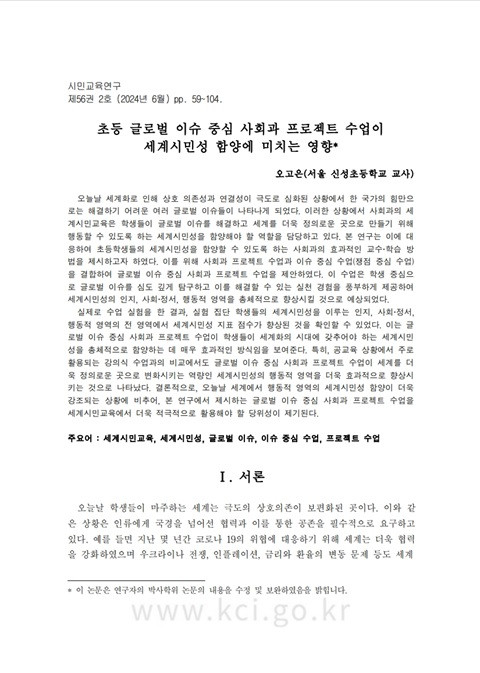 초등 글로벌 이슈 중심 사회과 프로젝트 수업이 세계시민성 함양에 미치는 영향 (시민교육연구; Vol. 56, No. 2) Год публикации: 2024 Автор: 오고은 Организация-автор: 한국사회과교육학회 오늘날 세계화로 인해 상호 의존성과 연결성이 극도로 심화된 상황에서 한 국가의 힘만으로는 해결하기 어려운 여러 글로벌 이슈들이 나타나게 되었다. 이러한 상황에서 사회과의 세계시민교육은 학생들이 글로벌 이슈를 해결하고 세계를 더욱 정의로운 곳으로 만들기 위해 행동할 수 있도록 하는 세계시민성을 함양해야 할 역할을 담당하고 있다. 본 연구는 이에 대응하여 초등학생들의 세계시민성을 함양할 수 있도록 하는 사회과의 효과적인 교수-학습 방법을 제시하고자 하였다. 이를 위해 사회과 프로젝트 수업과 이슈 중심 수업(쟁점 중심 수업)을 결합하여 글로벌 이슈 중심 사회과 프로젝트 수업을 제안하였다. 이 수업은 학생 중심으로 글로벌 이슈를 심도 깊게 탐구하고 이를 해결할 수 있는 실천 경험을 풍부하게 제공하여 세계시민성의 인지, 사회-정서, 행동적 영역을 총체적으로 향상시킬 것으로 예상되었다. 실제로 수업 실험을 한 결과, 실험 집단 학생들의 세계시민성을 이루는 인지, 사회-정서, 행동적 영역의 전 영역에서 세계시민성 지표 점수가 향상된 것을 확인할 수 있었다. 이는 글로벌 이슈 중심 사회과 프로젝트 수업이 학생들이 세계화의 시대에 갖추어야 하는 세계시민성을 총체적으로 함양하는 데 매우 효과적인 방식임을 보여준다. 특히, 공교육 상황에서 주로 활용되는 강의식 수업과의 비교에서도 글로벌 이슈 중심 사회과 프로젝트 수업이 세계를 더욱 정의로운 곳으로 변화시키는 역량인 세계시민성의 행동적 영역을 더욱 효과적으로 향상시키는 것으로 나타났다. 결론적으로, 오늘날 세계에서 행동적 영역의 세계시민성 함양이 더욱 강조되는 상황에 비추어, 본 연구에서 제시하는 글로벌 이슈 중심 사회과 프로젝트 수업을 세계시민교육에서 더욱 적극적으로 활용해야 할 당위성이 제기된다.
 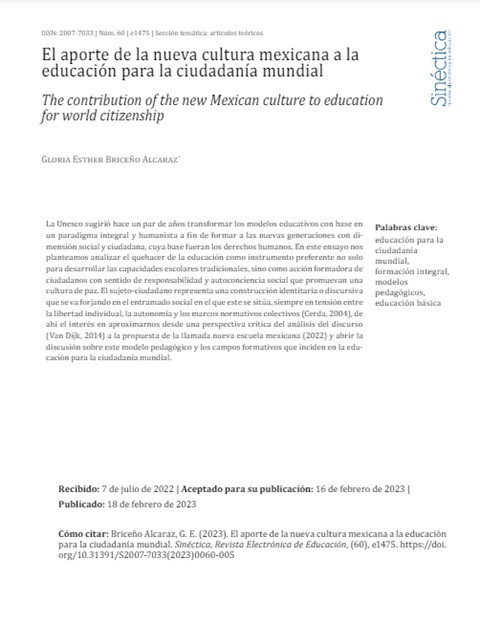 The Contribution of the New Mexican Culture to Education for World Citizenship(Sinéctica, Revista electrónica de educación; no. 60) Год публикации: 2023 Автор: Gloria Esther Briceño Alcaraz Организация-автор: Sinéctica, Revista Electrónica de Educación A couple of years ago, UNESCO suggested transforming educational models based on an in-tegral and humanist paradigm in order to train new generations with a social and civic di-mension, based on human rights. In this essay we propose to analyze the work of education as a preferential instrument not only to develop traditional school skills, but also as an ac-tion to form citizens with a sense of responsibility and social self-awareness that promote a culture of peace. The citizen-subject represents an identity or discursive construction that is forged in the social framework in which it is situated, always in tension between individual freedom, autonomy and collective normative frameworks (Cerda, 2004), hence the interest in approaching from a critical perspective of discourse analysis (Van Dijk, 2014) to the pro-posal of the new educational model of Mexico called the New Mexican School (2022) and open the discussion on this pedagogical model and the formative fields that affect education for global citizenship. El aporte de la nueva cultura mexicana a la educación para la ciudadanía mundial(Sinéctica, Revista electrónica de educación; núm. 60) Год публикации: 2023 Автор: Gloria Esther Briceño Alcaraz Организация-автор: Sinéctica, Revista Electrónica de Educación La UNESCO sugirió hace un par de años transformar los modelos educativos con base en un paradigma integral y humanista a fin de formar a las nuevas generaciones con dimensión social y ciudadana, cuya base fueran los derechos humanos. En este ensayo nos planteamos analizar el quehacer de la educación como instrumento preferente no solo para desarrollar las capacidades escolares tradicionales, sino como acción formadora de ciudadanos con sentido de responsabilidad y autoconciencia social que promuevan una cultura de paz. El sujeto-ciudadano representa una construcción identitaria o discursiva que se va forjando en el entramado social en el que este se sitúa, siempre en tensión entre la libertad individual, la autonomía y los marcos normativos colectivos (Cerda, 2004), de ahí el interés en aproximarnos desde una perspectiva crítica del análisis del discurso (Van Dijk, 2014) a la propuesta de la llamada nueva escuela mexicana (2022) y abrir la discusión sobre este modelo pedagógico y los campos formativos que inciden en la educación para la ciudadanía mundial.
  Teaching Controversial Issues Год публикации: 2006 Организация-автор: Oxfam GB Young people frequently face making decisions about a wide range of issues on which there are many different views. Issues like sexuality, religion, bullying, and war can evoke complicated emotions, both in and out of the classroom.Young people need to develop skills that allow them to discuss and come to their own views about these types of issues. Having a chance to engage with controversial topics in a constructive environment will help young people to develop as global citizens, and teachers have a key role to play in enabling this.This guide explores what controversial issues are, why they should be taught, and includes classroom strategies, existing guidance and practical teaching activities.