
Ресурсы
Изучайте широкий спектр ценных ресурсов ВГГ, чтобы углубить своё понимание и повысить эффективность исследований, просветительской деятельности, преподавания и обучения.
Найдено: 3,158
 In Solidarity With Girls: Gender and Education in Crisis (Policy Brief Series) Год публикации: 2020 Организация-автор: United Nations Girls' Education Initiative (UNGEI) The In Solidarity With Girls: Gender and education in crisis policy brief series was developed through a series of intergenerational dialogues on gender, education and COVID-19. The contents of this paper and its recommendations belong to the young women activists featured in each brief. Drawing on the ‘build back equal’ principle, this brief contributes to policy dialogues and discussions on (1) how we can plan for and work towards more equal, gender-responsive school systems once restrictions are lifted, and (2) achieve this through meaningful partnership with youth and youth-led networks.
 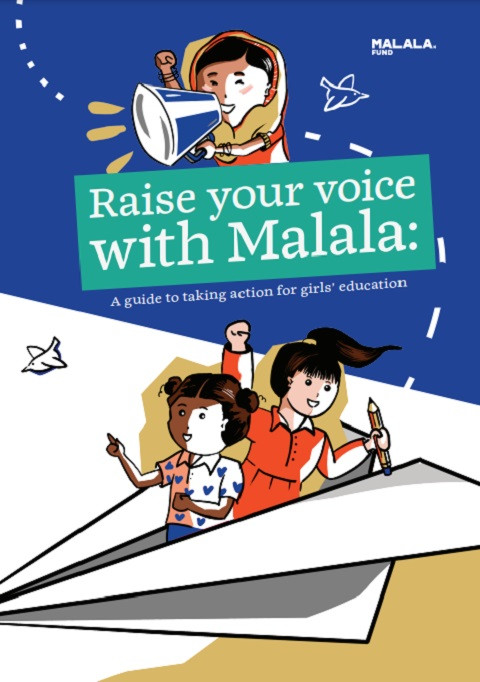 Raise Your Voice With Malala: A Guide to Taking Action for Girls’ Education Год публикации: 2018 Автор: Emily Laurie | Eleanor Gall Организация-автор: Malala Fund This guide gives young activists the tools to raise their voices and make change happen. Girls around the world are standing up in support of their out-of-school sisters and fighting to see every girl complete 12 years of free, safe, quality education. By taking action in their communities, girls can contribute to the peace and prosperity of our entire world. The guide includes real stories about girls around the world working to make sure all girls have the opportunity to go to school.
  G7 Global Objectives On Girls’ Education: Baseline Report Год публикации: 2022 Организация-автор: United Nations Girls' Education Initiative (UNGEI) This publication serves as a baseline report to accompany efforts of the G7 Accountability Working Group to monitor progress towards the two global objectives. It presents evidence on low- and lower-middle-income countries’ progress in achieving the two global objectives and what remains to be done.It is important to stress that the two G7 global objectives on girls’ education are measures of gender parity, which are necessary but not sufficient as measures of gender equality. Assessing progress towards the latter requires information, which tends not to be available systematically enough to allow a comparative perspective. However, this report provides insights to remaining challenges.
 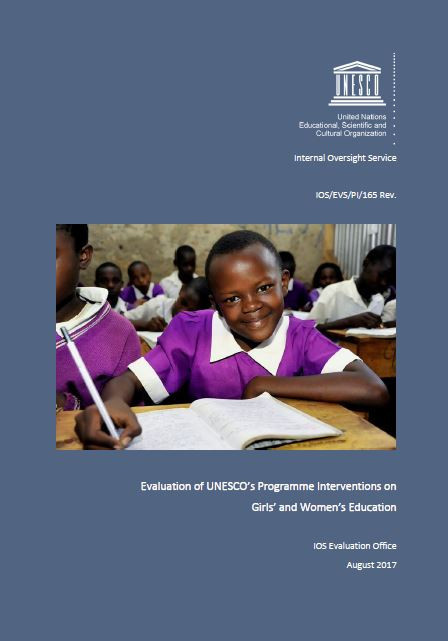 Evaluation of UNESCO's Programme Interventions on Girls' and Women's Education Год публикации: 2017 Автор: Michael Reynolds, Martina Rathner, Estelle Loiseau Организация-автор: UNESCO Internal Oversight Service (IOS) Since 2008, Gender Equality has been one of two global priorities for UNESCO. In May 2011, UNESCO launched the Global Partnership for Girls’ and Women’s Education, also known as “Better Life, Better Future”, which aims to increase learning opportunities for adolescent girls and women and to find solutions to some of the biggest obstacles to their education. To further advance the global priority of Gender Equality, since 2015 a dedicated Section of Education for Inclusion and Gender Equality specifically addresses the gender dimensions in education that contribute to differential access, participation, completion, and learning outcomes by boys and girls, and men and women. The evaluation examines UNESCO’s programme interventions in girls’ and women’s education during the period 2015 to 2017, in particular to ascertain the relevance, effectiveness, efficiency and sustainability of initiatives, and to clarify the strategic role and positioning of the Organization in supporting girls’ and women’s education at regional and country levels.The evaluation found that although UNESCO’s efforts for enhancing girls’ and women’s education are clearly aligned to SDG 4 and SDG 5 and also broadly in line with the overall principle of leaving no one behind, there is at times a trade-off between targeting the hardest to reach and other donor priorities, and UNESCO needs to more clearly position its efforts in support of girls’ and women’s education and its niche in the 2030 Agenda. Furthermore, continued efforts are required to scale up and/or replicate small-scale interventions, to better ensure sustainability and to consolidate mechanisms for coordination and information sharing among different interventions to seize synergies and enhance organizational learning.
  Key Concepts: A Feminist Approach to Human Rights Education (Chapter 4) Год публикации: 2014 Автор: Julie Maia Организация-автор: Stanford Human Rights Education Initiative (SHREI) Developed for the Stanford Human Rights Education Initiative (SHREI), this curriculum project examines connections among Gender Studies, feminist theory, and human rights movements around the world. This SHREI project presents its four key concepts through four curricular units, or chapters, each with a series of activities that can easily be adapted for use in courses in many disciplines. Each chapter contains these elements: A definition of the key concept An example of the use of the concept in a human rights document A brief essay on the value of the concept for human rights education A series of activities that guide students in using gender, race/ethnicity/nation, and class as lenses for analyzing social justice issues include transnational and multicultural perspectives on gender and human rights issues use "best practices" pedagogies for teaching human rights topics in community colleges. Within each chapter, activities are orgaized from simple to complex. Most activities, however, have self-contained objectives and can be used independently of the others. Sections on “Extending the Learning” offer longer readings or in-depth material for advanced courses. The GCED Clearinghouse introduces only chapter 4, "global citizenship" of this SHERI project.
  2014 syllabus: character and citizenship education: primary Год публикации: 2014 Организация-автор: Singapore. Ministry of Education. Student Development Curriculum Division Character and Citizenship Education (CCE) has always been at the heart of Singapore's education system. In CCE, students learn to be responsible to family and community; and understand their roles in shaping the future of nation. The emerging trends and global developments that impact the society, such as social changes, globalisation and technological advancements are taken into consideration in the development of the CCE curriculum.The goal of CCE is to inculcate values and build competencies in students to develop them to be good individuals and useful citizens. Since 1959, various key programmes have been introduced to inculcate values, habits, competencies and skills in students. Some of these programmes include Civics and Moral Education (CME, 1992), National Education (NE, 1997), Social and Emotional Learning (SEL, 2005), and learning experiences such as Co-Curricular Activities (CCA).The new CCE curriculum shifts focus from programmes to a common purpose. The desired outcomes of CCE are aligned to the Key Stage Outcomes (KSOs) and Desired Outcomes of Education (DOE). CCE is central to the Framework for 21st Century Competencies and Student Outcomes. It emphasizes the interconnectedness of the core values, social and emotional competencies and civic literacy, global awareness and cross-cultural skills that are critical for character and citizenship development of students. 2014 syllabus: le caractère et l'éducation à la citoyenneté: primaire Год публикации: 2014 Организация-автор: Singapore. Ministry of Education. Student Development Curriculum Division Caractère et éducation à la citoyenneté (CEC) a toujours été au cœur du système éducatif de Singapour. En CEC, les élèves apprennent à être responsables de la famille et de la communauté; et de comprendre leurs rôles dans l'élaboration de l'avenir de la nation. Les nouvelles tendances et évolutions mondiales qui influent sur la société, tels que les changements sociaux, la mondialisation et les progrès technologiques sont pris en considération dans l'élaboration du programme d'études du CEC. Le but du CEC est d'inculquer des valeurs et de construire des compétences chez les élèves de les développer pour être de bons individus et des citoyens utiles. Depuis 1959, divers programmes clés ont été mis en place pour inculquer des valeurs, des habitudes, des compétences et des compétences chez les élèves. Certains de ces programmes comprennent l'éducation civique et l'éducation morale (ECM, 1992), l'éducation nationale (NE, 1997), social et apprentissage émotionnel (SPE, 2005), et les expériences d'apprentissage tels que Co-curriculaires Activités (CCA). Les nouveaux changements du curriculum CEC se concentrent des programmes à un but commun. Les résultats escomptés du CEC sont alignés sur les résultats clés de scène (RCS) et résultats souhaités de l'Education (RSE). CEC est au centre du cadre pour les compétences du 21e siècle et résultats des élèves. Il met l'aCECnt sur l'interdépendance des valeurs fondamentales, les compétences sociales et émotionnelles et alphabétisation civique, la sensibilisation mondiale et les compétences interculturelles qui sont critiques pour le caractère et la citoyenneté développement des élèves.
  2014 课程标准 品格与公民教育 小学 Год публикации: 2014 Организация-автор: Singapore. Ministry of Education. Student Development Curriculum Division Character and Citizenship Education (CCE) has always been at the heart of Singapore's education system. In CCE, students learn to be responsible to family and community; and understand their roles in shaping the future of nation. The emerging trends and global developments that impact the society, such as social changes, globalisation and technological advancements are taken into consideration in the development of the CCE curriculum.The goal of CCE is to inculcate values and build competencies in students to develop them to be good individuals and useful citizens. Since 1959, various key programmes have been introduced to inculcate values, habits, competencies and skills in students. Some of these programmes include Civics and Moral Education (CME, 1992), National Education (NE, 1997), Social and Emotional Learning (SEL, 2005), and learning experiences such as Co-Curricular Activities (CCA). The new CCE curriculum shifts focus from programmes to a common purpose. The desired outcomes of CCE are aligned to the Key Stage Outcomes (KSOs) and Desired Outcomes of Education (DOE). CCE is central to the Framework for 21st Century Competencies and Student Outcomes. It emphasizes the interconnectedness of the core values, social and emotional competencies and civic literacy, global awareness and cross-cultural skills that are critical for character and citizenship development of students. SUKATAN PELAJARAN 2014 PENDIDIKAN PERWATAKAN DAN KEWARGANEGARAAN SEKOLAH RENDAH Год публикации: 2014 Организация-автор: Singapore. Ministry of Education. Student Development Curriculum Division Character and Citizenship Education (CCE) has always been at the heart of Singapore's education system. In CCE, students learn to be responsible to family and community; and understand their roles in shaping the future of nation. The emerging trends and global developments that impact the society, such as social changes, globalisation and technological advancements are taken into consideration in the development of the CCE curriculum.The goal of CCE is to inculcate values and build competencies in students to develop them to be good individuals and useful citizens. Since 1959, various key programmes have been introduced to inculcate values, habits, competencies and skills in students. Some of these programmes include Civics and Moral Education (CME, 1992), National Education (NE, 1997), Social and Emotional Learning (SEL, 2005), and learning experiences such as Co-Curricular Activities (CCA). The new CCE curriculum shifts focus from programmes to a common purpose. The desired outcomes of CCE are aligned to the Key Stage Outcomes (KSOs) and Desired Outcomes of Education (DOE). CCE is central to the Framework for 21st Century Competencies and Student Outcomes. It emphasizes the interconnectedness of the core values, social and emotional competencies and civic literacy, global awareness and cross-cultural skills that are critical for character and citizenship development of students. 2014 syllabus: character and citizenship education: primary Год публикации: 2014 Организация-автор: Singapore. Ministry of Education. Student Development Curriculum Division Character and Citizenship Education (CCE) has always been at the heart of Singapore's education system. In CCE, students learn to be responsible to family and community; and understand their roles in shaping the future of nation. The emerging trends and global developments that impact the society, such as social changes, globalisation and technological advancements are taken into consideration in the development of the CCE curriculum.The goal of CCE is to inculcate values and build competencies in students to develop them to be good individuals and useful citizens. Since 1959, various key programmes have been introduced to inculcate values, habits, competencies and skills in students. Some of these programmes include Civics and Moral Education (CME, 1992), National Education (NE, 1997), Social and Emotional Learning (SEL, 2005), and learning experiences such as Co-Curricular Activities (CCA). The new CCE curriculum shifts focus from programmes to a common purpose. The desired outcomes of CCE are aligned to the Key Stage Outcomes (KSOs) and Desired Outcomes of Education (DOE). CCE is central to the Framework for 21st Century Competencies and Student Outcomes. It emphasizes the interconnectedness of the core values, social and emotional competencies and civic literacy, global awareness and cross-cultural skills that are critical for character and citizenship development of students.