
Ресурсы
Изучайте широкий спектр ценных ресурсов ВГГ, чтобы углубить своё понимание и повысить эффективность исследований, просветительской деятельности, преподавания и обучения.
Найдено: 3,128
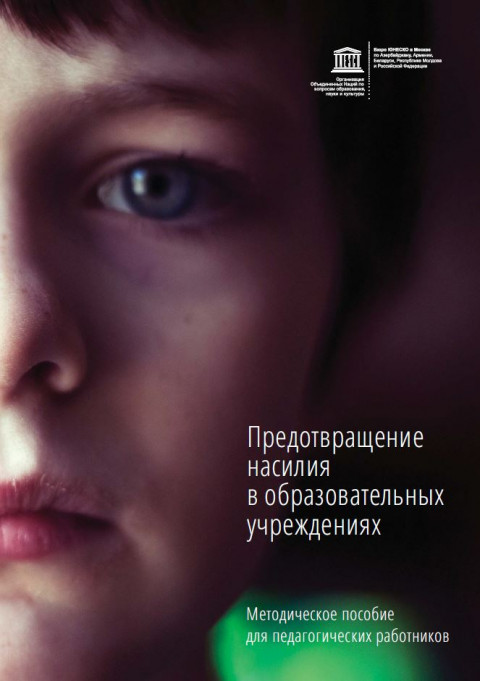 A Guide on Violence Prevention in Educational Settings in Eastern Europe and Central Asia Год публикации: 2015 Организация-автор: UNESCO The emphasis is given to gender-based violence. This guide offers practical advice and proposes organizational and educational measures, as well as response schemes for the management and staff of education institutions in order to address acts of violence and provide assistance to the victims. The guide is advisory in nature: it can be used as a background material for developing a national recommendation on the prevention of violence in an education institution.Experts from the ministries of education, education institutions and public organizations of Eastern Europe and Central Asia, as well as the United Nations Educational, Scientific and Cultural Organization (UNESCO) and the United Nations Children's Fund (UNICEF) took part in discussions throughout the process of publication-writing. Предотвращение насилия в образовательных учреждениях: Методическое пособие для педагогических работников Год публикации: 2015 Организация-автор: Организация Объединенных Наций по вопросам образования, науки и культуры (UNESCO) Методическое пособие предназначено для руководителей и сотрудников (учителей, психологов, социальных педагогов и др.), общеобразовательных школ и учреждений среднего профессионального образования. В нем представлена информация о природе и причинах насилия в образовательном учреждении, его видах и последствиях, вовлеченных сторонах.Особое внимание уделяется гендерному насилию. Пособие носит практический характер и предлагает организационные и воспитательные меры, а также алгоритмы действий руководства и персонала образовательного учреждения по реагированию на факты насилия и оказанию помощи пострадавшим. Пособие носит рекомендательный характер: на его основе могут быть разработаны национальные методические рекомендации по предотвращению насилия в образовательном учреждении.В обсуждении пособия в ходе его разработки приняли участие специалисты министерств образования, образовательных учреждений и общественных организаций стран Восточной Европы и Центральной Азии, а также Организации Объединенных Наций по вопросам образования, науки и культуры (ЮНЕСКО) и Детского фонда ООН (ЮНИСЕФ).
 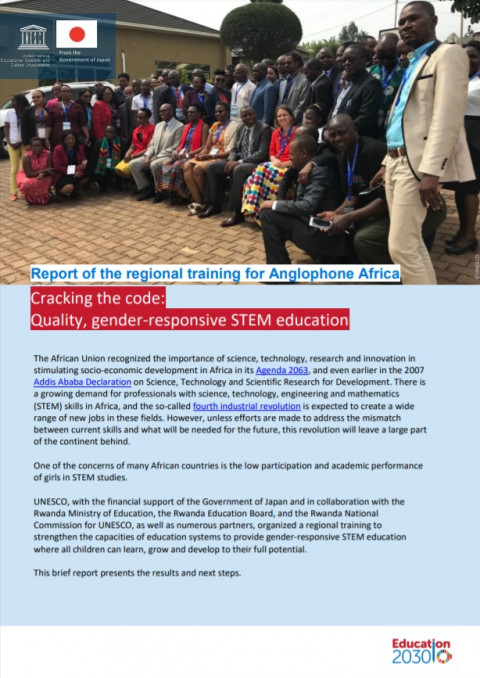 Report of the regional training for Anglophone Africa, Cracking the code: quality, gender-responsive STEM education Год публикации: 2019 Организация-автор: UNESCO The African Union recognized the importance of science, technology, research and innovation in stimulating socio-economic development in Africa in its Agenda 2063, and even earlier in the 2007 Addis Ababa Declaration on Science, Technology and Scientific Research for Development. There is a growing demand for professionals with science, technology, engineering and mathematics (STEM) skills in Africa, and the so-called fourth industrial revolution is expected to create a wide range of new jobs in these fields. However, unless efforts are made to address the mismatch between current skills and what will be needed for the future, this revolution will leave a large part of the continent behind. One of the concerns of many African countries is the low participation and academic performance of girls in STEM studies. UNESCO, with the financial support of the Government of Japan and in collaboration with the Rwanda Ministry of Education, the Rwanda Education Board, and the Rwanda National Commission for UNESCO, as well as numerous partners, organized a regional training to strengthen the capacities of education systems to provide gender-responsive STEM education where all children can learn, grow and develop to their full potential. This brief report presents the results and next steps.
 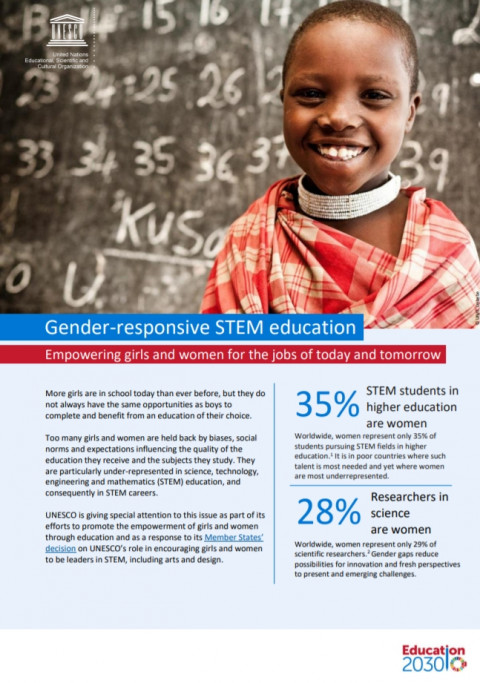 Gender-responsive STEM education: Empowering girls and women for the jobs of today and tomorrow Год публикации: 2019 Организация-автор: UNESCO More girls are in school today than ever before, but they do not always have the same opportunities as boys to complete and benefit from an education of their choice. Too many girls and women are held back by biases, social norms and expectations influencing the quality of the education they receive and the subjects they study. They are particularly under-represented in science, technology, engineering and mathematics (STEM) education, and consequently in STEM careers. UNESCO is giving special attention to this issue as part of its efforts to promote the empowerment of girls and women through education and as a response to its Member States’decisionon UNESCO’s role in encouraging girls and women to be leaders in STEM, including arts and design.
  Teaching and Learning Transformative Engagement Год публикации: 2019 Организация-автор: UNESCO While there is a large body of literature on citizenship and civic education, there is less clarity about the meaning of ‘responsible transformative engagement’ for young learners in relation to GCED and ESD – notably, the types of transformative engagement and the meaning of ‘responsible’. Understanding better the connection between learners’ engagement and education can clarify the knowledge, skills and competencies that schools may provide, as well as how the role of education can vary depending on context. In this light, this paper explores the meaning of ‘responsible transformative engagement’ with a view to clarifying the role of education in ways that may be reflected by UNESCO and other education stakeholders. Enseigner et apprendre l'engagement transformatif Год публикации: 2019 Организация-автор: Organisation des Nations Unies pour l'éducation, la science et la culture (UNESCO) Si les ouvrages consacrés à la citoyenneté et à l’éducation civique foisonnent, le sens d’un « engagement transformatif responsable » pour de jeunes apprenants dans le contexte de l’ECM et de l’EDD est moins clairement défini, notamment les types d’engagement transformatif et la notion de « responsabilité ». Mieux comprendre le lien entre l’engagement des apprenants et l’éducation permet de clarifier les connaissances, aptitudes et compétences que l’école peut enseigner, ainsi que le rôle variable que peut jouer l’éducation selon le contexte. Dans cette optique, le présent document s’interroge sur le sens d’un « engagement transformatif responsable » en vue d’apporter des éclaircissements sur le rôle de l’éducation qui peuvent être pris en compte par l’UNESCO et d’autres acteurs de l’éducation. Enseñando y aprendiendo para una participación transformadora Год публикации: 2019 Организация-автор: Organización de las Naciones Unidas para la Educación, la Ciencia y la Cultura (UNESCO) Si bien existe una extensa bibliografía sobre educación cívica y ciudadana, hay menos claridad acerca del significado del concepto de una "participación transformadora responsable" de jóvenes estudiantes en relación con la ECM y la EDS, en particular, los tipos de participación transformadora y la definición del término "responsable". Comprender mejor la relación entre la participación de los estudiantes y la educación puede contribuir a mejorar la definición de los conocimientos, aptitudes y competencias que las escuelas pueden enseñar, así como las maneras en que el papel de la educación puede variar según el contexto. En este sentido, el presente documento explora el significado de una "participación transformadora responsable", con miras a explicar el papel de la educación de formas que puedan reflejar la UNESCO y otros actores de la educación
  Her education, our future: snapshots of UNESCO's work Год публикации: 2019 Организация-автор: UNESCO This collection provides snapshots of some of UNESCO’s efforts to empower women and girls through education. It highlights core areas of work undertaken, as profiled on the next page. The aim is to give the reader a flavour of what it is that UNESCO, including its 53 field offices and specialized institutes, is doing to transform her education and our future.
 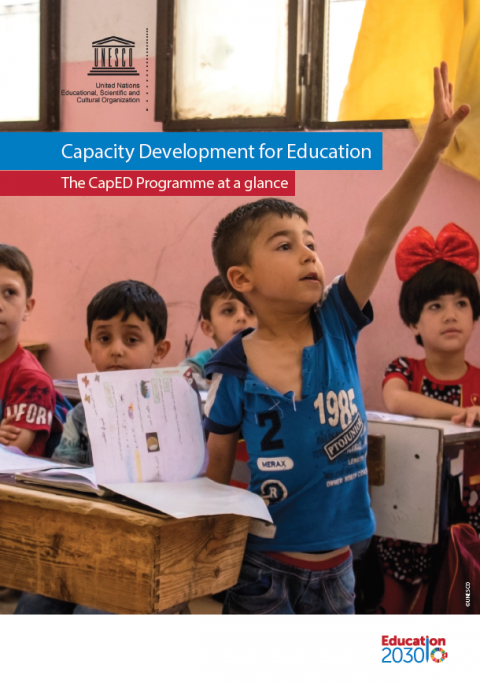 Capacity Develoment for Education: the CapED Programme at a glance Год публикации: 2019 Организация-автор: UNESCO Education has the power to transform lives and is at the heart of UNESCO’s mission to build peace, eradicate poverty and drive sustainable development. Right now, 750 million adults – two-thirds women – still lack basic literacy skills. Around 264 million children and youth are out of school and the international community must have almost 69 million new teachers to reach the 2030 education goals. These challenges can be tackled effectively through education reforms. However, these can only take place when countries have the capacities to put this change into action. As well as trained staff, countries need efficient organizational processes, functioning institutions and the tools and resources to design, implement and manage tailored education policies and plans. This is where the CapED Programme steps in. By mobilizing UNESCO’s global network, the Programme provides selected countries with a cohesive package of support. It works alongside stakeholders to reinforce national capacities to undertake evidence-based education reforms that fit into their national priorities and respond to SDG4 commitments, in order to offer quality education opportunities to all.
 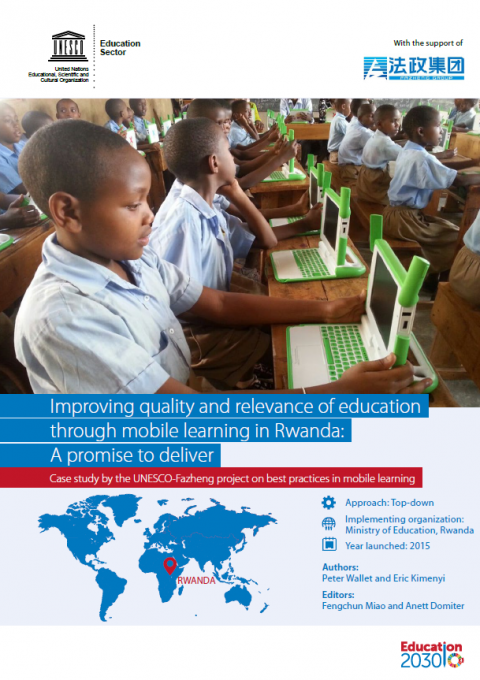 Improving quality and relevance of education through mobile learning in Rwanda: a promise to deliver: case study by the UNESCO-Fazheng project on best practices in mobile learning Год публикации: 2019 Автор: Wallet, Peter | Kimenyi, Eric | Miao, Fengchun | Domiter, Anett Организация-автор: UNESCO Rwanda’s education sector is evolving through the adoption of information and communication technology (ICT ). Whereas the focus was previously on the extensive deployment of laptop devices, it is shifting towards advancing adaptive child-centred learning and the use of ICT augmented environments to enrich teaching and learning. In developing countries, however, an orientation frequently remains to select strategies which have previously shown to be successful in developed contexts without taking into account the full range of elements required for effective implementation including a comprehensive assessment of the financial implications required to ensure longer term sustainability. This case study aims to showcase Rwanda’s customised approach to the integration of ICT in classrooms adapted to meet the particular needs of the Rwandan education system. The SMARTRwanda Master Plan lays out a vision to transform Rwanda’s economy by leveraging the use of ICT. Aligned to SMART Rwanda, the Ministry of Education (MINEDUC) is implementing the SMARTClassroominitiative under its ICT in Education Master Plan to reach all schools by 2020. Although there have been several challenges encountered during the various phases of implementation, more than half of all schools across the country are now equipped with ICT devices and many teachers have undergone various capacity-building initiatives to make better use of ICT in teaching and learning. More work is required in order to develop a fully functioning ICT in education ecosystem in Rwanda; nevertheless, this case study demonstrates progress made thus far and describes the various system stakeholders, their roles, responsibilities and contributions to date to improve access, quality and relevance of education through ICT adoption.