
Ресурсы
Изучайте широкий спектр ценных ресурсов ВГГ, чтобы углубить своё понимание и повысить эффективность исследований, просветительской деятельности, преподавания и обучения.
Найдено: 3,128
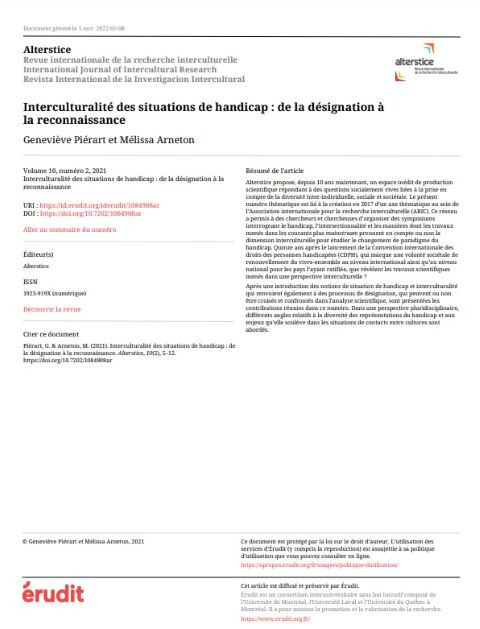 Interculturality of Disability Situations: From Designation to Recognition Год публикации: 2021 Автор: Geneviève Piérart | Mélissa Arneton Организация-автор: Alterstice Alterstice has been offering, for ten years, a unique space for scientific production responding to socially acute questions related to the consideration of inter-individual, social, and societal diversity. This thematic issue is linked to the creation in 2017 of a thematic axis within the International Association for Intercultural Research (ARIC). This network has enabled researchers to organize symposia questioning disability, intersectionality, and how the work carried out in more mainstream currents take into account or not the intercultural dimension to study the paradigm shift of disability. Fifteen years after the launch of the International Convention on the Rights of Persons with Disabilities (CRPD) marks a societal desire to renew living together at the international level as well as at the national level for the countries that have ratified it, as revealed by the work scientific studies carried out from an intercultural perspective. After an introduction to the notions of disability and interculturality, which also refer to designation processes, which may or may not be crossed and compared in scientific analysis. From a multidisciplinary perspective, different angles relating to the diversity of representations of disability and the issues it raises in situations of contact between cultures are discussed. Interculturalité des situations de handicap: De la désignation à la reconnaissance Год публикации: 2021 Автор: Geneviève Piérart | Mélissa Arneton Организация-автор: Alterstice Alterstice propose depuis dix ans un espace unique de production scientifique répondant à des questions socialement aiguës liées à la prise en compte de la diversité interindividuelle, sociale et sociétale. Ce numéro thématique est lié à la création en 2017 d'un axe thématique au sein de l'Association internationale pour la recherche interculturelle (ARIC). Ce réseau a permis aux chercheurs d'organiser des colloques questionnant le handicap, l'intersectionnalité, et comment les travaux menés dans des courants plus mainstream prennent en compte ou non la dimension interculturelle pour étudier le changement de paradigme du handicap. Quinze ans après le lancement de la Convention Internationale des Droits des Personnes Handicapées (CDPH) marque une volonté sociétale de renouveler le vivre ensemble au niveau international comme au niveau national pour les pays qui l'ont ratifiée, comme le révèle la travaux d'études scientifiques menées dans une perspective interculturelle. Après une introduction aux notions de handicap et d'interculturalité, qui renvoient également à des processus de désignation, qui peuvent ou non être croisés et comparés dans l'analyse scientifique. Dans une perspective pluridisciplinaire, différents angles relatifs à la diversité des représentations du handicap et aux enjeux qu'il soulève dans les situations de contact entre cultures sont abordés.
  2022 인천 평화교육 포럼 Год публикации: 2022 Организация-автор: 인천광역시교육청 인천시교육청, '2022 인천 평화교육 포럼' 개최1. 행사명: 2022 인천 평화교육 포럼2. 일시: 2022. 11. 10.(목) 16:00~18:003. 포럼 주제: (평화·공존을 실천하는 세계시민 양성)인천 평화교육의 방향과 과제4. 대상: 인천교육공동체 누구나5. 주관: 정책기획조정관 교육정책연구소, 동아시아시민교육과 평화・공존교육팀 ○ 자료집: https://url.kr/tmwez3
  Strengthening Social and Emotional Learning in Hybrid Modes of Education: Building Support for Students, Teachers, Schools and Families Год публикации: 2024 Организация-автор: UNESCO International Bureau of Education (IBE) This Discussion Paper focuses on the essential role of social and emotional learning (SEL) in the global movement to transform education and amplify its social, economic, environmental and personal impacts in a rapidly changing world. It explores how the mainstreaming of SEL into educational policies and practices can contribute to realizing future visions of education that are flexible, reflective, innovative, and impactful. Specifically, the Paper focuses on six topics that, as a whole, reflect global experiences in integrating and implementing SEL in its various forms both during and in the wake of the COVID-19 pandemic. Its main objective is to animate discussion on how to integrate a SEL dimension in hybrid modes of teaching and learning. This introductory overview presents the overall purpose and scope of the Paper, defines its underlying concepts and introduces the topics brought to this forum through the lenses of a diverse group of educators from Africa, the Arab States, Asia, Europe, and Latin America.
  Les clichés du gaming, comment chasser le racisme ou le patriarcat des jeux vidéos ? Год публикации: 2024 Организация-автор: France Inter Produit phare de l’industrie culturelle, le jeu vidéo a, au même titre que le cinéma, une dimension politique et sociale. Certains titres, ont été jugés comme étant racistes. Alors, comment décoloniser le jeu vidéo ?A flagship product of the cultural industry, video games have, like cinema, a political and social dimension. Some titles, like Resident Evil 5, have been deemed racist. So how do we decolonize video games?
  être citoyen numérique, ça te dit ? Год публикации: 2022 Организация-автор: TRALALERE Vinz est très excité, il a été sélectionné pour participer au concours du meilleur citoyen numérique ! En effet, dans les vidéos qu’il a déjà réalisées, il respecte, sans le savoir, la Charte pour l’éducation à la culture et à la citoyenneté numériques. Une belle occasion pour Vinz de nous expliquer les notions de charte et de citoyenneté numérique. Vinz is very excited - he's been selected to take part in the best digital citizen competition! In fact, in the videos he's already made, he unknowingly respects the Charter for Education in Digital Culture and Citizenship. This is a great opportunity for Vinz to explain the concepts of the Charter and of digital citizenship.
 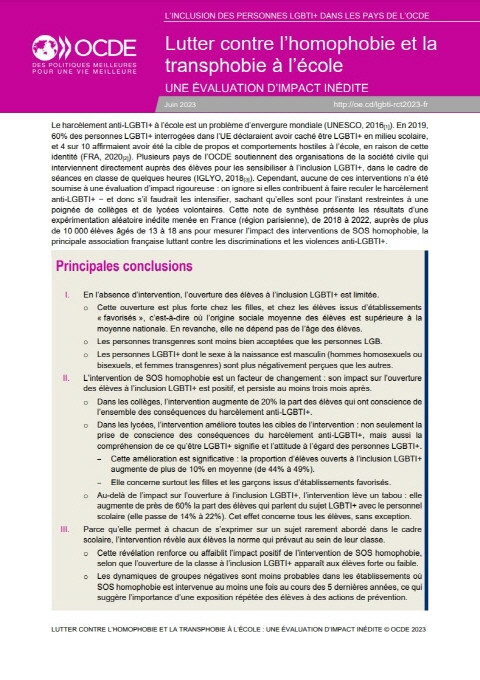 Lutter contre l’homophobie et la transphobie à l’école Год публикации: 2023 Организация-автор: Organisation de coopération et de développement économiques (OCDE) Cette note de synthèse présente les résultats d’une expérimentation inédite que l’OCDE a menée en France (région parisienne), de 2018 à 2022, auprès de plus de 10 000 élèves âgés de 13 à 18 ans pour mesurer l’impact des interventions de SOS homophobie, la principale association française luttant contre les discriminations et les violences anti-LGBTI+. This briefing note presents the results of an unprecedented experiment that the OECD conducted in France (Paris region), from 2018 to 2022, with more than 10,000 pupils aged 13 to 18, to measure the impact of interventions by SOS homophobie, the leading French association fighting anti-LGBTI+ discrimination and violence.
 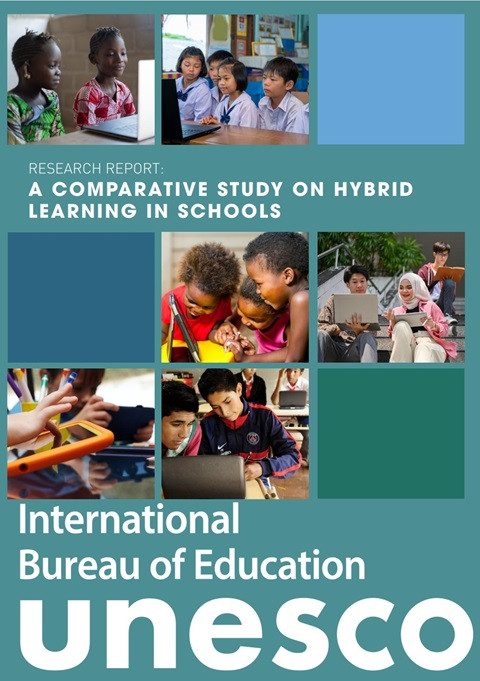 Research Report: A Comparative Study on Hybrid Learning in Schools Год публикации: 2024 Организация-автор: UNESCO International Bureau of Education (IBE) During the COVID-19 lockdown, policymakers and educators faced an unprecedented challenge disrupting all levels of education. The initial optimism about replacing physical classes with virtual lessons diminished as complex interconnected issues emerged. To address the need for continuous and sustainable learning, school systems implemented variations of hybrid learning during the pandemic, seeking to integrate physical and virtual classes. These approaches prompted this comparative study led by UNESCO-IBE. The initial phase of this study involved collecting and analysing data on hybrid strategies from six countries. The research aimed to examine factors influencing hybrid learning implementation during the lockdown, with a subsequent focus on developing and validating a practical Hybrid Learning Framework for Schools. The cross-case analysis was designed not to rank or compare, but to understand and connect different scenarios and contexts. Phase I focuses on current hybrid learning practices and influencing factors, while Phases II and III will concentrate on using the information gathered to create and validate a Hybrid Learning Framework for Schools. Aligned with UNESCO-IBE’s overarching vision of a comprehensive, personalized, and democratized curriculum accessible to all, hybrid learning facilitates inclusive education across diverse regions, overcoming geographical and temporal limitations. The approach aims to unlock the unique potential of every learner, fostering a more flexible educational environment.
  قيم المواطنة في التعليم الأبتدائي : دراسة وصفية تحليلية لمحتوى كتاب التربية المدنية Год публикации: 2022 Автор: Abdelghani Makhloufi Организация-автор: Democratic Arab Center هدفت الدراسة إلى الوقوف على واقع انسجام قيم المواطنة الواردة في كتاب التربية المدنية للتعليم الابتدائي مع تلك القيم التي وردت في القانون التوجيهي للتربية الوطنية، باعتباره الإطار المرجعي لتأليف المناهج والكتب المدرسية، حيث توصلت الدراسة باعتماد منهج تحليل المحتوى من خلال شبكة تحليل محددة لقيم المواطنة في القانون التوجيهي، وتحليل محتويات كتب التربية المدنية لمرحلة التعليم الابتدائي ككل على ضوئها، إلى أن قيم المواطنة الواردة في كتاب التربية المدنية لمرحلة التعليم الابتدائي لا تتوافق مع مقدار القيم الواردة في القانون التوجيهي للتربية الوطنية إلا بنسبة46.15%، وهي نسبة غير كافية للدلالة على الاعتماد الفعلي للمؤلفين والجهات الوصية على مرجعية القانون التوجيهي للتربية الوطنية في المؤلفات المدرسية. Citizenship Values in Primary Education : An Analytical Descriptive Study of the Content of the Civics Textbook Год публикации: 2022 Автор: Abdelghani Makhloufi Организация-автор: Democratic Arab Center The study aimed to assess the alignment between the citizenship values presented in the civics textbooks for primary education and those outlined in the National Education Directive Law, which serves as the guiding framework for curriculum and textbook development. Employing a content analysis approach, the study compared the network of citizenship values delineated in the directive law with the contents of civics textbooks for primary education. Findings revealed a discrepancy, with the citizenship values in the civics textbooks aligning with only 53.85% of those specified in the directive law for national education. This disparity suggests a lack of adherence by textbook authors and publishers to the values prescribed in the directive law.