
Ресурсы
Изучайте широкий спектр ценных ресурсов ВГГ, чтобы углубить своё понимание и повысить эффективность исследований, просветительской деятельности, преподавания и обучения.
Найдено: 3,530
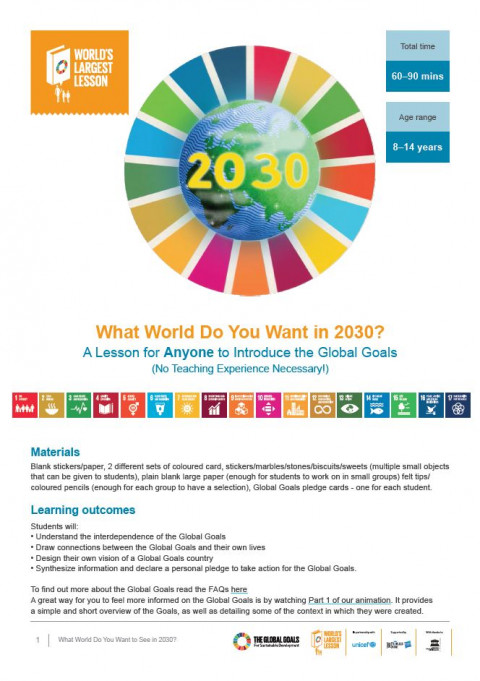 What World Do You Want in 2030?: A Lesson for Anyone to Introduce the Global Goals Год публикации: 2018 Организация-автор: World’s Largest Lesson MaterialsBlank stickers/paper, 2 different sets of coloured card, stickers/marbles/stones/biscuits/sweets (multiple small objects that can be given to students), plain blank large paper (enough for students to work on in small groups) felt tips/coloured pencils (enough for each group to have a selection), Global Goals pledge cards - one for each student. Learning outcomesStudents will:• Understand the interdependence of the Global Goals• Draw connections between the Global Goals and their own lives• Design their own vision of a Global Goals country• Synthesize information and declare a personal pledge to take action for the Global Goals.
 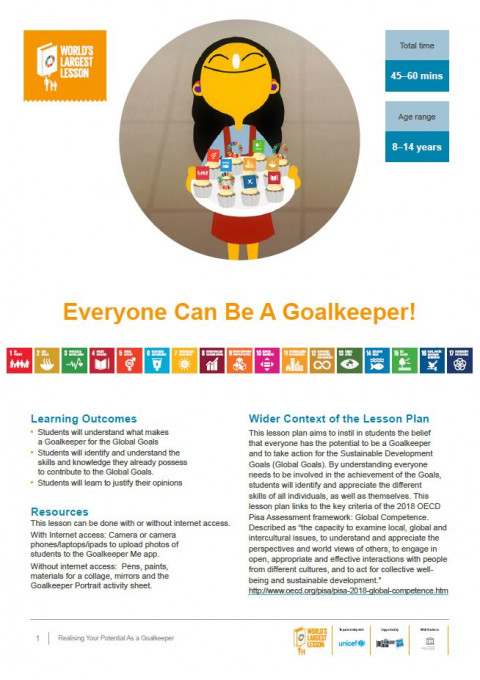 Everyone Can Be a Goalkeeper! Организация-автор: World’s Largest Lesson Learning Outcomes• Students will understand what makes a Goalkeeper for the Global Goals• Students will identify and understand the skills and knowledge they already possess to contribute to the Global Goals.• Students will learn to justify their opinions Resources This lesson can be done with or without internet access.With Internet access: Camera or camera phones/laptops/ipads to upload photos of students to the Goalkeeper Me app.Without internet access: Pens, paints, materials for a collage, mirrors and the Goalkeeper Portrait activity sheet. Wider Context of the Lesson PlanThis lesson plan aims to instil in students the belief that everyone has the potential to be a Goalkeeper and to take action for the Sustainable Development Goals (Global Goals). By understanding everyone needs to be involved in the achievement of the Goals, students will identify and appreciate the different skills of all individuals, as well as themselves. This lesson plan links to the key criteria of the 2018 OECD Pisa Assessment framework: Global Competence.Described as “the capacity to examine local, global and intercultural issues, to understand and appreciate the perspectives and world views of others, to engage in open, appropriate and effective interactions with people from different cultures, and to act for collective wellbeing and sustainable development.”
 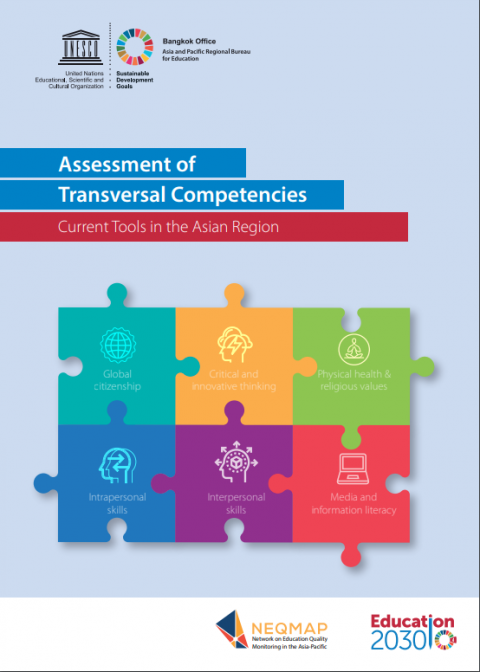 Assessment of Transversal Competencies: Current Tools in the Asian Region Год публикации: 2019 Автор: Esther Care | Alvin Vista | Helyn Kim Организация-автор: UNESCO Bangkok | Brookings Institution UNESCO’s Asia-Pacific Regional Bureau for Education has been working on education quality under the name of ‘transversal competencies’ (TVC) since 2013. Many of these competencies have been included in national education policy and curricula of countries in the region, but now the importance accorded them is increasingly gaining attention. As policy makers increasingly require their systems to provide evidence of 21st century skills acquired by their learners, implementation challenges highlight the need for a stronger alignment between curricula, pedagogy and learning assessments. UNESCO Bangkok’s Network on Education Quality Monitoring in the Asia Pacific (NEQMAP) undertook this regional study to examine components within countries’ learning assessments that show how these apply to and can measure transversal competencies. This report provides valuable information on how learning assessments are already capturing TVC and is useful for a broad range of education stakeholders, not only test developers, but also curriculum developers, teacher trainers and teachers. Particularly important is the need to align these skills and competencies across the entire education system.
  UNESCO IICBA: strategic plan Год публикации: 2019 Организация-автор: UNESCO International Institute for Capacity-Building in Africa (IICBA) UNESCO IICBA’s Strategic Plan for 2018-2021 is guided by its mandate and mission to strengthen the capacity of Member States in Africa in teacher policy and development. This work is vital to realizing its vision of an integrated, prosperous and peaceful Africa where everyone has access to qualified, motivated and professionally supported teachers. This plan is supported by a vision for Strategic Partnerships, because UNESCO IICBA recognizes their value in promoting regional and national cooperation in teacher-related issues, and in fostering dialogue on teachers and education. Strategic partnerships have three objectives:Successfully implement UNESCO IICBA’s Strategic Plan 2018-2021 Ensure the efficiency and effectiveness of resource mobilizationStrengthen advocacy, cooperation and coordination mechanisms The Strategic Plan is also supported by a Communication Strategy that covers all of UNESCO IICBA’s programme areas and will support collaboration, coordination and institutional operations. The strategy aims to contribute to effective communication that will:Help to fulfill UNESCO IICBA’s strategic goals and objectivesAmplify the visibility of UNESCO IICBA to its stakeholdersInform partners and donors on implementation progress, and demonstrate UNESCO IICBA’s accountabilityEnsure people understand what UNESCO IICBA represents and doesImprove teachers’ professional image and raise awareness to address teachers’ issues in AfricaKeep UNESCO IICBA team members proud, motivated, innovative and accountable in their tasks
 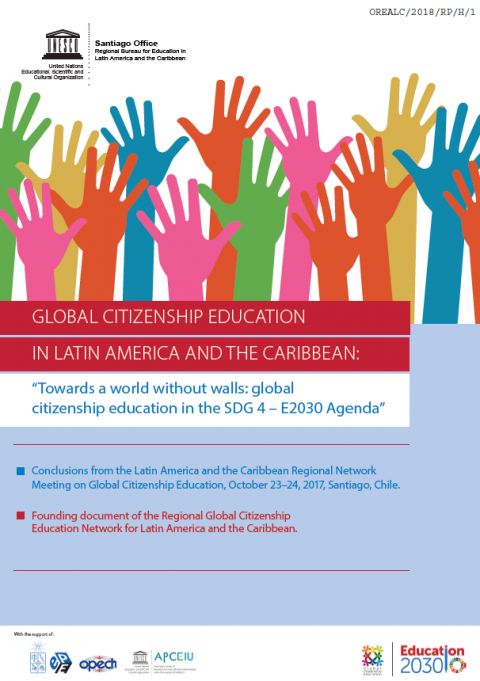 Global Citizenship Education in Latin America and the Caribbean: Towards a World without Walls: Global Citizenship Education in the SDG 4 - E2030 Agenda Год публикации: 2018 Организация-автор: UNESCO Santiago The Latin America and the Caribbean Regional Network Meeting on Global Citizenship Education “Towards a World without Walls: Global Citizenship Education in SDG 4 – Agenda E2030”, was organized by the UNESCO Regional Bureau for Education in Latin America and the Caribbean (OREALC / UNESCO Santiago) and the Asia – Pacific Centre of Education for International Understanding (APCEIU), in collaboration with the Chilean Observatory of Educational Policies (OPECH) of the University of Chile. The event, held on October 23 and 24, 2017, in Santiago, Chile, brought together regional researchers, members of civil society organizations and activists, educational communities, social movements, government educational authorities and universities. The objective of the meeting was to promote dialogue on the concept of Global Citizenship Education (GCED), deepen the regional perspective on the topic and create a network that helps strengthen the implementation of GCED in the context of the Latin America and the Caribbean region. This document summarizes the main topics addressed and issues discussed at the meeting. Subsequently, the founding document of the Regional Global Citizenship Education Network for Latin America and the Caribbean, which was elaborated in light of the meeting’s discussions, is presented. Educación para la Ciudadanía Mundial en América Latina y el Caribe: Hacia un mundo sin muros: educación para la ciudadanía mundial en el ODS4 - Agenda E2030 Год публикации: 2018 Организация-автор: UNESCO Santiago La Reunión Regional para América Latina y el Caribe de la Red de Educación para la Ciudadanía Mundial “Hacia un mundo sin muros: educación para la ciudadanía mundial en el ODS 4 – Agenda E2030”, fue organizada por la Oficina Regional de Educación para América Latina y el Caribe (OREALC / UNESCO Santiago) y el Centro de Educación para la Comprensión Internacional de Asia-Pacífico (APCEIU), en colaboración con el Observatorio Chileno de Políticas Educativas de la Universidad de Chile (OPECH). La cita se desarrolló el 23 y 24 de octubre de 2017 en Santiago de Chile, y a ella fueron convocados pensadores y activistas de la región, provenientes de organizaciones de la sociedad civil, comunidades educativas, movimientos sociales, organismos gubernamentales y universidades. El objetivo de la reunión fue promover el diálogo sobre el concepto de Educación para la Ciudadanía Mundial (ECM) y profundizar en una mirada regional para propiciar la conformación de una red que permita fortalecer la implementación de la ECM, situada en el contexto de América Latina y el Caribe. Se presenta este documento como síntesis de las principales temáticas que fueron abordadas y discutidas en el encuentro. A continuación, se presenta el documento fundacional que establece la Red Regional de Educación para la Ciudadanía Mundial para América Latina y el Caribe, que fue elaborada a raíz de las discusiones.
 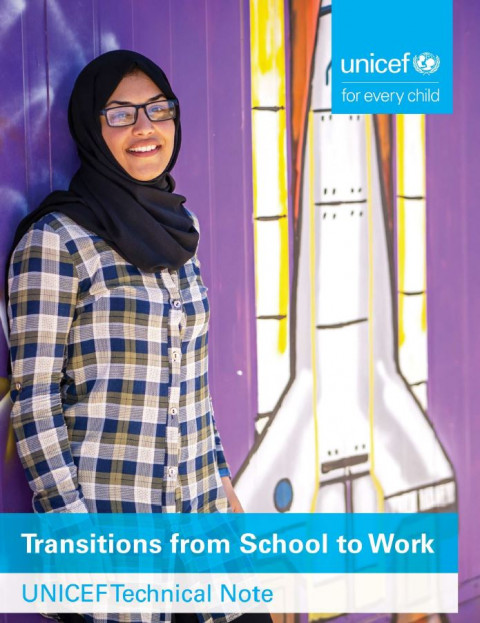 Transitions from School to Work: UNICEF Technical Note Год публикации: 2019 Организация-автор: United Nations Children's Fund (UNICEF) This report provides guidance on ways that UNICEF can support governments and partners to help adolescents to make a smooth transition from school to decent work. To prepare them for life, work, citizenship and life-long learning, UNICEF encourages governments and partners to expand access to learning and skills development for all children and adolescents – from pre-primary to upper-secondary age, and particularly for the most marginalized. UNICEF further advocates strengthening systems to enable them to develop a breadth of skills across the life course and through multiple learning pathways, such as formal, non-formal, on the job and community based.
 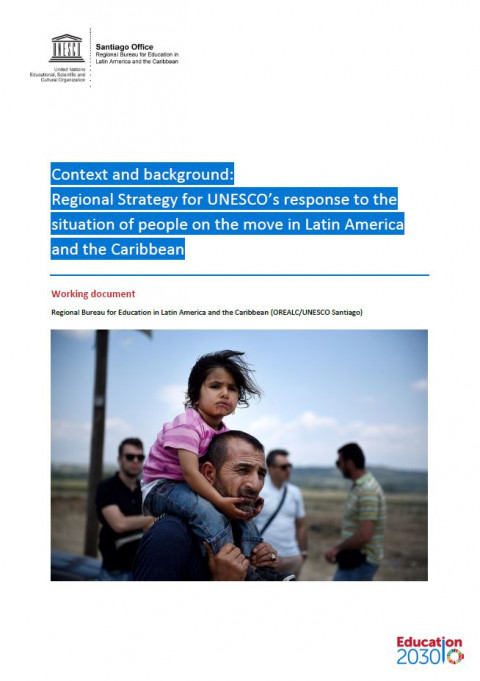 Context and Background: Regional Strategy for UNESCO’s Response to the Situation of People on the Move in Latin America and the Caribbean Год публикации: 2019 Организация-автор: UNESCO Santiago The UNESCO offices in Latin America and the Caribbean, under the coordination of the Regional Bureau for Education in Latin America and the Caribbean OREALC/UNESCO Santiago, have proposed the development of a regional strategy that provides a response from UNESCO based on the needs of the region’s countries for guaranteeing the right to education of migrants, refugees, asylum seekers and returnees. The purpose of this document is to present key information for the development of the regional strategy. It reviews a set of information that contextualizes human mobility in Latin America and the Caribbean, recognizing contemporary trends, identifying their driving factors and describing the main demographic qualities that characterize them.The authors then address the needs for protection of individuals in the context of mobility in the region, particularly those associated with the exercise of their fundamental rights and processes of inclusion in social protection systems in the destination society. They then present the right to education as a multiplier right in contexts of human mobility, reviewing the main obstacles faced by migrants, refugees, asylum seekers and returnees. Finally, the text presents a discussion of UNESCO’s role in this context based on the review of international regulatory instruments and frameworks, institutional frameworks, the work agenda at the regional level and the migratory institutional structure in Latin America and the Caribbean. Antecedentes para una estrategia regional de respuesta de la UNESCO a la situación de personas en contexto de movilidad en América Latina y el Caribe: documento de trabajo Год публикации: 2019 Организация-автор: UNESCO Santiago Las oficinas de la UNESCO en América Latina y el Caribe, bajo la coordinación de la Oficina Regional de Educación OREALC/UNESCO Santiago, se han propuesto el desarrollo de una estrategia regional que estructure una respuesta de la UNESCO en función de las necesidades de los países de la región para garantizar el derecho a la educación de personas migrantes, refugiados, solicitantes de asilo y retornados. El presente documento tiene como objetivo presentar antecedentes relevantes para la elaboración de la estrategia regional. En él, se revisa un conjunto de antecedentes que contextualizan la movilidad humana en América Latina y el Caribe, reconociendo tendencias contemporáneas, identificando los factores que la impulsan y revisando las principales cualidades demográficas que la caracterizan. Posteriormente, se abordan las necesidades de protección de las personas en contexto de movilidad en la región, especialmente aquellas asociadas al ejercicio de sus derechos fundamentales y a los procesos de inclusión a los sistemas de protección social en la sociedad receptora. Luego, se presenta el derecho a la educación como derecho multiplicador en los contextos de movilidad humana, revisando los principales obstáculos para su realización que deben enfrentar las personas migrantes, refugiadas, solicitantes de asilo y retornadas. Finalmente, se discute el rol de la UNESCO en este escenario a partir de la revisión de los instrumentos y marcos normativos a nivel internacional, marcos institucionales, la agenda de trabajo a nivel regional y la institucionalidad migratoria de América Latina y el Caribe.
 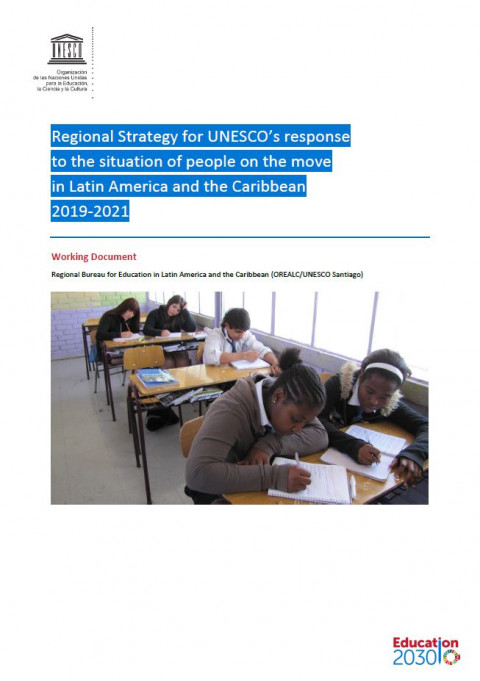 Regional Strategy for UNESCO’s Response to the Situation of People on the Move in Latin America and the Caribbean 2019-2021: Working Document Год публикации: 2019 Организация-автор: UNESCO Santiago This document introduces the three priority strategic areas, defined in coherence with those analyzed in the document Background for a Regional Strategy of UNESCO, as well as the components and initiatives of each of them. In addition, the following strategic dimensions are established: coordination and implementation mechanisms, advocacy and communications, planning and financing, and finally, the consolidation of resources, tools and existing publications of UNESCO, a product of the aforementioned intersectoral consultation process.