
Ресурсы
Изучайте широкий спектр ценных ресурсов ВГГ, чтобы углубить своё понимание и повысить эффективность исследований, просветительской деятельности, преподавания и обучения.
Найдено: 3,530
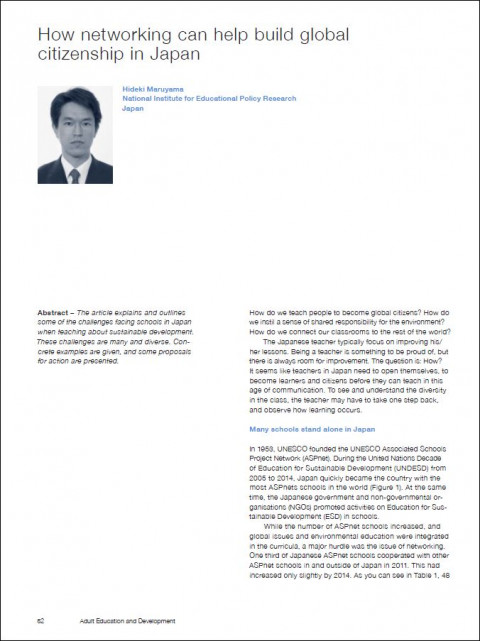 Comment les réseaux peuvent aider à construire une citoyenneté mondiale au Japon Год публикации: 2015 Автор: Hideki Maruyama Организация-автор: Éducation des Adultes et Développement L’article présente sommairement quelques-uns des défi s auxquels les écoles sont confrontées au Japon lorsque l’enseignement porte sur le développement durable. Ces défi s sont nombreux et divers. L’article en fournit des exemples concrets et présente quelques propositions d’action.
  Entre generaciones. La experiencia de la transmisión en el relato testimonial. Profesorado. Revista de currículum y formación del profesorado The purpose of this paper is to rethink the relationship between experience and education, when what we face, as readers, learners and educators, is an altogether inconceivable experience: the account of the surviving witness of the concentration camps, a literary genre that is the end of the Bildungsroman or coming-of-age novel. Some questions guide this effort: Is there any way to read and give our young people, within the discourse of the learning society, where the crisis of transmissions is more than evident, some texts suggesting a discontinuous type of transmission? What kind of experience is the experience of reading this literature? What learning experience and transmission does it contain, if any? (By the author)
 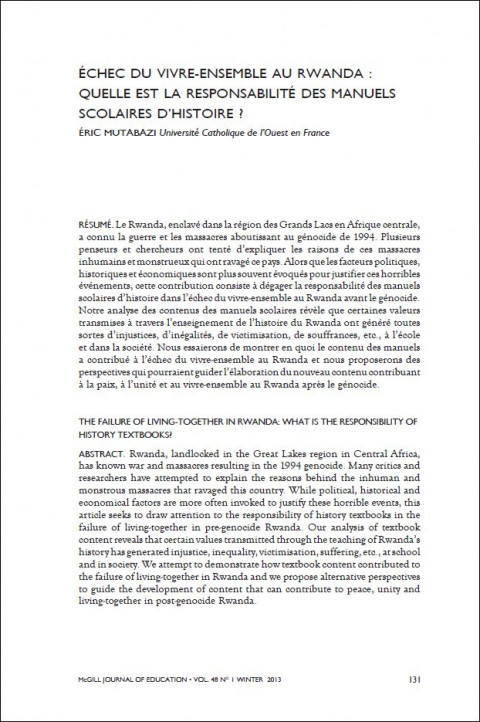 The Failure of Living-Together in Rwanda: What is the Responsibility of History Textbooks? Год публикации: 2013 Автор: Éric Mutabazi Организация-автор: McGill University. Faculty of Education Rwanda, landlocked in the Great Lakes region in Central Africa, has known war and massacres resulting in the 1994 genocide. Many critics and researchers have attempted to explain the reasons behind the inhuman and monstrous massacres that ravaged this country. While political, historical and economical factors are more often invoked to justify these horrible events, this article seeks to draw attention to the responsibility of history textbooks in the failure of living-together in pre-genocide Rwanda. Our analysis of textbook content reveals that certain values transmitted through the teaching of Rwanda’s history has generated injustice, inequality, victimisation, suffering, etc., at school and in society. We attempt to demonstrate how textbook content contributed to the failure of living-together in Rwanda and we propose alternative perspectives to guide the development of content that can contribute to peace, unity and living-together in post-genocide Rwanda. Échec du vivre-ensemble au Rwanda : quelle est la responsabilité des manuels scolaires d’histoire ? Год публикации: 2013 Автор: Éric Mutabazi Организация-автор: McGill University. Faculty of Education Le Rwanda, enclavé dans la région des Grands Lacs en Afrique centrale, a connu la guerre et les massacres aboutissant au génocide de 1994. Plusieurs penseurs et chercheurs ont tenté d’expliquer les raisons de ces massacres inhumains et monstrueux qui ont ravagé ce pays. Alors que les facteurs politiques, historiques et économiques sont plus souvent évoqués pour justifier ces horribles événements, cette contribution consiste à dégager la responsabilité des manuels scolaires d’histoire dans l’échec du vivre-ensemble au Rwanda avant le génocide. Notre analyse des contenus des manuels scolaires révèle que certaines valeurs transmises à travers l’enseignement de l’histoire du Rwanda ont généré toutes sortes d’injustices, d’inégalités, de victimisation, de souffrances, etc., à l’école et dans la société. Nous essaierons de montrer en quoi le contenu des manuels a contribué à l’échec du vivre-ensemble au Rwanda et nous proposerons des perspectives qui pourraient guider l’élaboration du nouveau contenu contribuant à la paix, à l’unité et au vivre-ensemble au Rwanda après le génocide.
 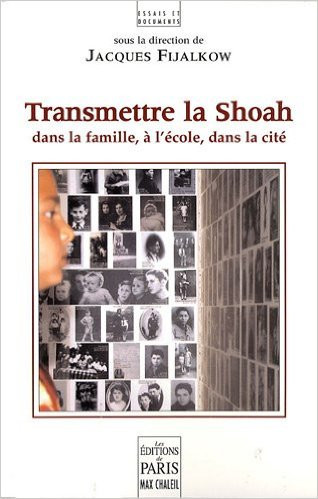 Transmettre la Shoah : Dans la famille, à l'école, dans la cité This volume deals with transmission of the history and the memory of the Shoah within the family as well as in school, in museums, in cultural productions (cinema, literature and art), and in legislation. Two countries are in the centre of the analysis : France and Israel. France with its history of the "Vel d'Hiv" and the Rivesaltes and Chambon-sur-Lignon camps. And Israel against the background of the Eichmann trial and the aftermath of "Shoah" by Lanzmann. Several contributions deal with transmission, knowledge and social representations of the Shoah. (By the editor)
 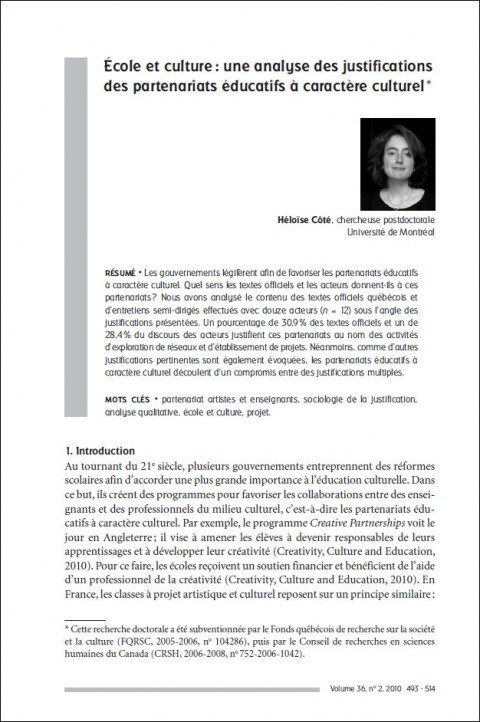 École et culture : une analyse des justifications des partenariats éducatifs à caractère culturel Год публикации: 2010 Автор: Héloïse Côté Организация-автор: Revue des sciences de l’éducation Les gouvernements légifèrent afin de favoriser les partenariats éducatifs à caractère culturel. Quel sens les textes officiels et les acteurs donnent-ils à ces partenariats ? Nous avons analysé le contenu des textes officiels québécois et d’entretiens semi-dirigés effectués avec douze acteurs (n = 12) sous l’angle des justifications présentées. Un pourcentage de 30,9 % des textes officiels et un de 28,4 % du discours des acteurs justifient ces partenariats au nom des activités d’exploration de réseaux et d’établissement de projets. Néanmoins, comme d’autres justifications pertinentes sont également évoquées, les partenariats éducatifs à caractère culturel découlent d’un compromis entre des justifications multiples. Holocaust Memorial Day in schools - context, process and content: a review of research into Holocaust education The Holocaust was officially remembered in Britain for the first time on 27 January 2001. This is to be an annual event and it is intended that it will provide a focus for work in schools. The paper reviews the findings of research into Holocaust education and discusses the implications for teachers intending to respond to this important initiative. (By the author) Using archival documents, memoir, and testimony to teach about Jewish families during and after the Holocaust Carson Phillips suggests the use of archival documents, memoir and recorded testimony to engage students in learning. Use the three survivor testimonies below, from Czechoslovakia, Hungary and Croatia, in conjunction with those in the Gurewitsch essay (pp. 48–55) for a rich and varied look at the fraught experiences of Jewish families struggling to survive and, ultimately, rebuild their lives. (By the publisher) Holocaust Education in Post-Communist Romania As Israeli historian Leon Volovici noted in a recent article, Romania today is marked by the concurrent presence of a prolific nationalistic media with strong anti-Semitic accents and a swell of events dedicated to the history of its Jews. This remarkable paradox is perhaps just one more example of the originality of Romania’s post-communist transition, the more so since the object of both trends is becoming less and less numerous every day: there are only about 9,000, mostly elderly Jews living in contemporary Romania. After 45 years of “relative silence” imposed by the communists and eight more years of “relevant silence” imposed by the neo-communists, as of 1998 the Holocaust is finally mentioned and discussed, but “in the third person”, as it were: it’s true, it happened, but not in Romania! (By the author) Entering the World of a Holocaust Victim: Schoolchildren Discuss a Ghetto Memoir – a Case Study Despite Adorno's famous dictum, the memory of the Shoah features prominently in the cultural legacy of the 20th century and beyond. It has led to a proliferation of works of representation and re-memorialization which have brought in their wake concerns about a 'holocaust industry' and banalization. This volume sheds fresh light on some of the issues, such as the question of silence and denial, of the formation of contemporary identities — German, East European, Jewish or Israeli, the consequences of the legacy of the Shoah for survivors and for the 'second generation,' and the political, ideological, and professional implications of Shoah historiography. One of the conclusions to be drawn from this volume is that the 'Auschwitz code’, invoked in relation to all 'unspeakable' catastrophes, has impoverished our vocabulary; it does not help us remember the Shoah and its victims, but rather erases that memory. (By the author)