
Ресурсы
Изучайте широкий спектр ценных ресурсов ВГГ, чтобы углубить своё понимание и повысить эффективность исследований, просветительской деятельности, преподавания и обучения.
Найдено: 3,530
 Lesson Components from Echoes and Reflections Prepared by the Anti-Defamation League, the USC Shoah Foundation and Yad Vashem, Echoes and Reflections provides educators with the professional development and resources necessary to acquire the necessary knowledge, capacity, and practice to responsibly and effectively teach the Holocaust. The ten multipart lessons in the Teacher's Resource Guide, along with additional supplementary material provided here, can enhance both teachers' and students' experiences with Echoes and Reflections. Holocaust Educational Trust - Teaching Resources The Holocaust Educational Trust aim is to educate young people from every background about the Holocaust and the important lessons to be learned for today. The Trust works in schools, universities and in the community to raise awareness and understanding of the Holocaust, providing teacher training, an outreach programme for schools, teaching aids and resource material. The Teaching Resources section of the Trust’s website provides free, downloadable lesson plans, classroom resources and guidance documents for teachers. The access to the teaching resources is free, but you need to login to access the materials.
 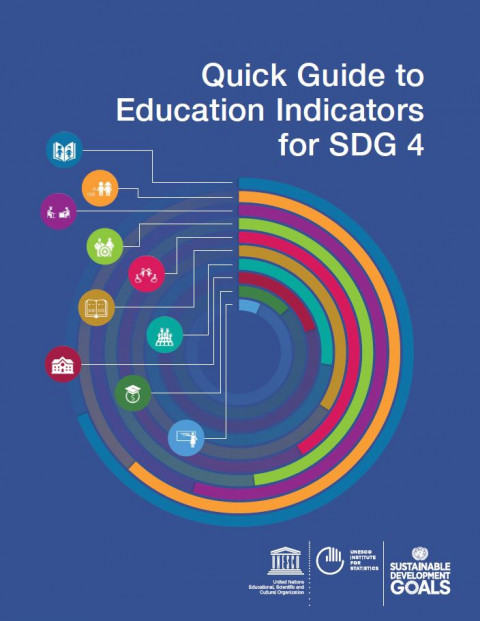 Quick Guide to Education Indicators for SDG 4 Год публикации: 2018 Организация-автор: UNESCO Institute for Statistics (UIS) This guide serves as a quick reference on how to monitor progress towards Sustainable Development Goal 4 (SDG 4) on quality education. It provides basic explanations of SDG 4 targets, their indicators, how they are created and where to find the information needed for these indicators. The Holocaust, 1933-1945 : Educational Resources kit Организация-автор: Simon Wiesenthal Center This educational kit released by the Simon Wiesenthal Center Library and Archives proposes numerous teaching materials educational staff can appropriate. It offers a timeline of the Holocaust, a glossary of terms, places and personalities, a History lesson under a "questions/answers" session, information about each Nazi camp (number of deaths, present status...) readings, resources and a list of associations working on this topic.
  Holocaust Education in Ontario High Schools: An antidote to racism? The premise underpinning this article is that if the Holocaust is taught well, it can help to promote anti-racist goals. The need to realize the Holocaust's anti-racist potential is self-evident, but is arguably greatest where conventional anti-racism (aimed at enhancing the life chances of visible minorities) is under threat. Such a situation currently exists in Ontario, where the right wing Progressive Conservative party was elected to office in June 1995. The uncertain future of anti-racism in the province provides the background to this article. It examines the teaching of the Holocaust in Ontario high schools and reports the findings of a survey carried out among history staff in May 1998. Various ways are suggested in which the teachers involved (and others elsewhere) might alter their approach to the Holocaust in order to strengthen its contribution to anti-racist education. (By the author)
  Confronting the Holocaust in Religious Education Studies of Holocaust education in secondary schools have tended to focus on how the subject is taught as part of the history curriculum. Comparatively little work of either a theoretical or an empirical nature has looked at how the subject is handled in other curricular areas. Religious education is a case in point, for the field is marked both by a dearth of literature on appropriate content and by a virtual absence of research on teachers' practices. The need to address these lacunae provides the rationale for the article. In relation to content, two concerns dominate the discussion. The first is that the Holocaust may be portrayed as an act of religious intolerance; the second is that students may be offered a diluted or distorted account of the part played by Christianity. The empirical core of the article surveys the practices of 28 teachers of religious education in connection with both concerns. It also contains a content analysis of how textbooks used by the teachers treat the attempted annihilation of European Jewry. The article concludes with a discussion of the policy implications of the findings. (By the author)
  Review of Curricula and Curricular Frameworks: Report to Inform the Update of the UNESCO International Technical Guidance on Sexuality Education Год публикации: 2018 Автор: Nicole Cheetham | Nora Gelperin Организация-автор: Advocates for Youth In 2009, UNESCO published the International Technical Guidance on Sexuality Education (ITGSE): An evidence-informed approach for schools, teachers and health educators. The purpose of the ITGSE is to assist education, health and other relevant authorities in the development and implementation of school-based sexuality education programmes and materials (UNESCO, 2009). The publication was released in two volumes: Volume I, which focuses on the rationale for sexuality education and provides sound technical advice on the characteristics of effective programmes; and Volume II, which focuses on the topics and learning objectives to be covered in a ‘basic minimum package’ on sexuality education for children and young people from 5 to 18+ years of age, and includes a bibliography of useful resources.In 2016, UNESCO began a process to update the ITGSE, consisting of a literature review of the evidence and lessons learned since the release of the original publication; a stakeholder consultation on sexuality education held in October of 2016; an online user survey; and an expert, Comprehensive Sexuality Education (CSE) Advisory Group established to inform the process and its findings.This report summarizes evidence-informed conclusions, expert recommendations and current practice for curriculum-based sexuality education for ages 5-18+ and provides preliminary, overarching changes to Volume II of the ITGSE for consideration by the UNESCO CSE Advisory Group.
  Lessons learned from the Holocaust blogging to teach critical multicultural literacy This qualitative dual-case study addresses two 21st century teacher education imperatives, technology infusion and critical multicultural literacy instruction. We researched the integration of a blog as a tool to promote technology use in a graduate course on literacy and technology with a thematic focus on the Holocaust. Using a grounded theory approach (Corbin & Strauss, 2008), we analyzed data sources, including interviews, blog postings and surveys. We conducted a second analysis using a priori coding schemes to further analyze students’ blog posts. Findings suggest that blogging has the potential to enhance knowledge of the ways technology can be harnessed to promote critical multicultural literacy instruction. From an action research stance, we also discuss implications for our future practice. (By the author) L'Holocauste, 1933-1945: kit Ressources pédagogiques Организация-автор: Simon Wiesenthal Center Ce kit éducatif publié par le Centre Simon Wiesenthal Bibliothèque et Archives propose de nombreux matériaux d'enseignement du personnel éducatif peut approprier. Il propose une chronologie de l'Holocauste, un glossaire des termes, des lieux et des personnalités, une leçon d'histoire sous une session "Questions / réponses", des informations sur chaque camp nazi (nombre de décès, le statut actuel ...) des lectures, des ressources et un liste des associations travaillant sur le sujet.
 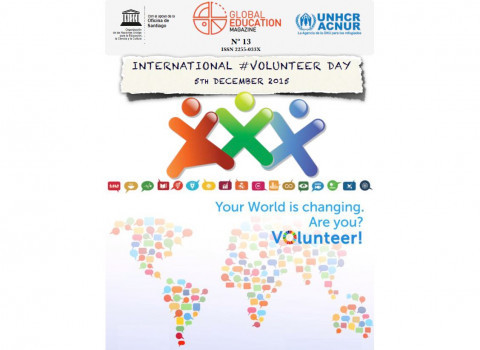 Global Education Magazine No. 13: International #Volunteer Day Год публикации: 2015 Автор: Global Education Magazine This year’s International Volunteer Day (IVD) theme, "The world is changing. Are you? Volunteer!" is challenging each and every one of us to be part of implementing the newly launched Global Goals. The 2030 Agenda for Sustainable Development is a plan of action for ending poverty in all its dimensions, irreversibly, everywhere. Volunteerism, and each one of your volunteer actions, are critical to ensure we “leave no one behind” in this effort.The contribution of volunteers in the new development agenda is two-fold. Volunteerism is a way for us all to be directly involved in achieving sustainable development and peace. At the same time, this essential way of fostering people’s participation makes it a key element for success when striving for sustainability of development. Volunteer organizations can be brokers of civic engagement, connecting institutional initiatives with volunteer action at local, national and global levels.