
Ресурсы
Изучайте широкий спектр ценных ресурсов ВГГ, чтобы углубить своё понимание и повысить эффективность исследований, просветительской деятельности, преподавания и обучения.
Найдено: 3,530
 Mémoire et pédagogie. Autour de la transmission de la destruction des Juifs d'Europe Based on qualitative interviews, "Memory and pedagogy" takes inventory of the representations and fears teachers can encounter when they broach the Holocaust, especially if their personal background echoes that part of history. The author then describes different postures they can adopt ‒ centred victim empathy, genocide as a general theme or focused on "lessons" from the past. This book, one of the first research projects on this topic in Switzerland, is a contribution to a collective reflection on the current and future transmission of the history and memory of the destruction of European Jews. (By the author - Translation)
 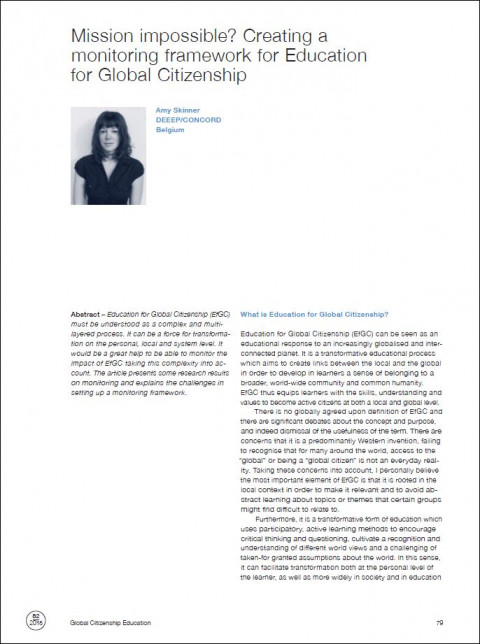 Mission Impossible? Creating a Monitoring Framework for Education for Global Citizenship Год публикации: 2015 Автор: Amy Skinner Организация-автор: Éducation des Adultes et Développement Global Citizenship Education (GCED) must be understood as a complex and multilayered process. It can be a force for transformation on the personal, local and system level. It would be a great help to be able to monitor the impact of GCED taking this complexity into account. The article presents some research results on monitoring and explains the challenges in setting up a monitoring framework. ¿Misión imposible? Crear un marco de seguimiento destinado a la educación para la ciudadanía mundial Год публикации: 2015 Автор: Amy Skinner Организация-автор: Éducation des Adultes et Développement La educación para la ciudadanía mundial (ECM) debe entenderse como un proceso complejo y de varios niveles. Puede ser una fuerza de transformación a nivel personal, local y sistémico. Sería muy útil poder realizar un seguimiento del impacto de la ECM, teniendo en cuenta su complejidad. En el artículo se presentan algunas conclusiones de investigaciones sobre el seguimiento, y se explican los desafíos que plantea la creación de un marco para llevarlo a cabo. Exploring pupil perceptions of Jews, Jewish identity and the Holocaust This paper argues that effective Holocaust education involves exploring pupils' perceptions of Jews and Jewish identity. Identifying these preconceptions is necessary for combating anti-Semitism, challenging misconceptions and facilitating a historically accurate understanding of the Holocaust. How do pupils define the Jews and what it is that makes someone Jewish? How do pupils explain the causes of the Holocaust and why it was that the Nazi regime specifically targeted Jews? The empirical basis of this paper attempts to help answer these questions. One hundred and forty seven children aged 13 and 14 took part in mixed-method research in order to explore their ideas and concepts of Jewish identity and why the Holocaust took place. The paper concludes with a discussion of the implications of the findings for Holocaust education. (By the author) The boy in the striped pyjamas: a blessing or curse for Holocaust education This essay analyses the effectiveness of The Boy in the Striped Pyjamas as a pedagogic tool in Holocaust education. Drawing upon an empirical study conducted on 298 students’ preconceptions of the Holocaust, it suggests that the book and the film have had a large influence on existing ideas and have helped to establish problematic misconceptions. By highlighting its historicalinaccuracies and skewed moral messages, this essay suggests that The Boy in the Striped Pyjamas is principally a curse for Holocaust education. It concludes by considering practical responses to the story’s popularity and how its negative impact can be reduced. (By the author)
  La citoyenneté des adolescents du 21e siècle dans une perspective de justice sociale : pourquoi et comment ? Год публикации: 2018 Автор: Caroline Caron Организация-автор: Lien social et Politiques Comment sait-on ce que l’on sait sur la citoyenneté des adolescents et leurs pratiques de participation civique ? Cette question épistémologique a été négligée dans les écrits traitant de l’engagement civique et de la participation politique des jeunes. Cet article utilise la perspective théorique de la justice sociale pour examiner le rôle que jouent les rapports sociaux fondés sur l’âge dans la production de connaissances qui offrent un portrait pessimiste du rapport des jeunes à la politique. L’analyse montre que l’injustice épistémique et la validation empirique déficiente des connaissances à propos de la compétence civique appellent une théorisation alternative, précisément inclusive, de la citoyenneté des jeunes. L’analyse souligne aussi que l’avènement du Web social a créé de nouveaux besoins de connaissances que les cadres de recherche établis par tradition peinent à satisfaire. Un premier pas vers la production de connaissances socialement justes au sujet des compétences civiques des adolescents à l’ère du Web social consiste à analyser les fondements épistémologiques des approches de recherche prédominantes afin de susciter des échanges fructueux au sujet des critères normatifs qui devraient guider la confection des protocoles de recherche dans le futur. Historical Understanding - Beyond the Past and into the Present In this chapter Boix-Mansilla looks at the possibilities for using history to understand present-day issues. Partially funded through the Facing History and Ourselves organization, this study looked at whether learning about the Holocaust provided a more contextualized understanding of the 1994 genocide in Rwanda. This research found that students often used an ineffectual I-know-this-history-so-I-know-that-experience reasoning when making links between the two genocides, even though historical comparisons rely on both similarities and differences in analysis. Boix-Mansilla emphasizes that directed instruction on the process of historical comparison can remedy the weak reasoning demonstrated in the study and cites the literature on the strengths of using history to speak about present events to support this. (By the author)
  Expérience et projet : la pensée de Dewey traduite en action pédagogique Год публикации: 2016 Автор: Marc Boutet Организация-автор: Phronesis John Dewey parle du sujet comme d’un « agency of doing » qui, par son action, s’efforce de créer du sens. À partir de cette conception, Dewey propose de nouveaux principes d’enseignement mettant l’accent sur l’apprentissage dans un contexte d’activité libre plutôt que dans un contexte de discipline contraignante. L’apprenant n’est plus seulement invité à se représenter le phénomène à comprendre, il est en quelque sorte invité à aller à sa rencontre, à en faire l’expérience, celle-ci étant définie comme une transaction entre l’être humain et son environnement physique et social. Dewey affirmait également que l’absence d’une continuité dans l’expérience marque l’amorce de la démarche d’apprentissage, qu’il nomme démarche d’enquête (inquiry), laquelle n’est plus décrite comme essentiellement individualiste, ce qui fonde sa perception épistémique de la démocratie. Après avoir décrit brièvement notre rencontre avec la pensée éducative de Dewey, nous tenterons d’établir, à partir de sa conception de l’action, de l’enquête et de la démocratie, comment sa pensée peut être considérée comme fondatrice d’une innovation pédagogique majeure symbolisant la réforme de l’éducation au Québec des années 2000 : l’approche par projet. "Hitler is a Bully" Middle School Students’ Perspectives on Holocaust Education in Greater Victoria, British Columbia This study investigates middle school students’ interest in learning about the Holocaust, which methods are the most effective at teaching the Holocaust and how the testimony of Holocaust survivors can be retold to the next generations of middle school students. In order to answer these research questions, my study uses surveys with three classes of current middle school students in Greater Victoria, British Columbia, a focus group with graduate students at the University of Victoria and an interview with Larissa Weber, the director of the Anne Frank Exhibition in Berlin. These quantitative and qualitative results are analyzed using a mixed methods approach. The middle school students’ perceptions regarding effective educational methods when teaching the Holocaust in my limited sample (n=77 in the first survey and n=58 in the second survey) suggest that there is a connection between personal narrative and empathy when teaching the Holocaust in middle school classrooms. These findings are contextualized with a summary of the history of Holocaust education in Canadian public schools and a discussion regarding the role of empathy in learning about the Holocaust. (By the author)
  Educating Citizens at School: Individualization and Depoliticization of Citizenship Год публикации: 2018 Автор: Géraldine Bozec Организация-автор: Lien social et Politiques This text analyzes the features and the figures of the legitimate citizen in the sphere of school, through both official guidelines and school staff’s conceptions and practices. Data from two qualitative fieldwork surveys in French schools are used. The analysis focuses on the political dimension of citizenship: the relationship between individuals and power and their agency in collective and political life. Overall, citizens’ participation is a secondary dimension in school citizenship education, which rather emphasizes the intellectual autonomy of the critical citizen. The school hardly offers tools enabling students to understand political life, its issues, its actors and its concrete processes. The avoidance of political issues that is observed in classrooms is related to a particular conception of school political neutrality, but still more to the objective of cohesion officially attributed to school and recognized by teachers as legitimate. In other respects, citizenship is increasingly intended to be translated into the school life itself, whose modes of organization must move closer to those of adult political democracy. The article shows the limitations of such an analogy between the school and political society and identifies several obstacles that hinder the implementation of this “democratic school”. Lastly, it highlights the gap between the emphasis on the figure of individual citizen in the school space and the relationship to groups entailed by the actual practice of citizenship.