
Ресурсы
Изучайте широкий спектр ценных ресурсов ВГГ, чтобы углубить своё понимание и повысить эффективность исследований, просветительской деятельности, преподавания и обучения.
Найдено: 3,500
 La educación en la prevención del radicalismo: una revisión para Europa Год публикации: 2022 Автор: Arantxa Azqueta | Adoración Merino-Arribas Организация-автор: Spain. Ministry of Education Esta investigación analiza si las actitudes de la competencia global (OECD, 2018) -apertura, respeto, conciencia cívica, responsabilidad, autoeficacia y tolerancia- se recogen en los documentos gubernamentales sobre prevención del radicalismo de 16 países europeos, aglutinados en dos grupos control, en función de la presencia o ausencia de víctimas mortales en los atentados. Estas actitudes, evaluadas por PISA en 2018, definen a una ciudadanía democrática e interculturalmente competente. Se emplea una metodología comparativa con un análisis de contenido lexicográfico mediante el software Iramuteq junto al análisis crítico-interpretativo que contextualiza los documentos.
  Poverty Culture Impact on Some Educational Values and Attitudes of Secondary Stage Students in Al-Madinah Al-Munawarah Province Год публикации: 2013 Автор: Aysha Al-Ahmadi Организация-автор: University of Jordan The study aimed at identifying the impact of the culture of poverty on some educational values and attitudes of high school students in Madinah. The researcher adopted the descriptive approach through the application of a questionnaire concerned with monitoring the moral and sensory trends of the study sample. The questionnaire was developed towards measuring some educational values and attitudes, and collecting data related to the student’s gender and family income Ownership and type of housing, and parenting education. أثر ثقافة الفقر على بعض القيم والمواقف التعليمية لدى طلبة المرحلة الثانوية في منطقة المدينة المنورة Год публикации: 2013 Автор: Aysha Al-Ahmadi Организация-автор: University of Jordan هدفت الدراسة الحالية تعرّف أثر ثقافة الفقر على بعض القيم والمواقف التعليمية لدى طلبة المرحلة الثانوية بالمدينة المنورة، اعتمدت فيها الباحثة المنهج الوصفي من خلال تطبيق إستبانه اهتمت برصد التوجهات المعنوية والحسية لعينة الدراسة، نحو بعض القيم والمواقف التعليمية، وجمع بيانات ارتبطت بجنس الطالب، ودخل الأسرة، وملكية السكن ونوعه، وتعليم الوالدين.
  基于信息化仿真的物理实验教学改革与实践 Год публикации: 2022 Автор: 刘美玲 | 张震 | 谢艳妮 | 萧雅楠 物理实验是物理的基础,它对于培养物理概念、掌握物理规律、培养科学探究意识有着至关重要的作用。当前,我国的物理实验教学存在着许多不足,包括实验环节讲授理论化、仪器配备不足、不操作演示实验等问题。随着教育改革的不断深化,信息技术和教育的结合越来越密切,教学方法也在不断地变化,逐步弥补了传统的实验教学模式,而仿真实验作为信息时代的新产品,已经在教学中得到了广泛的应用,而如何将仿真实验和传统的实验教学有机地结合起来,这是困扰着一线物理老师的一个难题。为了解决这一问题,本文就如何把仿真实验和物理实验相结合,以改善实验教学的质量。本文将指出仿真实验的概念及其特点,其次阐述基于信息化仿真的物理实验教学流程,最后指出基于信息化仿真的物理实验教学改革与实践的相关建议,以期推动信息化时代仿真物理实验教学改革。
 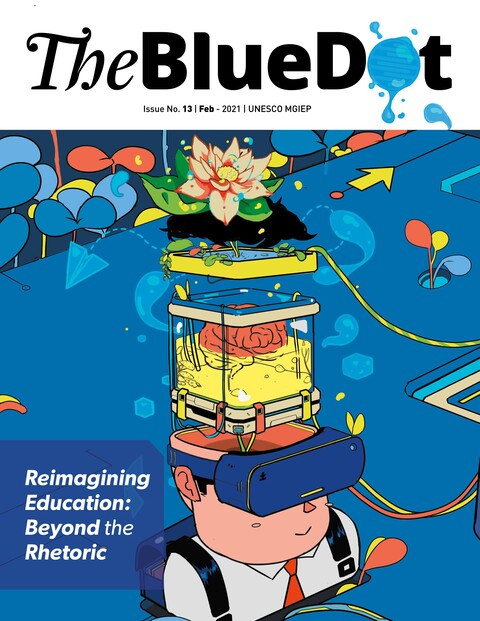 Reimagining Education: Beyond the Rhetoric (The Blue Dot; No.13, 2021) Год публикации: 2021 Организация-автор: Mahatma Gandhi Institute of Education for Peace and Sustainable Development (MGIEP) The events of the year 2020, driven predominantly by the COVID-19 pandemic, have forced governments, policymakers, educators and organisations to rethink the purpose, structure and modality of existing education systems. Even while the world is struggling with climate change, decreased empathy, violent extremism, xenophobia and an increase in mental health issues in children, with a recent report by WHO highlighting that 800,000 people between the ages of 15-29 are dying by suicide ever year, globally1 , the COVID-19 virus singlehandedly shut down access to face-to-face school education for roughly half of the world’s student population. These ongoing and unexpected challenges bring to light the urgent need for education systems to be more adaptable, responsive, and resilient to future shocks and disasters. We can work to transform education in many ways, such as by translating our understanding of how the brain learns from the research laboratory to the classroom and leveraging the power of technology to ensure that learning can reach every child who hungers to learn. It is time we reimagine education to ensure learning continues with minimal disruption but also empowers students as compassionate human beings, prepared for an unpredictable future, but also as global citizens seeking a peaceful and kinder world. The purpose of education needs to change from being instrumental (based on human capital) to one that is constitutive (human-flourishing), accessible to all and structured such that learning can happen anytime and anywhere and always.
  Rethinking Schooling for the 21st Century: The State of Education for Peace, Sustainable Development and Global Citizenship in Asia Год публикации: 2017 Организация-автор: Mahatma Gandhi Institute of Education for Peace and Sustainable Development (MGIEP) Calls to gear up schools for the 21st century are ubiquitous today. Dominant international educational discourse hails the potential of 'the youth dividend' and digital technology for enhancing growth. Some Asian education systems are held up as models for an innovation-led utopian future. But across much of Asia, neither the reality of schooling nor the patterns of development with which it is associated give cause for blithe optimism.This study is informed by UNESCO’s commitment to realising the Sustainable Development Goals (SDGs) through educational reform worldwide. Since its inception, UNESCO has championed a humanistic vision of education — a vision today encapsulated in SDG 4.7. These ideals need to be strongly restated and defended in an era when educational debate worldwide has come to be framed by a narrowly economistic and instrumentalist agenda.Deriving urgent significance from this broader context, the present report analyses how far the ideals of SDG 4.7 – of 'education for peace, sustainable development and global citizenship' - are embodied in policies and curricula across 22 Asian societies. At one level, it seeks to develop benchmarks against which future progress can be assessed. It also argues forcefully that conceptions of the fundamental purposes of schooling need to be reconfigured, if the ideals to which the global community has subscribed are actually to be realised.
  Recommendation on Education for Peace, Human Rights and Sustainable Development: An Implementation Guide Год публикации: 2025 Организация-автор: UNESCO There is no peace without education. With conflicts rising on so many fronts, there has never been a more urgent need for a transformed education geared towards building and sustaining peace.The Recommendation on Education for Peace and Human Rights, International Understanding, Cooperation, Fundamental Freedoms, Global Citizenship and Sustainable Development, adopted by all 194 Member States of UNESCO in 2023, articulates a humanistic and transformative vision of education that can help address contemporary and future affronts to peace. These challenges range from the resurgence of conflicts driven by systemic inequalities and injustices, the rise and spread of hate speech, racism and discrimination particularly online, to the adverse effects of digital technologies and the existential threat of climate change.UNESCO has developed this Guide as the first of several tools to assist Member States in unpacking and fully implementing the 2023 Recommendation. The Guide elaborates its contents, integrating the 2023 Recommendation’s transdisciplinary lens to connect key concepts and issues. It also provides concrete ideas and curated resources for action at different levels and types of education, while calling for a multi-stakeholder and whole-of-society approach that includes everyone and builds on existing positive efforts.The Guide is a timely addition to the pool of available collective resources to fully implement the 2023 Recommendation and foster an education that is transformative for a just and peaceful world.
  Recommandation sur l’éducation pour la paix, les droits de l’homme et le développement durable: un guide de mise en oeuvre Год публикации: 2025 Организация-автор: UNESCO Il n’y a pas de paix sans éducation. Face à la multiplication des conflits sur de nombreux fronts, jamais la nécessité d’une éducation transformée, orientée vers la construction et le maintien de la paix, n’a été aussi pressante. La Recommandation sur l’éducation pour la paix et les droits de l’homme, la compréhension internationale, la coopération, les libertés fondamentales, la citoyenneté mondiale et le développement durable, adoptée en 2023 par l’ensemble des 194 États membres de l’UNESCO, exprime une vision humaniste et transformatrice de l’éducation, capable de répondre aux défis actuels et futurs à la paix. Ces défis vont de la résurgence de conflits alimentés par les inégalités et injustices systémiques, à la montée et la diffusion des discours de haine, du racisme et de la discrimination – notamment en ligne – en passant par les effets négatifs des technologies numériques et la menace existentielle que constitue le changement climatique. L’UNESCO a élaboré le présent Guide comme le premier d’une série d’outils destinés à aider les États membres à comprendre et à mettre pleinement en œuvre la Recommandation de 2023. Le Guide développe son contenu, en intégrant la perspective transdisciplinaire de la Recommandation afin de relier concepts et enjeux clés. Il propose également des pistes concrètes et des ressources sélectionnées pour 2 milliards de personnes – un quart de l’humanité – vivent dans des zones touchées par des conflits l’action à différents niveaux et dans divers types d’éducation, tout en appelant à une approche multi-acteurs et à l’échelle de la société, qui inclut toutes et tous et s’appuie sur les efforts positifs déjà entrepris. Le Guide constitue une ressource collective opportune pour mettre pleinement en œuvre la Recommandation de 2023 et promouvoir une éducation véritablement transformatrice au service d’un monde plus juste et pacifique. Recomendación sobre la educación para la paz, los derechos humanos y el desarrollo sostenible: guía de implementación Год публикации: 2026 Организация-автор: UNESCO Sin educación no hay paz. Una educación transformadora, orientada a la construcción y el mantenimiento de la paz es más urgente que nunca, dado el aumento de los conflictos en diversos frentes.La Recomendación sobre la Educación para la Paz y los Derechos Humanos, la Comprensión Internacional, la Cooperación, las Libertades Fundamentales, la Ciudadanía Mundial y el Desarrollo Sostenible, que fue adoptada por los 194 Estados Miembros de la UNESCO en 2023, articula la visión humanista y transformadora de la educación que ayuda a abordar los actuales y futuros agravios a la paz. Estos desafíos abarcan desde el resurgimiento de conflictos impulsados por desigualdades e injusticias sistémicas, el auge y la propagación del discurso de odio, el racismo y la discriminación—especialmente en línea—, hasta los efectos adversos de las tecnologías digitales y la amenaza existencial del cambio climático.La UNESCO ha elaborado esta Guía como la primera de varias herramientas que ayudarán a los Estados miembro a comprender e implementar plenamente la Recomendación de 2023. Su contenido ha sido desarrollado integrando la perspectiva transdisciplinaria para conectar conceptos y cuestiones clave de la Recomendación de 2023. Además, proporciona ideas concretas y recursos seleccionados para la acción en distintos niveles y tipos de educación. Asimismo, promueve un enfoque multisectorial que parte de las iniciativas positivas ya en marcha y busca la inclusión de todas las personas.Esta Guía es una incorporación oportuna al conjunto de recursos colectivos disponibles para implementar plenamente la Recomendación de 2023 y promover así una educación transformadora para un mundo justo y pacífico.
  Addressing Violent Pasts through Education: A Policy Guide Год публикации: 2025 Организация-автор: UNESCO Teaching about violent pasts and their legacies is a powerful way to foster sustainable peace.Education can build a nuanced understanding of complex histories, raise awareness of the roots and legacies of violence, nationally and internationally, and sensitize learners for their own agency as actors of change for reconciliation and conflict prevention.Educating about violent pasts is a challenging yet critical endeavour for policy-makers globally. It entails tailored approaches and an important support for educators to address traumatic pasts sensitively and to navigate related emotions and narratives successfully.Building on UNESCO’s programme on Global Citizenship Education, this guide offers education policy-makers a set of strategies, principles, and education practices to effectively integrate education about violent pasts into local education systems. It suggests a comprehensive approach that spans formal and informal education and aligns with the 2023 Recommendation on Education for Peace, Human Rights and Sustainable Development, opening new perspectives on history education, dialogue, and conflict transformation.