
Ресурсы
Изучайте широкий спектр ценных ресурсов ВГГ, чтобы углубить своё понимание и повысить эффективность исследований, просветительской деятельности, преподавания и обучения.
Найдено: 3,530
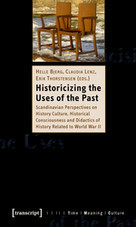 Historicizing the Uses of the Past: Scandinavian Perspectives on History Culture, Historical Consciousness and Didactics of History Related to World War II This book presents new developments in Scandinavian memory cultures related to World War II and the Holocaust by combining this focus with the perspective of history didactics. The theoretical framework of historical consciousness offers an approach linking individual and collective uses and re-uses of the past to the question how history can and should be taught. It also offers some examples of good practice in this field. The book promotes a teaching practice which, in taking the social constructivist notions of historical consciousness as a starting point, can contribute to self-reflecting and critical thinking - being fundamental for any democratic political culture. (By the author)
 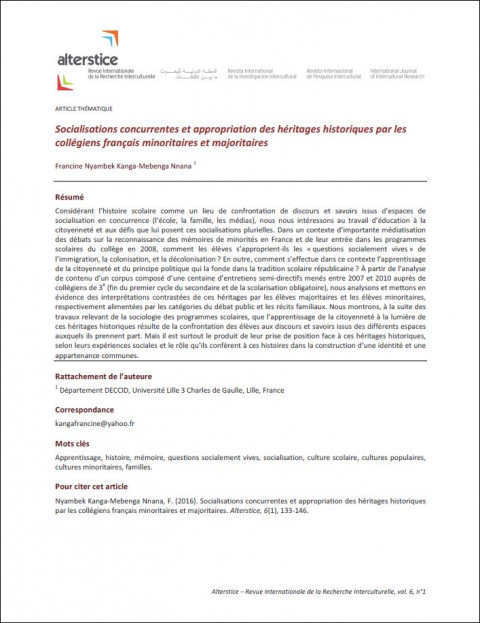 Socialisations concurrentes et appropriation des héritages historiques par les collégiens français minoritaires et majoritaires Год публикации: 2016 Автор: Francine Nyambek Kanga-Mebenga Nnana Организация-автор: Alterstice Considérant l’histoire scolaire comme un lieu de confrontation de discours et savoirs issus d’espaces de socialisation en concurrence (l’école, la famille, les médias), nous nous intéressons au travail d’éducation à la citoyenneté et aux défis que lui posent ces socialisations plurielles. Dans un contexte d’importante médiatisation des débats sur la reconnaissance des mémoires de minorités en France et de leur entrée dans les programmes scolaires du collège en 2008, comment les élèves s’approprient-ils les « questions socialement vives » de l’immigration, la colonisation, et la décolonisation ? En outre, comment s’effectue dans ce contexte l’apprentissage de la citoyenneté et du principe politique qui la fonde dans la tradition scolaire républicaine ? À partir de l’analyse de contenu d’un corpus composé d’une centaine d’entretiens semi-directifs menés entre 2007 et 2010 auprès de collégiens de 3e (fin du premier cycle du secondaire et de la scolarisation obligatoire), nous analysons et mettons en évidence des interprétations contrastées de ces héritages par les élèves majoritaires et les élèves minoritaires, respectivement alimentées par les catégories du débat public et les récits familiaux. Nous montrons, à la suite des travaux relevant de la sociologie des programmes scolaires, que l’apprentissage de la citoyenneté à la lumière de ces héritages historiques résulte de la confrontation des élèves aux discours et savoirs issus des différents espaces auxquels ils prennent part. Mais il est surtout le produit de leur prise de position face à ces héritages historiques, selon leurs expériences sociales et le rôle qu’ils confèrent à ces histoires dans la construction d’une identité et une appartenance communes.
 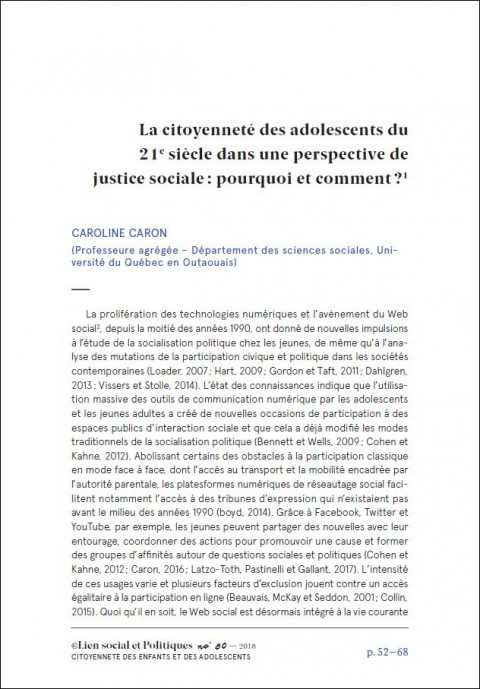 Thinking Today’s Adolescents’ Citizenship through Social Justice Lens: Why and How? Год публикации: 2018 Автор: Caroline Caron Организация-автор: Lien social et Politiques How do we know what we know about youth citizenship ? This epistemological question has been neglected in the field of youth citizenship and public discourses on youth political apathy. This article draws on the theoretical perspective of social justice studies to unmask the relations of power based on age that have shaped current knowledge about youth citizenship. The analysis draws attention to the epistemic injustices and methodological flaws in the specific field of civic literacy in Canada. It is argued that a difference-centered approach to youth citizenship could help foster a better understanding of youth experiences of civic engagement and political participation. Yet, this potentiel can only be achieved through a self-reflexive inquiry that critically investigates the research process itself in current research trends. Although a dominant approach in the study of civic literacy is limited in its capacity to produce knowledge that is socially just towards adolescents, the concept could be reinvigorated through a critical empirically-grounded examination of youth civic competencies that are evidenced in some of their engagments with new media technologies. Yet, to fulfill this goal also requires that scholars engage in crucial debates about their chosen epistemology and theory of democracy.
  Holocaust Education and English Language Learner Students - Reflections on Teaching the Shoah Teaching the Holocaust involves confronting many challenges regardless of the setting involved. The complex nature of Holocaust history demands that students and teachers function at high intellectual levels as they study that history, and the need to determine how sensitive topics should be approached challenges educators in ways that are not present when teaching most other topics. Thus, any teaching of the Shoah places significant demands on teachers‘ content knowledge and pedagogical expertise. These demands increase when educators teach students whose backgrounds differ from those of the general population. Specifically, students whose language skills limit their understanding of texts and classroom dialogue face multiple challenges as they seek to learn within new school environments. Moreover, the distinctive cultural milieu and life experiences that form the frames of references from which these students approach the study of all social studies topics make it imperative that teachers build curricula that include culturally relevant perspectives in order to ensure that students are provided an opportunity to learn material at sophisticated levels. This paper considers how these factors influence the teaching of the Shoah in a Roman Catholic high school located in a major city in the western United States. More than 80% of the school’s students are either immigrants to the United States or members of the first generation of their families to be born in this country; thus, most students have been identified as English Language Learners (ELLs), a category used to determine if special language services should be provided to them. This paper overviews English language learning in the United States and teaching social studies to ELL students before discussing teaching the Holocaust in a parochial school whose primary focus is on teaching ELL students. (By the author - Introduction) Challenging stereotypes and avoiding the superficial: A suggested approach to teaching the Holocaust Alison Kitson provides a rationale for a scheme of work for Year 9 (13-14 year olds). She argues that teachers should analyse the kind of historical learning that is taking place when the Holocaust is studied. Critical of the assumption that learning will take place as a result of exposure, she argues that teachers need to think about learning outcomes and to explore how these connect and support each other. She draws upon the types of historical thinking specified by the National Curriculum in England and shows how these can link up with areas of knowledge that pupils need if they are to understand the context of the Holocaust. Like Kate Hammond, she argues that emotional, human response and moral learning can and should be involved in teaching the Holocaust and that this can support ‒ rather than detract from ‒ rigorous historical analysis of sources and causes. (By the publisher)
 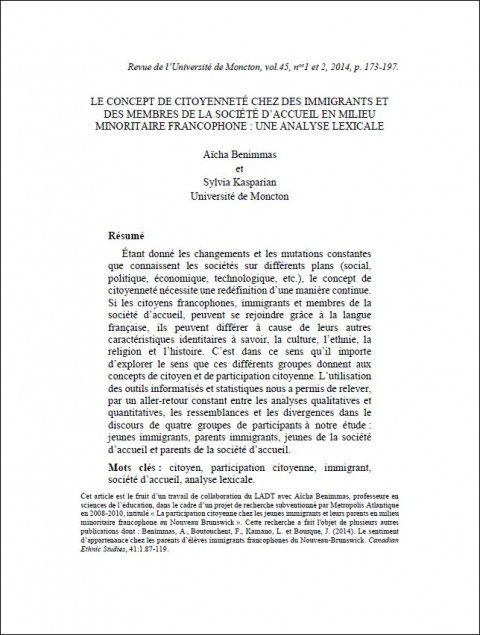 The Concept of Citizenship for Immigrants and Members of the Host Society within the Minority Francophone Context: A Lexical Analyse Год публикации: 2014 Автор: Aïcha Benimmas | Sylvia Kasparian Организация-автор: Revue de l’Université de Moncton Given the changes and constant mutations which occur in societies at the social, political, economic, technological, and educational levels, the concept of citizenship must be continually redefined. While French-speaking citizens, immigrants and members of the host society can find common ground thanks to the French language, they can also find differences because of other characteristics linked to their identity, such as culture, ethnic background, religion, and history. This is why we must analyze the meaning that these groups give to the concepts of citizenship and citizen participation, interpreting the differences and similarities that surface in their discourse regarding these two concepts. The use of computerized tools and statistics has enabled us to find through a constant comparison between qualitative and quantitative analyses-the perceptions, similarities, and divergences in the discourse of four groups of participants involved in our study: immigrant youth, immigrant parents, host society youth, and host society parents. Le concept de citoyenneté chez des immigrants et des membres de la société d’accueil en milieu minoritaire francophone : une analyse lexicale Год публикации: 2014 Автор: Aïcha Benimmas | Sylvia Kasparian Организация-автор: Revue de l’Université de Moncton Étant donné les changements et les mutations constantes que connaissent les sociétés sur différents plans (social, politique, économique, technologique, etc.), le concept de citoyenneté nécessite une redéfinition d’une manière continue. Si les citoyens francophones, immigrants et membres de la société d’accueil, peuvent se rejoindre grâce à la langue française, ils peuvent différer à cause de leurs autres caractéristiques identitaires à savoir, la culture, l’ethnie, la religion et l’histoire. C’est dans ce sens qu’il importe d’explorer le sens que ces différents groupes donnent aux concepts de citoyen et de participation citoyenne. L’utilisation des outils informatisés et statistiques nous a permis de relever, par un aller-retour constant entre les analyses qualitatives et quantitatives, les ressemblances et les divergences dans le discours de quatre groupes de participants à notre étude : jeunes immigrants, parents immigrants, jeunes de la société d’accueil et parents de la société d’accueil. Learn, Teach, Prevent - Holocaust Education In The 21st Century: The Ethel LeFrak Holocaust Conference Proceedings The National Catholic Center for Holocaust Education publishes conference proceedings following each of its conferences. In 2008, Mrs. Ethel LeFrak, a noted New York philanthropist, created The Ethel LeFrak Holocaust Education Conference Endowment Fund, which underwrites publication of The Ethel LeFrak Holocaust Education Conference Proceedings. Copies of the proceedings are available for purchase by contacting ncche@setonhill.edu
  La didactique de l’éducation à la citoyenneté en colloque Год публикации: 2017 Автор: Claire Ravez Организация-автор: Institut Français de l'Education (IFÉ) Les enjeux de l’éducation à la citoyenneté ont été depuis deux ans renouvelés par des orientations politiques prises à l’échelle nationale (onze mesures pour une grande mobilisation de l’Ecole pour les valeurs de la République annoncées par la ministre N. Vallaud-Belkacem le 22 janvier 2015) et européenne (déclaration de Paris du 17 mars 2015 des ministres européens de l’éducation de l’Union européenne portant sur la promotion de l’éducation à la citoyenneté et aux valeurs communes de liberté, de tolérance et de non-discrimination). Au sein du système éducatif français, de nouvelles prescriptions curriculaires sont apparues : le domaine 3 du socle commun de connaissances, de compétences et de culture entré en vigueur en septembre 2016 porte sur la formation de la personne et du citoyen, l’enseignement moral et civique a été mis en place du cours préparatoire au baccalauréat, un parcours citoyen a été créé.
 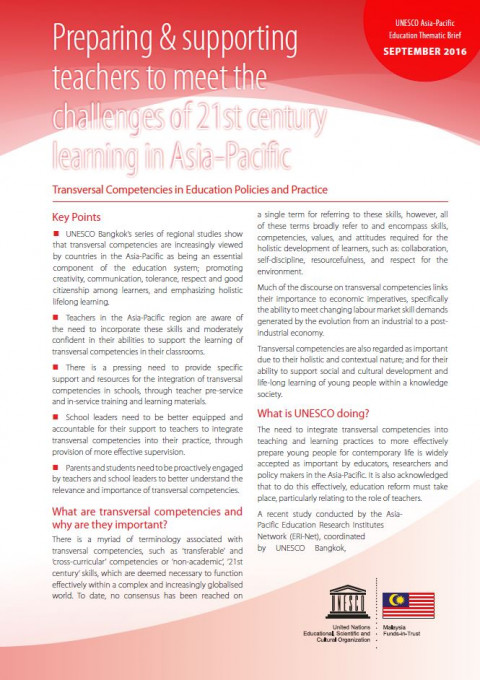 Подготовка и поддержка учителей для решения задач обучения 21-го века в Азиатско-Тихоокеанском регионе Год публикации: 2016 Организация-автор: Regional Bureau for Education in Asia and the Pacific | UNESCO Bangkok Подготовка и поддержка учителей для решения задач обучения 21-го века в Азиатско-Тихоокеанском регионе. Междисциплинарные компетенции в области политики и практики в области образования. Это итог исследований III фазы ERI-Net для междисциплинарных компетенций в области политики и практики в образовании.